
A handheld vacuum sealer for induction cooking can help organize ingredients before they reach the stove, but it does not heat food or interact directly with induction cookware. Its main purpose is removing air from compatible storage bags or containers. This guide explains where handheld sealing fits into an induction kitchen, which features matter, and how to avoid unsafe packaging and cooking practices.
- Quick Verdict: Is a Handheld Vacuum Sealer Useful in an Induction Kitchen?
- Handheld Vacuum Sealer vs. Other Kitchen Equipment
- How Handheld Vacuum Sealers Work
- Choosing the Right Handheld Vacuum Sealer
- Where a Handheld Sealer Helps With Induction Meal Prep
- Induction Cooking Compatibility: Important Distinctions
- Food Safety and Packaging Integrity
- Common Buying Mistakes
- Frequently Asked Questions
- Conclusion
Quick Verdict: Is a Handheld Vacuum Sealer Useful in an Induction Kitchen?
A handheld vacuum sealer can be a convenient accessory for people who prepare ingredients ahead of time and cook them later using an induction cooktop.
However, the two appliances perform entirely different functions.
An induction cooktop uses electromagnetic energy to heat compatible cookware. A handheld vacuum sealer removes air from specially designed food-storage packaging.
Vacuum sealing does not make packaging safe for use on an induction burner.
For most home cooks, a rechargeable handheld sealer paired with compatible food-storage bags or containers is the most practical category to evaluate.
The purchase makes sense when you regularly portion vegetables, freeze ingredients, or prepare food in advance. It offers little advantage if you simply cook fresh ingredients immediately.
Handheld Vacuum Sealer vs. Other Kitchen Equipment
| Equipment | Main Function | Relationship to Induction Cooking |
|---|---|---|
| Handheld vacuum sealer | Removes air from compatible packaging | Supports ingredient storage before or after cooking |
| External suction sealer | Removes air and heat-seals compatible bags | Useful for larger batches of freezer preparation |
| Chamber vacuum sealer | Packages suitable foods within an evacuated chamber | Specialized food preparation and storage |
| Induction cooktop | Heats induction-compatible cookware | Performs the cooking |
| Sous vide circulator | Controls a water bath’s temperature | Can cook suitable packaged food in a separate approved setup |
A vacuum sealer is an optional food-storage tool rather than an induction cooking accessory required for normal operation.
How Handheld Vacuum Sealers Work
Understanding Air Removal
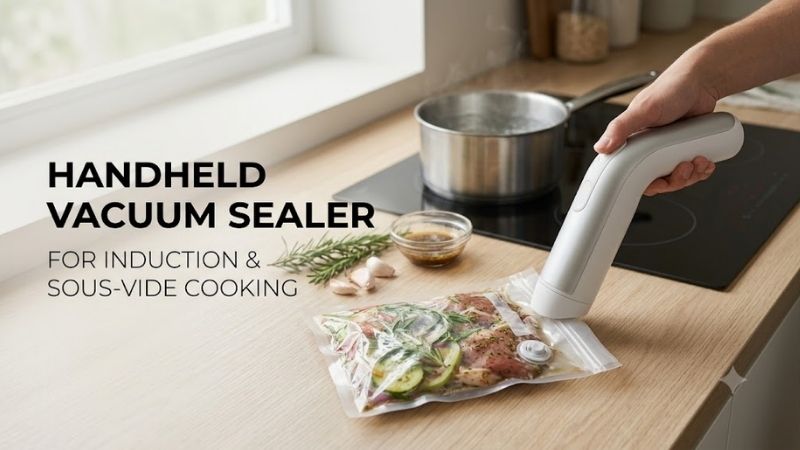
Many handheld vacuum sealers use a small electric pump that connects to a valve on a compatible bag or container.
The pump removes some of the air from the package.
The valve then helps maintain the reduced-air environment.
This can reduce exposure to oxygen and help certain foods retain quality during appropriate refrigerated or frozen storage.
However, the amount of air removed and the integrity of the seal depend on the exact equipment.
A handheld sealer does not necessarily create the same packaging conditions as a chamber vacuum machine.
Reusable Vacuum Bags
Reusable bags can reduce reliance on disposable packaging when used appropriately.
They usually contain a valve compatible with the handheld pump.
However, repeated reuse is not suitable for every food-contact situation.
Bags used for raw meat, fish, or other high-risk foods may have special cleaning or reuse restrictions.
Follow manufacturer instructions rather than assuming every bag can be cleaned indefinitely.
Vacuum Containers
Certain handheld systems also work with compatible rigid containers.
These can be useful for foods that might otherwise be crushed by flexible bags.
However, reduced air pressure does not eliminate the need for refrigeration.
Vacuum containers are not equivalent to shelf-stable canning equipment.
Handheld vs. Countertop Vacuum Sealers
A handheld sealer may occupy less storage space than a full-size countertop machine.
However, it commonly depends on proprietary bags or valve systems.
Countertop external suction machines may offer heat sealing and more packaging options.
Choose the smaller system when portability and modest storage quantities matter most.
For frequent bulk freezer preparation, a countertop machine may be more practical.
Choosing the Right Handheld Vacuum Sealer
Bag and Container Compatibility
Compatibility is the most important purchasing consideration.
A handheld pump may only work with bags or containers from a particular system.
Before buying, check the exact accessories included and the availability of replacements.
A low-cost pump can become expensive to operate if compatible bags are difficult to find.
Do not assume that ordinary zipper bags will maintain a vacuum simply because they can be closed.
Rechargeable vs. Replaceable Batteries
Many handheld sealers use rechargeable batteries.
Others may use replaceable batteries or different power arrangements.
For a kitchen used regularly, convenient charging can reduce preparation interruptions.
However, battery endurance depends on the pump, packaging volume, and operating conditions.
Avoid relying on unsupported claims about how many bags can be sealed per charge.
Pump Controls
A simple start-and-stop control may be sufficient.
Some devices stop automatically when they reach a particular operating condition.
Others require manual operation.
An automatic stop can improve convenience but does not prove every package has a perfect seal.
Always inspect the bag or container after sealing.
Cleaning Requirements
Food residue or liquid drawn toward the vacuum port can interfere with the device.
Some systems include protective accessories or cleaning procedures.
Check whether the vacuum nozzle is accessible and how the manufacturer instructs users to clean it.
Never immerse an electrical pump unless explicitly approved.
Where a Handheld Sealer Helps With Induction Meal Prep
Portioning Ingredients Before Cooking
For example, a home cook might divide washed and properly prepared vegetables into portions for several meals.
The portions can then be packaged and stored according to their food-safety requirements.
When needed, the ingredients are removed from packaging and cooked in induction-compatible cookware.
The sealer improves organization rather than cooking performance.
Preparing Freezer Meals
Some ingredients and fully cooked foods can be packaged in freezer-compatible vacuum bags.
This may help reduce air exposure and freezer-related quality loss.
However, vacuum sealing does not make foods safe without refrigeration or freezing.
Raw proteins and cooked meals must remain at appropriate temperatures.
Storing Cooked Leftovers
Food prepared on an induction cooktop may be suitable for vacuum packaging after proper cooling.
Do not leave cooked food at room temperature while preparing numerous packages.
Cool and refrigerate perishable foods promptly.
Vacuum packaging does not reset food-safety storage limits or eliminate microorganisms.
Preparing Food for Sous Vide
Some vacuum packaging systems can be used with sous vide cooking, but only when the bags are explicitly approved for the temperatures and durations involved.
Many handheld storage bags are not designed for heated water baths.
Choose packaging certified or documented by the manufacturer for the specific cooking application.
A bag that holds a vacuum in the refrigerator is not necessarily safe for prolonged heating.
Induction Cooking Compatibility: Important Distinctions
Can Vacuum Bags Go Directly on an Induction Cooktop?
No.
An induction cooktop is designed to heat compatible cookware, not flexible plastic packaging.
Do not place vacuum bags directly on an active induction cooking zone.
They can be damaged by hot cookware or surfaces and may melt or cause contamination.
Can You Use an Induction Pot for Sous Vide?
An induction-compatible pot can sometimes hold a sous vide water bath when used with a separate immersion circulator and an approved setup.
However, the circulator must have adequate clearance, minimum and maximum water levels, and appropriate mounting.
Do not assume every induction stove can independently maintain the precise water temperatures required for safe sous vide cooking.
A dedicated circulator is generally the more appropriate tool for that process.
Does Vacuum Sealing Improve Induction Heating?
No.
Removing air from food packaging does not improve the electromagnetic heating performance of induction cookware.
Cooking efficiency depends on the cooktop, cookware base, heat setting, and food preparation method.
Vacuum sealing may improve organization or storage quality, but it is not a heating technology.
Should You Seal Food Before or After Cooking?
Both workflows can be appropriate when food safety and packaging requirements are met.
For raw ingredients, package them promptly and refrigerate or freeze as needed.
For cooked foods, use safe cooling procedures before storage.
When preparing sous vide meals, follow a validated time-temperature process and use approved cooking bags.
Food Safety and Packaging Integrity
Reduced Oxygen Does Not Mean Sterile Food
Vacuum sealing removes some air but does not sterilize food.
Certain microorganisms can survive or grow in low-oxygen environments.
This is particularly important for moist, perishable foods.
Never treat ordinary vacuum-sealed cooked foods as shelf stable.
Refrigeration and Freezing
Keep perishable foods refrigerated at 40°F or below or frozen at 0°F or below.
The correct storage duration depends on the food, preparation, and packaging method.
A tight-looking seal does not guarantee safe storage.
Raw Meat and Cross-Contamination
Raw meat packaging requires clean surfaces and careful handling.
Wash hands and keep raw ingredients separate from ready-to-eat foods.
Clean reusable accessories according to the manufacturer’s instructions.
If a bag cannot be safely cleaned after contact with raw meat, discard it.
Packaging Hot Food
Do not seal hot perishable food and leave it at room temperature to cool slowly.
Use safe cooling procedures before refrigerated storage.
Avoid trapping large quantities of hot food inside insulated or tightly packed arrangements that interfere with rapid cooling.
Common Buying Mistakes
Buying Based Only on Pump Size
A compact pump is convenient, but bag compatibility and sealing reliability determine usefulness.
Assuming Every Bag Is Heat Safe
Storage bags and cooking bags have different intended uses.
Check exact temperature and application instructions.
Confusing Vacuum Packaging With Food Preservation
Vacuum sealing alone does not provide shelf-stable preservation.
Paying for a Sealer Without a Storage Routine
If you rarely freeze or portion food, ordinary reusable containers may be simpler.
Ignoring Replacement Consumables
Check compatible bag and valve availability before purchasing.
Frequently Asked Questions
Can a Handheld Vacuum Sealer Be Used With an Induction Cooktop?
It can support ingredient storage in an induction kitchen, but it has no direct heating function and does not connect to the cooktop.
Are Handheld Vacuum Bags Safe for Sous Vide?
Only when the specific bags are approved for the cooking temperatures, durations, and food-contact conditions involved.
Does Vacuum Sealing Make Meat Last Longer?
Proper packaging may help preserve quality, particularly during freezing, but it does not eliminate food-safety storage requirements.
Can I Put Vacuum-Sealed Food in an Induction Pan?
Remove food from ordinary storage packaging before cooking. Only use cooking bags in a separately approved preparation method.
Is a Handheld Sealer Better Than a Countertop Sealer?
A handheld model is useful for compact storage and modest quantities. A countertop sealer may be more practical for frequent bulk packaging.
Can I Reuse Handheld Vacuum Bags?
Only when the manufacturer permits reuse for the specific food and cleaning situation.
Conclusion
A handheld vacuum sealer for induction cooking is best understood as a food-storage accessory rather than part of the induction heating system. Choose a model with dependable compatible bags, convenient controls, and manageable cleaning requirements when you regularly prepare ingredients ahead of time. Never place vacuum packaging directly on an induction burner, and follow proper refrigeration, freezing, and food-contact safety instructions.
Write Your Review
No reviews yet. Be the first to share your experience!