
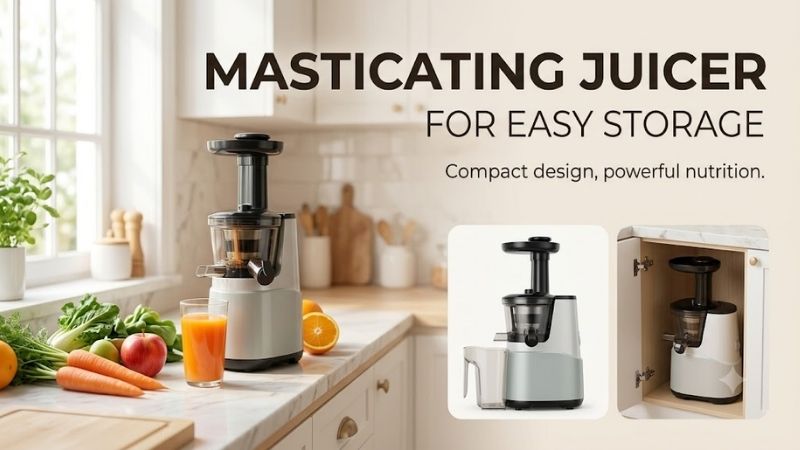
A masticating juicer for easy storage should extract juice effectively without demanding a permanent place on the kitchen counter. Although these appliances are often called slow or cold-press juicers, their designs vary widely in height, width, component count, and cleaning complexity. This guide explains how to choose a storage-friendly machine that still works well for the produce you regularly use.
- Quick Verdict: Which Masticating Juicer Is Easiest to Store?
- Understanding Masticating Juicers
- Vertical vs. Horizontal Masticating Juicers
- Measuring for Storage and Operation
- Assembly and Disassembly Convenience
- Feed Chute Design and Preparation Time
- Juice Extraction and Performance
- Motor Design and Operating Limits
- Cleaning: The Hidden Space and Time Requirement
- Fresh Juice and Nutrition: What Buyers Should Know
- Choosing for Different Kitchens
- Understanding Purchase Value
- Common Buying Mistakes
- Frequently Asked Questions
- Conclusion
Quick Verdict: Which Masticating Juicer Is Easiest to Store?
For many small kitchens, a compact vertical masticating juicer is a reasonable category to consider because it may occupy less countertop width than a horizontal design.
However, vertical machines can be tall, and their feed hoppers or collection containers may make cabinet storage difficult.
The right choice depends on the actual dimensions of the assembled and disassembled appliance.
| Buying Factor | What to Check | Why It Matters |
|---|---|---|
| Assembled dimensions | Width, depth, height | Determines operating footprint |
| Disassembled dimensions | Size of motor base and largest attachment | Determines cabinet storage |
| Appliance weight | Total weight and component weight | Affects lifting convenience |
| Number of parts | Auger, screen, hopper, containers, seals | Influences cleanup and storage |
| Assembly method | Alignment and locking mechanism | Determines everyday setup effort |
| Feed-chute design | Ingredient preparation requirements | Affects convenience |
| Juice and pulp containers | Size and storage shape | Adds to total space |
| Cleaning access | Screen and pulp-channel design | Determines maintenance workload |
A compact juicer is worth buying only if its complete preparation, juicing, cleaning, and storage routine is practical.
Understanding Masticating Juicers
What Is a Masticating Juicer?
A masticating juicer uses a rotating auger or related crushing mechanism to press produce against a strainer or extraction system.
Juice separates from much of the fibrous pulp and exits through a designated outlet.
The remaining pulp passes through another channel.
These machines generally operate at slower rotational speeds than traditional centrifugal juicers.
However, rotational speed alone does not establish juice yield, nutritional quality, or durability.
Why Are They Called Slow Juicers?
The term slow juicer commonly refers to the relatively low rotation speed of the auger.
The actual time required to prepare a glass depends on ingredient cutting, feeding, extraction, and cleaning.
A slow juicer is not necessarily slow in every practical sense, and a higher advertised speed is not automatically a disadvantage.
The appliance should be evaluated according to the foods you process and the effort required to use it.
What Does Cold Press Mean?
Cold press is frequently used in marketing for masticating juicers.
However, different manufacturers use the term in different ways.
These appliances typically extract juice mechanically rather than by applying high cooking temperatures.
Nevertheless, friction and operating conditions can influence temperature.
Do not assume that a cold-press label proves a particular nutrient content or shelf life.
Vertical vs. Horizontal Masticating Juicers
Vertical Juicers
Vertical juicers position the auger and extraction assembly in an upright arrangement.
This can reduce the horizontal footprint of the main body.
However, the complete machine may be relatively tall.
A large hopper and upper feed assembly can create storage challenges beneath wall cabinets.
Vertical designs can be convenient for certain produce combinations, but feeding behavior varies.
Horizontal Juicers
Horizontal masticating juicers position their extraction mechanism along a more horizontal axis.
Some designs have a longer body and extend farther across the counter.
However, their lower height may make them easier to fit beneath certain shelves.
Some horizontal machines support additional food-processing accessories, depending on the model.
The additional versatility may also create more components to store.
Which Type Is Better for Easy Storage?
| Factor | Vertical Design | Horizontal Design |
|---|---|---|
| Typical footprint | May be narrower | May be longer |
| Height | Often taller | Often lower |
| Under-cabinet operation | Can be restricted by height | Depends on feed chute and attachments |
| Assembly | Model-dependent | Model-dependent |
| Leafy greens | Depends on auger and feed behavior | Some designs are well suited |
| Storage accessories | Often includes separate containers | May include additional processing attachments |
| Best fit | Narrow counters with vertical clearance | Low shelving with adequate counter depth |
There is no universal winner.
Measure your available space and compare the exact model’s dimensions.
Measuring for Storage and Operation
Measure Cabinet Openings
A shelf may be deep enough for the juicer but have a narrow opening.
Measure both the interior space and access opening.
The machine may be difficult to retrieve if it must be rotated around cabinet hinges or surrounding items.
Measure the Largest Component
A disassembled juicer often contains several parts.
The motor base may be compact while the hopper or feed assembly is much wider.
Compare the dimensions of the largest component, not only the motor.
Account for Juice Containers
Many juicers use separate containers for juice and pulp.
These can occupy more space than the main machine suggests.
If they stack or nest, storage may be easier.
However, do not assume that nesting is permitted or practical without examining the design.
Consider Electrical Cord Storage
A long power cord can become inconvenient in a small cabinet.
Some appliances include designated cord-storage features.
Avoid sharply bending cords or trapping them beneath heavy components.
Plan the Operating Area
A juicer needs space for ingredients, the machine, juice collection, pulp collection, and cleaning.
Even a narrow motor housing can require a considerable amount of working space.
Make sure you can load produce without contacting overhead cabinets.
Assembly and Disassembly Convenience
Why Assembly Matters
Masticating juicers often contain an auger, strainer, extraction chamber, lid, and other components.
These must be correctly positioned before use.
If the assembly process is complicated, the machine may become inconvenient for daily juicing.
Look for clear instructions and an arrangement that can be assembled without forcing parts.
Alignment Markings
Some juicers use arrows, icons, or other alignment markings.
These can simplify reassembly.
However, markings alone are not enough if the parts are difficult to seat.
A well-designed locking system should allow correct installation without excessive pressure.
Number of Components
Fewer components can reduce storage and washing requirements.
However, a simplified design does not automatically produce better extraction or easier cleaning.
A machine with several large, accessible parts may be easier to maintain than one with fewer but difficult-to-clean components.
Safe Disassembly
Always disconnect the appliance before removing components.
Do not attempt to disassemble it while the auger is moving.
Follow the manufacturer’s procedure, especially when the extraction chamber contains jammed produce.
Feed Chute Design and Preparation Time
Narrow Feed Chutes
A narrow chute may require ingredients to be cut into smaller pieces.
This adds preparation time but can help keep large objects away from moving components.
Do not bypass the feed chute’s safety design.
Wide Feed Chutes
A wider chute may accommodate larger produce pieces.
However, it does not mean every whole fruit or vegetable can be inserted without preparation.
Hard seeds, thick peels, and oversized ingredients may still need removal or cutting.
Follow the manufacturer’s approved food list.
Self-Feeding Hoppers
Some models include hoppers intended to hold prepared produce for gradual feeding.
This can reduce repeated manual loading.
However, hoppers increase height and may add cleaning requirements.
For storage-focused buyers, the additional convenience should be weighed against their physical dimensions.
Using a Food Pusher
Use only the pusher supplied or approved by the manufacturer.
Never put fingers, knives, forks, or other utensils into a moving feed chute.
If produce becomes stuck, stop the appliance and follow its instructions.
Juice Extraction and Performance
Juice Yield
Juice yield depends on produce characteristics, auger design, strainer construction, and operating conditions.
A masticating juicer may perform well with certain ingredients and less effectively with others.
Do not assume that all slow juicers extract more juice than all centrifugal machines.
Meaningful yield comparisons require controlled tests using equivalent produce quantities.
Pulp Moisture
The moisture remaining in discharged pulp can offer some indication of extraction effectiveness.
However, it is not a complete performance measure.
Different foods naturally produce different pulp textures.
A dry-looking pulp sample alone does not establish superior yield.
Pulp in the Finished Juice
Screen design influences how much fine pulp passes into the juice.
Some juicers provide different strainers.
Others offer limited texture adjustment.
If you prefer very smooth juice, a fine strainer may be important.
However, finer screens may require more cleaning.
Processing Leafy Greens
Kale, spinach, and other leafy greens can behave differently from firm fruit.
Some machines handle fibrous leaves effectively, while others require careful feeding.
If leafy greens are your main ingredients, seek credible comparisons involving those foods.
Do not choose based solely on an orange or apple demonstration.
Processing Soft Fruits
Very soft fruit may produce thick puree-like material rather than easily separated juice.
Some juicers handle these ingredients better than others.
Follow the manufacturer’s supported ingredient list.
For soft-fruit smoothies, a blender may be more appropriate.
Motor Design and Operating Limits
Understanding Torque and Rotation
An auger must apply sufficient force to process the intended food.
However, motor wattage and rotation speed do not independently establish extraction capability.
Gear design, auger geometry, and overload protection also matter.
Choose a machine suited to your regular ingredients.
Reverse Function
A reverse setting can help address certain jams.
However, it must be used according to the manual.
Repeatedly reversing a severely blocked machine may not resolve the problem safely.
Stop and disassemble the appliance as directed when necessary.
Continuous Operating Time
Some compact juicers have limited continuous-duty periods.
This is important when preparing juice for multiple people.
If the motor requires frequent cooling periods, the machine may be inconvenient for large batches.
Noise
Masticating juicers are sometimes marketed as quieter than centrifugal models.
Actual sound levels vary.
Motor loading, produce hardness, and construction affect noise.
Do not assume that slow rotational speed guarantees silent operation.
Cleaning: The Hidden Space and Time Requirement
Strainer Cleaning
Fine screens can trap pulp fibers.
A suitable cleaning brush may be necessary.
Check whether the screen is accessible from both sides and whether the manufacturer provides a practical cleaning procedure.
A difficult-to-clean screen can make an otherwise compact machine inconvenient.
Auger Cleaning
Food residue can collect along the auger’s grooves.
Remove and clean the auger according to the manual.
Avoid damaging sealing surfaces and connection points.
Pulp Outlet
Pulp outlets can accumulate dense fibers.
Inspect whether the outlet can be accessed without tools or unauthorized disassembly.
A removable outlet cover may simplify cleaning.
Gaskets and Seals
Some juicers use silicone seals or similar components.
These may require periodic removal and washing when permitted.
Incorrectly installed seals can cause leaking or poor operation.
Dishwasher Compatibility
Some parts may be dishwasher safe.
Others require handwashing.
Do not assume that all removable plastic components can tolerate dishwasher temperatures.
Drying Before Storage
This is especially important for an appliance with multiple nested parts.
Moisture trapped around seals or extraction chambers can cause unpleasant odors or hygiene concerns.
Let components dry thoroughly before reassembly and storage as directed.
Fresh Juice and Nutrition: What Buyers Should Know
Juice Is Not the Same as Whole Produce
Juicing removes some of the fibrous material found in whole fruits and vegetables.
The finished juice may contain vitamins and minerals, but it is not nutritionally identical to eating the whole produce.
A juicer should complement a balanced diet rather than be treated as a replacement for whole fruits and vegetables.
Does Slow Juicing Preserve More Nutrients?
Marketing often claims that slow juicers retain substantially more nutrients.
However, nutrient retention depends on the produce, preparation, oxidation, temperature, storage conditions, and specific nutrients measured.
A low auger speed alone does not establish a universal nutritional advantage.
Avoid paying a premium solely for unverified health claims.
Juice Oxidation
Fresh juice can change color, aroma, and flavor after preparation.
Exposure to oxygen and storage conditions may contribute.
However, the rate varies by ingredient and handling.
Vacuum containers or sealed bottles do not make untreated juice sterile.
Food Safety
Wash produce thoroughly under running water before cutting or juicing.
Keep preparation surfaces clean.
Fresh home-extracted juice is usually unpasteurized and can contain harmful bacteria from produce.
People at higher risk of serious foodborne illness may be better served by pasteurized juice.
Refrigerate fresh juice promptly rather than leaving it on the counter.
Choosing for Different Kitchens
Small Apartment
A compact vertical juicer may suit a narrow counter with sufficient overhead space.
If cabinet height is limited, compare a lower horizontal design.
Shared Kitchen
Look for quick assembly, easy cleaning, and manageable storage.
The appliance should not monopolize shared counter space.
Home With Limited Cabinet Access
If you must lift a heavy motor base from an overhead shelf, the machine may be impractical.
Choose accessible storage or a lighter model with suitable performance.
One-Person Household
A compact juicer can be sufficient for modest portions.
However, consider whether the time spent preparing and cleaning outweighs the convenience of making a small amount of juice.
Frequent Juicing
Regular users should prioritize assembly, cleaning access, and replacement-part availability.
A machine that is slightly larger but easier to maintain may offer better long-term convenience than the smallest available design.
Understanding Purchase Value
Budget Models
Budget masticating juicers may provide basic extraction.
However, check motor duty cycles, spare parts, cleaning tools, and supported ingredients.
Midrange Models
Additional features such as reverse operation, improved feed systems, or accessible pulp outlets may provide useful convenience.
However, they should be evaluated individually.
Premium Models
Premium construction may offer broader accessories, warranty coverage, or specialized extraction systems.
A higher price does not guarantee the smallest footprint or easiest cleaning.
Replacement Parts
Strainers, seals, and augers can wear or become damaged.
Check compatibility and availability.
A juicer with unavailable essential parts may have a shorter practical service life.
Common Buying Mistakes
Measuring Only the Motor Base
The hopper, containers, and attachments also require space.
Assuming Vertical Means Compact in Every Direction
Vertical machines can be too tall for some cabinets.
Buying Based on RPM Alone
Rotational speed does not establish nutritional value or extraction quality.
Ignoring Pulp Outlet Cleaning
A difficult-to-clean outlet can make everyday use frustrating.
Choosing a Large Hopper Without Storage Planning
Convenient feeding may come at the cost of added height.
Expecting a Juicer to Replace a Blender
Juicers remove much of the pulp; blenders generally retain the blended ingredients.
Frequently Asked Questions
Are Vertical Masticating Juicers Easier to Store?
They may occupy less horizontal space, but they are often taller. Compare complete dimensions and detachable components.
Can a Slow Juicer Fit Under Kitchen Cabinets?
It depends on the assembled height, feed-chute clearance, and manufacturer’s operating requirements.
Are Masticating Juicers Easy to Clean?
Cleaning difficulty varies. Strainers, augers, seals, and pulp outlets may require attention after each use.
Is a Slow Juicer Better Than a Centrifugal Juicer?
It depends on the ingredients, yield, preparation time, budget, and cleaning priorities. Neither category is universally superior.
Can I Put Frozen Fruit Into a Masticating Juicer?
Only when the exact model and accessory configuration explicitly support that use.
How Should I Store a Juicer After Cleaning?
Dry all components according to the manual and store them where the motor, auger, screen, and seals are protected from damage.
Conclusion
The best masticating juicer for easy storage balances compact dimensions with practical assembly, suitable extraction performance, and manageable cleaning. Vertical models may conserve countertop width, while horizontal designs can offer advantages where height is limited. Measure every component, consider the entire juicing workflow, and prioritize accessible strainers and replaceable parts over unsupported claims about nutrient retention or extraction speed.










Write Your Review
No reviews yet. Be the first to share your experience!