
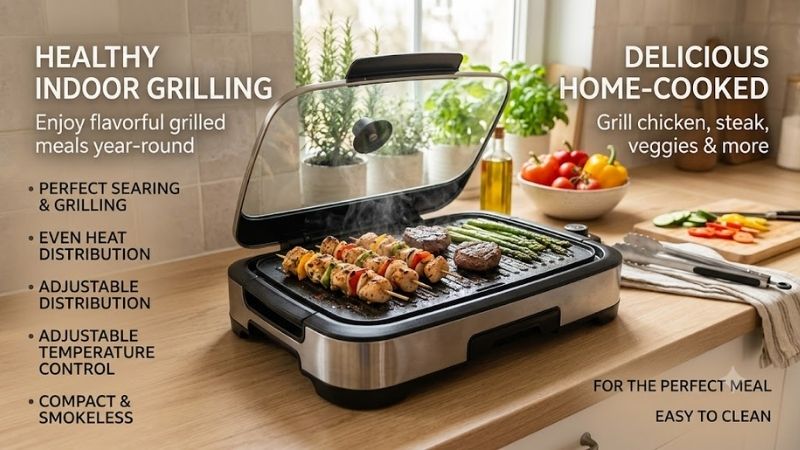
An indoor grill makes it easier to cook burgers, steaks, chicken, and vegetables without relying on an outdoor cooking setup. The best models balance cooking temperature, usable surface area, smoke management, and cleanup. This guide compares six indoor electric grills to help you find the right choice for your kitchen, cooking habits, and budget.
- Quick Verdict: Best Indoor Grills at a Glance
- Quick Comparison Table: 6 Best Indoor Grills
- How We Selected These Indoor Grills
- Detailed Product Recommendations
- Indoor Grill Buying Guide: What Matters Most?
- Indoor Grill Cooking Tips for Better Results
- Common Indoor Grill Problems and Solutions
- Frequently Asked Questions
- Final Verdict: Which Indoor Grill Should You Buy?
Quick Verdict: Best Indoor Grills at a Glance
The Ninja Sizzle Indoor Grill & Griddle GR101 is our best overall pick for households wanting dedicated indoor grilling alongside everyday griddle cooking. Its interchangeable plates, adjustable heat up to 500°F, and removable splatter-control lid make it particularly practical for regular countertop use.
However, a different model may serve you better depending on whether you prioritize searing, multifunction cooking, sandwiches, or a larger cooking surface.
-
Best Overall: Ninja Sizzle Indoor Grill & Griddle GR101 — Interchangeable grilling and griddling surfaces with high-temperature capability.
-
Best Budget-Oriented Choice: Hamilton Beach Electric Indoor Searing Grill 25361 — Straightforward grilling controls, a viewing window, and dishwasher-safe removable components.
-
Best for Versatility: Cuisinart Griddler GR-4NNAS — Five cooking configurations for grilling, griddling, and making paninis.
-
Best for Families: Ninja Foodi Smart XL 6-in-1 Indoor Grill DG551 — Large grilling capacity, an integrated thermometer, and additional air-frying functions.
-
Best Premium Contact Grill: Breville Smart Grill BGR820 — Embedded heating elements, digital controls, and an expansive flat-open grilling configuration.
-
Best for Flexible Meal Preparation: De’Longhi Livenza All-Day Grill CGH1020D — Multiple cooking positions and independent cooking-zone controls.
These selections represent different appliance formats rather than results from a single standardized cooking test. Manufacturer specifications establish the available features, while the recommendations reflect how those features fit typical household needs.
Quick Comparison Table: 6 Best Indoor Grills
| Product | Best For | Key Specifications | Main Advantage | Trade-Off |
|---|---|---|---|---|
| Ninja Sizzle GR101 | Everyday indoor grilling | Up to 500°F; interchangeable 14-inch grill and griddle plates | Dedicated grill and flat griddle surfaces | Single-sided cooking |
| Hamilton Beach 25361 | Simple, budget-conscious grilling | 200–450°F; removable ceramic nonstick plate; viewing window | Easy operation and removable cleaning components | No contact-grilling function |
| Cuisinart Griddler GR-4NNAS | Multifunction cooking | Five configurations; reversible plates; griddle settings up to 425°F | Grill, griddle, and panini functionality | Less specialized for open-top searing |
| Ninja Foodi Smart XL DG551 | Family meals and multifunction cooking | Six functions; 4-quart crisper basket; up to 500°F grilling system | Grilling plus air frying and thermometer-guided cooking | Bulky compared with basic grills |
| Breville Smart Grill BGR820 | Premium contact grilling | 1,800W; 260 sq. in. open-flat cooking area | Embedded heating elements and digital controls | Larger investment and workspace requirement |
| De’Longhi Livenza CGH1020D | Flexible cooking arrangements | Digital controls; open, contact, and elevated-top configurations | Adaptable plates and cooking positions | More components and settings to manage |
The cooking areas and advertised temperatures above are not directly comparable performance-test results. Grill construction, heating methods, and food placement affect actual cooking outcomes.
How We Selected These Indoor Grills
We evaluated these six identifiable indoor grill models using manufacturer-published features, intended cooking configurations, cleaning arrangements, and practical kitchen requirements.
Selection focused on the characteristics that affect everyday ownership rather than on unverified claims of cooking speed or durability.
Cooking Design and Temperature Control
An indoor grill should deliver usable heat for the foods its owner prepares most frequently.
High-temperature settings can support browning, especially with adequate preheating and proper surface contact. However, an advertised maximum temperature does not establish how accurately the appliance maintains that temperature when loaded with cold food.
We also considered adjustable heat settings for delicate proteins, vegetables, sandwiches, and recipes that do not benefit from maximum heat.
Cooking Capacity and Countertop Footprint
Manufacturer serving estimates are useful but depend heavily on food dimensions.
A grill that accommodates several hamburgers may fit fewer large chicken breasts or thick steaks. We therefore considered cooking-surface configuration alongside claimed capacity.
Countertop clearance also matters. Hinged grills require space behind or above the appliance, while fully opening models need additional horizontal room.
Smoke Management and Grease Collection
Electric indoor grills eliminate charcoal combustion and propane burners, but they do not eliminate cooking smoke.
Fat rendering onto hot surfaces, sugary marinades, and accumulated residue can still produce visible smoke.
We favored practical splatter-control features, grease channels, drip trays, and removable components where appropriate.
Cleaning and Maintenance
A grill that requires extensive cleaning after every meal may become less convenient than a skillet.
Removable plates and dishwasher-compatible components can reduce cleanup effort, although the electrical base must remain dry.
Nonstick surfaces also require appropriate utensils and care to avoid premature coating damage.
Versatility and Long-Term Usefulness
Not every household needs a multifunction appliance.
A dedicated open-top grill may be sufficient for burgers and vegetables. Other kitchens benefit from a contact grill, griddle, panini press, or combined air-fryer system.
We considered whether each additional function solves a practical cooking problem rather than simply increasing the feature count.
Detailed Product Recommendations
1. Ninja Sizzle Indoor Grill & Griddle GR101 — Best Overall
Best For: Home cooks who want an adaptable indoor grill for burgers, chicken, vegetables, breakfast foods, and other everyday meals.
Why We Picked It: The Ninja Sizzle GR101 offers a particularly useful balance of grilling capability and everyday functionality. Its interchangeable cooking plates let owners switch between a ridged grilling surface and a flat griddle without buying two separate countertop appliances.
Key Specifications
| Feature | Specification |
|---|---|
| Model | GR101 |
| Grill type | Open-top electric grill and griddle |
| Maximum advertised temperature | 500°F |
| Cooking plates | Interchangeable grill and griddle |
| Plate size | 14 inches |
| Dimensions | 14.72 L × 15.16 W × 6.1 H inches |
| Lid | Removable perforated mesh lid |
| Cooking surface | Nonstick removable plates |
| Temperature control | Adjustable |
Features & Benefits
The interchangeable grill and griddle surfaces distinguish this model from indoor grills designed exclusively for ridged grilling.
The grill plate is suited to foods such as burgers, chicken breasts, and sliced vegetables. Switching to the griddle enables pancakes, eggs, quesadillas, and other foods that cook more effectively on a flat surface.
Ninja specifies a maximum temperature of 500°F. This gives users access to a high-temperature setting for browning meat, although actual surface temperatures and recovery after loading food depend on cooking conditions.
The detachable perforated lid is intended to limit splattering and help manage smoke. Its design is useful for fatty foods, but it should not be interpreted as eliminating smoke entirely.
Performance & Practical Use
The Ninja Sizzle is particularly suitable for meals that benefit from direct contact with an electrically heated cooking plate.
Preheating the plate, avoiding overcrowding, and drying excess surface moisture from meat can help encourage browning.
Because the unit heats from below rather than pressing food between two plates, thicker foods generally require turning during cooking.
The removable plates simplify access for cleaning compared with designs that have permanently attached cooking surfaces.
What Makes It Different
Unlike the Cuisinart Griddler, the Ninja Sizzle is an open-top appliance rather than a hinged contact grill. That makes it particularly intuitive for cooks who prefer turning food manually and observing the exposed cooking surface.
Pros
-
Interchangeable grill and griddle plates expand cooking options.
-
High advertised maximum temperature supports searing-oriented cooking.
-
Removable lid and cooking plates improve cleaning access.
Cons
-
Does not provide two-sided contact cooking.
-
Smoke production still depends on ingredients, fat content, and cooking settings.
Buy If: You regularly grill burgers, chicken, and vegetables but also want a flat griddle for breakfast or weeknight meals.
Skip If: You prefer a hinged grill that cooks food from above and below simultaneously, or you want integrated air-frying functions.
2. Hamilton Beach Electric Indoor Searing Grill 25361 — Best Budget-Oriented Choice
Best For: Shoppers who want straightforward indoor grilling without investing in a complex multifunction appliance.
Why We Picked It: The Hamilton Beach 25361 focuses on practical grilling essentials: adjustable temperature control, a removable hood with a viewing window, a ceramic nonstick cooking plate, and an accessible drip tray.
Key Specifications
| Feature | Specification |
|---|---|
| Model | 25361 |
| Grill design | Open electric grill with hood |
| Temperature range | 200–450°F |
| Cooking plate | Ceramic nonstick |
| Dimensions | 16.73 W × 12.4 D × 6.81 H inches |
| Lid | Removable with viewing window |
| Drip tray | Removable |
| Cleaning | Dishwasher-safe plate, hood, and drip tray |
Features & Benefits
The adjustable temperature dial lets users select lower settings for foods that require gentler cooking or increase the heat for searing.
A 450°F maximum setting offers a high-temperature grilling option without requiring a programmable interface.
The viewing window is especially convenient when cooking foods that need periodic monitoring. It lets users inspect their food without repeatedly lifting the hood, which can release heat and expose the cook to hot steam.
The removable ceramic nonstick plate helps release food and reduces the need for aggressive scraping after cooking.
Hamilton Beach also provides an enlarged drip tray positioned beneath the cooking surface to collect grease and other cooking liquids.
Performance & Practical Use
This grill is well suited to burgers, boneless chicken, pork chops, fish, and vegetables.
Its single heated cooking surface means users should expect to turn food when necessary. The hood helps enclose the cooking area but does not function as a heated upper contact plate.
The 200–450°F range allows more flexibility than a grill offering only one heating level.
However, the 450°F advertised setting should not be treated as evidence that this grill produces the same crust as a higher-powered contact grill or outdoor gas grill.
What Makes It Different
Its distinctive feature is simplicity. The Hamilton Beach provides an adjustable grill surface and removable hood without requiring owners to manage multiple plate configurations or specialized cooking programs.
Pros
-
Straightforward temperature dial with preheat indicators.
-
Viewing window helps monitor food.
-
Dishwasher-safe removable cooking components.
Cons
-
No reversible griddle plate or contact-grilling mode.
-
Maximum advertised temperature is lower than the Ninja Sizzle’s.
Buy If: You mainly grill meat and vegetables and want an uncomplicated appliance with manageable cleanup.
Skip If: You need a breakfast griddle, panini press, or integrated air fryer.
3. Cuisinart Griddler GR-4NNAS — Best for Versatility
Best For: Smaller households that regularly prepare grilled sandwiches, burgers, breakfast foods, and meals requiring different cooking surfaces.
Why We Picked It: The Cuisinart Griddler GR-4NNAS provides five distinct cooking arrangements using reversible plates and a hinged lid. This flexibility makes it useful for households trying to minimize the number of separate countertop appliances.
Key Specifications
| Feature | Specification |
|---|---|
| Model | GR-4NNAS |
| Cooking modes | Five configurations |
| Plates | Reversible grill/griddle plates |
| Surface coating | Ceramic nonstick |
| Griddle temperature range | 200–425°F |
| Grill/panini control | Warm-to-sear settings |
| Dimensions | 13.5 L × 11.5 W × 7.12 H inches |
| Plate cleaning | Removable and dishwasher-safe |
| Accessories | Drip tray and cleaning tool |
Features & Benefits
Its five cooking arrangements are contact grill, panini press, full grill, full griddle, and half grill/half griddle.
In contact-grill mode, heated upper and lower plates cook both sides of the food. This is particularly convenient for grilled sandwiches, pressed chicken portions, and foods that fit comfortably between the plates.
The full-open position doubles the available single-sided cooking area. It also enables different foods to cook on separate plate surfaces.
The reversible plates offer a significant advantage over grills with fixed ridges because they allow flat-surface cooking without additional standard accessories.
Cuisinart also identifies compatible waffle plates sold separately, expanding the appliance’s potential uses.
Performance & Practical Use
The Griddler is useful for breakfast, lunch, and dinner preparation.
For breakfast, the flat plates can accommodate foods such as pancakes, eggs, and sausage. For lunch, the hinged configuration supports paninis and grilled sandwiches. For dinner, the grill plates can be used for burgers, chicken, and vegetables.
Contact cooking can reduce the need to turn certain foods manually, although cooking time still depends on thickness, temperature, and food placement.
The floating hinge helps accommodate different food thicknesses. Users should avoid forcing the upper plate down on delicate foods.
What Makes It Different
The GR-4NNAS emphasizes cooking versatility rather than a single specialized grilling method.
Unlike the Ninja Sizzle, it can operate as a two-sided contact grill. Unlike the Ninja Foodi Smart XL, it does not rely on a fan-assisted cooking chamber.
Pros
-
Five useful cooking configurations.
-
Reversible removable plates support grilling and flat cooking.
-
Dishwasher-safe plates simplify cleanup.
Cons
-
No built-in meat thermometer.
-
The fully open configuration requires additional counter space.
Buy If: You want one appliance for grilled sandwiches, burgers, pancakes, and other quick meals.
Skip If: You primarily want a dedicated open-top grill with a high numerical temperature setting or a multifunction air-frying system.
4. Ninja Foodi Smart XL 6-in-1 Indoor Grill DG551 — Best for Families
Best For: Households wanting substantial grilling capacity along with air frying and other countertop cooking functions.
Why We Picked It: The Ninja Foodi Smart XL DG551 combines a grilling system with several additional cooking modes and an integrated food thermometer. These features make it especially attractive to households preparing different types of meals throughout the week.
Key Specifications
| Feature | Specification |
|---|---|
| Model | DG551 |
| Cooking functions | Six |
| Functions | Grill, Air Crisp, Roast, Bake, Broil, Dehydrate |
| Advertised grill temperature | Up to 500°F |
| Grill capacity | Up to six steaks, depending on size |
| Crisper basket | 4 quarts |
| Power | 1,760W |
| Voltage | 120V |
| Weight | 26.9 lb |
| Dimensions | 15.7 L × 11.1 W × 16 H inches |
| Temperature monitoring | Integrated food thermometer |
Features & Benefits
The Foodi Smart XL uses a fan-assisted cooking system with a grill grate to combine direct surface contact and circulating hot air.
Ninja specifies heat up to 500°F for its grilling system. The combination of hot air and a heated grate is intended to support browning and cooking throughout the food.
Its integrated thermometer helps users monitor internal food temperature without relying exclusively on visual appearance or estimated cooking time.
The six cooking functions are also useful for households wanting to prepare side dishes without operating a full-size oven.
For example, a family might use grill mode for chicken breasts and Air Crisp mode for potatoes on a separate cooking cycle.
Performance & Practical Use
The enclosed cooking chamber distinguishes this model from simple countertop plate grills.
Fan-assisted heat can be useful for thicker foods and for recipes that benefit from heat circulating around the ingredients.
However, its air-frying and grilling components do not necessarily provide the same results as a dedicated outdoor grill.
The advertised capacity of up to six steaks depends on the dimensions and thickness of the individual cuts. Food should be positioned with sufficient room for the intended cooking method.
The built-in thermometer is particularly useful for checking doneness, although the probe should be inserted correctly according to the appliance instructions.
What Makes It Different
This Ninja model combines grilling with a broader countertop cooking system.
Unlike the Ninja Sizzle or Hamilton Beach grill, it can prepare air-fried foods, baked dishes, and roasted ingredients using the corresponding accessories and settings.
Pros
-
Six cooking functions reduce the need for separate appliances.
-
Integrated thermometer supports internal-temperature monitoring.
-
Larger advertised grilling capacity suits family meals.
Cons
-
Heavier and taller than compact plate grills.
-
More accessories and cooking components require cleaning and storage.
Buy If: You want an indoor grill that can also handle air frying and several other common cooking methods.
Skip If: You already own a capable air fryer and mainly want a compact, uncomplicated grill.
5. Breville Smart Grill BGR820 — Best Premium Contact Grill
Best For: Home cooks who prioritize adjustable cooking controls, contact grilling, and a relatively expansive open-flat cooking surface.
Why We Picked It: The Breville Smart Grill BGR820 combines embedded heating elements, electronic temperature management, and removable cooking plates. Its design focuses on controlled contact cooking rather than collecting numerous unrelated appliance functions.
Key Specifications
| Feature | Specification |
|---|---|
| Model family | BGR820 |
| Grill format | Hinged contact grill |
| Power | 1,800W |
| Heating design | Elements embedded in cooking plates |
| Open-flat cooking area | 260 square inches |
| Display | LCD |
| Cooking positions | Closed contact and open-flat BBQ mode |
| Plates | Removable nonstick |
| Cleaning | Dishwasher-safe plates |
| Grease management | Removable drip tray |
Features & Benefits
The heating elements are embedded within the cooking plates rather than positioned entirely beneath them.
This design is intended to improve the responsiveness of the heated surfaces. However, the specification alone does not establish superiority in an independently controlled cooking comparison.
The electronic thermostat helps regulate the selected cooking temperature.
An LCD display provides information about settings and cooking operation, making the unit more configurable than a grill operated exclusively with a simple rotary dial.
The hinge allows the appliance to open flat, creating a manufacturer-specified cooking area of 260 square inches.
Performance & Practical Use
The Breville is suitable for foods that benefit from two-sided surface contact, including paninis, burgers, and appropriately sized cuts of meat.
In open-flat mode, it can accommodate more separate pieces of food while allowing users to turn them manually.
This versatility is useful when preparing meals for several people or cooking vegetables alongside proteins.
Its substantial power rating indicates the electrical load the appliance is designed to use. It should not be interpreted as a direct measurement of cooking speed or energy efficiency.
The removable plates simplify cleanup, although maintaining the nonstick surfaces requires using suitable utensils and cleaning methods.
What Makes It Different
The Breville prioritizes heating-system design and cooking control.
Compared with the Cuisinart Griddler, it offers a larger stated flat-open cooking area and embedded heating elements. Whether those differences justify the cost depends on how often the owner uses contact grilling.
Pros
-
Embedded heating elements with electronic control.
-
Large open-flat cooking configuration.
-
Removable dishwasher-safe plates and drip tray.
Cons
-
Premium positioning may be unnecessary for occasional grilling.
-
Fully open operation requires generous horizontal space.
Buy If: You frequently prepare grilled meals and sandwiches and value detailed temperature controls and a substantial cooking area.
Skip If: You only grill occasionally or prefer a simple open-top appliance.
6. De’Longhi Livenza All-Day Grill CGH1020D — Best for Flexible Meal Preparation
Best For: Households wanting a multifunction contact grill with adaptable cooking positions and digital operation.
Why We Picked It: The De’Longhi Livenza CGH1020D offers several cooking configurations, including an open grill, a contact grill, and an elevated-top arrangement. These options make it particularly practical for preparing different types of foods without relying on one fixed cooking position.
Key Specifications
| Feature | Specification |
|---|---|
| Model | CGH1020D |
| Grill category | Multifunction electric contact grill |
| Cooking arrangements | Open grill, contact grill, elevated-top cooking |
| Controls | Digital temperature and time controls |
| Temperature zones | Independent plate-temperature adjustment |
| Hinge | Floating, adjustable upper plate |
| Cooking surfaces | Removable grill/griddle plates |
| Additional function | Sear setting |
| Optional accessories | Compatible waffle-plate accessories |
Features & Benefits
One of the most useful aspects of the Livenza system is its ability to adapt the upper cooking plate’s position.
In contact mode, both plates can heat food directly. In the open configuration, the appliance offers separate cooking surfaces.
An elevated upper-plate arrangement is useful when cooking food that should receive heat from above without being compressed between the plates.
Digital temperature and timing controls offer more control than a basic single-setting grill.
Independent plate-temperature adjustment can also be helpful when preparing foods that require different heating levels.
Performance & Practical Use
The Livenza is well suited to households that switch between grilled sandwiches, meat, vegetables, and breakfast dishes.
A contact-grilling configuration supports meals where both sides of the food can benefit from direct heating.
An open configuration allows foods with different shapes or cooking requirements to be arranged separately.
Its multiple positions also make it useful for delicate foods that should not be pressed firmly.
The additional flexibility comes with greater operational complexity. Users should understand plate placement, temperature selection, and hinge positions before switching between cooking methods.
What Makes It Different
The De’Longhi emphasizes adaptable cooking positions and independent temperature management.
While the Cuisinart Griddler also supports several configurations, the Livenza is especially appealing to cooks who want greater control over the positioning and operation of the upper heated plate.
Pros
-
Multiple cooking positions suit a wide range of foods.
-
Independent plate controls enable different cooking settings.
-
Digital controls support more deliberate temperature and timing adjustments.
Cons
-
More operating options create a learning curve.
-
Its multifunction design may be unnecessary for households primarily grilling burgers or vegetables.
Buy If: You regularly prepare different styles of grilled meals and want adjustable cooking positions.
Skip If: You prefer a straightforward grill with minimal setup or controls.
Indoor Grill Buying Guide: What Matters Most?
The best indoor grill is not necessarily the one with the highest advertised temperature or the largest number of cooking modes.
The right choice depends on how you cook, where the appliance will sit, and how much effort you are willing to spend cleaning it.
1. Choose the Right Indoor Grill Type
There are three common designs worth considering.
| Grill Type | How It Works | Best For | Main Limitation |
|---|---|---|---|
| Open-top electric grill | Heats food on a lower cooking surface | Burgers, chicken, vegetables, seafood | Foods usually need turning |
| Contact grill | Heats food between upper and lower plates | Paninis, sandwiches, thinner meat portions | Thick or irregular foods can be harder to position |
| Enclosed multifunction grill | Combines a grilling surface with circulating heated air | Family meals, thicker foods, multifunction cooking | More bulk and components |
An open-top design often feels most familiar to cooks accustomed to outdoor grilling.
A contact grill is more convenient for sandwiches and quick meals.
An enclosed multifunction model may offer better overall appliance consolidation when the owner also needs air-frying or roasting functions.
2. Understand Temperature Settings and Searing Performance
Temperature control is important because different foods benefit from different cooking conditions.
A higher grill setting can promote browning when the food surface is sufficiently dry and the appliance maintains adequate heat.
However, food texture, moisture, thickness, and contact area are just as important as the displayed temperature.
A grill advertising 500°F is not automatically superior to one advertising 450°F.
Real differences require comparable measurements of plate temperature, heat recovery, food browning, and finished internal temperature.
For practical use, select a grill that provides an appropriate temperature range and clear preheating instructions.
3. Match the Cooking Surface to Your Household
A grill’s advertised serving capacity should not be interpreted as a guaranteed number of full meals.
Six hamburger patties may fit differently from six chicken breasts or a combination of steaks and vegetables.
Consider the shape of the cooking surface, not just its total area.
For a single person or couple, a compact grill may provide sufficient room for routine meals.
For a family, a larger open surface or an enclosed grill with greater capacity can reduce the need for multiple cooking batches.
When preparing meat and vegetables together, leave enough space for effective cooking and keep raw-meat juices from contaminating ready-to-eat foods.
4. Evaluate Smoke and Splatter Control
Indoor grills are often promoted as smokeless or low-smoke appliances.
These descriptions require realistic expectations.
Electric grilling removes the smoke associated with burning charcoal, but cooking oils, animal fat, marinades, and residue can still produce smoke when exposed to high temperatures.
Useful features include grease channels, drip trays, raised plate edges, and splatter-reducing lids.
For lower-smoke cooking, remove excessive surface fat, avoid sugary sauces early in high-temperature cooking, and clean grease buildup after the appliance cools.
Use an appropriate kitchen exhaust hood when available. Never operate a charcoal or outdoor propane grill indoors as a substitute for an indoor-rated electric model.
5. Consider Nonstick Coatings and Cooking Materials
Many indoor grills use coated metal cooking plates.
Nonstick coatings can make cooking and cleanup easier, particularly when preparing fish, eggs, or foods that tend to adhere to hot surfaces.
Some manufacturers describe their coatings as ceramic nonstick, while others use different nonstick systems.
These terms do not independently establish the complete chemical composition or the absence of particular substances.
Follow the product’s temperature limits and utensil instructions.
Avoid abrasive cleaning pads and metal tools unless explicitly approved by the manufacturer.
Replace damaged cooking components according to manufacturer guidance rather than continuing to use plates with significant peeling or deterioration.
6. Look for Removable Plates and Accessible Drip Trays
Cleaning is one of the most important ownership considerations.
Grills collect food particles, rendered fat, oils, and cooked-on sauces.
Removable cooking plates allow better access to grooves and corners than permanently attached surfaces.
Dishwasher compatibility can be helpful, but it must be verified for the exact component.
A dishwasher-safe cooking plate does not mean that the electrical housing, control panel, power cord, or entire grill can be submerged or washed in a dishwasher.
Always unplug the appliance and allow it to cool before cleaning.
7. Measure Countertop Space and Storage Clearance
An indoor grill may fit comfortably on a counter when closed but require significantly more room while operating.
Contact grills sometimes open to 180 degrees, increasing the horizontal space needed.
Enclosed multifunction grills may require additional overhead clearance to open their lids.
Before purchasing, consider the appliance’s width, depth, height, lid movement, power-cord placement, and required ventilation clearances.
Check the manufacturer’s instructions before positioning a grill beneath low cabinetry or close to walls and other heat-sensitive surfaces.
8. Check Electrical Compatibility
Indoor electric grills should be operated according to the electrical requirements printed on the specific appliance.
High-powered countertop grills can place significant demand on household circuits, especially when operated alongside other appliances.
For example, running a grill together with a microwave or toaster oven on the same circuit may cause an overloaded circuit to trip.
Use an appropriate grounded outlet when required.
Avoid extension cords or power strips unless the manufacturer’s instructions expressly permit a suitable arrangement.
Never bypass electrical safety devices or use an appliance with a damaged cord.
9. Consider Whether Extra Functions Are Worth Paying For
Multifunction grills can replace several specialized appliances, but their value depends on actual household use.
A grill-and-griddle combination may be especially practical for someone preparing both breakfast and dinner on the same countertop appliance.
A grill with an integrated air fryer can be worthwhile for a household without a separate air fryer.
However, someone already satisfied with their oven, air fryer, and sandwich press may benefit more from a dedicated grilling appliance.
Prioritize functions you will use regularly rather than buying the largest feature list.
Indoor Grill Cooking Tips for Better Results
Preheat the Cooking Surface Properly
Most electric grills work best when allowed to reach the selected operating temperature before food is added.
Follow the manufacturer’s preheat indicators or instructions.
Placing cold meat onto an insufficiently heated surface can encourage sticking and reduce initial browning.
Avoid assuming that every model requires the same preheating duration.
Dry Meat Before High-Heat Grilling
Excess surface moisture can delay browning because water must evaporate before the surface temperature rises sufficiently.
Pat meat dry with clean paper towels when appropriate, then season according to the recipe.
Avoid adding excessive oil, which may increase smoke or collect in the drip tray.
For marinades containing sugar, consider lower cooking temperatures or adding the sauce later to reduce scorching.
Avoid Overcrowding
Overloading a grill with cold ingredients can reduce surface temperature and trap moisture.
Food may then release more liquid and develop less browning than expected.
Cook in batches when necessary, allowing adequate space between pieces.
Check Internal Food Temperature
Color, grill marks, and cooking time are not reliable substitutes for measuring internal temperature.
Use a food thermometer in the thickest portion of the food, avoiding bones where applicable.
For common USDA guidance:
| Food | Safe Minimum Internal Temperature |
|---|---|
| Chicken and other poultry | 165°F |
| Ground beef and other ground meats | 160°F |
| Beef, pork, lamb, and veal steaks, chops, and roasts | 145°F, followed by a 3-minute rest |
| Fish | 145°F |
| Leftovers | 165°F |
Use the food-specific recommendations applicable to your recipe. A grill’s built-in probe may improve convenience, but it must be positioned correctly.
Clean After Each Cooking Session
Allow the appliance to cool, unplug it, and remove grease and food residue using the cleaning procedure specified in its manual.
Grease accumulation can lead to unpleasant odors and more smoke during subsequent cooking sessions.
Clean the drip tray regularly and inspect removable parts before reassembly.
Common Indoor Grill Problems and Solutions
Food Sticks to the Cooking Plates
Sticking may occur when the plates are not sufficiently preheated, food is moved too early, or a nonstick surface has deteriorated.
Check that the plates are clean and properly installed.
Use a suitable amount of cooking oil if the manufacturer permits it. Avoid forcing stuck food loose with sharp metal utensils.
The Grill Produces Too Much Smoke
Excess grease, high cooking temperatures, and sugary marinades are common contributors.
Reduce excess surface fat, clean the drip tray, and consider lowering the temperature when the recipe allows.
If smoke becomes unusually heavy or an electrical smell develops, stop cooking, disconnect power when safe, and inspect the appliance according to the manufacturer’s troubleshooting instructions.
Meat Is Brown Outside but Undercooked Inside
A high surface temperature can brown the exterior before sufficient heat reaches the center of a thick piece of meat.
Adjust the heat or use an appropriate two-stage cooking method supported by the appliance.
Check the internal temperature rather than relying on exterior appearance.
Food Develops Weak Grill Marks
Grill marks depend on effective contact between food and hot ridges.
Ensure the grill is adequately preheated and avoid moving the food excessively.
Not all grills produce equally pronounced marks, and visible grill marks alone do not establish whether the food is properly cooked.
Frequently Asked Questions
Are Indoor Grills Worth Buying?
An indoor grill can be worthwhile for households that regularly cook burgers, chicken, vegetables, seafood, or grilled sandwiches.
Electric models provide a cooking option when outdoor grilling is inconvenient or unavailable.
Their main advantages are countertop convenience and year-round usability. Their limitations include cooking capacity, cleaning requirements, and the inability to reproduce every characteristic of charcoal or gas grilling.
Can an Indoor Grill Really Be Smokeless?
No electric grill can guarantee absolutely smoke-free cooking under every condition.
Some models are designed to reduce smoke through enclosed cooking systems, splatter-control lids, and grease-management features.
However, fatty foods, high temperatures, accumulated grease, and certain marinades can still produce smoke.
Follow the manufacturer’s ventilation recommendations and use appropriate kitchen exhaust ventilation.
What Is the Difference Between an Indoor Grill and an Electric Griddle?
An indoor grill typically uses a ridged cooking surface designed to make contact with food at raised points while allowing some grease to drain away.
An electric griddle uses a flat surface that provides broader contact with food.
Grills are often preferred for burgers and steaks, while griddles are more convenient for pancakes, eggs, and foods requiring a continuous flat surface.
Combination models, such as the Ninja Sizzle GR101 and Cuisinart Griddler GR-4NNAS, offer both options.
Can You Cook Frozen Meat on an Indoor Grill?
Some indoor grills provide manufacturer-approved methods for cooking certain frozen foods.
However, frozen meat can cook unevenly if its exterior browns before its center reaches a safe temperature.
Follow the product manual and food-specific cooking instructions. Use a thermometer to verify safe internal temperature.
When thawing food before cooking, use safe methods such as refrigerator thawing rather than leaving raw meat at room temperature.
Are Indoor Grill Plates Dishwasher Safe?
Dishwasher compatibility depends on the model and component.
The Hamilton Beach 25361, Cuisinart GR-4NNAS, and Breville Smart Grill BGR820 have removable cooking components identified by their manufacturers as dishwasher-safe.
Other parts may require hand washing.
Do not place electrical housings, attached cords, or controls in water or a dishwasher. Always follow the exact appliance’s instructions.
Is an Indoor Grill Better Than an Air Fryer?
Neither appliance is universally better.
An indoor grill with a ridged cooking plate is useful for direct-contact browning and cooking foods such as burgers, steaks, and grilled vegetables.
An air fryer uses circulating hot air and can be more convenient for foods that benefit from relatively even surrounding heat, such as potato wedges and certain breaded foods.
A multifunction appliance like the Ninja Foodi Smart XL DG551 offers both methods, but it also requires more countertop space and additional accessories.
Final Verdict: Which Indoor Grill Should You Buy?
The Ninja Sizzle Indoor Grill & Griddle GR101 is the best overall choice in this roundup for everyday indoor grilling, thanks to its interchangeable cooking surfaces, high-temperature capability, and practical cleanup design. Choose the Hamilton Beach 25361 for simpler grilling, the Cuisinart Griddler GR-4NNAS for versatile contact cooking, or the Ninja Foodi Smart XL DG551 for family meals and air-frying functions. The Breville BGR820 and De’Longhi CGH1020D are compelling alternatives for cooks who value advanced controls and flexible cooking positions. Ultimately, the best indoor grill is the one that matches your most frequently prepared foods, available counter space, and preferred cleaning routine.







Write Your Review
No reviews yet. Be the first to share your experience!