
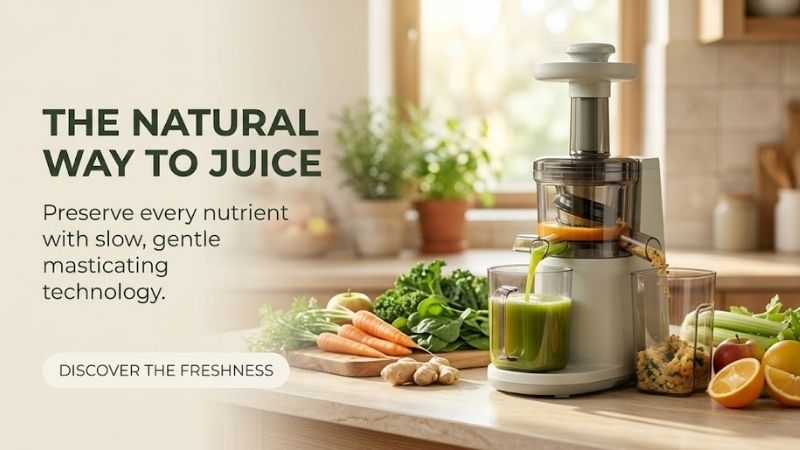
A masticating juicer uses a rotating auger to crush and press fruits and vegetables, separating juice from much of the pulp. Unlike a citrus-only juicer, it can process ingredients such as carrots, celery, apples, and leafy greens. This guide compares six models by feeding design, processing versatility, cleaning requirements, countertop space, and everyday convenience.
Quick Verdict: Which Masticating Juicer Should You Buy?
The Nama J2 Cold Press Juicer is our best overall recommendation for households that want to prepare mixed fruit and vegetable juices with less continuous manual feeding.
Its self-feeding hopper, 50-RPM auger, and relatively compact vertical design are particularly useful for regular juicing.
The Kuvings REVO830 is a stronger match for people who frequently juice long ingredients such as celery and carrots.
-
Best Overall: Nama J2 Cold Press Juicer — Self-feeding hopper for mixed produce.
-
Best for Carrots and Celery: Kuvings REVO830 — Dual feed chutes with an automatic cutting mechanism.
-
Best for Easy Cleaning: Hurom H400 Easy Clean Slow Juicer — Strainer-free-style Easy Clean chamber.
-
Best for Leafy Greens: Omega Cold Press 365 Horizontal Juicer — Horizontal auger design for smaller batches of fibrous produce.
-
Best Compact Option: Hurom H310A Slow Juicer — Small vertical self-feeding design.
-
Best for Adjustable Pulp: Ninja NeverClog Cold Press Juicer JC151 — Two pulp filters and reverse operation.
Quick Verdict: Which Masticating Juicer Should You Buy?
Quick Comparison Table
| Product | Best For | Key Specifications | Main Advantage | Trade-Off |
|---|---|---|---|---|
| Nama J2 | Overall use | 200W; 50 RPM; self-feeding hopper | Less continuous manual feeding | Multiple components require cleaning |
| Kuvings REVO830 | Celery and carrots | 240W US model; 50 RPM; dual chutes | Automatic cutting of long produce | Tall, heavy appliance |
| Hurom H400 | Easy cleanup | Large hopper; Easy Clean mechanism | Reduces reliance on fine mesh strainers | Premium equipment footprint |
| Omega Cold Press 365 | Leafy greens | Horizontal auger; slow extraction | Suitable for fibrous ingredients | More manual feeding |
| Hurom H310A | Small kitchens | Compact vertical design; self-feeding | Smaller preparation footprint | Limited batch capacity |
| Ninja JC151 | Pulp preferences | 150W; two pulp filters; reverse function | Selectable pulp amount | Smaller feed chute |
How We Selected These Masticating Juicers
Our evaluation focused on how each juicer handles ingredients, how much preparation is required, and how easily the food-contact components can be cleaned.
Masticating juicers use mechanical pressure rather than high-speed centrifugal separation.
Their advertised rotational speed is useful for understanding the mechanism, but lower RPM does not automatically mean higher juice yield, better flavor, or superior nutrient retention.
Those outcomes depend on produce type, auger geometry, strainers, preparation, and measurable processing conditions.
We also avoided treating manufacturer claims about reduced oxidation or maximum nutrient preservation as independent scientific conclusions.
Detailed Masticating Juicer Reviews
1. Nama J2 Cold Press Juicer — Best Overall
Best For: Home cooks who regularly prepare mixed fruit and vegetable juices and want a convenient batch-loading system.
Why We Picked It: The Nama J2 combines a self-feeding hopper with a slow rotating auger, allowing several prepared ingredients to be loaded before processing.
Key Specifications
| Specification | Details |
|---|---|
| Model | J2 / SJ200 US configuration |
| Power | 200W |
| Rotation Speed | 50 RPM |
| Voltage | 120V / 60Hz |
| Dimensions | 9.8 × 9 × 17.7 inches |
| Weight | 12.1 pounds |
| Motor | Single-phase induction |
| Feed System | Self-feeding hopper |
| Included Strainers | Juice and coarse strainers |
Features & Benefits
The hopper holds multiple ingredients, reducing the need to feed each piece individually during operation.
The auger presses produce through the juicing assembly while pulp exits separately.
The included strainers allow users to select the appropriate configuration for supported recipes.
Performance & Practical Use
The J2 is practical for juices combining apples, carrots, cucumbers, and leafy vegetables.
Users can prepare and load suitable produce in batches.
However, self-feeding does not mean all ingredients can be inserted uncut.
Produce should be prepared according to the manufacturer’s size and hardness requirements.
The juicing chamber and strainer also need thorough cleaning after use.
What Makes It Different
Its hopper system changes the workflow from continuous manual feeding to more convenient batch loading.
Pros
-
Self-feeding hopper.
-
50-RPM auger.
-
Useful for mixed-produce juices.
Cons
-
Requires several components to be cleaned.
-
Higher initial investment than basic juicers.
Buy If: You juice frequently and want to reduce hands-on feeding.
Skip If: You only prepare citrus juice occasionally.
2. Kuvings REVO830 — Best for Carrots and Celery
Best For: Households that frequently process carrots, celery, cucumbers, and fibrous vegetables.
Why We Picked It: The US-market REVO830 features separate feed openings designed for different ingredient shapes.
Key Specifications
| Specification | Details |
|---|---|
| Model | REVO830 US configuration |
| Power | 240W |
| Voltage | 110–120V / 60Hz |
| Speed | 50 RPM |
| Main Feed Chute | 3.5 inches |
| Secondary Chute | Approximately 1.7 inches |
| Dimensions | 10 × 8 × 19 inches |
| Weight | Approximately 16.5 pounds |
| Mechanism | Auto-cutting auger |
Features & Benefits
The wide feed opening accommodates suitable larger fruit.
A narrower feeding channel is intended for long ingredients such as carrots and celery.
The auto-cutting mechanism helps break down appropriate produce as it enters the auger.
This can reduce preparation work for people who juice long vegetables frequently.
Performance & Practical Use
The REVO830 is particularly useful for celery-based and carrot-based juice recipes.
The dual-chute arrangement is more specialized than a conventional single-chute juicer.
However, large produce should still be assessed for size and suitability before loading.
Its tall housing also requires substantial clearance under kitchen cabinets.
What Makes It Different
The dual feed chutes and auto-cutting mechanism distinguish it from conventional vertical slow juicers.
Pros
-
Dedicated opening for long vegetables.
-
Wide main chute.
-
50-RPM processing system.
Cons
-
Large and relatively heavy.
-
More expensive positioning than entry-level models.
Buy If: Carrot and celery juice are regular parts of your routine.
Skip If: You primarily juice soft fruit in small quantities.
3. Hurom H400 Easy Clean Slow Juicer — Best for Easy Cleaning
Best For: Juicing enthusiasts who prioritize simplifying cleanup after preparing multiple servings.
Why We Picked It: The H400 uses Hurom’s Easy Clean design, which reduces reliance on the fine mesh strainer arrangement found in many traditional juicers.
Key Specifications
-
Model: H400
-
Juicer Type: Vertical slow juicer
-
Feeding: Large self-feeding hopper
-
Extraction: Slow rotating auger
-
Cleaning Design: Easy Clean chamber
-
Juice and Pulp: Separate collection
-
Primary Use: Fruit and vegetable juices
Features & Benefits
The large hopper allows prepared ingredients to be loaded before processing.
The Easy Clean mechanism reduces the amount of fine strainer mesh that users need to scrub.
This is especially useful because cleaning juice strainers can be one of the most time-consuming parts of slow juicing.
Performance & Practical Use
The H400 is suitable for mixed juice recipes involving fruit, vegetables, and approved leafy greens.
Its self-feeding design supports regular batch preparation.
However, Easy Clean does not mean maintenance-free.
The auger, chamber, pulp outlet, and other food-contact parts still require cleaning.
What Makes It Different
The simplified straining assembly is its main practical advantage.
Pros
-
Easy Clean design.
-
Large ingredient hopper.
-
Suitable for frequent mixed-produce juicing.
Cons
-
Large premium appliance.
-
Still requires full cleaning of food-contact components.
Buy If: Cleaning effort is your main objection to regular juicing.
Skip If: You want the simplest possible compact appliance.
4. Omega Cold Press 365 Horizontal Juicer — Best for Leafy Greens
Best For: Home cooks who regularly juice leafy greens and smaller quantities of fibrous produce.
Why We Picked It: The Cold Press 365 uses a horizontal auger arrangement rather than the tall vertical system common among hopper-style juicers.
Key Specifications
-
Product: Omega Cold Press 365
-
Juicing System: Horizontal single auger
-
Feeding: Manual feed chute
-
Pulp Discharge: Separate outlet
-
Primary Applications: Fruits, vegetables, and compatible leafy greens
-
Design: Horizontal countertop configuration
Features & Benefits
The horizontal auger draws produce into the pressing chamber.
This configuration is useful for certain fibrous ingredients, including leafy greens.
Its smaller feeding opening encourages more controlled ingredient preparation.
Performance & Practical Use
The Cold Press 365 may suit people who prepare green juices using kale, spinach, or similar ingredients.
However, produce must generally be fed individually or in smaller portions.
This makes preparation more hands-on than using a large self-feeding hopper.
What Makes It Different
Its horizontal auger provides an alternative to the vertical juicing systems used by most other models in this roundup.
Pros
-
Horizontal auger arrangement.
-
Suitable for approved leafy greens.
-
Controlled ingredient feeding.
Cons
-
More manual feeding.
-
Long horizontal body may occupy additional counter depth.
Buy If: You primarily juice leafy greens and do not mind preparing ingredients individually.
Skip If: You want to load an entire mixed batch into a hopper.
5. Hurom H310A Slow Juicer — Best Compact Option
Best For: Individuals and couples who want slow juicing without a large countertop appliance.
Why We Picked It: The H310A provides Hurom’s slow-juicing approach in a smaller self-feeding design.
Key Specifications
| Specification | Details |
|---|---|
| Model | H310A |
| Type | Vertical slow juicer |
| Feeding | Self-feeding |
| Auger | Slow squeeze system |
| Intended Capacity | Small household batches |
| Cleaning | Removable juicing components |
| Format | Compact countertop |
Features & Benefits
The compact design is useful for kitchens with limited space.
Its self-feeding system can reduce continuous manual feeding compared with traditional narrow-chute machines.
The appliance separates juice and pulp using its integrated processing assembly.
Performance & Practical Use
The H310A is appropriate for one or two servings of juice.
It is particularly relevant to households that want fresh vegetable juice but do not prepare large quantities.
However, smaller size limits how much produce can be loaded at once.
What Makes It Different
It combines compact storage with self-feeding convenience.
Pros
-
Compact vertical design.
-
Self-feeding capability.
-
Suitable for small portions.
Cons
-
Smaller batch capacity.
-
Not ideal for large-scale juicing.
Buy If: You juice for one or two people.
Skip If: You regularly prepare several pitchers of juice.
6. Ninja NeverClog Cold Press Juicer JC151 — Best for Adjustable Pulp
Best For: Households seeking a simpler slow juicer with selectable pulp levels.
Why We Picked It: The Ninja JC151 combines slow juicing with two pulp filters and a reverse function.
Key Specifications
| Specification | Details |
|---|---|
| Model | JC151 |
| Power | 150W |
| Juicing | Slow auger |
| Pulp Filters | Two |
| Operation | Start/stop and reverse |
| Cleaning | Dishwasher-safe approved components |
| Juice Collection | Separate juice and pulp containers |
Features & Benefits
The two pulp filters allow users to choose between different juice textures.
The reverse function can help address certain feeding obstructions.
Its removable components support regular cleaning.
Performance & Practical Use
The JC151 is useful for preparing ordinary fruit and vegetable juices.
Its pulp-control options are particularly relevant when household members prefer different juice textures.
However, thicker juice is not necessarily more nutritious, and fine filtration does not eliminate every suspended particle.
What Makes It Different
Two interchangeable pulp filters are its main practical distinction.
Pros
-
Two pulp filter options.
-
Reverse function.
-
Removable washable components.
Cons
-
Requires more produce preparation than large-hopper models.
-
Cleaning multiple filters adds work.
Buy If: You want control over how much pulp remains in your juice.
Skip If: You prioritize large self-feeding capacity.
Masticating Juicer Buying Guide
Vertical vs. Horizontal Auger
Vertical machines often use compact upright housings.
Some provide large self-feeding hoppers, which can reduce preparation effort.
Horizontal juicers use an auger arranged along the countertop.
They can be useful for fibrous ingredients but often require more manual feeding.
Choose based on ingredients and workflow rather than assuming one design always produces more juice.
Feed Chute Size
A wide chute can accommodate larger pieces of produce.
This may reduce chopping time.
However, whole-fruit compatibility depends on the ingredient’s actual dimensions and the machine’s instructions.
A large opening does not mean every fruit can be inserted unprepared.
Motor Power and RPM
Masticating juicers often operate at comparatively low rotational speeds.
However, low RPM alone does not prove superior nutrient retention or juice yield.
Motor performance also depends on torque, auger design, strainers, and ingredient resistance.
Cleaning Requirements
The most demanding components are often the strainer and pulp outlet.
Fine mesh can trap fibrous residue.
Easy-clean designs may reduce scrubbing but still require proper disassembly and washing.
Juice Storage
Fresh juice should be handled as a perishable food.
Refrigerate promptly and follow appropriate food-safety guidance.
Slow juicing does not make raw juice pasteurized or shelf-stable.
Wash produce thoroughly before juicing, and use extra caution when serving unpasteurized juice to vulnerable individuals.
Frequently Asked Questions
Is a masticating juicer better than a centrifugal juicer?
A masticating juicer uses slower pressing, while a centrifugal juicer uses a rapidly rotating cutting and filtering system. The better choice depends on ingredients, preparation time, cleanup, and the desired juice texture.
Are cold press and masticating juicers the same?
In home-appliance marketing, the terms often overlap. Many cold press juicers use a rotating auger to crush and press produce, although industrial cold-press equipment can operate differently.
Can a masticating juicer process celery?
Yes, many models can. Some, including the Kuvings REVO830, offer feeding designs specifically intended for long vegetables.
Do slow juicers preserve more nutrients?
Nutrient retention varies with produce, processing conditions, oxidation, and storage. A lower auger speed alone does not establish a universal nutritional advantage.
Can you make nut milk with a masticating juicer?
Some models support certain nut-milk recipes and accessories. Check the exact manufacturer’s instructions rather than assuming every auger juicer is suitable.
Are masticating juicers hard to clean?
Cleaning requirements vary. Traditional mesh strainers may need careful brushing, while simplified straining designs can reduce certain steps. All food-contact components still require thorough cleaning.
Conclusion
The Nama J2 Cold Press Juicer is the best overall masticating juicer in this comparison for self-feeding convenience and versatile mixed-produce preparation. Choose Kuvings REVO830 for carrots and celery, Hurom H400 for easier strainer maintenance, Omega Cold Press 365 for a horizontal juicing system, Hurom H310A for smaller kitchens, or Ninja JC151 for pulp adjustment. Prioritize ingredient compatibility, preparation effort, and cleaning before advertised juice-yield claims.








Write Your Review
No reviews yet. Be the first to share your experience!