
A personal smoothie blender for apartments should be compact, practical to store, easy to clean, and capable of handling the ingredients you use regularly. Apartment living adds concerns about operating noise, limited outlets, shared walls, and crowded countertops. This guide explains how to balance blending performance with the space and convenience requirements of smaller homes.
- Quick Answer: What Matters Most?
- Understanding Personal Smoothie Blenders
- How to Choose the Right Blender Size
- Blending Performance for Apartment Cooking
- Noise: An Important Apartment Consideration
- Cleaning and Daily Maintenance
- Which Blender Setup Fits Your Apartment?
- Common Buying Mistakes
- Frequently Asked Questions
- Conclusion
Quick Answer: What Matters Most?
For most apartment residents, a compact corded personal blender with removable blending cups is a sensible starting point.
It offers convenient single-serving preparation without the footprint of a large countertop blender.
However, the best configuration depends on your ingredients and storage needs.
Prioritize:
-
A base that fits your available countertop or cabinet space.
-
A blending cup large enough for your normal smoothie recipe.
-
Documented capability for the ingredients you use.
-
A secure blade assembly and appropriate safety interlocks.
-
Easy-to-clean cups, lids, and seals.
-
Manageable operating noise.
-
A stable design that does not move excessively during blending.
-
Accessible replacement cups or blade assemblies when available.
A compact appliance should simplify your routine rather than introduce additional cleaning and storage problems.
Understanding Personal Smoothie Blenders
What Is a Personal Blender?
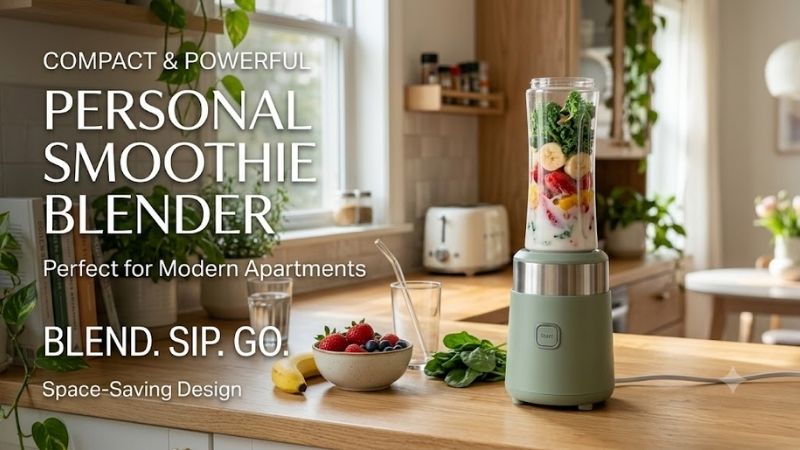
A personal blender is designed primarily for individual portions.
Many models use a removable blending cup that attaches directly to the motor base.
After blending, the cup can often be separated from the blade assembly and fitted with a drinking lid.
This eliminates the need to transfer the smoothie into a separate glass and reduces the number of containers used.
However, blending cups, blade assemblies, and lids are not universally interchangeable.
Replacement components must be compatible with the exact model.
How Is It Different From a Full-Size Blender?
A personal blender generally offers smaller batch capacity and a more compact footprint.
A full-size blender may be more appropriate for family-sized recipes, large soups, or processing substantial quantities of ingredients.
| Consideration | Personal Blender | Full-Size Blender |
|---|---|---|
| Serving size | Primarily individual portions | Often accommodates larger batches |
| Counter space | Usually smaller footprint | Usually requires more room |
| Storage | Base and individual cups | Larger jar and base |
| Cleanup | Fewer large components | More surface area to wash |
| Frozen ingredients | Depends on exact model | Depends on exact model |
| Meal preparation | Limited by cup capacity | Often better for larger recipes |
Personal blenders can be highly capable within their intended workloads, but small size alone does not guarantee efficient blending.
Should Apartment Residents Choose Corded or Rechargeable?
Corded personal blenders are practical when smoothies are prepared at home.
They avoid battery charging and may be more appropriate for recipes containing demanding ingredients.
Rechargeable blenders are useful when mobility matters, but they introduce battery maintenance and charging considerations.
For most people who blend in the same apartment kitchen every morning, a compact corded design is often the simpler choice.
How to Choose the Right Blender Size
Measure Your Countertop
The blender must fit within the area where you plan to operate it.
Measure the usable width and depth, allowing space for nearby appliances, walls, and any required airflow or operating clearance.
Make sure the base is fully supported on a level surface.
Avoid placing the appliance where the power cord crosses a sink or cooking area.
Also consider how much preparation space remains for cutting fruit, adding ingredients, and setting down the blending cup.
A compact footprint is only helpful if the blender can be used without rearranging the entire kitchen.
Check Cup Height and Storage
Tall blending cups can become awkward in cabinets with limited shelf height.
Measure the height of the motor base, cups, and any lid attachments.
Consider whether the cups can be stored separately from the base.
A model with several accessories may require more total storage volume than a simpler blender with one or two cups.
Buy additional containers only when they provide a clear benefit to your routine.
Choose the Right Cup Capacity
The ideal capacity depends on your typical smoothie ingredients.
A simple fruit-and-milk drink may need less space than a smoothie containing yogurt, oats, nut butter, and multiple fruits.
Check the maximum operating fill level rather than relying only on the advertised container volume.
Ingredients need room to circulate during blending.
Overfilling can reduce performance and cause leaking or other problems.
Blending Performance for Apartment Cooking
Soft Fruit and Everyday Smoothies
Bananas, suitable berries, yogurt, milk, and similar ingredients are common personal-blender workloads.
A blender that handles these ingredients consistently can be sufficient for many apartment households.
However, cutting large ingredients into smaller pieces and adding an appropriate amount of liquid can improve circulation.
Follow the recommended ingredient-loading sequence for the exact model.
Frozen Fruit and Ice
Frozen fruit requires more processing effort than many fresh ingredients.
Some personal blenders are specifically designed to handle frozen mixtures, while others have important restrictions.
Check manufacturer guidance on ice, frozen fruit, portion sizes, and liquid requirements.
Do not assume that a small blender with a high advertised wattage can crush every type of frozen ingredient.
If you routinely make thick smoothies from mostly frozen ingredients, select a model with credible evidence of handling similar mixtures.
Protein Powders and Oats
Protein powders are commonly incorporated into smoothies, but dry powder can collect along cup walls or form clumps.
Ingredient-loading order and sufficient liquid help produce a more uniform mixture.
Oats may also require additional processing depending on their form and the desired texture.
Avoid overloading the blender with dry or thick ingredients.
If the blades stop turning, switch off the appliance and follow the manufacturer’s procedure for safely correcting the problem.
Smoothies With Nut Butters
Nut butters increase mixture thickness and can stick to container walls.
This may make blending more challenging, especially in smaller cups.
Check the blender’s recommended ingredient combinations and loading limits.
A machine intended for liquid smoothies may not be suitable for processing large quantities of whole nuts into nut butter.
These are different tasks with different mechanical demands.
Noise: An Important Apartment Consideration
Why Are Personal Blenders Loud?
Blenders produce sound from the motor, blade rotation, ingredient impact, and vibration transferred to the supporting surface.
Hard frozen ingredients can create distinct impact noises.
The amount and character of the sound depend on the machine, workload, and surrounding environment.
A high-powered appliance is not automatically louder in every situation, and advertised motor power alone does not establish operating noise.
Look for published noise tests using comparable ingredients when possible.
How to Reduce Blender Noise
Begin with stable placement on a level, sturdy countertop.
Keep the appliance away from the edges of counters and ensure that its feet are clean and properly seated.
Use manufacturer-approved ingredients and avoid unnecessarily long blending cycles.
Preparing measured ingredients in advance can reduce the time spent operating the blender.
Do not cover the motor with towels, place it inside a closed cabinet while running, or block ventilation openings to reduce sound.
These practices can interfere with cooling and create safety risks.
Is a Quiet Blender Worth Paying More For?
Quiet operation may be valuable in a studio apartment, shared home, or building with thin walls.
However, the term quiet is subjective unless supported by comparable measurements.
A model with an effective enclosure or sound-reduction design may offer benefits, but those features can increase size and cost.
Evaluate actual noise evidence alongside footprint and blending performance.
Cleaning and Daily Maintenance
Choose Dishwasher-Safe Parts When Appropriate
Some blender cups, lids, and removable components are dishwasher safe.
Others require handwashing or have temperature and placement restrictions.
Check the model-specific cleaning instructions.
Never place the motor base in a dishwasher unless the manufacturer explicitly states that this is permitted.
Regularly inspect cup threads, seals, and lid openings for trapped residue.
Clean Immediately After Blending
Smoothies containing yogurt, milk, protein powder, or fruit can leave sticky residue.
Cleaning soon after use generally reduces the effort required to remove it.
Follow the manufacturer’s disassembly procedure and wash the components with approved methods.
Do not touch sharp blade edges directly.
Dry parts according to the instructions before storage or reassembly.
Consider Replacement Parts
A personal blender may eventually need replacement cups, lids, seals, or blade components.
Check whether compatible replacement parts are available from the manufacturer.
Avoid assuming that visually similar components from a different series will fit safely.
Replacement blade assemblies must match the exact appliance and its locking or activation system.
Which Blender Setup Fits Your Apartment?
Studio Apartment With Minimal Counter Space
Prioritize a narrow, stable motor base and a cup that can be stored separately.
Choose a simple configuration with minimal accessories.
If cabinet storage is available, a lightweight base may be easier to put away after use.
Apartment With a Shared Kitchen
A personal blender with removable cups can simplify individual meal preparation.
However, operating noise and access to shared outlets may matter.
Choose an easy-clean design that does not occupy communal counter space unnecessarily.
Apartment for a Fitness-Focused Household
If you regularly prepare protein smoothies, focus on appropriate cup capacity and easy cleaning.
For frozen fruit and thicker mixtures, verified ingredient-handling capability becomes more important.
Additional cups may be useful for several people, provided they fit the exact model.
Apartment With Limited Storage but Frequent Cooking
A personal blender is worthwhile when it serves a clear daily purpose.
If you also need to puree large batches of soup or prepare sizable sauces, consider whether an immersion blender or a larger kitchen appliance would better support those additional tasks.
Avoid buying multiple appliances with overlapping functions unless they solve distinct problems.
Common Buying Mistakes
Choosing the Smallest Blender Available
Very small cups may require multiple batches or limit your preferred recipes.
Choose the smallest capacity that comfortably accommodates your normal serving, not simply the smallest advertised appliance.
Ignoring Cup and Accessory Storage
A compact motor base can still come with numerous bulky accessories.
Consider the total storage arrangement before ordering.
Assuming High Wattage Guarantees Smooth Results
Advertised power is only one factor.
Blade geometry, cup shape, ingredients, operating limits, and construction also matter.
Buying Without Considering Noise
A blender that fits physically may still be disruptive if you use it early in the morning in a shared apartment.
Compare credible noise information where possible and consider your household schedule.
Overlooking Safety Features
Choose a model with clear instructions and proper safeguards against unintended activation.
Avoid using damaged cups, cracked blade assemblies, or incompatible replacement components.
Frequently Asked Questions
What Size Personal Blender Is Best for an Apartment?
The best size is one that fits your available workspace and prepares your usual serving without overfilling.
Measure both the blender and its storage accessories before purchasing.
Are Personal Blenders Good for Frozen Fruit?
Many can handle frozen fruit, but capabilities vary.
Check the exact model’s instructions for ingredient size, liquid requirements, and operating restrictions.
Can I Make More Than One Smoothie at a Time?
Some models offer larger cups, but personal blenders are generally intended for smaller batches.
Never exceed the maximum fill level to increase serving size.
How Can I Make My Blender Quieter?
Use a stable, level surface, make sure the appliance is correctly assembled, and avoid overloading it with difficult ingredients.
Do not obstruct ventilation or wrap the motor in sound-dampening materials.
Can I Store My Smoothie in the Blending Cup?
Many models provide drinking or storage lids for their cups.
Follow food-storage guidance for the ingredients used. Perishable smoothies should be refrigerated promptly at 40°F or below and not left at room temperature for extended periods.
Is a Personal Blender Better Than an Immersion Blender?
For individual smoothies, a personal blender often provides a convenient cup-based workflow.
An immersion blender may be more versatile for soups, sauces, and preparation directly in suitable cookware.
The better choice depends on the foods you prepare most often.
Conclusion
A personal smoothie blender for apartments should balance adequate blending capability with compact storage, reasonable noise, and convenient cleanup. For most residents, a corded personal blender with a practical cup size and simple accessories offers a useful everyday setup. Choose according to your ingredients, actual kitchen dimensions, and daily routine rather than relying only on advertised motor power or compact appearance.
Write Your Review
No reviews yet. Be the first to share your experience!