
A pod coffee maker for home cooking can make it convenient to prepare coffee alongside breakfast, baking, and everyday meal preparation. However, pod machines are beverage brewers, not cooking appliances. The right model should match your coffee preferences, available counter space, and kitchen routine without creating unnecessary capsule costs or cleaning work. This guide explains what to consider before buying.
- Quick Verdict: What Pod Coffee Maker Should Home Cooks Buy?
- Understanding Pod Coffee Makers
- Understanding Different Pod Systems
- Pod Coffee vs. Traditional Brewing
- Choosing the Right Beverage Style
- Cup-Size Options
- Capsule Compatibility and Long-Term Flexibility
- Calculating the True Cost of Pod Coffee
- Capacity for Different Households
- Choosing for a Busy Home Kitchen
- Brewing Performance and Coffee Quality
- Cleaning a Pod Coffee Maker
- Capsules, Waste, and Environmental Considerations
- Using Pod Coffee for Home Cooking and Baking
- Pod Coffee Makers With Milk Systems
- Choosing by Budget and Lifestyle
- Common Buying Mistakes
- Frequently Asked Questions
- Conclusion
Quick Verdict: What Pod Coffee Maker Should Home Cooks Buy?
For most households, a pod coffee maker with reliable cup-size options, a removable water reservoir, accessible capsule disposal, and straightforward cleaning is a practical choice.
However, the right brewing system depends on whether you want regular American-style coffee, concentrated espresso, or both.
Some pod machines are designed primarily for larger coffee beverages. Others focus on espresso-style extraction.
A machine advertising several drink sizes may not prepare every style equally well.
| Buying Factor | Why It Matters | Priority |
|---|---|---|
| Capsule system | Determines compatible coffee products | Essential |
| Beverage type | Matches regular coffee or espresso preferences | Essential |
| Cup-size options | Supports different serving needs | High |
| Removable water reservoir | Simplifies refilling and cleaning | High |
| Used-capsule disposal | Reduces daily handling | High |
| Brew temperature and consistency | Influences beverage quality | High |
| Countertop footprint | Fits cooking and coffee preparation areas | High |
| Cleaning and descaling | Supports reliable long-term operation | High |
| Capsule cost | Determines ongoing expense | Essential |
| Compatible beverage selection | Affects long-term flexibility | High |
A pod coffee maker is most valuable when it simplifies beverage preparation while you focus on other kitchen tasks.
It should not be purchased as a substitute for a kettle, saucepan, or other appliance intended to cook food.
Understanding Pod Coffee Makers
How Do Pod Coffee Makers Work?
Pod coffee makers use pre-portioned coffee contained in a compatible capsule or pod.
The machine introduces water into the coffee portion using a brewing method designed for that system.
Depending on the appliance, water may pass through coffee under pressure or another controlled process.
The brewed beverage flows into a cup.
The used coffee portion is then discarded or collected inside the appliance.
This can reduce the need to measure loose coffee, grind beans, and clean an open coffee filter after every drink.
However, it also makes the user dependent on compatible coffee portions.
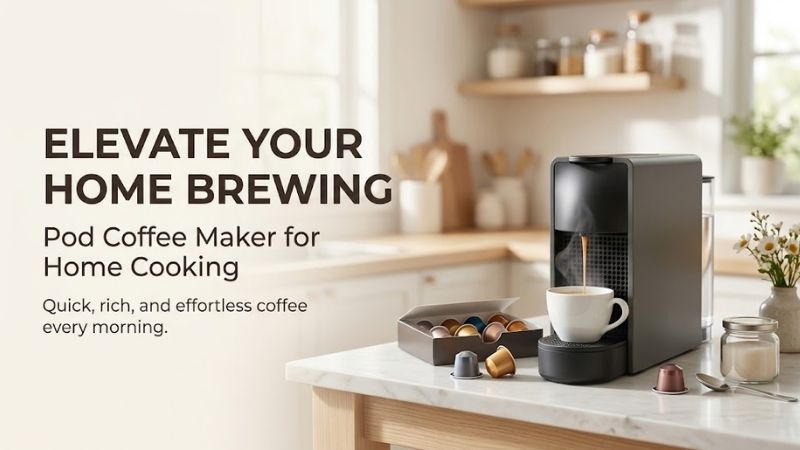
Why Pod Coffee Makers Are Convenient for Home Cooking
Home cooks often prepare several things at once.
Breakfast might involve making eggs, warming bread, and organizing lunch ingredients.
A pod coffee machine can simplify the beverage portion of the routine.
Instead of grinding coffee and preparing a manual brewer, the user inserts a compatible pod and starts the brewing cycle.
This can reduce active preparation effort.
However, the machine still requires water, routine cleaning, and attention to hot beverage handling.
Convenience depends on the entire workflow.
What a Pod Coffee Maker Cannot Do
Pod coffee makers are designed for beverages.
They are not generally intended to cook raw food or heat cookware.
Do not insert soup ingredients, raw eggs, oil, or other foods into the coffee brewing system.
Likewise, the hot-water outlet should not automatically be treated as a food-cooking appliance.
A machine that produces hot water for beverages may not deliver the temperature or volume needed to safely cook a particular food.
Follow the manufacturer’s approved uses.
Understanding Different Pod Systems
Single-Serve Coffee Pod Systems
Some pod systems focus on preparing regular coffee in several serving sizes.
These can be convenient for households that drink larger mugs.
However, the coffee portion and brewing method influence beverage strength.
A larger cup setting does not necessarily produce the same flavor as using a separate appropriate coffee portion.
Choose according to how you normally drink coffee.
Espresso Capsule Systems
Other systems are intended for espresso or concentrated coffee beverages.
These may use pressure-based brewing and smaller beverage volumes.
However, capsule systems are not interchangeable.
A machine designed for one capsule format may not accept another.
Before purchasing, confirm the exact compatible capsule type.
Paper Coffee Pods
Some machines use soft paper pods, which differ from rigid capsules.
These may be convenient for certain brewing designs.
However, paper pods are not universally compatible with capsule machines.
A similar-looking coffee portion should not be forced into the wrong brewer.
Reusable Coffee Capsules
Certain systems support compatible reusable capsules.
These may allow users to add their own ground coffee.
However, compatibility and brewing performance vary.
Some machine manufacturers do not approve third-party reusable capsules.
An incompatible accessory can leak, jam, or damage the brewer.
Use only products explicitly suitable for the machine.
Pod Coffee vs. Traditional Brewing
| Feature | Pod Coffee Maker | Drip Coffee Maker | Semi-Automatic Espresso Machine |
|---|---|---|---|
| Coffee preparation | Pre-portioned pods | Ground coffee and filter | Ground coffee prepared in portafilter |
| Convenience | High for single servings | Strong for larger batches | More hands-on |
| Customization | Limited by system | Flexible coffee quantity and grind | Extensive extraction control |
| Multiple servings | Usually sequential | Often batch brewing | Usually sequential |
| Cleanup | Used pods and routine rinsing | Filter and carafe | Portafilter, basket, group, and possibly steam wand |
| Ongoing packaging | System-dependent | Filters and coffee packaging | Coffee packaging |
| Best fit | Individual convenience | Multiple regular coffee servings | Traditional espresso preparation |
The right machine depends on what your household drinks and how much preparation effort you want.
Choosing the Right Beverage Style
Regular Black Coffee
For people who drink a standard mug of black coffee each morning, a pod system designed for larger coffee servings can be convenient.
However, taste depends on coffee quantity, capsule freshness, water volume, and extraction method.
A machine offering a large cup setting does not guarantee that the coffee will retain the same strength as a smaller serving.
Choose capsules and settings appropriate for your preferred taste.
Espresso
If espresso is your primary drink, choose a capsule system specifically intended to produce the style you want.
However, not all concentrated pod coffee is equivalent to traditional espresso extracted from freshly ground coffee.
Evaluate beverage volume, flavor, and system design.
Americano-Style Drinks
An Americano-style beverage combines espresso with hot water.
Some capsule machines offer suitable beverage programs.
Others require the user to add water separately.
Check whether the system supports the intended preparation.
Iced Coffee
Some pod machines can brew coffee suitable for iced beverages.
However, pouring hot coffee directly over ice changes beverage concentration as the ice melts.
Certain systems offer specific iced coffee settings.
These settings may alter beverage volume or brewing behavior.
Choose based on the actual recipe rather than assuming an iced label guarantees stronger or colder coffee.
Milk-Based Drinks
A basic pod coffee maker may not froth milk.
For lattes and cappuccinos, a separate milk frother or machine with an approved milk system may be needed.
Consider the additional equipment and cleaning requirements.
A pod machine that appears compact may require more total space once milk accessories are included.
Cup-Size Options
Why Cup Size Matters
A household may use several different mugs.
A machine that supports only one beverage size may feel restrictive.
However, cup-size flexibility should be evaluated alongside coffee quality.
A large water volume passing through the same coffee portion can produce a more diluted beverage.
Small Cups
Small beverage settings may be appropriate for espresso-style drinks or concentrated coffee.
However, the intended extraction method is system-specific.
Medium Coffee Cups
A medium serving may suit an ordinary breakfast mug.
Check whether the machine’s coffee portion is designed for that volume.
Large Travel Mugs
Some pod brewers support tall mugs or allow the drip tray to be removed.
However, maximum cup height varies.
A tall travel mug may fit physically but not necessarily correspond to a supported beverage volume.
Measure cup clearance and check the water reservoir capacity.
Programmable Beverage Sizes
Certain machines allow users to adjust beverage volume.
This can be convenient.
However, customization may affect beverage strength.
Follow the system’s recommendations and adjust based on taste.
Capsule Compatibility and Long-Term Flexibility
Why Capsule Format Matters
Pod systems can use proprietary or specialized capsule designs.
Choosing a machine effectively commits the household to a particular coffee ecosystem.
That influences flavor options, purchase availability, and ongoing costs.
Original and Compatible Capsules
Some systems support third-party capsules manufactured for their format.
However, compatibility should be verified for the specific machine generation.
A capsule advertised as compatible may still behave differently in particular models.
Availability in Local Stores
A coffee system is more convenient when compatible pods are easy to purchase.
Consider whether your preferred coffee is available from local grocery stores or requires special ordering.
A lower-priced machine may become inconvenient if compatible capsules are difficult to find.
Decaf Options
Families may include people who prefer decaffeinated coffee.
Check whether the system provides suitable decaf options.
Do not assume every capsule range offers identical regular and decaf selections.
Flavor Variety
Some pod systems offer flavored coffee, dark roasts, lighter roasts, and other beverages.
However, flavor variety is not automatically a benefit if you only drink one coffee regularly.
Avoid paying for a complex system based on options you are unlikely to use.
Calculating the True Cost of Pod Coffee
Machine Price Is Only the Beginning
A pod coffee maker may have a relatively low purchase price.
However, each beverage requires a compatible pod or capsule.
This creates a recurring cost.
For a household with several coffee drinkers, the long-term expense may become substantial.
Calculate Monthly Capsule Consumption
Suppose two adults each drink two pod coffees daily.
That equals four pods per day.
Over a 30-day month, the household uses approximately 120 pods.
If the hypothetical cost per pod is $0.70, the monthly capsule expense is $84.
At $1.00 per pod, it becomes $120.
These are illustrative calculations, not current market price claims.
The actual expense depends on system, capsule brand, discounts, and consumption.
Compare With Ground Coffee
Traditional drip brewing and espresso preparation use ground coffee rather than individually packaged capsules.
The cost per beverage can differ substantially.
However, equipment, filters, grinder costs, and coffee quality also influence total ownership expense.
A fair comparison should include both the purchase price and recurring supplies.
Compare With Coffee Shop Purchases
A pod coffee maker may reduce spending compared with purchasing prepared drinks at a coffee shop.
However, the savings depend on how often you actually replace coffee shop purchases with homemade drinks.
Buying a machine does not guarantee savings if you continue purchasing the same number of outside drinks.
Consider Service and Maintenance
Water filters, descaling products, and replacement parts may create additional costs.
Review the manufacturer’s maintenance requirements.
Capacity for Different Households
One-Person Household
A compact single-serve pod machine can be sufficient.
Choose a water tank size that is convenient to refill.
A very large reservoir may be unnecessary when only one cup is prepared daily.
Couples
A moderately sized tank can reduce refill frequency.
However, the machine still prepares drinks sequentially unless it has a specialized design.
If both people drink coffee at the same time, consider total brewing time.
Families
Several coffee drinkers can consume many pods.
A larger water reservoir and accessible used-capsule container may be valuable.
However, recurring capsule cost becomes a major decision factor.
Households With Different Preferences
Pod machines can make it easy to switch between compatible coffee varieties without emptying a bean hopper.
This may suit families where one person likes dark coffee and another prefers decaf.
However, each preference must be supported by the same capsule system.
Choosing for a Busy Home Kitchen
Countertop Footprint
Measure the machine’s width, depth, and height.
Some pod brewers are relatively narrow but deep.
Others have water tanks extending from the side.
Consider where the cord and reservoir will sit.
A machine should not interfere with the safe use of nearby cooking appliances.
Water Tank Access
A removable water tank can simplify refilling.
However, the tank may require rear or top clearance.
If the machine is beneath a cabinet, check whether you can remove it without moving the entire brewer.
Drip Tray and Cup Height
A removable drip tray may provide more room for tall mugs.
However, removing it can expose the counter to spills.
Follow the manufacturer’s intended arrangement.
Placement Near Cooking Equipment
Avoid placing the coffee maker next to hot burners, ovens, or areas with excessive steam.
Kitchen heat and splashes can damage electrical equipment.
Follow all required clearances.
Outlet Access
Use a suitable outlet and avoid overloaded power strips.
Pod brewers contain electrical heating systems, even when their housings are small.
Brewing Performance and Coffee Quality
Water Temperature
Water temperature influences coffee extraction.
However, a machine’s displayed readiness does not necessarily reveal actual brewing temperature.
Performance varies between systems and models.
A pod brewer should be judged on beverage results and reliability rather than marketing claims alone.
Beverage Strength
Coffee strength depends on coffee dose, grind, water volume, and extraction.
A larger cup setting can change concentration.
Choose settings suited to the intended capsule.
Coffee Freshness
Sealed capsules can help protect coffee from air and moisture before use.
However, freshness depends on packaging integrity, processing, and storage conditions.
A capsule being sealed does not guarantee ideal flavor indefinitely.
Store pods according to their instructions.
Consistency
Pre-portioned capsules can reduce variation caused by manual measuring and grinding.
However, machines still depend on clean water pathways and correct operation.
A blocked needle or scaled heating system can affect results.
Foam and Crema
Certain espresso capsules produce a foamy layer.
However, foam volume or appearance alone does not establish coffee quality.
Different brewing systems may produce different textures.
Evaluate flavor and mouthfeel as well.
Cleaning a Pod Coffee Maker
Daily Used-Pod Disposal
Remove used capsules according to the machine’s instructions.
Some machines collect spent capsules internally.
Others require manual removal after each brew.
A large capsule container may reduce emptying frequency, but damp used coffee portions should not be left indefinitely.
Drip Tray Cleaning
Coffee spills and rinse water can accumulate in the drip tray.
Empty and wash it regularly.
Check whether components are dishwasher safe.
Water Tank Cleaning
Refresh water and wash the reservoir according to the manual.
Do not leave stagnant water in the tank for prolonged periods.
Brewing Needle and Outlet
Some capsule machines contain needles or piercing mechanisms.
These can become obstructed by coffee particles.
Never place fingers near a sharp capsule-piercing component.
Follow the manufacturer’s approved cleaning and troubleshooting procedures.
Descaling
Mineral scale can build up in heated water pathways.
Descale according to machine instructions and water conditions.
Use the approved descaling product.
Do not assume that every pod machine can be safely cleaned using vinegar.
Capsules, Waste, and Environmental Considerations
Single-Use Packaging
Many capsule systems use individually packaged coffee portions.
This creates packaging waste.
However, materials and recovery programs vary.
Some capsules use aluminum, plastic, paper, or other constructions.
The environmental impact depends on the entire system, including materials, production, transportation, and disposal.
Recycling Programs
Some manufacturers offer capsule collection or recycling programs.
However, availability depends on location.
A capsule being described as recyclable does not guarantee it can be placed in an ordinary household recycling bin.
Check local rules and program requirements.
Compostable Pods
Certain coffee pods are marketed as compostable.
However, compostability may depend on specific industrial composting conditions.
Do not assume that every product labeled compostable will break down in a backyard compost system.
Reusable Capsules
Reusable products may reduce some single-use packaging, but they require filling, cleaning, and compatibility checks.
They also reduce some of the convenience that motivates people to buy pod machines.
Choose based on your priorities.
Using Pod Coffee for Home Cooking and Baking
Coffee-Based Desserts
Brewed coffee can be an ingredient in certain desserts.
For example, appropriately prepared coffee may be used in coffee-flavored cakes, sauces, or chilled desserts.
However, the quantity and strength should match the recipe.
A concentrated espresso capsule may not be directly interchangeable with a full cup of brewed coffee.
Use a recipe developed for the intended coffee type.
Coffee for Chocolate Recipes
Some chocolate recipes use coffee to contribute flavor complexity.
However, adding coffee changes the recipe’s liquid balance.
Do not substitute a large beverage for a small amount of concentrated coffee without considering the recipe.
Tiramisu-Style Desserts
Coffee is commonly used in tiramisu-style desserts.
A pod brewer can prepare the coffee component.
However, dessert food safety depends on all ingredients and preparation steps.
For recipes involving eggs or dairy, use safe handling and appropriate refrigeration.
Breakfast Beverages
A pod machine can provide a convenient cup of coffee alongside cooked breakfast.
However, it does not replace the appliances needed to prepare eggs, pancakes, or other foods.
Hot Water for Recipes
Some pod brewers have hot-water functions.
However, water temperature, cleanliness, and flow may be unsuitable for particular food preparation tasks.
Do not assume that hot water from a coffee machine safely cooks raw food or sterilizes equipment.
Use a suitable kettle or cooking appliance when the recipe requires it.
Pod Coffee Makers With Milk Systems
Basic Machines Without Milk Frothers
A basic coffee-only machine is usually simpler to clean and store.
It may be sufficient for black coffee drinkers.
Machines With Separate Milk Frothers
A separate milk frother provides additional drink options.
However, it adds equipment and cleaning work.
Integrated Milk Systems
Some machines offer automatic milk preparation.
These may simplify lattes and cappuccinos.
However, their milk-contact components require sanitation and appropriate refrigerated storage.
Which Is Worth Buying?
If you rarely drink milk beverages, avoid unnecessary complexity.
If you prepare lattes every morning, an integrated or separate frother may provide meaningful value.
Choose based on total convenience rather than drink-menu length.
Choosing by Budget and Lifestyle
Budget-Conscious Households
Prioritize capsule affordability and availability.
A low machine price can be offset by expensive recurring coffee purchases.
Apartment Residents
Choose manageable dimensions and convenient water access.
Avoid placing the machine where cooking steam or heat can damage it.
Busy Parents
A straightforward pod system can reduce active beverage preparation.
However, keep hot drinks and capsules away from young children.
Work-From-Home Users
Frequent daily coffee consumption can increase capsule expenses.
Evaluate whether a drip machine or grinder-based setup might provide better long-term value.
Occasional Coffee Drinkers
A small pod machine may be convenient when you rarely prepare more than one beverage.
However, ensure that capsules remain available and are stored appropriately.
Common Buying Mistakes
Buying Without Checking Capsule Compatibility
Capsule formats are not universally interchangeable.
Choosing by Machine Price Alone
Ongoing capsule expenses can be substantial.
Assuming Every Pod Machine Makes Traditional Espresso
Brewing methods and beverages differ.
Using Coffee Pods to Prepare Food Inside the Brewer
Pod machines are not general cooking appliances.
Ignoring Milk-System Cleaning
Automatic milk features add maintenance.
Assuming All Capsules Are Locally Recyclable
Recycling availability depends on local programs.
Buying a Large Machine for One Occasional Cup
Choose equipment capacity according to normal demand.
Frequently Asked Questions
Is a Pod Coffee Maker Good for Home Cooking?
It is useful for preparing coffee alongside home meals and for certain recipes requiring brewed coffee. It is not designed to cook food directly.
Can a Pod Coffee Maker Make Espresso?
Some capsule systems are specifically designed for espresso-style beverages. Others primarily prepare regular coffee. Check the brewing system and supported products.
Are Pod Coffee Makers Cheaper Than Traditional Coffee Makers?
Their initial purchase prices may be competitive, but recurring capsule costs can be higher than some ground-coffee brewing methods.
Can I Use Any Coffee Pod in Any Machine?
No. Capsule and pod formats are system-specific. Verify compatibility before buying.
Do Pod Coffee Makers Need Descaling?
Yes, many require periodic descaling to manage mineral buildup. Follow the manufacturer’s instructions.
Are Reusable Coffee Pods Worth It?
They may reduce some disposable packaging and offer coffee choice, but they require additional preparation and cleaning and must be compatible with the machine.
Conclusion
The best pod coffee maker for home cooking should simplify coffee preparation while fitting your kitchen, preferred beverage style, and long-term budget. Choose a system with readily available compatible pods, useful cup sizes, accessible water and waste containers, and manageable cleaning requirements. Treat it as a beverage appliance that complements home cooking rather than a substitute for cooking equipment, and compare recurring capsule costs before committing to a particular system.



Write Your Review
No reviews yet. Be the first to share your experience!