
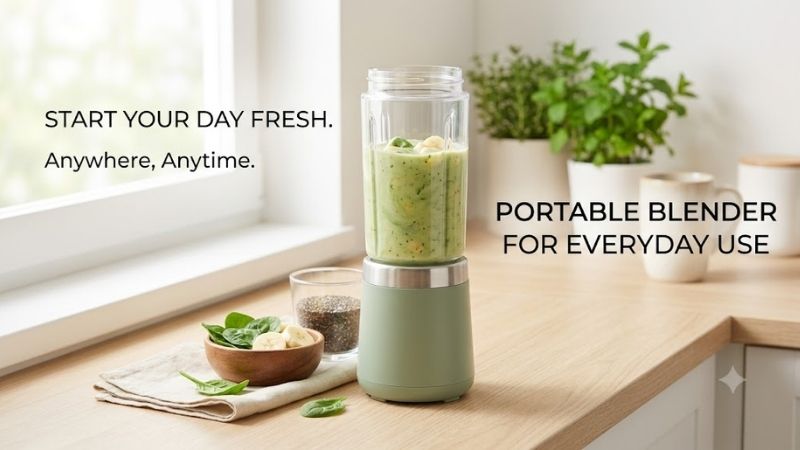
A portable blender for everyday use can make smoothies, protein shakes, and simple blended drinks more convenient at home, at work, or while traveling. However, portable designs vary considerably in power, capacity, blade protection, and cleaning requirements. Choosing the right one means understanding what it can safely blend and how well it fits your routine.
- Quick Answer: Which Portable Blender Should You Choose?
- Understanding Portable Blender Types
- Choosing Enough Blending Capability
- Capacity and Everyday Convenience
- Battery Life and Charging
- Cleaning and Maintenance
- Choosing a Portable Blender for Different Routines
- Common Buying Mistakes
- Frequently Asked Questions
- Conclusion
Quick Answer: Which Portable Blender Should You Choose?
For everyday smoothies and protein shakes, look for a portable blender with reliable safety interlocks, manageable weight, a properly sealed drinking container, and enough blending capability for your typical ingredients.
A rechargeable blender may be suitable when you need to blend away from an electrical outlet. If you mainly prepare drinks in your kitchen, a compact corded personal blender may offer greater flexibility for demanding ingredients.
The best choice depends on where and how you blend.
| Feature | Why It Matters | What to Check |
|---|---|---|
| Power source | Determines where the blender operates | Rechargeable battery or corded power |
| Container capacity | Controls practical serving size | Maximum liquid and food fill levels |
| Blade system | Affects blending ability and safe handling | Manufacturer-approved ingredients and safety features |
| Portability | Determines carrying convenience | Total weight, lid security, overall dimensions |
| Cleaning | Influences daily usability | Removable parts and approved washing methods |
| Charging | Affects travel convenience | Charging port, cable, charging restrictions |
| Safety interlocks | Help prevent unintended blade activation | Documented locking and activation safeguards |
Do not assume that all portable blenders can crush ice, process frozen fruit, or blend hard ingredients.
Understanding Portable Blender Types
Rechargeable Portable Blenders
Rechargeable portable blenders typically integrate a battery-powered motor and a relatively small blending container.
Their main advantage is the ability to blend without a nearby wall outlet.
They are useful for office beverages, travel, and locations where a conventional blender would be inconvenient.
However, blending capability depends on the exact motor system, battery condition, blade design, and ingredient load.
A rechargeable blender may struggle with thick frozen mixtures that a more capable corded model can process.
Corded Personal Blenders
Corded personal blenders usually have a compact motor base and a removable blending cup.
They are designed for smaller portions than full-size countertop blenders.
Some can blend ingredients directly in the cup that becomes a drinking container after the blade assembly is removed and replaced with an appropriate lid.
Because they receive power from an outlet, they do not depend on battery charge.
For people who prepare smoothies at home every day, this can be more convenient than managing a rechargeable appliance.
Portable Blender vs. Full-Size Blender
A full-size blender usually provides greater jar capacity and may offer a broader range of speeds and processing functions.
However, that additional capability comes with more counter space and storage requirements.
A portable blender is better suited to smaller drinks and simpler preparation tasks.
It should not be treated as a universal replacement for a full-size machine, food processor, or commercial blender.
Choosing Enough Blending Capability
Motor Power Is Only Part of the Picture
Manufacturers may describe blender power using watts, motor speed, or other performance-related figures.
These specifications can provide useful context, but they do not independently establish how well a machine blends particular foods.
Blade design, container geometry, motor control, and ingredient movement also affect performance.
A high advertised speed does not guarantee that frozen ingredients will blend smoothly.
When possible, prioritize credible published tests using ingredients similar to those you plan to prepare.
Can Portable Blenders Crush Ice?
Some portable blenders are approved for limited ice blending, while others are not.
Never assume ice-crushing capability based on blade appearance or marketing language alone.
If you regularly use ice, check the instructions for the exact model.
The manufacturer may specify limits on ice size, quantity, added liquid, or operating duration.
For frequent ice-heavy smoothies, a suitably designed corded personal blender may be more appropriate than a lightweight rechargeable model.
Blending Frozen Fruit
Frozen fruit can be challenging because hard pieces may resist blade movement, especially when liquid cannot circulate around them.
Choose a blender whose manufacturer explicitly supports your intended frozen ingredients.
Use the recommended proportions and preparation methods.
Avoid forcing the blades through an overloaded mixture or operating the motor repeatedly while the contents remain jammed.
A blender that requires substantial thawing or ingredient rearrangement may be inconvenient for an everyday frozen smoothie routine.
Protein Powder and Soft Ingredients
Protein powder, milk, yogurt, and soft fruit generally require less intensive processing than hard frozen ingredients.
However, thick mixtures can still create problems if there is insufficient liquid or the container is overfilled.
For simple protein shakes, a smaller and less powerful model may be perfectly adequate.
If your routine includes nut butters, dense frozen fruit, oats, and multiple ingredients, check whether the model is suitable for those combinations.
Capacity and Everyday Convenience
Choose a Realistic Serving Size
Portable blenders commonly use smaller containers than full-size countertop machines.
However, the advertised container volume may differ from the maximum recommended blending fill level.
Check both measurements.
Consider how much liquid, fruit, yogurt, and other ingredients you actually use.
A container that is comfortable for a basic protein shake may be too small for a smoothie intended to replace a meal.
If you regularly prepare larger portions, a compact corded model with a larger approved cup may be more convenient.
Account for Ingredient Expansion and Movement
Blending requires space for ingredients to move.
Overfilling can cause poor circulation, leaking, or improper operation.
Do not assume that a container can be filled completely simply because its labeled capacity appears large enough.
Follow the maximum fill line and ingredient-loading instructions.
Hot ingredients require special caution because steam and pressure can create serious risks in sealed containers. Never blend hot liquids in a portable blender unless the manufacturer explicitly provides a safe procedure for that model.
Look for a Secure Lid
A portable blender may travel in a bag, cup holder, or backpack.
A reliable drinking lid is important, but a product described as leak-resistant is not necessarily leakproof in every position.
Check whether the drinking lid is designed to seal the container during transportation.
Do not transport a blender containing liquid with an exposed or accessible blade assembly.
Follow the manufacturer’s instructions for separating the motor, blades, drinking cup, and lid.
Battery Life and Charging
Understand Battery-Life Claims
Rechargeable blenders may advertise a number of blends per charge.
Actual battery performance depends on ingredients, operating duration, load, battery condition, and environmental factors.
Light drinks may require less energy than dense frozen mixtures.
Compare battery specifications and independently documented performance when available.
Avoid treating an advertised blend count as a guarantee for every recipe.
Check Charging Requirements
Some portable blenders use USB charging, but charging connectors and accepted power inputs vary.
Confirm which cable and power source the manufacturer approves.
Inspect whether the charging port needs to remain completely dry and whether the blender must be disconnected from charging before use.
Do not assume that every USB charger or adapter is appropriate.
Battery Safety Matters
Rechargeable appliances require careful handling because battery damage, charging faults, and manufacturing defects can create hazards.
Choose products with clear manufacturer identification, safety instructions, support information, and relevant documented safety compliance.
Follow charging instructions, avoid excessive heat, and discontinue use if the appliance shows damage, unusual swelling, overheating, or other abnormal behavior.
Check for applicable product recalls before purchasing and before continuing to use an older machine.
Cleaning and Maintenance
Choose Easy-to-Clean Components
A portable blender should be convenient enough to clean immediately after use.
Look for a drinking cup and lid with accessible surfaces and minimal hard-to-reach recesses.
Blender seals and threads can retain residue, especially after preparing drinks containing dairy products, nut butters, or protein powder.
Check which parts are removable and whether the manufacturer allows dishwasher cleaning.
Never immerse a motor or battery compartment unless the product instructions explicitly permit it.
Are Self-Cleaning Blenders Really Self-Cleaning?
Some manufacturers describe a water-and-detergent blending cycle as self-cleaning.
This process can loosen certain residues, but it may not replace thorough manual washing.
Food particles can remain around seals, lid openings, and blade assemblies.
Always follow the specific cleaning instructions, particularly after blending perishable ingredients.
Handle Blades Safely
Blender blades can cause cuts even when the motor is switched off.
Before cleaning, ensure the machine cannot activate accidentally.
Follow the manufacturer’s instructions for separating components and avoid touching sharp edges directly.
Never reach into the blade area while the appliance is assembled in a condition where the motor could operate.
Choosing a Portable Blender for Different Routines
Best for Office Protein Shakes
A rechargeable model can be convenient when you want to mix powder and liquids at work without using a shared kitchen appliance.
Prioritize easy cleaning, practical capacity, a secure drinking lid, and straightforward charging.
If you only need to mix powder with liquid, a manual shaker bottle may be simpler and easier to maintain.
Best for Daily Fruit Smoothies
For soft fruits, yogurt, and suitable liquids, a portable blender with sufficient capacity and an easy-clean cup can work well.
If the recipe frequently contains frozen fruit, check explicit manufacturer approval and performance evidence.
Best for Travel
Choose manageable weight, a secure drinking container, and a design that can be cleaned with the facilities available at your destination.
Air travel requires additional attention because lithium batteries are subject to airline and aviation security rules.
Check the exact battery specifications and current airline requirements before flying.
Best for Small Apartments
A compact corded personal blender may be a better choice when the appliance is used almost entirely at home.
It avoids battery charging and may provide greater ingredient flexibility.
A rechargeable model makes more sense when operation away from an outlet is genuinely valuable.
Common Buying Mistakes
Choosing Only by Advertised RPM
Rotational speed is not a complete measure of blending performance.
Consider motor design, blade assembly, ingredients, and credible performance evidence.
Expecting Full-Size Blender Results
Portable models are not necessarily suitable for hard ice, dense frozen mixtures, or demanding food preparation.
Choose equipment based on your actual recipes rather than the broadest marketing claims.
Ignoring Cleaning Difficulty
An appliance used daily should be easy to wash and dry thoroughly.
Complicated blade and gasket assemblies can make an otherwise convenient blender less practical.
Overlooking Safety and Product Support
Avoid poorly documented products that provide no clear operating instructions, safety information, or identifiable manufacturer support.
Product safety should outweigh small differences in price or appearance.
Frequently Asked Questions
Can a Portable Blender Replace a Regular Blender?
It can replace a larger blender for some simple, small-serving drinks.
However, larger batches, dense frozen mixtures, and more demanding food processing may require different equipment.
Are Rechargeable Portable Blenders Powerful Enough for Smoothies?
Some are suitable for soft fruit and liquid-based smoothies.
Performance varies significantly, so check manufacturer-approved ingredients and reliable evidence rather than assuming universal capability.
Can I Put Frozen Strawberries in a Portable Blender?
Only when the manufacturer permits that use.
Frozen fruit size, liquid quantity, and blending load can affect whether the appliance operates safely and effectively.
Can I Blend Hot Coffee in a Portable Blender?
Do not blend hot coffee in a sealed portable blender unless the manufacturer specifically approves the practice and provides instructions.
Hot liquids can create pressure, spills, and burn hazards.
Are Portable Blender Cups Dishwasher Safe?
Some cups and lids are dishwasher safe, while others require handwashing.
Motor and battery assemblies generally have different restrictions. Check the exact product manual.
How Do I Know When to Replace My Portable Blender?
Consider replacement when the appliance develops persistent performance problems, damaged seals, electrical faults, battery defects, or parts that cannot be repaired or replaced safely.
Stop using it immediately if there are signs of a serious safety problem.
Conclusion
The right portable blender for everyday use should handle your actual recipes safely, provide enough capacity, and remain convenient to clean and carry. Choose a rechargeable model when blending away from outlets is essential, or a compact corded personal blender for more demanding home smoothie routines. Prioritize documented ingredient compatibility, blade safety, and reliable construction over exaggerated power or portability claims.


Write Your Review
No reviews yet. Be the first to share your experience!