
A smokeless indoor grill for everyday use can make cooking burgers, chicken, vegetables, and sandwiches more convenient in a home kitchen. However, smokeless does not mean that an appliance produces absolutely no smoke or cooking odors. The best option should combine practical grease control, appropriate heat settings, easy cleaning, and reliable cooking capacity. This guide explains how to choose one for regular use.
- Quick Verdict: What Should You Prioritize?
- What Does Smokeless Really Mean?
- Choosing the Right Cooking Surface
- Temperature Control for Daily Cooking
- Everyday Cooking Applications
- Grease Management and Smoke Reduction
- Daily Cleaning and Maintenance
- Choosing for Different Households
- Common Buying Mistakes
- Frequently Asked Questions
- Conclusion
Quick Verdict: What Should You Prioritize?
For everyday cooking, choose an electric indoor grill specifically designed to minimize smoke through appropriate grease management and cooking-surface construction.
Look for removable plates, accessible drip trays, adjustable temperature settings, and documented ventilation requirements.
Do not assume that a smokeless label guarantees zero emissions.
| Feature | Why It Matters | Buying Priority |
|---|---|---|
| Grease collection | Helps keep fat away from hot surfaces | High |
| Temperature control | Allows appropriate cooking settings | High |
| Removable plates | Simplifies washing | High |
| Cooking area | Determines meal portions | High |
| Splash protection | Helps contain cooking mess | Useful |
| Lid design | Influences cooking and cleanup | Model-dependent |
| Water-filled drip tray | Used in certain smoke-reduction designs | Model-dependent |
| Storage dimensions | Determines daily convenience | High for small kitchens |
A grill that is easy to clean and appropriately sized for your regular meals is likely to be more useful than a larger model with complicated controls.
What Does Smokeless Really Mean?
Why Indoor Grills Produce Smoke
Smoke can develop when fats, oils, marinades, or food residues become hot enough to break down or burn.
High surface temperatures can increase the likelihood of visible smoke, particularly when cooking fatty foods.
Some foods naturally release more grease than others.
Smoke is therefore influenced by both the appliance and cooking technique.
A grill advertised as smokeless may reduce visible smoke under certain conditions but cannot guarantee that every ingredient cooks without fumes.
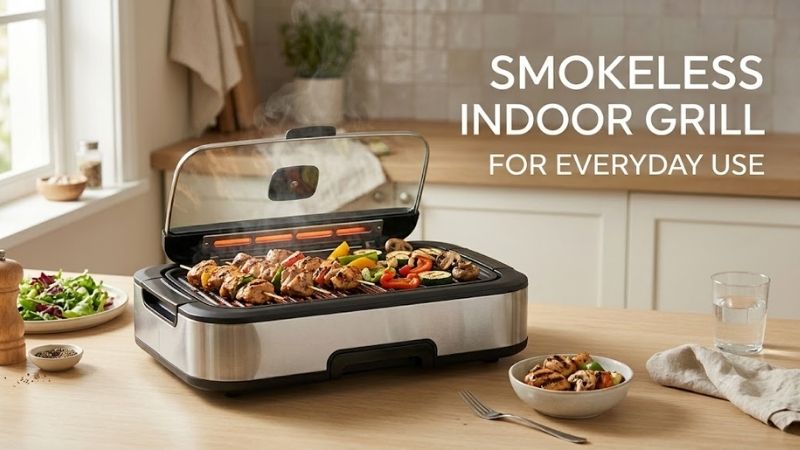
How Smoke-Reduction Designs Work
Different indoor grills use different approaches.
Some direct grease away from the heated cooking surface.
Others use drip trays or water reservoirs to collect grease.
Certain designs include fans, filters, or enclosed cooking chambers.
These methods may help manage smoke, but their effectiveness depends on construction, temperature, food type, and maintenance.
Do not assume that every appliance uses the same smoke-reduction technology.
Do Smokeless Indoor Grills Need Ventilation?
Yes. Proper ventilation remains important.
Cooking can release heat, moisture, odors, grease particles, and other airborne substances even when visible smoke is limited.
Use the grill in an appropriate kitchen environment.
Follow the appliance’s installation and clearance instructions.
Never obstruct vents or operate it in a tightly enclosed cabinet.
Does Smokeless Mean Healthier?
No single smoke-reduction feature establishes that a cooking appliance produces healthier food.
The nutritional characteristics of a meal depend on ingredients, preparation methods, portions, and cooking conditions.
Reducing visible smoke can improve convenience, but it should not be presented as proof of eliminating all cooking-related emissions or health risks.
Choosing the Right Cooking Surface
Open Grill Plates
An open plate gives convenient access to food.
This can be useful for burgers, vegetables, and other ingredients that benefit from turning.
However, an exposed surface may allow cooking fumes and splatter to spread more freely.
Consider whether the grill includes a suitable splash guard or grease collection system.
Contact Grill Plates
A contact grill heats food between two surfaces.
This can be convenient for sandwiches and appropriately sized protein portions.
Some contact models are marketed as low-smoke or smokeless.
However, grease can still accumulate, and fumes may escape when the lid opens.
Choose a model with accessible cleaning components.
Nonstick Coatings
Nonstick-coated plates may reduce food sticking and simplify cleanup.
However, coating type and care requirements are model-specific.
Never infer composition or safety properties solely from terms such as ceramic, granite, or non-toxic.
Follow temperature restrictions and approved utensil requirements.
Removable Cooking Plates
For everyday use, removable plates can be a major convenience advantage.
They allow more direct access to cooking residue.
Check the removal mechanism, weight, and cleaning instructions.
Some plates are dishwasher safe, while others require handwashing.
Temperature Control for Daily Cooking
Adjustable Heat Settings
Different foods require different cooking conditions.
A grill that provides useful temperature adjustment can offer more flexibility than one fixed setting.
However, the displayed setting may not exactly match every part of the cooking surface.
Heating uniformity varies by design.
Why Maximum Heat Is Not Always Best
High temperatures may promote browning but can also increase smoke, sticking, and food burning.
For fatty meats or sugary marinades, unnecessary maximum heat can make cleanup more difficult.
Choose appropriate settings for the recipe and manufacturer’s instructions.
Preheating
Preheating helps the cooking surface reach its intended operating condition.
However, preheating requirements vary.
Follow the appliance’s readiness indicators or prescribed procedure.
Do not leave an empty grill heating unnecessarily.
Internal Food Temperatures
A smokeless grill does not remove the need to verify food safety.
Use a food thermometer.
Cook poultry to 165°F, ground beef to 160°F, and fish to 145°F or according to applicable safe doneness guidance.
For whole beef or pork cuts, 145°F with a three-minute rest is a common USDA recommendation.
Everyday Cooking Applications
Chicken for Lunch and Dinner
Chicken can be practical for regular meal preparation.
Choose reasonably uniform pieces and avoid overloading the cooking surface.
Use the model’s recommended settings.
Verify 165°F at the thickest part.
Clean food-contact surfaces after handling raw poultry.
Burgers
Burger patties can release substantial grease.
A well-designed grease tray is especially useful for this workload.
Do not allow collected grease to overflow.
Cook ground beef to 160°F.
If preparing multiple batches, follow the instructions for safely handling hot trays and accumulated grease.
Vegetables
Bell peppers, zucchini, mushrooms, and other suitable vegetables may produce less grease than fatty meats.
However, moisture and marinades can still cause splattering.
Avoid excessive oil.
Arrange ingredients so that cooking surfaces are not unnecessarily crowded.
Sandwiches
Certain grill designs are suitable for grilled sandwiches.
Contact grills may be convenient because they heat both sides.
However, fillings can leak and burn on hot plates.
Avoid excessive cheese or sauces that may drip into difficult-to-clean areas.
Fish and Seafood
Delicate fish may stick or break during turning.
Choose an appropriate cooking surface and follow the recipe.
Avoid forcing the fish away from the plate.
Use suitable safe cooking temperatures and clean the appliance thoroughly afterward.
Grease Management and Smoke Reduction
Drip Tray Placement
A removable grease tray should be easy to access.
Consider whether grease drains naturally from the cooking surface or collects in channels.
Poorly maintained channels can allow buildup.
A convenient tray makes daily cleaning more manageable.
Water Reservoir Systems
Some grills use water beneath the cooking surface as part of their smoke-management design.
Use only the amount specified by the manufacturer.
Do not improvise water levels or add water to systems not designed for it.
Never pour water onto a hot electrical grill unless the instructions explicitly require that procedure.
Preventing Grease Buildup
Remove food residue and grease after the appliance has cooled.
Accumulated grease can contribute to smoke and odors during later cooking.
Inspect removable plates, channels, and trays.
Dealing With Excessive Smoke
If a grill produces unusual or excessive smoke, stop cooking when safe to do so and follow the manufacturer’s troubleshooting guidance.
Potential causes include excess grease, burned marinades, residue, inappropriate temperatures, or appliance faults.
Do not continue operating equipment that shows signs of electrical damage or overheating.
Daily Cleaning and Maintenance
Cleaning Removable Plates
Allow the grill to cool and disconnect it from electricity.
Remove the plates as directed.
Use manufacturer-approved cleaning tools.
Avoid abrasive pads on coatings that prohibit them.
Cleaning Grease Trays
Empty grease after it has cooled sufficiently for safe handling.
Do not pour substantial amounts of fat into household drains.
Wash the tray according to the manual.
Cleaning Lids and Splash Guards
Grease may collect on lids, shields, and nearby surfaces.
Choose a design that allows safe access to these components.
Never immerse electrical assemblies unless approved.
Long-Term Component Care
Check whether replacement plates, trays, and other components are available.
Inspect coatings and electrical cords regularly.
Discontinue use when damaged parts create a safety concern.
Choosing for Different Households
Best for Apartments
Prioritize manageable smoke, compact footprint, and easy cleaning.
Confirm building rules and use appropriate ventilation.
Best for Daily Protein Preparation
Choose sufficient cooking area, practical temperature controls, and easy grease removal.
A food thermometer remains essential.
Best for Couples
A moderately sized grill may accommodate two portions without unnecessary countertop bulk.
Compare usable cooking area rather than exterior dimensions alone.
Best for Families
Larger cooking surfaces may reduce repeated batches.
However, a larger appliance requires more storage and cleaning space.
Best for Frequent Sandwiches
A contact grill may be more convenient than a large open grill.
Choose according to the thickness and types of sandwiches you prepare.
Common Buying Mistakes
Believing Smokeless Means Zero Smoke
Cooking fumes can still occur.
Provide appropriate ventilation.
Ignoring Grease Tray Capacity
Frequent fatty-food cooking can fill a small collection tray.
Inspect and empty it safely.
Choosing Only by High Temperature
Control and consistent performance matter more than maximum advertised heat.
Overlooking Replacement Components
Removable plates and trays may eventually need replacement.
Check compatibility and availability.
Cleaning Too Infrequently
Residue buildup can undermine smoke-management features.
Regular maintenance is essential.
Frequently Asked Questions
Are Smokeless Indoor Grills Completely Smoke-Free?
No. They are designed to reduce smoke under certain conditions, but cooking ingredients, temperatures, and grease can still produce fumes.
Can I Use a Smokeless Grill in an Apartment?
Many electric models are intended for indoor kitchens, but adequate ventilation, safe placement, and compliance with building rules remain necessary.
Are Smokeless Grills Good for Burgers?
They can be useful, especially when grease drains into a collection tray. Ground beef must reach 160°F.
Do Smokeless Grills Need Water?
Only models specifically designed with a water reservoir require water. Follow the exact manufacturer’s instructions.
Can I Cook Frozen Meat on a Smokeless Grill?
Only when the appliance and recipe support the preparation method. Use a thermometer to verify complete cooking.
How Often Should I Clean My Indoor Grill?
Clean food-contact surfaces and grease collection components after use, following manufacturer instructions.
Conclusion
The best smokeless indoor grill for everyday use combines practical grease management, useful temperature control, manageable capacity, and convenient cleaning. Treat smokeless as a smoke-reduction feature rather than a guarantee of zero cooking emissions. For regular meals, prioritize removable plates, accessible drip trays, safe operation, and appropriate ventilation over exaggerated marketing claims.









Write Your Review
No reviews yet. Be the first to share your experience!