
A portable induction cooktop for small kitchens can add flexible cooking space without requiring a full-size stove. However, choosing the right model involves more than finding the smallest burner. Cookware compatibility, electrical requirements, temperature control, ventilation, and storage all affect everyday usability. This guide explains how to select a practical induction burner for apartments, compact kitchens, and households with limited counter space.
- Quick Verdict: What Should You Buy?
- How Portable Induction Cooking Works
- Choosing the Right Size for a Small Kitchen
- Cookware Compatibility: The Most Important Buying Check
- Understanding Power Ratings
- Controls and Everyday Usability
- Cooking Performance by Everyday Task
- Small-Kitchen Use Cases
- Safety and Maintenance
- Common Buying Mistakes
- Frequently Asked Questions
- Conclusion
Quick Verdict: What Should You Buy?
For most small kitchens, a single-burner portable induction cooktop with adjustable power, dependable cookware detection, an easy-to-clean surface, and clear controls is the most practical choice.
A compact model with a power rating suitable for a standard US household circuit can handle many everyday tasks, including boiling water, cooking pasta, sautéing vegetables, and preparing meals in a skillet.
However, the best cooktop depends on your existing cookware and available electrical supply.
| Buying Factor | What to Prioritize | Why It Matters |
|---|---|---|
| Cooking zones | Single burner for limited space | Minimizes footprint |
| Power control | Multiple usable settings | Supports boiling, sautéing, and simmering |
| Cookware detection | Reliable recognition of compatible pans | Prevents frustrating operation |
| Minimum pan diameter | Compatibility with your smallest cookware | Important for small saucepans |
| Surface dimensions | Manageable width and depth | Preserves preparation space |
| Cooling system | Proper ventilation and automatic fan operation | Helps manage appliance heat |
| Control panel | Clear buttons or responsive controls | Improves everyday usability |
| Electrical rating | Compatible with your outlet and circuit | Essential for safe operation |
| Storage design | Reasonable weight and protected glass surface | Makes the unit practical to move |
Before choosing a model, confirm that your pots and pans are induction compatible. Purchasing a cooktop that cannot recognize your existing cookware may create more expense than expected.
How Portable Induction Cooking Works
Understanding Electromagnetic Heating
Unlike a conventional electric hot plate, an induction cooktop generates an electromagnetic field that interacts with compatible cookware.
A coil beneath the cooking surface produces the changing magnetic field. Suitable cookware responds by generating heat within its metal base.
This means the pot or pan becomes the primary heating element.
The cooktop’s surface can still become hot because heat transfers back from the cookware. It is therefore incorrect to describe an induction burner as completely cool to the touch.
Induction heating can provide responsive adjustments, particularly when moving between high and lower power settings.
However, actual cooking performance depends on the appliance, pan construction, and food being prepared.
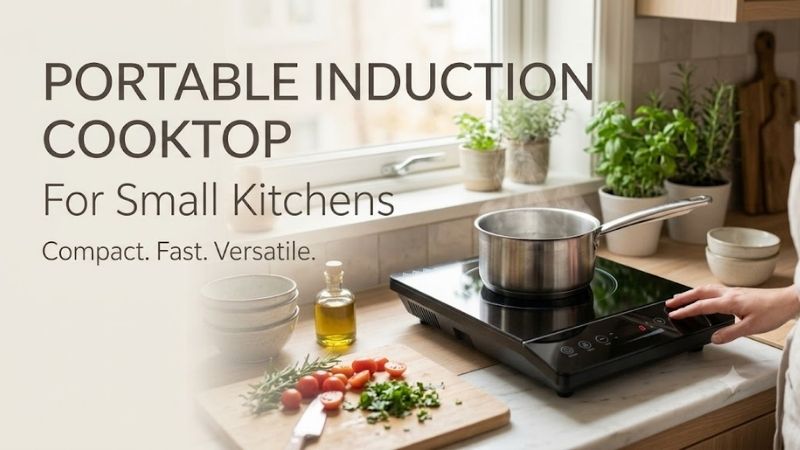
Portable Induction vs. Electric Hot Plates
A traditional electric hot plate heats a burner surface that transfers energy to cookware.
Induction creates heat directly in compatible cookware.
| Feature | Portable Induction Cooktop | Conventional Electric Hot Plate |
|---|---|---|
| Heating method | Electromagnetic induction | Heated electric element |
| Cookware requirement | Magnetic, compatible base | Broader range of suitable cookware |
| Heat adjustment | Can respond rapidly | Often has greater residual burner heat |
| Surface temperature | Can become hot from the pan | Heating element becomes hot |
| Cleaning | Usually smooth glass surface | Depends on element design |
| Fan noise | Common on many models | Not always present |
| Primary limitation | Cookware compatibility | Slower heat response on some designs |
A portable induction unit is appealing when responsive heating and compact operation matter. A conventional hot plate may be more practical when your existing cookware is unsuitable for induction.
Portable vs. Built-In Induction Cooktops
A built-in induction cooktop is installed into a kitchen counter and typically provides multiple cooking zones.
A portable model is designed for placement on a suitable surface and may be stored between uses.
For renters, portable designs can provide flexibility without requiring a permanent installation.
However, portability should not be confused with unrestricted placement. The appliance still requires appropriate ventilation, a stable surface, and a compatible electrical connection.
If you already have a full kitchen range, a portable burner may serve as an occasional additional cooking zone rather than a replacement.
Choosing the Right Size for a Small Kitchen
Measure More Than the Appliance Footprint
Start with the available width and depth of your countertop.
Then consider the dimensions of the cookware you intend to use.
A portable burner may occupy a relatively small area, but a large skillet can extend beyond its housing.
The pan handle may also project into a walkway or neighboring preparation area.
When evaluating the layout, imagine the cooktop with your largest normal pot in place.
You need enough room to stir, lift the lid, and remove hot cookware safely.
Single-Burner vs. Double-Burner Models
Single-burner induction cooktops are generally better suited to very small kitchens.
They can handle many basic meals without requiring a wide countertop.
Double-burner models offer additional flexibility, especially when cooking a main dish and side simultaneously.
However, they occupy more space and may divide available electrical power between their cooking zones.
Some double-burner appliances cannot operate both zones at their individual maximum settings simultaneously.
Check the total electrical rating and power-sharing design before buying.
For a studio apartment or secondary cooking station, a single burner is usually the more space-efficient starting point.
Storage Dimensions and Weight
A portable cooktop may be thin enough for cabinet storage, but the complete housing includes controls, cooling vents, and protective feet.
Measure the space where you plan to store it.
Check the manufacturer’s approved storage orientation.
Avoid placing heavy cookware directly on top of an unprotected glass cooking surface.
If you intend to move the unit daily, consider its weight and whether it has safe handling points.
A slightly larger but easier-to-handle design may be more practical than an extremely thin unit with an awkward shape.
Cookware Compatibility: The Most Important Buying Check
Which Materials Work on Induction?
Induction cookware needs an appropriate ferromagnetic base.
Cast iron, carbon steel, magnetic stainless steel, and some layered cookware are common compatible categories.
However, not every stainless steel pan works.
Aluminum, copper, and glass cookware generally require a specially constructed induction-compatible base.
The full construction matters more than the material used for the cookware’s walls.
A stainless steel saucepan with a suitable magnetic base may work even if other layers contain aluminum.
The Magnet Test
A refrigerator magnet can provide a useful preliminary compatibility check.
Place it against the bottom of a clean, dry pan.
If it sticks firmly, the base may be suitable for induction heating.
However, this does not guarantee that every portable burner will detect the pan.
The magnetic area must also meet the appliance’s size and positioning requirements.
Look for an explicit induction-compatible designation and consult the cooktop’s specifications.
Minimum Pan Diameter
Portable induction cooktops may fail to activate when the magnetic base of a pan is too small.
This is particularly relevant for small butter warmers, espresso preparation vessels, and narrow saucepans.
A pan’s advertised diameter may refer to its upper rim rather than the flat magnetic bottom.
Measure the usable base.
For example, a saucepan described as eight inches wide may have a considerably smaller bottom.
The exact minimum diameter varies by cooktop, so check the manual before purchasing.
Flat Bottoms and Pan Stability
Flat-bottomed cookware is generally preferable for portable induction cooking.
A warped pan may sit unevenly and create stability problems.
Some cookware also produces vibration or buzzing during induction operation.
Noise can depend on the metal layers and power setting.
Do not assume that all compatible cookware performs identically.
If you regularly use heavy cast iron, also verify the cooktop’s supported weight and handling instructions.
Understanding Power Ratings
What Does Wattage Tell You?
Portable induction burners sold for the US market often advertise power ratings in the general range of approximately 1,200 to 1,800 watts.
However, these figures are product-specific.
A higher rating may provide greater heating capability, but actual results depend on cookware, controls, and electrical conditions.
Do not assume that a higher wattage automatically produces better low-temperature cooking.
For small kitchens, controllable power across different tasks is usually more useful than maximum output alone.
Electrical Circuit Requirements
A high-power induction unit can place a substantial load on a household circuit.
For example, an appliance rated at 1,800 watts draws approximately 15 amps at 120 volts under its rated operating conditions.
That is a significant load for a typical 15-amp branch circuit, especially if other appliances share it.
Check the manufacturer’s required circuit, grounding, and outlet instructions.
Avoid extension cords or power strips unless explicitly permitted.
If the appliance requires a particular electrical configuration, do not assume an ordinary kitchen outlet is adequate.
Power Levels vs. Temperature Settings
Some induction cooktops provide power levels, while others also offer temperature selections.
A power setting controls electrical heating behavior.
A temperature setting may attempt to regulate the temperature of the cooking vessel or a measured location, depending on the model.
These are not interchangeable.
A displayed temperature does not necessarily equal the temperature of the food.
For sauces, frying, or delicate cooking, the control system’s real-world behavior matters more than the number of settings listed.
Low-Power Cycling
Many portable induction burners regulate lower heat levels by cycling power on and off.
This can cause visible simmering fluctuations, particularly with small quantities of liquid.
A sauce may alternate between bubbling and settling rather than remaining at one perfectly steady temperature.
Some models provide smoother low-power control than others.
If gentle simmering is central to your cooking, look for credible performance information involving sauces, soups, or low-temperature cooking.
Controls and Everyday Usability
Touch Controls vs. Physical Buttons
Touch-sensitive controls can make the surface easy to wipe.
However, they may be inconvenient when fingers are wet or when cooking splashes reach the control area.
Physical buttons can provide clearer tactile feedback.
Neither design is universally superior.
Choose controls that remain readable and accessible while a pot is centered on the cooking zone.
If the pan handle blocks the display or buttons, everyday operation can become frustrating.
Timer Function
A built-in timer may help coordinate boiling or cooking cycles.
However, different machines use timers differently.
Some shut off heating when the timer expires, while others provide alerts.
Read the manual to understand exactly what happens.
A timer does not eliminate the need to supervise cooking, particularly when using oil or a pan that could boil dry.
Automatic Pan Detection
Many portable induction cooktops detect whether suitable cookware is present.
The machine may stop or refuse to heat if it cannot recognize a pan.
This can be a useful safety feature, but detection sensitivity varies.
Do not treat cookware detection as a substitute for switching the appliance off after use.
Cooling Fans
Portable induction systems contain electronics that require cooling.
A fan may continue operating briefly after heating stops.
This can be normal.
Check the manufacturer’s instructions before disconnecting the appliance immediately after a cooking cycle.
An unusual grinding noise, blocked ventilation, or repeated overheating shutdown deserves attention.
Cooking Performance by Everyday Task
Boiling Water and Cooking Pasta
An induction burner can be useful for boiling water in a compatible saucepan.
However, boiling speed depends on water volume, starting temperature, pan construction, and available power.
A small portable unit may be more than sufficient for preparing pasta for one or two people.
For larger pasta pots, verify both the supported cookware dimensions and the appliance’s weight capacity.
Do not assume a large pot is stable merely because it fits on the cooking circle.
Sautéing Vegetables
Sautéing benefits from responsive heat adjustments.
An induction unit can make it convenient to reduce power when garlic or other ingredients begin to brown.
However, a portable cooktop’s heating area may be smaller than the base of a large skillet.
This can contribute to uneven pan temperature.
Choose cookware that reasonably matches the induction zone.
Avoid overcrowding vegetables, which can increase steaming and reduce browning.
Cooking Eggs
Eggs are useful for evaluating low-to-medium cooking control.
Scrambled eggs and omelets benefit from relatively gentle heat.
If the cooktop cycles aggressively at low settings, it may require additional attention.
A compatible skillet with appropriate thermal characteristics can help moderate temperature changes.
Use a food-safe cooking method and follow appropriate egg-doneness guidance.
Simmering Soup
A compact induction burner can handle small soup portions in a suitable pot.
However, simmering performance varies.
Choose an appliance with well-documented lower power settings if you frequently prepare delicate soups or sauces.
Do not leave the pot unattended.
The burner may stop automatically if it detects abnormal conditions, but this does not make unattended cooking safe.
Searing Meat
Induction can provide substantial heat when paired with suitable cookware.
However, the cooking zone must be appropriate for the pan size.
Use a food thermometer to confirm safe internal temperatures.
A browned exterior does not establish that the center of a thick piece of meat is safely cooked.
Small-Kitchen Use Cases
Studio Apartments
A single-burner induction cooktop may provide useful cooking capability in a small apartment with no permanent stovetop, provided building rules and electrical facilities permit it.
However, it should operate only on an appropriate heat-resistant surface with sufficient ventilation.
Rental Homes
Portable induction can be attractive because it avoids permanent installation.
Still, check rental rules and electrical requirements.
Some properties restrict independent cooking appliances.
Shared Kitchens
A portable burner may serve as a supplementary cooking zone when other burners are occupied.
However, placing it on an overcrowded counter can create burn and spill risks.
RVs and Temporary Kitchens
Use is possible only when the electrical supply and operating environment meet the manufacturer’s requirements.
A compact cooktop can still draw substantial power.
Do not assume ordinary vehicle power outlets or small inverters can support it.
Safety and Maintenance
The Glass Surface Can Become Hot
Induction heats compatible cookware, but the hot pan transfers heat back to the glass.
Residual surface heat can cause burns.
Keep children and pets away and follow any residual-heat indicators.
Avoid Empty-Pan Overheating
Heating an empty pan at high power can create excessive temperatures.
This may damage cookware and the cooktop.
Use the appliance according to its instructions and do not rely solely on automatic overheating protection.
Ventilation and Placement
Keep cooling vents unobstructed.
Never operate a portable induction cooktop on bedding, unstable furniture, or unsuitable surfaces.
Follow clearance requirements.
Cleaning the Cooking Surface
Allow the appliance to cool.
Use the manufacturer’s recommended cleaning method.
Avoid abrasive tools that could scratch the glass.
Pacemakers and Implanted Devices
People with pacemakers or other implanted electronic medical devices should consult their device manufacturer’s guidance and healthcare professional regarding induction cooking equipment.
Do not assume a generic distance recommendation applies to every implant.
Common Buying Mistakes
Buying Without Checking Cookware
An incompatible cookware collection can make the purchase unnecessarily expensive.
Choosing Only by Maximum Wattage
Low-temperature behavior and useful controls often matter just as much.
Ignoring the Minimum Pan Size
Very small saucepans may not activate the burner.
Underestimating Circuit Load
A compact burner can draw substantial electrical power.
Assuming the Surface Never Gets Hot
Cookware can transfer significant heat to the glass.
Buying a Double Burner Without Checking Shared Power
Two cooking zones may have a combined power limit.
Frequently Asked Questions
Is a Portable Induction Cooktop Good for a Small Kitchen?
Yes, it can provide flexible cooking with a relatively compact footprint. However, it requires compatible cookware, appropriate electrical access, and safe ventilation.
Can I Use Regular Stainless Steel Pots?
Only when the cookware has a suitable magnetic base and meets the cooktop’s pan-size requirements.
Is a 1,800-Watt Induction Burner Better Than a 1,200-Watt Model?
Not automatically. Higher rated power may help with demanding heating tasks, but low-temperature control, compatibility, and electrical requirements also matter.
Can I Cook With Cast Iron on a Portable Induction Burner?
Often yes, when the cooktop supports the pan’s size and weight. Lift cast iron carefully rather than dragging it across the glass.
Are Portable Induction Burners Energy Efficient?
Induction can transfer heat efficiently into compatible cookware, but total energy use depends on the cooking task, appliance, cookware, and operating conditions.
Can I Store an Induction Cooktop Vertically?
Only if the manufacturer permits that storage position. Protect the glass and electrical components from impacts.
Conclusion
The best portable induction cooktop for small kitchens combines dependable cookware detection, manageable dimensions, appropriate electrical requirements, and useful heat control. A single-burner model is usually a practical starting point for small households, but compatibility with your existing pans is essential. Measure the full cooking setup, verify minimum cookware dimensions and circuit requirements, and prioritize dependable everyday performance over maximum wattage alone.










Write Your Review
No reviews yet. Be the first to share your experience!