
Quick Verdict: Which Vacuum Sealer Should You Buy?
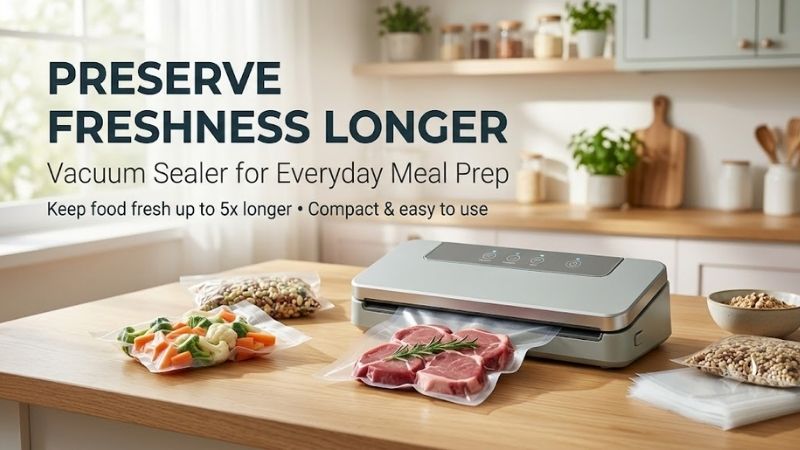
The NESCO Deluxe Vacuum Sealer VS-12 is our best overall choice for households that regularly portion meat, freeze prepared meals, and package food in different quantities.
- Quick Verdict: Which Vacuum Sealer Should You Buy?
- Quick Comparison Table
- How We Selected These Vacuum Sealers
- Detailed Vacuum Sealer Reviews
- Vacuum Sealer Buying Guide: What Should You Look For?
- What Can You Vacuum-Seal?
- Vacuum Sealing and Food Safety: Essential Rules
- Common Vacuum Sealer Problems and How to Fix Them
- Which Vacuum Sealer Is Best for Your Household?
- Frequently Asked Questions
- Conclusion
Its adjustable vacuum pressure, dry and moist sealing settings, double-seal option, and built-in bag storage provide useful flexibility without requiring a commercial vacuum packaging system.
Other options may be better depending on your cooking habits.
-
Best Overall: NESCO Deluxe Vacuum Sealer VS-12 — Adjustable pressure, pulse control, and double sealing for everyday food storage.
-
Best for Moist Foods: Anova Precision Vacuum Sealer Pro — Double sealing and low-pressure suction functionality for challenging ingredients.
-
Best for Beginners: NESCO Food Storage Vacuum Sealer VS-02 — Automatic sealing with convenient bag storage and cutting.
-
Best for Small Kitchens: FoodSaver VS1260 Space Saving Vacuum Sealing System — A compact option for occasional freezer preparation.
-
Best for Versatile Food Storage: FoodSaver VS3130 Premier Multi-Use Vacuum Sealing System — Combines heat sealing with a handheld vacuum accessory.
-
Best for Sous Vide Beginners: Anova Precision Vacuum Sealer — A compact, straightforward machine for sous vide bags and basic food storage.
These selections are based on manufacturer-documented features and practical suitability, not a single program of independent laboratory or hands-on performance tests.
Quick Comparison Table
| Product | Best For | Key Specifications | Main Advantage | Trade-Off |
|---|---|---|---|---|
| NESCO VS-12 | Overall household use | 130W; up to 11.8-inch bags; double seal | Adjustable pressure and sealing options | Requires dedicated storage space |
| Anova Precision Vacuum Sealer Pro | Moist foods and frequent sealing | 110W; 12 L/min advertised extraction; double seal | Moisture-oriented controls and accessory port | Larger than compact models |
| NESCO VS-02 | Beginners | 130W; up to 11.8-inch bags; automatic operation | Simple controls with roll storage | Less precise suction adjustment |
| FoodSaver VS1260 | Limited counter space | Compact external vacuum-sealing system | Space-saving design | Fewer advanced sealing options |
| FoodSaver VS3130 Premier | Multifunction storage | Heat sealing; handheld accessory; pulse mode | Multiple compatible packaging formats | Additional accessory management |
| Anova Precision Vacuum Sealer | Basic sous vide preparation | Automatic sealing; pulse control | Minimalist operation | No integrated bag-roll storage |
The best option is not necessarily the machine with the highest advertised suction specification. Bag compatibility, seal integrity, moisture management, and ease of repeated use are often more important for everyday households.
How We Selected These Vacuum Sealers
We selected six identifiable food vacuum sealers by evaluating published specifications, functional differences, intended food-storage applications, and practical ownership considerations.
Our comparison focuses on features that affect daily preparation and storage rather than unsupported claims about which machine seals fastest or keeps every food fresh for a specific period.
Vacuum and Sealing Controls
Vacuum sealers vary in the amount of control they offer over air extraction.
Basic machines typically use an automatic vacuum-and-seal cycle. More advanced systems may include pulse vacuum, gentle pressure, dry and moist settings, or additional sealing options.
These controls are particularly useful when packaging delicate foods or ingredients containing moisture.
Bag Compatibility
Most external vacuum sealers require compatible textured or embossed bags that allow air to escape through the open end.
We considered supported bag widths, roll storage, integrated cutters, and accessory compatibility.
These details affect convenience and the recurring cost of operating the machine.
Moisture Handling
Juicy foods can present challenges for external vacuum sealers.
Liquid may travel toward the vacuum chamber, interfere with heat sealing, or require additional cleaning.
We considered whether each machine offers settings intended for moist foods or provides more controlled vacuum extraction.
Cleaning and Maintenance
Vacuum packaging can involve raw meat juices, marinades, crumbs, and food particles.
Cleaning access is therefore important.
A removable drip tray, accessible vacuum chamber, replaceable gasket, or straightforward sealing surface can make regular maintenance more practical.
Kitchen Space and Ownership Costs
A larger machine may offer built-in bag storage and advanced controls but require more counter space.
A compact model may be easier to store while offering fewer conveniences.
We also considered the ongoing expense of compatible bags, rolls, and accessories.
Detailed Vacuum Sealer Reviews
1. NESCO Deluxe Vacuum Sealer VS-12 — Best Overall
Best For: Families that regularly buy groceries in bulk, freeze meat, portion leftovers, and prepare food for later cooking.
Why We Picked It: The NESCO VS-12 provides a practical balance of adjustable vacuum settings, multiple sealing options, and integrated bag preparation.
It is more flexible than a basic automatic sealer without requiring the size or expense associated with a chamber vacuum machine.
Key Specifications
| Specification | Details |
|---|---|
| Model | VS-12 / VS-12P |
| Power | 130W |
| Vacuum System | Double vacuum pump |
| Advertised Vacuum Pressure | 25.1 inHg |
| Maximum Bag Width | 11.8 inches |
| Vacuum Pressure Settings | Normal and gentle |
| Sealing Options | Dry, moist, and double |
| Pulse Vacuum | Yes |
| Bag Storage | Built-in |
| Bag Cutter | Built-in |
| Accessory Connection | Canister function |
Features & Benefits
The VS-12 offers two vacuum-pressure settings.
Normal pressure is intended for ordinary food packages, while gentle pressure gives users an option for softer ingredients.
Its pulse vacuum function allows manual control over air extraction, which is useful when full automatic suction could compress delicate items.
The sealing system includes dry, moist, and double settings.
The double-seal function creates an additional sealing band for packages that benefit from a more substantial closure.
A built-in compartment holds compatible bag rolls, while the cutter allows users to prepare bags of different lengths.
Performance & Practical Use
The VS-12 is suitable for portioning chicken, beef, pork, fish, and other ingredients before freezing.
Its variable settings also make it useful for softer foods that require more careful handling.
For example, a household could use normal vacuum pressure for a package of raw meat and a gentler setting when sealing certain baked goods.
The optional double seal is helpful for packaging foods that might stress a single sealing strip.
However, double sealing does not compensate for food debris, liquid, or wrinkles trapped in the sealing area.
For very moist foods, partial freezing may help prevent liquid from entering the vacuum chamber.
The manufacturer’s 25.1 inHg suction specification describes the machine’s advertised vacuum capability. It should not be interpreted as independently measured performance for every bag or food type.
What Makes It Different
The combination of normal and gentle pressure, pulse control, double sealing, and integrated bag storage distinguishes the VS-12 from more basic vacuum sealers.
It is especially useful for households that regularly seal several different categories of food.
Pros
-
Multiple pressure and sealing settings provide flexibility.
-
Double-seal option supports more demanding packaging tasks.
-
Built-in bag storage and cutter simplify preparation.
Cons
-
Larger than compact vacuum sealers.
-
Moist foods still require careful handling.
Buy If: You regularly package a variety of foods and want more control over vacuum pressure and sealing.
Skip If: You only seal a few dry ingredients each month and prefer a smaller appliance.
2. Anova Precision Vacuum Sealer Pro — Best for Moist Foods
Best For: Home cooks who frequently prepare sous vide bags, portion juicy ingredients, or vacuum-seal larger quantities of food.
Why We Picked It: The Anova Precision Vacuum Sealer Pro combines double sealing, lower-pressure suction functionality, an accessory port, and integrated bag-roll storage.
Its design emphasizes convenient repeated sealing and greater flexibility with challenging ingredients.
Key Specifications
| Specification | Details |
|---|---|
| Product | Anova Precision Vacuum Sealer Pro |
| Power | 110W |
| Voltage | 120V |
| Frequency | 60Hz |
| Advertised Extraction Rate | 12 L/min |
| Dimensions | 14.75 × 7 × 4.3 inches |
| Sealing System | Double seal |
| Bag Cutter | Integrated |
| Bag Storage | Integrated |
| Accessory Port | Yes |
| Included Accessory | Vacuum sealer bag roll |
Features & Benefits
The Anova Pro uses a double-sealing system designed to create a secure bag closure.
Its low-pressure suction functionality allows more deliberate handling of foods containing moisture.
The machine also has an accessory port and vacuum hose for use with compatible containers.
This can expand food-storage options beyond standard heat-sealed bags.
Its one-handed locking design is another practical feature, particularly when preparing several packages.
Performance & Practical Use
The Anova Pro is especially suitable for households that use vacuum packaging as part of a regular cooking routine.
For example, a home cook preparing several portions of marinated chicken for later sous vide cooking may benefit from a model designed with moisture handling in mind.
However, the machine should not be treated as a substitute for a chamber vacuum sealer when packaging unrestricted quantities of liquid.
Excess marinade can still create problems if it enters the vacuum channel or contaminates the sealing area.
The advertised 12 L/min extraction rate identifies the manufacturer’s specified air-extraction capacity.
It does not establish a directly comparable real-world sealing speed without consistent testing conditions.
What Makes It Different
Compared with the standard Anova Precision Vacuum Sealer, the Pro includes double sealing, built-in roll storage, a cutter, and additional accessory support.
These differences are useful for frequent food preparation.
Pros
-
Double-sealing system.
-
Built-in roll storage and cutting mechanism.
-
Accessory port supports compatible vacuum containers.
Cons
-
Takes more storage space than Anova’s standard model.
-
Liquid-heavy foods may still require partial freezing or alternative packaging methods.
Buy If: You frequently seal moist ingredients or prepare multiple sous vide portions.
Skip If: You mainly package small quantities of dry food and do not need advanced controls.
3. NESCO Food Storage Vacuum Sealer VS-02 — Best for Beginners
Best For: First-time vacuum sealer buyers who want an uncomplicated machine for freezing groceries and preparing food portions.
Why We Picked It: The NESCO VS-02 offers automatic vacuum sealing, built-in roll storage, a bag cutter, and extended seal-time functionality.
It provides more convenience than the most basic bag-only systems without requiring extensive setting adjustments.
Key Specifications
| Specification | Details |
|---|---|
| Model | VS-02 |
| Power | 130W |
| Maximum Bag Width | 11.8 inches |
| Operation | Automatic vacuum and seal |
| Seal-Only Function | Yes |
| Seal-Time Selection | Normal and extended |
| Bag Storage | Built-in |
| Bag Cutter | Built-in |
| Accessory Connection | Canister function |
| Automatic Shutoff | Yes |
Features & Benefits
The VS-02 provides a one-touch vacuum-and-seal cycle.
This reduces the number of manual steps required to package ordinary foods.
Its seal-only function can be used to close bags without performing a complete vacuum cycle.
The extended sealing option is intended for situations where additional heat-sealing time is appropriate, such as certain moist-food or thicker-bag applications.
Integrated roll storage and a cutter help users prepare custom bag lengths.
Performance & Practical Use
The VS-02 is useful for freezing portions of meat, packaging suitable vegetables, and organizing meal-prep ingredients.
A beginner can prepare a compatible bag, position it in the vacuum chamber, and start the automatic sealing cycle.
The machine removes air and then activates the heat seal.
However, the automatic process requires correct bag placement.
If the bag opening is positioned incorrectly or the sealing area contains food residue, the machine may fail to produce an adequate seal.
The VS-02 does not offer the VS-12’s same range of adjustable vacuum pressure settings, making it less flexible for fragile foods.
What Makes It Different
The VS-02 combines simple automatic operation with features that are useful for regular household food storage.
It is a practical middle ground between minimal compact sealers and more advanced adjustable-pressure systems.
Pros
-
Simple automatic vacuum-and-seal operation.
-
Built-in cutter and bag storage.
-
Extended sealing option for compatible packaging situations.
Cons
-
Fewer suction-control options than the VS-12.
-
Requires substantial storage space compared with minimalist sealers.
Buy If: You want a straightforward machine for occasional or regular freezer preparation.
Skip If: You frequently package delicate foods requiring carefully controlled air extraction.
4. FoodSaver VS1260 Space Saving Vacuum Sealing System — Best for Small Kitchens
Best For: Apartment dwellers, couples, and households that want vacuum sealing without dedicating substantial countertop space to the appliance.
Why We Picked It: The FoodSaver VS1260 emphasizes a compact external vacuum-sealing format.
It is suitable for shoppers who value straightforward food packaging over a large collection of specialized sealing features.
Key Specifications
| Specification | Details |
|---|---|
| Model | VS1260 |
| Product Type | Space Saving Vacuum Sealing System |
| Sealing Method | External vacuum and heat sealing |
| Intended Packaging | Compatible textured vacuum bags |
| Design Priority | Compact storage |
| Primary Uses | Freezer storage and food portioning |
Features & Benefits
The VS1260 is designed for households that want to package food using an external vacuum-sealing process.
The compact configuration makes it easier to accommodate in kitchens where cabinet space is limited.
For ordinary freezer preparation, the machine removes air from a compatible bag before sealing its opening.
This reduces direct air exposure around the food.
Performance & Practical Use
A compact vacuum sealer makes sense for households that purchase groceries in moderate amounts and package only a few portions at a time.
For example, a couple might divide a package of chicken into meal-size portions and freeze them separately.
A smaller machine can perform this basic task without requiring the features of a larger food-preservation system.
However, compact construction generally means fewer built-in conveniences.
Users may need to prepare bags separately and should confirm which bag sizes and accessories are supported.
What Makes It Different
The VS1260 prioritizes storage convenience rather than advanced sealing flexibility.
It is most appropriate for occasional vacuum packaging.
Pros
-
Space-saving design.
-
Suitable for ordinary household freezer preparation.
-
Simpler ownership requirements than multifunction systems.
Cons
-
Does not offer the same feature range as advanced models.
-
Less suitable for frequent high-volume sealing.
Buy If: You have limited kitchen space and only occasionally vacuum-seal food.
Skip If: You regularly package bulk groceries or require specialized sealing controls.
5. FoodSaver VS3130 Premier Multi-Use Vacuum Sealing System — Best for Versatile Food Storage
Best For: Households that want to use conventional vacuum bags alongside compatible reusable storage accessories.
Why We Picked It: The FoodSaver VS3130 combines a countertop heat sealer with handheld vacuum functionality.
This provides more packaging choices than machines designed exclusively for heat-sealed bags.
Key Specifications
| Specification | Details |
|---|---|
| Model | VS3130 |
| Product Series | Premier Multi-Use |
| Sealing System | Heat sealing and handheld vacuum |
| Vacuum Controls | Automatic and pulse |
| Food Settings | Dry and moist |
| Marinate Setting | Yes |
| Bag Roll Storage | Integrated |
| Bag Cutter | Integrated |
| Drip Tray | Removable |
| Accessory Support | Compatible FoodSaver containers and accessories |
Features & Benefits
The VS3130 supports conventional heat-sealed vacuum bags for freezer storage.
Its handheld vacuum functionality can be used with compatible containers and other approved accessories.
This gives households different ways to package food depending on the intended storage method.
The machine also includes a pulse function for more controlled suction and settings intended for moist and dry foods.
Its integrated roll storage and cutter help reduce the effort involved in preparing custom bag sizes.
Performance & Practical Use
The VS3130 is particularly useful for households that want one system for several food-storage routines.
For instance, a family may heat-seal meat portions for freezing while using compatible reusable containers for appropriate refrigerated foods.
The handheld accessory makes this possible without requiring a separate vacuum pump.
However, reusable accessories introduce additional compatibility requirements.
Not every food container, zipper bag, or jar is designed for vacuum sealing.
Only approved accessories should be used.
What Makes It Different
Its combination of heat sealing and handheld vacuum functionality offers more storage flexibility than a traditional bag-only sealer.
Pros
-
Supports multiple compatible storage formats.
-
Pulse, dry, moist, and marinate settings.
-
Built-in bag storage, cutter, and removable drip tray.
Cons
-
More accessories increase storage and maintenance needs.
-
Additional features may be unnecessary for occasional users.
Buy If: You want to vacuum-seal freezer bags and use compatible reusable food-storage containers.
Skip If: You only need a basic heat sealer for occasional freezer portions.
6. Anova Precision Vacuum Sealer — Best for Sous Vide Beginners
Best For: Home cooks who want a compact machine for preparing sous vide bags and packaging ordinary freezer portions.
Why We Picked It: The standard Anova Precision Vacuum Sealer offers automatic sealing and pulse vacuum control in a more minimalist design than the Pro model.
It is suitable for users who do not require integrated bag-roll storage or multiple advanced settings.
Key Specifications
| Specification | Details |
|---|---|
| Product | Anova Precision Vacuum Sealer |
| Sealing Type | External vacuum and heat sealing |
| Operation | Automatic |
| Pulse Control | Yes |
| Format | Compact countertop |
| Compatible Packaging | Appropriate textured vacuum bags |
| Intended Uses | Sous vide preparation and food storage |
Features & Benefits
The automatic vacuum-and-seal function simplifies ordinary packaging tasks.
Pulse vacuum control provides a way to adjust suction manually for foods that may be damaged by excessive compression.
Its compact design is useful for home cooks who prepare only a few bags during each cooking session.
The appliance works with suitable vacuum bags designed for its sealing system.
Performance & Practical Use
For someone beginning sous vide cooking, the standard Anova provides the essential function of removing air from compatible bags and heat-sealing them.
This can help prepare portions of meat, vegetables, and other ingredients for appropriate sous vide recipes.
However, vacuum sealing itself does not cook or pasteurize food.
Safe sous vide cooking still depends on correct time, temperature, food thickness, and handling procedures.
Compared with the Pro model, this version sacrifices conveniences such as built-in roll storage and double sealing.
What Makes It Different
The standard Anova emphasizes compactness and a smaller feature set.
It is suited to shoppers who want basic vacuum sealing rather than a broader food-storage system.
Pros
-
Compact and straightforward design.
-
Automatic sealing with pulse control.
-
Suitable for compatible sous vide packaging.
Cons
-
No integrated bag-roll storage.
-
Fewer advanced sealing functions than the Pro.
Buy If: You are beginning sous vide cooking or need a simple compact vacuum sealer.
Skip If: You regularly seal large food batches or need integrated roll storage and double sealing.
Vacuum Sealer Buying Guide: What Should You Look For?
A vacuum sealer is a food-packaging appliance, but its usefulness depends on more than suction strength.
Understanding bag materials, sealing methods, moisture management, and safe storage practices will help you choose the right machine.
External Vacuum Sealer vs. Chamber Vacuum Sealer
External vacuum sealers remove air through an opening at the top of a compatible bag before heat-sealing it.
They are common in home kitchens because they are relatively compact and work well for many freezer-storage tasks.
Chamber vacuum sealers operate differently.
The entire bag is placed inside a chamber, where the surrounding pressure is reduced before the bag is sealed.
This design is particularly useful for packaging liquids and certain high-moisture foods.
| Feature | External Vacuum Sealer | Chamber Vacuum Sealer |
|---|---|---|
| Everyday freezer portions | Suitable | Suitable |
| Dry foods | Suitable | Suitable |
| Liquid-heavy foods | More challenging | Generally better suited |
| Countertop footprint | Usually smaller | Often larger |
| Bag requirements | Typically textured bags | Often smooth chamber bags |
| Household use | Common | More specialized |
| Initial equipment cost | Generally lower | Generally higher |
For most households, an external vacuum sealer offers a practical balance of functionality and size.
A chamber machine becomes more relevant when packaging liquids is a regular requirement.
Vacuum Pressure and Suction Control
Vacuum pressure describes the degree to which a machine reduces pressure inside the package.
Manufacturers may express specifications using inches of mercury, kilopascals, or other units.
However, higher advertised vacuum pressure does not automatically produce better results with every food.
Strong suction can compress delicate items.
Pulse or gentle vacuum modes help users stop air extraction before fragile foods are damaged.
For ordinary meat portions, automatic suction may be sufficient.
For bread, pastries, and other delicate foods, more precise control can be useful.
Single vs. Double Heat Sealing
A vacuum sealer must form a reliable closure after air extraction.
Some machines create a single sealing band.
Others provide a double-seal setting.
A double seal can add a second line of closure, which may be useful when packaging foods that put additional demands on the bag.
However, seal integrity also depends on bag material, heating conditions, correct positioning, and the absence of contamination.
A double seal cannot guarantee that a poorly prepared bag will remain airtight.
Bag Width and Food Portion Size
Bag compatibility is one of the most important purchasing considerations.
Many external vacuum sealers support bag widths around 11 inches, although exact limits vary.
Wide bags are useful for larger food portions.
Narrow bags may reduce packaging material waste when sealing small servings.
Before buying, check whether the sealer supports the sizes you expect to use.
Also consider the length of the sealing strip and the workspace needed to position filled bags.
Bag Rolls vs. Precut Bags
Precut bags are convenient because they require less preparation.
However, fixed bag sizes may waste material when packaging small foods.
Bag rolls allow users to cut a length appropriate for the contents.
An integrated cutter makes this process easier, especially when preparing many packages.
Households that seal food frequently may benefit from built-in roll storage.
For occasional users, separate rolls and a simple cutter may be sufficient.
Bag Materials and Compatibility
Not every plastic bag is compatible with vacuum sealing.
Many external vacuum sealers rely on embossed or textured bags that allow air to move toward the vacuum channel.
Smooth bags may prevent the machine from removing air effectively.
Heat-sealing compatibility also matters.
A bag designed for ordinary refrigerator storage is not necessarily appropriate for vacuum heat sealing or sous vide cooking.
Always verify the bag’s intended use.
Moist and Dry Food Settings
Dry foods typically present fewer challenges during external vacuum sealing.
Moist foods can release liquid while air is being removed.
This liquid may reach the sealing area or vacuum channel.
Machines with moist-food settings may adjust sealing behavior to accommodate these conditions.
Pulse vacuum and lower-pressure modes can also improve control.
However, these features do not make every external vacuum sealer suitable for sealing unrestricted liquids.
For soup, sauce, or liquid-heavy marinades, consider freezing the contents before sealing or using an appropriate chamber vacuum system.
Built-In Bag Storage and Cutters
Integrated roll storage can make food preparation more convenient.
Instead of finding a separate roll, users can pull material directly from the appliance and cut a suitable bag length.
This is especially useful when sealing several portions in one session.
However, integrated storage adds to the appliance’s physical size.
A household with limited space may prefer a compact machine and separate bag supplies.
Handheld Vacuum Accessories
Some systems support handheld vacuum attachments for compatible containers and reusable bags.
These accessories can be useful for certain short-term storage tasks.
However, compatibility is specific to the manufacturer’s system.
Do not assume that ordinary plastic containers or Mason jars can safely hold a vacuum simply because their lids appear airtight.
Vacuum sealing standard jars is also not equivalent to tested home-canning methods.
Cleaning and Maintenance
A vacuum sealer can accumulate moisture, crumbs, oil, and food residue.
These contaminants may interfere with sealing.
After use, inspect the vacuum channel and sealing area.
Clean approved removable components according to the manual.
Avoid abrasive tools that could damage the heating strip or sealing gasket.
Allow cleaned components to dry before operating the machine.
Operating Costs
Vacuum sealing involves recurring packaging expenses.
The total cost depends on how frequently you use the machine and which bags or accessories it requires.
Consider the following:
-
Price of compatible bag rolls.
-
Cost of precut bags.
-
Availability of replacement gaskets.
-
Replacement accessory costs.
-
Whether compatible third-party bags are permitted.
-
Amount of material wasted during bag preparation.
A low initial purchase price does not necessarily mean low long-term ownership costs.
What Can You Vacuum-Seal?
Vacuum sealing is useful for many foods, but suitable storage conditions differ.
Raw Meat and Poultry
Vacuum sealing can help reduce air exposure around meat before freezing.
Divide purchases into meal-size portions and label each package with its contents and packaging date.
Raw meat and poultry still require appropriate refrigeration or freezing.
Use clean equipment and avoid cross-contamination.
Fish and Seafood
Fish and seafood can be packaged for frozen storage using suitable bags.
However, vacuum-packed fish requires particular attention to safe storage and thawing because reduced-oxygen packaging can create specific food-safety risks.
Follow food-specific handling instructions and applicable thawing guidance rather than assuming vacuum packaging makes seafood safe at room temperature.
Vegetables
Some vegetables can be vacuum-sealed for freezing.
Depending on the vegetable, blanching before freezing may help maintain color, texture, and quality.
Not every fresh vegetable is suitable for extended refrigerated vacuum storage without additional preparation.
Moisture, respiration, and microbial conditions vary among vegetables.
Cooked Meals
Vacuum sealing can help portion suitable cooked meals for freezer storage.
Cool cooked foods rapidly and safely before packaging.
Do not leave cooked meals at room temperature for extended periods while waiting to vacuum-seal them.
Dry Foods
Suitable grains, certain dry beans, and other dry foods may be packaged to reduce air exposure.
However, storage requirements depend on the food’s moisture content and susceptibility to spoilage.
Vacuum sealing does not sterilize dry foods or eliminate all storage risks.
Sous Vide Ingredients
Vacuum packaging is commonly used for sous vide preparation.
Compatible bags help maintain food contact with the water bath while keeping water out of the package.
However, correct cooking temperatures, cooking times, and handling procedures remain essential.
Vacuum Sealing and Food Safety: Essential Rules
Vacuum sealing can support food quality, but it does not make food sterile.
Removing oxygen does not eliminate pathogenic microorganisms.
Certain microorganisms can grow under reduced-oxygen conditions, making proper temperature control especially important.
Refrigeration and Freezing Are Still Required
Raw meat, poultry, seafood, and cooked perishable foods must be refrigerated or frozen according to appropriate food-safety guidance.
Vacuum-sealed perishable food should not be stored at room temperature merely because the bag appears airtight.
Do Not Assume a Universal Storage-Life Extension
Storage-life claims vary by food, packaging method, and storage conditions.
Vacuum sealing may help reduce freezer burn and oxidation, but it does not guarantee a fixed safe storage period for all foods.
Food safety and food quality are different considerations.
A food may retain desirable appearance while still being unsafe if mishandled.
Avoid Cross-Contamination
Use clean hands, utensils, and preparation surfaces.
Keep raw animal products separate from ready-to-eat foods.
Wash and sanitize food-contact surfaces as appropriate after handling raw meat.
Handle Vacuum-Sealed Fish Carefully
Reduced-oxygen packaging of fish can present risks involving Clostridium botulinum under certain conditions.
Follow the product’s thawing instructions.
When recommended, remove fish from its vacuum packaging before refrigerator thawing.
Use Food-Safe Bags for Sous Vide
Vacuum bags should be approved for their intended cooking temperature and duration.
Do not assume that every storage bag is suitable for heating.
Use appropriate food-temperature guidance and validated sous vide recipes.
Common Vacuum Sealer Problems and How to Fix Them
1. The Machine Does Not Remove Enough Air
Possible causes include incorrect bag placement, unsuitable bag material, food blocking the opening, or a damaged gasket.
Check that the bag is positioned correctly in the vacuum channel.
Confirm that the bag material is compatible with the sealer.
Inspect the sealing gasket for damage or residue.
2. The Bag Loses Its Seal After Freezing
A weak seal may result from moisture, wrinkles, food particles, or an incomplete heating cycle.
Before sealing, keep the opening clean and flat.
Avoid overfilling.
Allow enough extra bag length for correct positioning.
If the machine provides an extended or double-seal setting, use it according to the manual.
3. Liquid Gets Pulled Into the Machine
Moist ingredients can release liquid during suction.
Stop the cycle as instructed by the manufacturer.
Disconnect the machine before cleaning affected components.
For future use, chill or partially freeze suitable foods before sealing.
4. Soft Foods Become Crushed
Automatic suction may compress bread, pastries, and other delicate foods.
Use pulse or gentle vacuum settings if available.
Alternatively, consider an approved rigid vacuum container.
5. The Heat Seal Does Not Form Correctly
A heat seal can fail if the bag is wet, wrinkled, improperly positioned, or made from unsuitable material.
The machine may also require cooling between repeated sealing cycles.
Follow the manufacturer’s operating instructions and inspect the sealing element.
6. The Machine Stops During Repeated Sealing
Some vacuum sealers have operating limits that require brief cooling periods.
Repeated sealing without adequate cooling may interfere with operation or activate overheating protection.
Follow the manufacturer’s recommended operating cycle.
Do not force the appliance to continue running when it indicates a fault or cooling requirement.
Which Vacuum Sealer Is Best for Your Household?
For Families Buying Groceries in Bulk
The NESCO VS-12 is the strongest all-around recommendation in this comparison.
Its adjustable suction, double seal, and integrated roll cutter are practical when portioning several types of food.
For Frequent Sous Vide Cooking
The Anova Precision Vacuum Sealer Pro is well suited to cooks who regularly prepare multiple vacuum bags.
Its moisture-oriented controls and double-sealing system offer useful flexibility.
For Beginners
The NESCO VS-02 offers a manageable introduction to food vacuum sealing.
Its automatic operation makes ordinary freezer packaging relatively straightforward.
For Small Apartments
The FoodSaver VS1260 is worth considering when limited storage space is a major constraint.
It emphasizes essential sealing rather than a broad feature set.
For Reusable Storage Accessories
The FoodSaver VS3130 provides more flexibility through its compatible handheld vacuum system.
This can be helpful for households that want more than traditional heat-sealed freezer bags.
For Occasional Sous Vide Preparation
The standard Anova Precision Vacuum Sealer is appropriate when a compact appliance and basic sealing functions are sufficient.
There is little reason to pay for additional bag storage and accessory features if you will rarely use them.
Frequently Asked Questions
Is a vacuum sealer worth buying for home use?
A vacuum sealer can be worthwhile for households that regularly freeze groceries, portion meat, prepare meals in advance, or cook sous vide.
Its practical value comes from more organized packaging and reduced air exposure.
However, people who rarely freeze food may find that ordinary freezer-safe containers and bags are sufficient.
Does vacuum sealing prevent freezer burn?
Vacuum sealing can help reduce freezer burn by minimizing air exposure and associated moisture loss.
However, it does not eliminate the possibility entirely.
Poor seals, damaged bags, unsuitable packaging, and prolonged storage can still affect frozen food quality.
Can you vacuum-seal liquids?
Some vacuum sealers can handle small amounts of moisture, but external vacuum machines are generally less suitable for unrestricted liquids.
For soups, sauces, or marinades, partially freezing the contents before sealing may help.
Chamber vacuum sealers are generally better suited to liquid packaging.
How long does vacuum-sealed food last?
There is no universal storage period for vacuum-sealed food.
Safe storage depends on the food type, initial condition, packaging, storage temperature, and handling practices.
Vacuum sealing does not replace appropriate refrigeration or freezing.
Are all vacuum sealer bags interchangeable?
No.
Many external vacuum sealers require textured bags that allow air extraction.
Bag width, thickness, heat-sealing properties, and food-contact suitability also matter.
Use bags approved for the exact appliance and intended storage method.
Can you reuse vacuum sealer bags?
Some bags are intended for limited reuse, but suitability depends on the manufacturer and what was previously stored inside.
Do not reuse disposable bags that contained raw meat, poultry, seafood, or other foods presenting significant contamination concerns unless the manufacturer provides an explicitly validated reuse procedure.
Do vacuum sealers work for sous vide cooking?
Yes, many external vacuum sealers can prepare compatible bags for sous vide cooking.
However, the bags must be approved for the cooking conditions.
Safe sous vide preparation also requires correct temperature, duration, ingredient thickness, and handling procedures.
Conclusion
The NESCO Deluxe Vacuum Sealer VS-12 is the best overall vacuum sealer in this comparison for households seeking adjustable suction, double sealing, and convenient bag preparation. Choose the Anova Precision Vacuum Sealer Pro for frequent sealing and moist-food handling, the NESCO VS-02 for basic use, the FoodSaver VS1260 for smaller kitchens, the VS3130 for compatible storage accessories, or the standard Anova Precision Vacuum Sealer for simple sous vide preparation. Prioritize reliable bag compatibility, cleaning convenience, and proper food-storage practices over marketing claims about extended freshness.







Write Your Review
No reviews yet. Be the first to share your experience!