
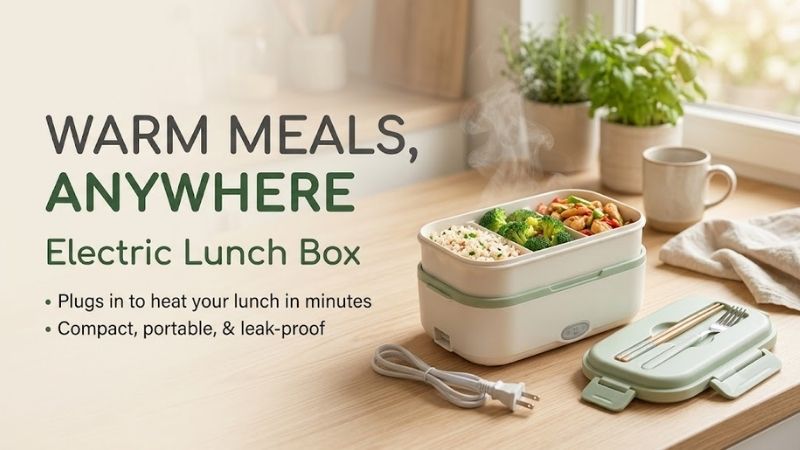
An electric lunch box lets you warm packed meals without relying on a shared office microwave. Depending on the design, it may use a wall outlet, vehicle power, or an internal battery. The best electric lunch box should match your meal size, available power source, warming needs, and cleaning routine. This guide compares six options for commuting, office lunches, and portable meal preparation.
Quick Verdict: Which Electric Lunch Box Should You Buy?
The Crock-Pot Lunch Crock Food Warmer is our best overall recommendation for office workers who want a simple way to warm previously cooked meals.
Its removable 20-ounce food container, detachable cord, and compact carrying design make it practical for individual lunches.
However, people who cannot access an electrical outlet may benefit more from a battery-powered model.
-
Best Overall: Crock-Pot Lunch Crock Food Warmer — A compact warmer for soups, leftovers, and individual meals.
-
Best for Cordless Heating: HeatsBox GO 2.0 — Rechargeable lunch box that warms food without an outlet during use.
-
Best for Cooking Lunch: Magic Itaki Pro Electric Lunch Box — A portable steaming system that can prepare suitable meals from ingredients.
-
Best for Passive Warming Convenience: HOTLOGIC Mini Portable Oven — An insulated warming system designed for compatible food containers.
-
Best for Larger Portable Meals: Crock-Pot GO Electric Lunch Box — A larger portable food warmer with a removable container.
-
Best for Scheduled Meals: LunchEAZE Cordless Heated Lunch Box — Battery-powered food warming with programmable heating functionality.
Quick Verdict: Which Electric Lunch Box Should You Buy?
Quick Comparison Table
| Product | Best For | Key Specifications | Main Advantage | Trade-Off |
|---|---|---|---|---|
| Crock-Pot Lunch Crock | Office lunches | 20 oz.; removable container; detachable cord | Compact and straightforward | Needs an outlet |
| HeatsBox GO 2.0 | Cordless meals | Rechargeable battery; app controls | Can heat without an external power source | Battery charging required |
| Magic Itaki Pro | Cooking lunch | 1.1–1.7L configuration; 110V-compatible version | Can steam suitable foods | Requires water and cooking preparation |
| HOTLOGIC Mini | Prepared meals | Insulated electric warming system | Works with compatible food containers | Requires advance heating time |
| Crock-Pot GO | Larger lunches | Portable electric food warmer; removable container | Suitable for larger individual meals | More space than compact warmers |
| LunchEAZE Cordless | Scheduled warming | Rechargeable heating; programmable operation | Useful without access to an outlet | Battery capacity limits operation |
How We Selected These Electric Lunch Boxes
We compared food capacity, power sources, heating mechanisms, portability, cleaning requirements, and the distinction between warming previously cooked food and cooking food from raw ingredients.
This distinction is essential.
Some electric lunch boxes function primarily as food warmers. Others are designed to cook suitable ingredients using steam.
A warming-only appliance should not be treated as a substitute for a cooker approved to prepare raw meat, poultry, or other foods requiring precise cooking.
We also considered food safety, leak resistance, electrical compatibility, and whether an appliance can be used away from a wall outlet.
Detailed Electric Lunch Box Reviews
1. Crock-Pot Lunch Crock Food Warmer — Best Overall
Best For: Office workers, students with permitted electrical access, and commuters who want to warm previously cooked lunches.
Why We Picked It: The Lunch Crock combines a removable food container with a compact heating base and detachable cord.
It is particularly appropriate for soup, chili, oatmeal, and similar prepared foods.
Key Specifications
| Specification | Details |
|---|---|
| Model | CPSCLC20 series |
| Food Capacity | 20 ounces |
| Weight | Approximately 1.7 pounds |
| Power Source | Electrical outlet |
| Heating | Electric warming base |
| Inner Container | Removable |
| Inner Lid | Removable |
| Cleaning | Dishwasher-safe food container and inner lid |
| Cord | Detachable |
| Carrying | Integrated handle |
Features & Benefits
The removable inner container allows users to prepare and transport food separately from the heating base.
A tight-fitting storage lid helps reduce spills during normal transport.
The detachable cord makes it easier to pack the warmer after use.
The inner container and lid can be cleaned in a dishwasher according to the manufacturer.
Performance & Practical Use
The Lunch Crock is particularly useful for previously cooked meals.
For example, a worker could pack leftover chili and warm it before lunch rather than waiting for a communal microwave.
However, its primary purpose is warming, not cooking raw ingredients.
Actual heating time varies with food quantity, initial temperature, and consistency.
Thick soups and dense meals may warm less evenly than thin liquids, so stirring when appropriate can help.
Check reheated leftovers with a food thermometer and bring them to the appropriate safe reheating temperature, generally 165°F.
What Makes It Different
The 20-ounce removable container and uncomplicated heating base make it convenient for single-serving office meals.
Pros
-
Compact individual portion size.
-
Removable dishwasher-safe inner container.
-
Detachable cord simplifies transport.
Cons
-
Requires access to electrical power.
-
Not intended as a general-purpose raw-food cooker.
Buy If: You primarily want to warm leftovers at work.
Skip If: You need fully cordless heating or plan to cook raw ingredients.
2. HeatsBox GO 2.0 — Best for Cordless Heating
Best For: Workers, travelers, and outdoor users who need to heat meals without connecting the lunch box to an outlet during use.
Why We Picked It: The HeatsBox GO 2.0 uses a rechargeable battery and an integrated heating system.
Its cordless design provides flexibility in locations where microwaves and electrical outlets are unavailable.
Key Specifications
| Specification | Details |
|---|---|
| Product | HeatsBox GO 2.0 |
| Power | Rechargeable lithium-ion battery |
| Charging | USB-C-compatible charging system |
| Heating | Integrated multi-sided heating |
| Temperature Control | Up to 185°F |
| Operation | On-device and compatible app |
| Food Container | Removable |
| Heating Time | Manufacturer advertises approximately 15–25 minutes under suitable conditions |
Features & Benefits
The integrated battery allows the lunch box to operate without a power cable while warming food.
The app provides additional control and scheduling functions.
Its removable food container simplifies filling and cleaning.
This design is useful for people whose workday includes driving, outdoor activities, or locations without reliable electrical access.
Performance & Practical Use
A cordless lunch box offers more flexibility than an outlet-powered warmer.
However, heating duration depends on battery charge, food quantity, initial food temperature, and ambient conditions.
The advertised heating time should not be treated as a guarantee for every meal.
Users must charge the battery in advance.
Dense foods may also require stirring or repositioning, according to manufacturer instructions, to promote even heating.
What Makes It Different
The built-in battery is the key advantage.
Unlike a traditional electric food warmer, the GO 2.0 does not require access to external power during a heating session.
Pros
-
Cordless heating.
-
Rechargeable battery.
-
App-supported controls and scheduling.
Cons
-
Requires charging before use.
-
Heating capacity is limited by battery energy.
Buy If: You frequently eat lunch where electrical outlets are unavailable.
Skip If: You always have access to a microwave or wall outlet and want a simpler product.
3. Magic Itaki Pro Electric Lunch Box — Best for Cooking Lunch
Best For: People who want to prepare suitable steamed meals rather than merely warming leftovers.
Why We Picked It: The Magic Itaki Pro uses a portable steaming system with food containers designed for preparing appropriate ingredients.
Key Specifications
| Specification | Details |
|---|---|
| Product | Magic Itaki Pro |
| Capacity | Approximately 1.1–1.7 liters, depending on configuration |
| Food Containers | Stainless steel |
| Exterior Components | Food-grade plastic |
| Cooking Method | Electric steam |
| Electrical Versions | Manufacturer offers 110V and 220V-compatible configurations |
| Cooking System | Stackable food containers |
| Accessories | Measuring cup and cooking containers |
Features & Benefits
The Magic Itaki Pro differs from warming-only lunch boxes because it can prepare suitable foods using steam.
Its stackable containers allow different ingredients to be organized into separate sections.
The heating system generates steam using the amount of water specified for the recipe.
This provides a way to prepare certain meals without a conventional stove.
Performance & Practical Use
The Itaki Pro may suit office workers who want to prepare rice, vegetables, and suitable steamed dishes.
However, cooking raw food requires greater care than warming fully cooked leftovers.
Follow the manufacturer’s ingredient quantities and validated cooking instructions.
Raw meat and poultry must reach appropriate safe internal temperatures.
Do not assume the appliance’s automatic shutoff independently verifies food doneness.
The appliance also requires a suitable power supply and access to water for its steaming mechanism.
What Makes It Different
Its ability to cook compatible ingredients distinguishes it from ordinary electric lunch warmers.
Pros
-
Can cook suitable meals using steam.
-
Stackable food containers.
-
More flexible food preparation than warming-only designs.
Cons
-
Requires preparation and measured water.
-
Raw-food cooking requires careful temperature verification.
Buy If: You want a portable appliance capable of preparing suitable steamed meals.
Skip If: You only need to reheat leftovers quickly.
4. HOTLOGIC Mini Portable Oven — Best for Prepared Meals
Best For: Workers who want to warm packaged meals using an insulated electric heating system.
Why We Picked It: The HOTLOGIC Mini uses a heated base inside an insulated carrying case.
It is designed to warm food in compatible containers rather than requiring every meal to be transferred into one proprietary bowl.
Key Specifications
-
Product: HOTLOGIC Mini Portable Oven
-
Heating Method: Electric heating plate
-
Housing: Insulated soft-sided enclosure
-
Food Container: Compatible flat-bottom containers
-
Power Source: Electrical outlet in the appropriate model
-
Primary Use: Warming suitable prepared meals
Features & Benefits
The insulated exterior helps retain heat around the food container.
The heating element warms food placed in approved cookware.
This makes the appliance particularly relevant to people who prefer carrying lunch in familiar containers.
Performance & Practical Use
The HOTLOGIC Mini is suited to warming previously cooked meals.
It may be useful for casseroles, rice dishes, and other prepared foods contained in appropriate cookware.
However, food container compatibility matters.
Use only materials, shapes, and sizes approved for the product.
The insulated design does not eliminate food-safety requirements.
Perishable food must be kept appropriately chilled before reheating, and leftovers should reach the proper safe internal temperature.
What Makes It Different
Its heated carrying-case design allows compatible food containers to be used rather than relying entirely on one integrated lunch bowl.
Pros
-
Insulated carrying format.
-
Supports approved separate food containers.
-
Convenient for prepared meals.
Cons
-
Outlet-powered models need electrical access.
-
Container compatibility requires attention.
Buy If: You prefer warming meals in suitable containers you already use.
Skip If: You need battery-powered heating or a compact rigid lunch container.
5. Crock-Pot GO Electric Lunch Box — Best for Larger Portable Meals
Best For: Adults who want a more substantial individual lunch-warming system.
Why We Picked It: The Crock-Pot GO is designed as a portable electric lunch box for taking prepared meals away from home.
It provides an alternative to the smaller Lunch Crock format.
Key Specifications
| Specification | Details |
|---|---|
| Product | Crock-Pot GO Electric Lunch Box |
| Appliance Type | Portable electric food warmer |
| Food Storage | Removable container |
| Power Source | Electrical |
| Design | Portable lunch box |
| Intended Use | Heating previously cooked meals |
Features & Benefits
The GO design is intended for taking prepared meals to work or other locations with compatible electrical access.
Its removable food container separates food handling from the heating base.
This helps simplify filling and cleanup.
Performance & Practical Use
The GO may be appropriate for rice bowls, pasta, stews, and other prepared lunches.
However, its usefulness depends on portion size and whether the user can access electrical power.
Like the Lunch Crock, it should not be assumed to cook raw ingredients safely unless the exact model’s instructions authorize that use.
What Makes It Different
Its larger portable-lunch orientation distinguishes it from the compact Lunch Crock.
Pros
-
Designed for portable meal warming.
-
Removable food container.
-
Useful for individual prepared meals.
Cons
-
Requires suitable electrical power.
-
Larger than compact single-serving warmers.
Buy If: You want a portable electric warmer for larger individual lunches.
Skip If: You prefer a small 20-ounce warmer or need cordless heating.
6. LunchEAZE Cordless Heated Lunch Box — Best for Scheduled Meals
Best For: Workers who want a rechargeable lunch warmer with scheduled heating functionality.
Why We Picked It: LunchEAZE focuses on battery-powered meal warming with programmable operation.
This is useful for people whose lunch breaks occur at relatively predictable times.
Key Specifications
-
Product: LunchEAZE Cordless Heated Lunch Box
-
Power: Rechargeable battery
-
Heating: Integrated electrical heating system
-
Scheduling: Programmable heating
-
Food Container: Removable
-
Primary Use: Heating packed meals without continuous outlet access
Features & Benefits
The rechargeable battery allows heating without keeping the appliance connected to a wall outlet.
Programmable operation can help coordinate meal warming with a planned lunch break.
The removable food container supports packing and cleaning.
Performance & Practical Use
This type of lunch box is appealing to workers whose breaks are scheduled and who may not have time to begin warming food manually.
However, scheduling creates additional food-safety considerations.
Perishable food must remain safely chilled until heating begins.
A programmed start time does not make it safe to leave perishable food unrefrigerated for hours.
Battery charge and initial food temperature also influence how long the appliance takes to warm a meal.
What Makes It Different
Scheduled battery-powered warming is its main practical advantage.
Pros
-
Cordless operation.
-
Programmable heating.
-
Removable food container.
Cons
-
Requires battery maintenance.
-
Scheduled heating does not replace safe cold storage.
Buy If: You have predictable lunch times and need cordless warming.
Skip If: You prefer immediate manual operation or have reliable access to a microwave.
Electric Lunch Box Buying Guide
Warming vs. Cooking
The first decision is whether you need to reheat prepared food or cook ingredients.
Most electric lunch boxes are designed primarily for warming.
Some specialized devices, such as steam-based portable cookers, can prepare compatible recipes from raw ingredients.
Do not assume these functions are interchangeable.
A warming-only appliance may be unsuitable for cooking raw chicken, beef, or other foods requiring controlled internal temperatures.
Choose the Right Capacity
An electric lunch box should hold your normal meal without excessive empty space.
| Lunch Type | Practical Capacity Consideration |
|---|---|
| Small soup or oatmeal serving | Approximately 20 ounces |
| Standard individual meal | Medium removable food container |
| Large rice or pasta meal | Larger single-meal container |
| Multiple dishes | Divided or stackable containers |
Capacity alone does not indicate whether a lunch box can safely handle thick or dense foods.
Heating performance also depends on food arrangement.
Plug-In vs. Battery-Powered Models
Plug-in electric lunch boxes generally require a suitable power outlet during warming.
Battery-powered designs offer more flexibility but must be charged in advance.
If you work at a desk, an outlet-powered model may be sufficient.
For construction sites, outdoor work, or travel, a cordless design may be more practical.
Car Power Compatibility
Some heated lunch boxes are designed for vehicle outlets.
However, do not assume that every portable warmer can operate from a standard 12V vehicle socket.
Check the required input voltage, wattage, plug type, and vehicle electrical limits.
A household 120V appliance must not be connected directly to a 12V outlet without an appropriate approved power system.
Stainless Steel vs. Plastic Containers
Many lunch warmers use removable stainless steel containers.
Stainless steel is durable and useful for food contact when properly manufactured.
Some products use approved food-grade plastic.
Cleaning instructions vary.
Do not assume every container is dishwasher-safe or microwave-safe.
Leak Resistance
A tight-fitting lid is important for transporting soup, stew, or saucy meals.
However, a lid described as leak-resistant may not be suitable for transporting completely liquid-filled containers upside down.
Keep food containers upright where instructed.
Do not heat the appliance with an airtight transport lid in place unless the manufacturer specifically permits it.
Cleaning Requirements
Removable containers make cleaning more convenient.
Some inner bowls and lids are dishwasher-safe, while heating bases usually require wiping.
Always unplug or switch off the appliance before cleaning.
Avoid exposing electrical connectors and batteries to water.
Safe Food Temperatures
Perishable packed meals must be kept at safe temperatures.
If cold storage is required, keep food refrigerated at 40°F or below until heating.
Reheated leftovers should generally reach 165°F internally.
If hot holding is necessary, maintain 140°F or above.
Use a food thermometer rather than assuming that a warm outer container means the center of the food is adequately heated.
Common Electric Lunch Box Problems
Food Is Warm Outside but Cold in the Center
Dense meals may heat unevenly.
Stir suitable foods according to the manufacturer’s instructions and check internal temperature.
Heating Takes Longer Than Expected
Initial food temperature, portion size, battery charge, and food composition affect heating duration.
A refrigerated solid meal may require different conditions from a small serving of soup.
Condensation Collects Inside
Moisture may accumulate during heating.
Follow the instructions for venting and lid placement.
Do not block designated steam outlets.
The Battery Does Not Last
Battery capacity changes with charge level, operating conditions, and age.
Charge fully according to instructions and avoid assuming every meal can be heated for the same duration.
The Container Leaks During Transport
Check the lid seal and avoid overfilling.
Inspect gaskets for damage and keep the lunch box in the recommended orientation.
Frequently Asked Questions
Are electric lunch boxes worth buying?
They can be useful for people who do not have convenient access to a microwave. They are less necessary when a safe, reliable microwave or kitchen is already available.
How long does an electric lunch box take to heat food?
Heating time varies by model, food quantity, initial temperature, and power source. Follow the appliance instructions and verify safe reheating temperatures.
Can you cook raw food in an electric lunch box?
Only in models specifically designed for cooking, using manufacturer-approved recipes and validated food-safety procedures. Many lunch boxes are warmers, not cookers.
Can you leave an electric lunch box plugged in all day?
Do not assume continuous unattended operation is safe. Follow the exact model’s instructions and maintain safe food temperatures.
Are electric lunch boxes safe for cars?
Only when the appliance is approved for the vehicle power system being used. Avoid operating or handling hot food while driving.
Can electric lunch boxes go in the dishwasher?
Some removable inner containers and lids are dishwasher-safe. Heating bases, batteries, and electrical components are not generally dishwasher-safe.
Conclusion
The Crock-Pot Lunch Crock Food Warmer is the best overall electric lunch box in this comparison for warming ordinary office lunches. Choose the HeatsBox GO 2.0 or LunchEAZE for cordless operation, Magic Itaki Pro for compatible steam-cooked meals, HOTLOGIC Mini for container-based warming, or Crock-Pot GO for larger portable lunches. Prioritize safe food handling, power compatibility, and practical meal capacity before convenience features.






Write Your Review
No reviews yet. Be the first to share your experience!