
An electric pressure cooker for home baristas may sound like a convenient way to combine coffee preparation and kitchen cooking, but the two activities require very different equipment. A food pressure cooker cannot replace an espresso machine. This guide explains the differences, which cooking functions may complement a home coffee station, and how to choose an appliance without compromising safety or brewing quality.
- Quick Verdict: Do Home Baristas Need an Electric Pressure Cooker?
- Understanding Pressure Cooking vs. Espresso Brewing
- When an Electric Pressure Cooker Makes Sense for a Coffee Enthusiast
- Choosing an Electric Pressure Cooker for a Small Coffee Station
- Pressure Cooker Safety Features That Matter
- Electric Pressure Cooker vs. Other Coffee-Station Appliances
- Cleaning and Maintenance
- Common Buying Mistakes
- Frequently Asked Questions
- Conclusion
Quick Verdict: Do Home Baristas Need an Electric Pressure Cooker?
An electric food pressure cooker is not an appropriate appliance for brewing espresso. Its pressure and heating systems are designed to cook food inside a sealed vessel, not push precisely controlled hot water through ground coffee.
For someone building a home coffee setup, a dedicated espresso machine, coffee brewer, or kettle should take priority.
An electric pressure cooker can still be useful in a coffee enthusiast’s kitchen for preparing breakfast, batch-cooking ingredients, or making desserts to accompany coffee.
| Home Barista Task | Appropriate Equipment | Role of Electric Pressure Cooker |
|---|---|---|
| Brewing espresso | Espresso machine | Not suitable |
| Making pour-over coffee | Pour-over brewer and kettle | Not suitable |
| Heating water for coffee | Suitable electric kettle | Not recommended as a substitute |
| Steaming milk | Espresso steam wand or approved milk steamer | Not suitable |
| Preparing breakfast | Appropriate cooking appliance | Potentially useful |
| Preparing selected desserts | Oven or approved cooking appliance | Useful for compatible recipes |
| Making yogurt | Yogurt maker or multicooker with approved program | Possible on supported models |
If your primary goal is better coffee, buy coffee-specific equipment. Consider an electric pressure cooker only when you also need its food preparation capabilities.
Understanding Pressure Cooking vs. Espresso Brewing
How Does an Electric Pressure Cooker Work?
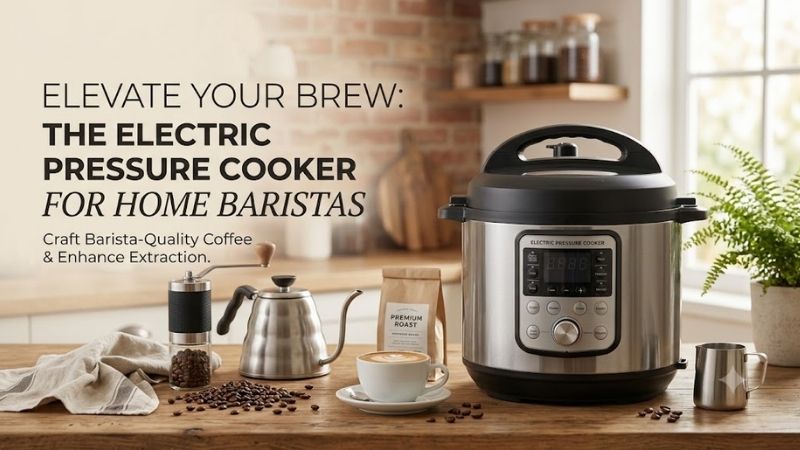
An electric pressure cooker heats water and food inside a sealed cooking vessel.
As the liquid produces steam, pressure increases and allows cooking at temperatures above the normal boiling point of water at the same altitude.
The appliance uses temperature and pressure sensors, a sealing lid, and pressure-release mechanisms to manage the cooking cycle.
Its controls are designed around food cooking requirements.
It is not built to deliver a measured flow of water through a tightly packed bed of coffee grounds.
How Does an Espresso Machine Work?
An espresso machine forces heated water through finely ground, compacted coffee using a purpose-designed brewing system.
Traditional espresso extraction commonly uses approximately 9 bars of pressure at the coffee bed, although specific brewing approaches can vary.
The machine must also regulate water temperature, flow, and extraction duration.
These characteristics directly affect the beverage.
An electric food pressure cooker does not provide the brewing group, portafilter, pump or lever mechanism, and controlled water delivery required for conventional espresso preparation.
Why Pressure Alone Is Not Enough
Pressure is only one part of espresso brewing.
A suitable machine must also control how water contacts the grounds.
Even if two appliances contain pressurized steam or water, they cannot be treated as interchangeable.
An electric pressure cooker is designed to hold food and steam inside a pressure vessel.
An espresso machine is designed to direct water through a coffee puck and into a cup.
Never modify an electric pressure cooker, attach improvised coffee extraction components, or interfere with its pressure-release system to make espresso.
Such modifications can cause dangerous pressure buildup, steam release, burns, or equipment failure.
Can Pressure-Cooker Steam Froth Milk?
A food pressure cooker’s steam-release valve is not a milk-frothing attachment.
It is a safety and pressure-management component.
The released steam can be extremely hot and may contain moisture or food residue.
Do not position milk containers or other objects in front of the valve to imitate an espresso steam wand.
Choose a dedicated milk frother or an espresso machine with an approved steam wand instead.
When an Electric Pressure Cooker Makes Sense for a Coffee Enthusiast
Preparing Breakfast Before Brewing Coffee
A pressure multicooker can help prepare approved breakfast dishes while the user works on another kitchen task.
Depending on its functions, it may support oatmeal, rice, egg-based recipes, or other cooked foods.
However, not every recipe requires pressure cooking.
A pressure cooker can involve preheating, pressure buildup, cooking, and pressure release, so it is not automatically faster for small breakfast portions.
If you usually eat a simple breakfast with coffee, a smaller appliance may be more practical.
Preparing Desserts for Coffee Pairings
Certain electric pressure cookers support desserts such as cheesecake-style preparations or steamed puddings when compatible recipes and accessories are used.
These dishes can complement espresso or other coffee beverages.
However, pressure cooking is not conventional dry-heat baking.
The cooking environment, texture, and final appearance may differ from oven preparation.
Follow recipes developed for the exact appliance and never improvise pressure-release procedures.
Making Yogurt and Dairy-Based Ingredients
Some electric multicookers offer a dedicated yogurt program.
This function may be useful for households preparing yogurt for breakfast bowls, smoothies, or other meals served with coffee.
A yogurt setting does not automatically mean every milk fermentation recipe is supported.
Use a validated recipe, follow temperature and sanitation instructions, and refrigerate finished food appropriately.
Do not attempt yogurt fermentation using an ordinary pressure-cooking program.
Batch Cooking for a Home Coffee Routine
Coffee enthusiasts who work from home may appreciate preparing several meals ahead of time.
A pressure cooker can help with approved rice, beans, stews, or other batch-cooking recipes.
This can reduce active cooking effort on busy mornings.
However, the usefulness comes from food preparation, not beverage extraction.
The purchase is justified when you regularly cook compatible meals and have sufficient kitchen space.
Choosing an Electric Pressure Cooker for a Small Coffee Station
Consider the Complete Countertop Footprint
A home coffee station may already contain a grinder, espresso machine, kettle, scale, and accessories.
Adding a pressure multicooker can create clutter.
Measure the available counter depth, width, and overhead clearance.
Consider the space required for opening the lid and safely releasing steam.
A pressure cooker must never operate beneath shelving or other surfaces that violate its manufacturer’s clearance instructions.
Keep it away from coffee grinders and electrical equipment that could be damaged by steam or splashing.
Choose Capacity Based on Food, Not Coffee
Electric pressure cooker capacity is commonly described in quarts.
A smaller cooking vessel may be suitable for one or two people, while a larger model can accommodate more substantial meals.
However, nominal pot volume is not the same as usable pressure-cooking capacity.
Pressure cookers have maximum fill limits, and certain expanding or foaming ingredients require additional headroom.
Follow the exact model’s restrictions.
For a compact coffee kitchen, avoid purchasing a large machine unless your cooking habits require it.
Evaluate the Cooking Programs
Common electric pressure cooker functions may include pressure cooking, sautéing, steaming, rice cooking, slow cooking, and yogurt preparation.
However, functionality varies by model.
Choose programs that match the foods you actually prepare.
An appliance with many settings is not automatically more useful.
A well-documented rice or yogurt program may offer more practical value than several unfamiliar functions that will rarely be used.
Check Inner Pot Materials
Electric pressure cookers may use stainless steel or coated inner pots.
Stainless steel can be convenient for certain cooking tasks and cleaning methods, but food may stick.
Nonstick-coated pots may simplify cleaning but require appropriate utensils and careful handling.
The material alone does not establish durability or dishwasher safety.
Review manufacturer instructions for the specific inner pot.
Pressure Cooker Safety Features That Matter
Secure Lid Locking
A pressure cooker must prevent unsafe opening while the vessel remains pressurized.
Choose a model with a clearly documented locking system and operating instructions.
Never force the lid open.
Wait until pressure has been completely released through the approved method.
Pressure-Release Controls
Different recipes may require natural pressure release or a manufacturer-approved controlled release.
Rapidly releasing pressure from foods containing substantial liquid, starch, or foam can cause dangerous splattering.
Always follow the recipe and appliance instructions.
Keep hands, face, and nearby equipment away from escaping steam.
Overpressure and Temperature Protection
Pressure cookers use safety mechanisms designed to manage abnormal operating conditions.
However, these features do not eliminate risk.
Regularly inspect seals, valves, and other safety components.
Do not operate a cooker with damaged or incorrectly installed parts.
Appropriate Electrical Setup
Use an outlet that meets the appliance’s rated requirements.
Keep the power cord away from wet coffee preparation areas and hot cooking surfaces.
Do not use an extension cord or power strip unless explicitly permitted.
A compact coffee station should never depend on unsafe electrical connections to accommodate another appliance.
Electric Pressure Cooker vs. Other Coffee-Station Appliances
Pressure Cooker vs. Espresso Machine
These appliances have different purposes.
The espresso machine prepares coffee through a dedicated extraction system.
The pressure cooker prepares food with pressurized steam.
One cannot safely replace the other.
Pressure Cooker vs. Electric Kettle
An electric kettle is designed to heat water for beverages.
Some models provide temperature selection and controlled pouring.
A pressure cooker is not a practical substitute for an electric kettle, especially for small quantities of brewing water.
Pressure Cooker vs. Milk Frother
A milk frother is designed to incorporate air into milk or a compatible alternative.
A pressure cooker does not provide equivalent controlled aeration.
Use suitable beverage equipment for milk preparation.
Pressure Cooker vs. Slow Cooker
Some electric pressure cookers include slow-cooking programs, allowing one appliance to perform multiple food preparation tasks.
However, slow-cooking behavior may differ from that of a dedicated slow cooker.
If you mainly prepare long-simmered meals, compare the actual cooking functions rather than assuming that one appliance performs every task identically.
Cleaning and Maintenance
Clean Food-Contact Components
Pressure cooking can leave residue on the inner pot, lid, gasket, and pressure-control components.
Follow the exact cleaning instructions after use.
Some parts may be dishwasher safe, while others require handwashing.
Never immerse the electrical base.
Prevent Odor Transfer
Sealing rings can retain food odors.
If a cooker is used for savory meals and desserts, lingering aromas may be undesirable.
Some manufacturers offer replacement or additional compatible sealing rings.
Check exact model compatibility before purchasing accessories.
Inspect Steam Valves
Food particles can interfere with pressure-release components.
Inspect and clean valves according to the manual.
Never insert inappropriate tools, modify valves, or operate the cooker with blocked passages.
Store the Appliance Properly
After cleaning and cooling, store the pot and lid according to manufacturer guidance.
Avoid compressing or damaging the sealing ring.
Keep the electrical cord and accessories organized.
Common Buying Mistakes
Confusing Food Pressure With Espresso Pressure
An electric pressure cooker cannot make espresso simply because it uses pressure.
The brewing mechanism is fundamentally different.
Buying a Pressure Cooker Only for Coffee Preparation
A pressure cooker does not perform the essential functions of a coffee brewer, grinder, kettle, or milk frother.
Purchase one only for its supported cooking applications.
Ignoring Steam Clearance
Pressure-release steam can damage nearby cabinetry and electrical appliances.
Provide manufacturer-required clearance.
Paying for Unnecessary Cooking Programs
Choose functions that match your food preparation habits.
A complicated multicooker may offer little value when you only want coffee and a simple breakfast.
Frequently Asked Questions
Can an Electric Pressure Cooker Make Espresso?
No. A food pressure cooker is not designed to deliver controlled brewing water through a coffee puck and should never be modified for that purpose.
Can I Use a Pressure Cooker to Heat Coffee Water?
A pressure cooker is not an appropriate substitute for a dedicated beverage kettle. Use a kettle or other appliance specifically designed for heating brewing water.
Can a Pressure Cooker Steam Milk?
No. The pressure-release valve is a safety component, not a milk-steaming wand.
Is a Pressure Cooker Useful in a Home Coffee Kitchen?
It can be useful for preparing breakfast, approved desserts, and batch-cooked meals. Its value comes from food preparation rather than coffee extraction.
What Size Pressure Cooker Should a Home Barista Buy?
Choose capacity based on meal portions and household size, not beverage quantities. Consider countertop space and safe steam clearance.
Should I Buy an Espresso Machine or Pressure Cooker First?
If your primary goal is espresso preparation, prioritize an espresso machine. Buy an electric pressure cooker when you also have a clear need for its cooking functions.
Conclusion
An electric pressure cooker for home baristas should be considered a complementary cooking appliance, not coffee-brewing equipment. It can help prepare breakfasts, desserts, and other meals around a home coffee routine, but espresso extraction and milk steaming require purpose-built tools. Choose a pressure cooker only when its food preparation functions justify the space, expense, and maintenance, and never modify its pressure system for coffee brewing.
Write Your Review
No reviews yet. Be the first to share your experience!