
A compact toaster oven for beginners on a budget can provide a convenient way to toast bread, reheat leftovers, and prepare small meals without purchasing a larger countertop appliance. However, inexpensive models vary in cooking capacity, controls, cleaning convenience, and construction. This guide explains which features are worth paying for, what to avoid, and how to choose a practical first toaster oven.
- Quick Verdict: What Should Beginners Buy?
- Understanding Budget Compact Toaster Ovens
- Setting a Realistic Budget
- Choosing the Right Size
- Heating Functions Beginners Actually Need
- Manual Controls vs. Digital Controls
- Everyday Cooking Tasks for Beginners
- Cleaning and Maintenance
- Safety Features and Placement
- Choosing by Household Needs
- Common Buying Mistakes
- Frequently Asked Questions
- Conclusion
Quick Verdict: What Should Beginners Buy?
For most budget-conscious beginners, a compact toaster oven with straightforward temperature controls, a timer, useful rack positions, and a removable crumb tray is a sensible starting point.
You do not need an elaborate digital display or numerous cooking presets to prepare basic meals.
The best budget option should offer:
-
Enough cooking space for your normal portions.
-
Clearly labeled temperature and timer controls.
-
A suitable toast setting.
-
A removable crumb tray.
-
Stable construction and secure door operation.
-
Manufacturer-approved cooking accessories.
-
Adequate operating clearance.
-
Appropriate electrical safety documentation.
-
Understandable operating and cleaning instructions.
A simple machine that reliably supports your usual cooking tasks can provide better value than a feature-heavy model with functions you rarely use.
Understanding Budget Compact Toaster Ovens
What Is a Compact Toaster Oven?
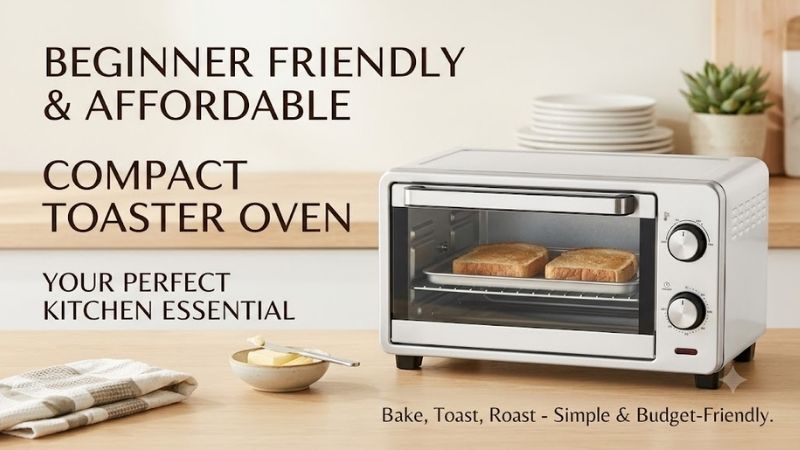
A compact toaster oven is a small countertop appliance that uses electric heating elements to cook food inside an enclosed chamber.
Depending on the model, it may provide toast, bake, broil, and other functions.
Compact models generally accommodate smaller portions than large countertop ovens.
However, manufacturers use the word compact for different sizes.
Always compare exterior dimensions and usable cooking space.
Who Benefits Most From a Budget Toaster Oven?
A compact toaster oven may be useful for one-person households, couples preparing small meals, apartment residents with suitable kitchen space, beginners learning basic cooking techniques, and households that want to avoid using a larger oven for small portions.
It may be less suitable for preparing large family meals or using oversized baking dishes.
Budget Toaster Oven vs. Full-Size Oven
A full-size oven generally supports larger cookware and greater cooking quantities.
A compact toaster oven can be convenient for smaller tasks.
However, it is not automatically more energy-efficient or faster for every recipe.
Energy use depends on appliance design, cooking duration, operating temperature, and food quantity.
For beginners, choose according to the meals you actually prepare rather than broad efficiency claims.
Setting a Realistic Budget
Understand What You Are Paying For
A budget toaster oven may emphasize basic heating functions and simpler controls.
Higher-priced models may include additional presets, convection fans, larger chambers, or advanced displays.
However, price alone does not establish cooking performance or durability.
Before comparing models, identify the features that are essential for your kitchen.
Avoid paying for functions that do not support your everyday cooking habits.
Essential vs. Optional Features
| Feature | Priority for Beginners | Why It Matters |
|---|---|---|
| Temperature control | Essential for baking-oriented use | Allows selection of cooking temperature |
| Timer | High | Helps manage cooking duration |
| Toast setting | High if regularly toasting bread | Supports basic breakfast preparation |
| Removable crumb tray | High | Simplifies cleaning |
| Suitable rack positions | Useful | Supports different food heights |
| Convection fan | Optional | May improve certain cooking applications |
| Digital display | Optional | Can add convenience but is not necessary |
| Air-fry mode | Optional | Expands functions when genuinely needed |
| Specialized presets | Optional | May simplify specific recipes |
A beginner should prioritize core cooking controls and safety over additional presets.
Consider Long-Term Ownership Costs
Purchase price is not the only cost.
Replacement trays, racks, and other compatible accessories may affect long-term value.
Electricity use and cleaning requirements also matter.
Check whether replacement components are available.
A slightly more expensive appliance with accessible parts and practical controls may offer better ownership value than a cheaper model with difficult maintenance.
Choosing the Right Size
Measure Available Counter Space
Record the width, depth, and height of the intended operating area.
Account for the handle, control panel, and open door.
The oven needs a stable, level, heat-resistant location.
Do not place it where the cord crosses a sink or cooking area.
Most importantly, follow the manufacturer’s specified operating clearances.
Check Interior Capacity
Exterior dimensions do not always reveal usable cooking space.
Check the interior dimensions and supported cookware.
A compact oven may fit toast and small snacks but not larger baking pans.
If you prepare frozen foods or small casseroles, make sure the cooking chamber accommodates them without contacting heating elements.
Understand Toast Capacity
Some toaster ovens advertise capacity using bread slices.
However, a stated slice count does not account for every bread shape.
Large bagels, thick artisan bread, and oversized slices may require additional space.
Choose according to your normal food portions.
Consider Interior Height
Interior height matters for thicker foods and baking dishes.
A shallow chamber may limit what can be cooked safely.
Check rack positions and clearance from heating elements.
Do not attempt to force oversized cookware or food into the oven.
Heating Functions Beginners Actually Need
Toast Function
Toasting is one of the most common uses.
Basic models may use a toast-shade control or a timed heating setting.
However, controls differ.
Some ovens require selecting both a cooking mode and a timer setting.
Read the operating instructions before first use.
Bake Function
A bake function allows the user to select an appropriate temperature for approved recipes.
This can be useful for small portions of vegetables, casseroles, and baked foods.
However, cooking time and temperature behavior may differ from a full-size oven.
Beginners should monitor food carefully until familiar with the appliance.
Broil Function
Broiling uses intense upper heat in many toaster oven designs.
It can be useful for certain foods but requires close attention.
Food positioned too close to the heating element may burn rapidly.
Follow the manufacturer’s rack and pan recommendations.
Never leave broiling unattended.
Convection Cooking
Some compact toaster ovens include a fan that circulates heated air.
This may influence cooking speed and browning.
However, convection performance varies between appliances.
A convection feature is useful when supported recipes and cooking tasks justify it.
For basic toast and reheating, it is optional.
Manual Controls vs. Digital Controls
Manual Dial Controls
Manual controls are common in simpler toaster ovens.
They may include temperature, function, and timer dials.
Their main advantage is straightforward operation.
However, dial markings and timer precision vary.
Beginners should choose controls that are clearly labeled and easy to understand.
Digital Controls
Digital toaster ovens may provide displays, presets, and electronic timers.
These can improve convenience for some users.
However, additional electronics do not automatically improve food quality.
A beginner preparing basic meals may not need an advanced interface.
Why Timer Design Matters
Some ovens use mechanical timers that require particular operating procedures.
Others use electronic countdown controls.
Check how the appliance stops heating and whether it provides an automatic shutoff function.
Do not assume that every model turns off in the same way.
For safety, follow instructions and monitor cooking.
Everyday Cooking Tasks for Beginners
Making Toast and Bagels
Toaster ovens can prepare bread and certain bagels.
However, browning patterns vary.
Follow the recommended rack position and settings.
Avoid putting spreads, toppings, or other ingredients close to exposed heating elements when the manufacturer warns against it.
Reheating Pizza
A toaster oven can reheat pizza using an appropriate baking setting.
The exact result depends on temperature, heating elements, pan choice, and pizza thickness.
Use suitable cookware.
Monitor the food to prevent burning.
Do not place food directly on surfaces not approved for cooking.
Roasting Vegetables
Small portions of vegetables can be cooked in a toaster oven when the recipe and appliance support the method.
Cut ingredients into appropriate sizes and use an approved pan.
Avoid overcrowding, which can affect moisture release and browning.
Follow safe handling procedures when removing hot cookware.
Preparing Frozen Snacks
Many frozen foods can be prepared in countertop ovens.
However, package instructions may assume a conventional oven or air fryer.
Follow the food manufacturer’s instructions when specifically applicable, and adjust only using safe, appropriate guidance for the toaster oven.
Check internal temperatures for foods that require them.
Cooking Small Protein Portions
A toaster oven may be suitable for certain small meat or fish portions.
However, cooking time alone does not guarantee food safety.
Use an appropriate thermometer.
Chicken and other poultry should reach 165°F.
For fish, follow applicable safe cooking guidance, including an internal temperature of 145°F for most fish.
Cleaning and Maintenance
Removable Crumb Tray
A removable crumb tray simplifies routine cleaning.
Bread crumbs and food residue can accumulate during normal use.
Allow the oven to cool and unplug it before removing the tray.
Clean it according to manufacturer instructions.
Interior Surface Care
Some oven interiors have coatings or finishes that require specific cleaning methods.
Avoid abrasive tools and unapproved chemicals.
Do not spray liquids directly onto heating elements or electrical controls.
Cleaning the Door
Glass doors may collect grease or fingerprints.
Use an approved cleaning method after the appliance cools.
Avoid forcing removable parts that are not designed for disassembly.
Cleaning Accessories
Racks and trays should be washed according to the manual.
Some accessories may be dishwasher safe, while others require handwashing.
Dry components appropriately before reinstallation.
Safety Features and Placement
Exterior Heat
Toaster oven exterior surfaces can become very hot.
Keep children, pets, and combustible materials away.
Use appropriate oven mitts when handling hot cookware.
Do not touch the door glass or metal housing during or immediately after cooking.
Operating Clearance
Manufacturer clearance requirements are essential.
A compact oven may still need substantial free space above and around it.
Do not operate the appliance beneath cabinets or inside enclosed shelving unless specifically permitted.
Safe Electrical Connections
Use the rated outlet and follow the manufacturer’s electrical instructions.
Avoid overloaded circuits.
Do not use extension cords or power strips unless approved.
Recognized Safety Documentation
Look for a clearly identified manufacturer, complete operating instructions, and relevant independent electrical safety certification information when available.
Do not assume that a decorative badge or vague safety claim proves compliance with a recognized standard.
Check the exact product documentation.
Product Recall Awareness
Before purchasing, especially when considering older or discounted models, check applicable product recall information.
A low price should not outweigh unresolved safety concerns.
Choosing by Household Needs
Best for One Person
A compact basic toaster oven may be sufficient for toast, reheating, and small meals.
Prioritize convenient cleaning and manageable dimensions.
Best for Apartment Beginners
Check the operating location carefully.
A toaster oven must have sufficient ventilation and safe electrical access.
Storage convenience should not compromise operating safety.
Best for Occasional Baking
Choose a model with a clearly labeled baking mode and suitable interior dimensions.
A more sophisticated convection system may not be essential for occasional use.
Best for Daily Breakfast Preparation
Prioritize straightforward toast controls, a practical crumb tray, and a capacity suited to usual bread portions.
If breakfast toasting is your only task, a pop-up toaster may be simpler and less expensive.
Best for Budget-Conscious Students
Confirm that the accommodation permits toaster ovens.
Many residence halls prohibit them in individual rooms.
Do not buy an appliance that cannot be legally or safely operated in the intended location.
Common Buying Mistakes
Choosing Only by Lowest Price
A low purchase price does not establish value.
Compare capacity, controls, safety documentation, cleaning, and replacement parts.
Ignoring Operating Clearance
Compact does not mean safe inside tight cabinetry.
Follow the manufacturer’s installation requirements.
Paying for Too Many Functions
Digital presets and air-fry features may be unnecessary for basic toast and reheating.
Purchase features you will actually use.
Assuming All Baking Pans Fit
Measure interior dimensions and check approved cookware requirements.
Do not force oversized pans into a small chamber.
Neglecting Cleaning
Food debris can create unpleasant odors and increase fire risk.
Clean the crumb tray and interior regularly according to the manual.
Frequently Asked Questions
What Should a Beginner Look for in a Budget Toaster Oven?
Prioritize clear controls, suitable cooking capacity, a removable crumb tray, safe construction, and adequate operating clearance.
Is a Compact Toaster Oven Worth Buying?
It can be worthwhile for small meals, toast, reheating, and occasional baking. For households that only toast bread, a pop-up toaster may be sufficient.
Do I Need an Air-Fry Function?
Not necessarily. Basic toast, bake, and broil functions may handle your normal cooking needs.
Can I Bake in a Budget Toaster Oven?
Many models support baking, but capacity and temperature behavior vary. Use appropriate cookware and follow the appliance’s instructions.
Can I Use a Toaster Oven in a Dorm Room?
Only if the residence hall explicitly permits it. Many colleges prohibit toaster ovens in student bedrooms.
How Long Should a Budget Toaster Oven Last?
Service life varies with design, usage, maintenance, and component quality. Compare warranty terms and replacement-part availability rather than relying on an unsupported universal lifespan.
Conclusion
A compact toaster oven for beginners on a budget should focus on essential cooking functions, sufficient capacity, easy cleaning, and safe operation. Choose a straightforward model with useful temperature controls, an understandable timer, and a removable crumb tray before paying for advanced features. The best value comes from an appliance that fits your kitchen, supports your everyday meals, and remains convenient to maintain.

Write Your Review
No reviews yet. Be the first to share your experience!