
A bread machine for limited counter space can simplify homemade bread by mixing, kneading, proofing, and baking inside one appliance. However, even compact models require room for lid opening, heat ventilation, ingredient loading, and safe handling. This guide explains how to select a bread maker that fits a smaller kitchen without sacrificing the loaf size or programs you actually need.
- Quick Verdict: What Bread Machine Should You Choose?
- Understanding Compact Bread Machines
- Measuring Counter Space Correctly
- Choosing the Right Loaf Capacity
- Essential Bread-Making Programs
- Important Mechanical and Cleaning Features
- Baking Performance and Practical Use
- Choosing for Small Kitchens
- Common Buying Mistakes
- Frequently Asked Questions
- Conclusion
Quick Verdict: What Bread Machine Should You Choose?
For small kitchens, a compact vertical-loaf bread machine with a suitable loaf capacity, straightforward programs, and an accessible removable bread pan is a practical starting category.
Vertical designs may use less counter width than some horizontal-loaf machines, but their actual dimensions vary.
Never assume a machine will fit beneath cabinets based only on its closed height.
| Feature | Why It Matters | Priority |
|---|---|---|
| Exterior width and depth | Determines footprint | Essential |
| Open-lid height | Determines access beneath cabinets | Essential |
| Loaf size | Matches household bread consumption | High |
| Minimum batch size | Matters for small households | High |
| Dough-only program | Allows oven baking later | Useful |
| Removable bread pan | Simplifies cleanup | High |
| Appliance weight | Affects storage convenience | High |
| Heat clearance | Prevents unsafe placement | Essential |
The right machine must fit in both its storage position and its complete operating configuration.
Understanding Compact Bread Machines
How Does a Bread Machine Work?
A bread machine uses a motor-driven kneading paddle, a removable baking pan, controlled heating, and programmed cycles.
Depending on the selected program, it can mix ingredients, knead dough, support rising, and bake a finished loaf.
This automation reduces active preparation work.
However, bread quality still depends on ingredient measurements, yeast condition, flour characteristics, recipe suitability, and program selection.
The machine is not a substitute for following a reliable recipe.
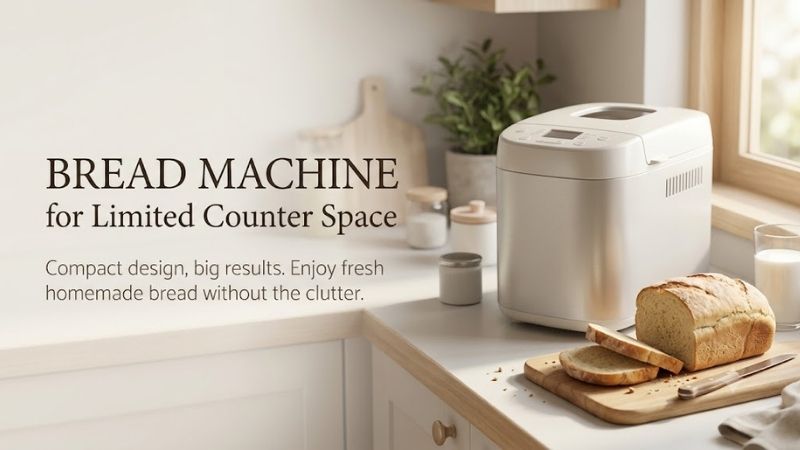
Vertical vs. Horizontal Bread Machines
Some compact bread makers produce relatively tall, vertical loaves.
Others use longer horizontal pans.
| Feature | Vertical-Loaf Machine | Horizontal-Loaf Machine |
|---|---|---|
| Typical shape | Taller loaf | Longer loaf |
| Counter width | May be narrower | May require more width |
| Bread slicing | Shape may be less familiar | Often resembles conventional loaf slices |
| Pan design | Often one primary kneading area | May use one or more paddles |
| Storage | Depends on exterior dimensions | Depends on exterior dimensions |
| Baking characteristics | Model-dependent | Model-dependent |
A vertical loaf may be easier to accommodate in a narrow kitchen, but the finished bread shape may be less convenient for standard sandwiches.
Choose according to both available space and intended use.
Bread Machine vs. Stand Mixer
A stand mixer can mix and knead supported doughs, but normally does not bake bread inside its bowl.
A bread machine combines several steps.
However, it takes up a dedicated appliance footprint and may be less flexible for recipes requiring manual shaping or specialty baking methods.
For households making one straightforward loaf regularly, a bread machine can be convenient.
For varied artisan breads, a mixer and conventional oven may provide more control.
Measuring Counter Space Correctly
Exterior Width and Depth
Measure the available counter area before comparing machines.
Include space for the power cord, handles, and protruding parts.
A bread machine must stand on a stable, level surface.
Do not place it partially over a sink or counter edge.
Open-Lid Clearance
Many bread makers have upward-opening lids.
The machine may fit beneath a cabinet when closed but become difficult to load or unload.
Check the open-lid height.
Also consider whether you can safely lift the hot bread pan out of the machine.
Heat and Ventilation Clearance
Bread machines generate heat during baking.
They require manufacturer-specified space around the appliance.
Do not use a machine inside a closed cabinet or appliance garage unless that installation is explicitly approved.
Keep surrounding objects away from heat outlets.
Vibration During Kneading
Kneading creates mechanical movement.
A bread machine may vibrate during certain cycles.
Place it on a stable surface and make sure the feet are properly seated.
Avoid positioning it close to the counter edge.
Do not attempt to reduce noise by wrapping the appliance or blocking its ventilation.
Choosing the Right Loaf Capacity
One-Pound Loaves
Smaller loaf programs can be useful for one-person households or couples who consume modest amounts of bread.
However, a machine advertised as compact does not necessarily support a 1-pound loaf.
Check its approved loaf sizes.
Also confirm that the smallest recipe works properly with the pan and paddle arrangement.
One-and-a-Half-Pound Loaves
A 1.5-pound loaf category may provide a practical balance for some households.
However, actual serving count depends on slice thickness, loaf shape, and recipe.
Choose based on how quickly your household consumes bread.
Two-Pound Loaves
A 2-pound capacity can be useful for households that consume more bread.
However, machines supporting larger loaves may require additional space.
Some models offer smaller settings as well.
Do not assume that every machine produces equally good results at all listed sizes without comparable evidence.
Avoiding Food Waste
A larger loaf is not always preferable.
Homemade bread may lack certain commercial preservatives and can become stale.
If you regularly discard unused bread, a smaller batch may provide greater value.
Appropriately cooled sliced bread can be frozen for longer storage.
Essential Bread-Making Programs
Basic White Bread
A basic bread program supports ordinary recipes developed for that cycle.
This is often the most frequently used setting.
Choose a machine with clearly documented ingredient quantities and loading order.
Whole Wheat Bread
Whole wheat dough may require different handling because its flour composition influences water absorption and gluten development.
A dedicated whole wheat program can be useful.
However, the existence of the program does not guarantee compatibility with every whole-grain recipe.
Dough-Only Cycle
A dough cycle mixes and kneads dough without completing an in-machine baking program.
This can be useful for pizza dough, rolls, or bread that you want to shape and bake separately.
For small kitchens with access to an oven, a dough program can add worthwhile versatility.
Gluten-Free Program
Some bread machines include gluten-free settings.
Gluten-free dough behavior differs from conventional wheat dough.
Choose recipes specifically developed for the appliance and program.
A gluten-free label does not establish that a machine or its components are free from cross-contact with gluten.
Delay Timer
Some machines allow delayed starts.
This can make bread ready at a convenient time.
However, not all ingredients are suitable for sitting unrefrigerated before baking.
Avoid using delayed cycles with milk, eggs, or other perishable ingredients unless the manufacturer’s approved recipe specifically addresses safe use.
Important Mechanical and Cleaning Features
Removable Baking Pan
A removable pan makes bread removal and cleaning more convenient.
Check the release mechanism and how the pan locks in place.
A poorly seated pan can interfere with kneading.
Follow the manufacturer’s insertion instructions.
Kneading Paddle
The paddle mixes and kneads ingredients.
Some paddles remain embedded in the finished loaf and must be removed after baking.
Others use collapsible or differently shaped designs.
Paddle performance and removal convenience vary.
Never touch or remove the paddle while the machine is operating.
Nonstick Pan Coating
Many bread pans use nonstick coatings.
These can help release baked loaves.
However, metal utensils and abrasive cleaners may damage them.
Follow model-specific cleaning instructions.
Replacement Parts
Bread pans and kneading paddles can wear or become damaged.
Check whether genuine compatible replacements are available.
A low-priced machine may become inconvenient if essential replacement parts are difficult to obtain.
Baking Performance and Practical Use
Why Ingredient Measurements Matter
Bread making depends on the relationship between flour, water, yeast, salt, and other ingredients.
Measuring flour by weight can improve consistency because volume measurements vary with packing.
Use the manufacturer’s approved recipe quantities.
Do not exceed flour or dough capacity.
Yeast and Dough Development
Yeast activity depends on conditions including temperature, ingredient proportions, and yeast condition.
Too much or too little yeast can affect loaf rise.
A bread machine automates timing but cannot correct every ingredient error.
Follow the recipe and use appropriate ingredients.
Crust Color Settings
Some machines offer light, medium, and dark crust selections.
These settings may affect baking time or heating behavior.
Actual crust color depends on recipe ingredients and appliance performance.
A dark setting does not guarantee that every loaf will brown evenly.
Bread Shape and Texture
Bread-machine loaves may differ from oven-baked artisan loaves.
Pan geometry determines the final shape.
A machine with a compact vertical pan may produce taller slices.
If traditional sandwich shape matters, compare loaf dimensions before buying.
Choosing for Small Kitchens
Studio Apartments
Prioritize manageable footprint, safe clearance, and accessible storage.
A compact vertical machine may be practical.
Small Households
Choose a model supporting smaller loaf recipes.
Avoid unnecessarily large batches.
Frequent Bread Bakers
A machine with reliable basic, whole wheat, and dough programs may justify permanent counter space.
Consider whether the machine replaces enough manual work to earn that space.
Occasional Bakers
If you bake bread rarely, a dedicated machine may not be worth storing.
Manual bread making or a stand mixer may be more practical.
Common Buying Mistakes
Measuring Only Closed Dimensions
The lid and bread pan require additional room.
Buying Too Much Loaf Capacity
Oversized loaves may lead to waste.
Ignoring Machine Weight
A heavy bread maker may be difficult to move between storage and the counter.
Assuming Every Recipe Works
Use approved recipes and observe dough capacity limits.
Overlooking Paddle Replacement
Essential replacement parts influence long-term usability.
Frequently Asked Questions
What Type of Bread Machine Uses the Least Counter Space?
Compact vertical-loaf models may have narrower footprints, but actual exterior dimensions vary. Compare complete measurements.
Can a Bread Machine Fit Under Kitchen Cabinets?
It may fit when closed, but lid opening and heat-clearance requirements can make that location unsuitable during operation.
Can I Make a Small Loaf in a Large Bread Machine?
Only if the machine includes a suitable smaller-loaf setting and approved recipe.
Can I Make Pizza Dough in a Bread Machine?
Many models provide a dough-only cycle, but check the exact machine’s supported recipes.
Are Bread Machine Pans Dishwasher Safe?
Some components may be dishwasher safe, but many require handwashing. Follow the manufacturer’s instructions.
Is a Bread Machine Worth It for One Person?
It can be worthwhile if you regularly eat homemade bread and choose a machine supporting small loaves. Otherwise, storage requirements may outweigh the convenience.
Conclusion
The right bread machine for limited counter space should accommodate your normal loaf size while leaving enough room for lid opening, ventilation, and safe pan removal. A compact vertical-loaf model is a useful starting category, especially for small households. Prioritize complete operating dimensions, practical bread programs, manageable weight, and replacement-part availability rather than selecting by compact appearance alone.

Write Your Review
No reviews yet. Be the first to share your experience!