
A toaster oven for easy storage should provide convenient cooking without permanently occupying valuable counter space. However, compact dimensions do not automatically make an appliance easy to move, clean, or put away. Heat clearance, overall weight, door design, and storage access can be just as important as cooking capacity. This guide explains how to choose a toaster oven that fits a small kitchen and remains practical to use.
- Quick Verdict: What Makes a Toaster Oven Easy to Store?
- Understanding Compact Toaster Oven Designs
- Measuring Storage Space
- Safe Operating Clearance
- Choosing the Right Cooking Capacity
- Cooking Functions Worth Considering
- Cleaning and Maintenance
- Choosing for Different Kitchens
- Common Buying Mistakes
- Frequently Asked Questions
- Conclusion
Quick Verdict: What Makes a Toaster Oven Easy to Store?
For most kitchens with limited counter space, a compact toaster oven with straightforward controls, manageable weight, and a removable crumb tray is a practical choice.
However, the right model must provide adequate cooking capacity and safe ventilation when operating.
Prioritize these features:
-
A footprint that fits the intended storage space.
-
Manageable weight for moving between storage and the counter.
-
Sufficient cooking capacity for your usual meals.
-
Removable crumb tray.
-
Convenient door access.
-
Simple accessory storage.
-
Clearly documented operating clearance.
-
Stable feet and a suitable electrical connection.
Never operate a toaster oven inside a cabinet or enclosed storage area unless the manufacturer explicitly approves that installation.
Storage dimensions and safe operating dimensions are different.
Understanding Compact Toaster Oven Designs
What Is a Compact Toaster Oven?
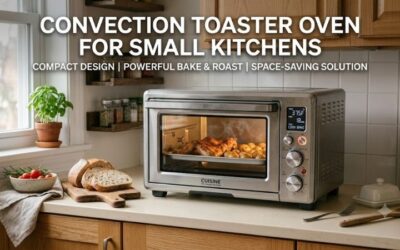
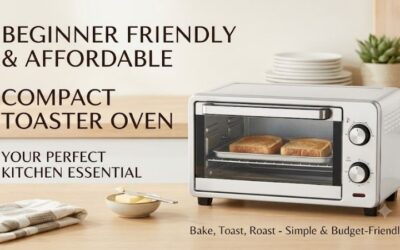
A compact toaster oven is a countertop cooking appliance designed with a smaller footprint or cooking chamber than larger countertop ovens.
It typically uses electric heating elements to toast, bake, or broil food, depending on the model.
However, there is no single universal size standard for compact toaster ovens.
Manufacturers may describe different appliance dimensions using similar terms.
Compare actual width, depth, height, and cooking capacity.
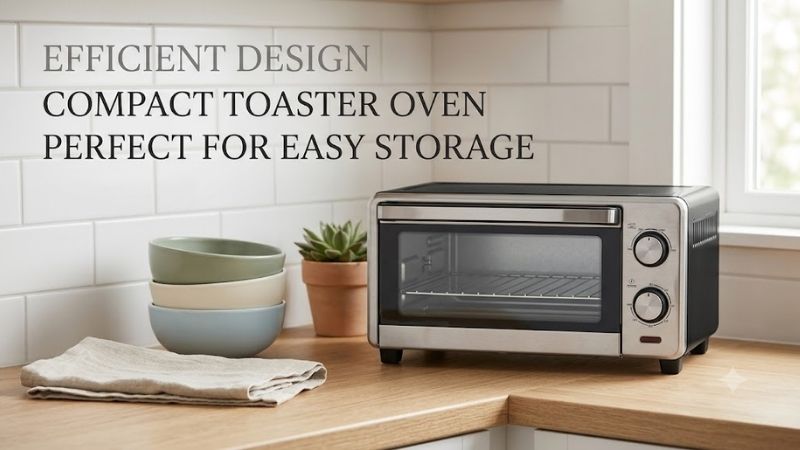
Compact Toaster Oven vs. Full-Size Countertop Oven
| Feature | Compact Toaster Oven | Larger Countertop Oven |
|---|---|---|
| Counter footprint | Usually smaller | Generally larger |
| Cooking chamber | Limited | Often accommodates larger dishes |
| Portability | May be easier to move | Often heavier |
| Storage | More practical in cabinets when cooled | May require dedicated space |
| Accessories | Usually fewer | May include additional racks and pans |
| Main use | Toast, reheating, small meals | Larger portions and more varied cooking |
| Heat clearance | Model-specific | Model-specific |
A compact oven is useful when meal portions are small.
A larger oven may be preferable when cooking for several people or using larger baking dishes.
Does a Smaller Oven Cook Faster?
Not necessarily.
Cooking time depends on heating element design, temperature control, food quantity, and cooking mode.
A smaller chamber may heat differently from a larger oven, but size alone does not establish cooking speed.
Compare reliable cooking tests when available.
Do not assume that every compact toaster oven performs identically.
Measuring Storage Space
Measure Width, Depth, and Height
Before buying, measure the storage location.
Record internal shelf width, depth, and height.
Also measure the cabinet opening.
A toaster oven may fit inside a cabinet but be difficult to insert or remove because of its door or handles.
Check the appliance’s complete exterior dimensions, including protruding controls and rear components.
Consider Appliance Weight
A toaster oven that must be moved after every use should be comfortable to lift.
Heavier machines may be inconvenient for people with limited strength or mobility.
Compare manufacturer-listed weight and the availability of secure lifting points.
Do not lift the oven by its door handle unless the manufacturer explicitly permits it.
Never move the appliance while hot.
Check Shelf Strength
A storage shelf must support the toaster oven’s weight.
Consider the shelf material, mounting hardware, and access position.
Avoid storing a heavy appliance where retrieving it requires awkward overhead lifting.
For daily use, a lower accessible cabinet may be safer and more convenient.
Account for Accessories
Toaster ovens may include racks, baking pans, broiling accessories, and crumb trays.
These items also require storage.
A compact oven with several bulky accessories may occupy more total cabinet space than expected.
Check whether accessories can be stored safely inside the cooled appliance according to manufacturer instructions.
Safe Operating Clearance
Why Ventilation Matters
Toaster ovens release substantial heat during operation.
The appliance’s exterior surfaces, vents, and surrounding air can become hot.
A toaster oven that fits neatly beneath a cabinet may still be unsafe to operate there.
Always follow the exact manufacturer’s specified clearance requirements.
Do not rely on a generic assumption that a few inches of space will be sufficient for every model.
Can You Operate a Toaster Oven Under Cabinets?
Only if the manufacturer explicitly permits the installation and all required clearances can be maintained.
Some countertop oven manufacturers specifically warn against operation beneath wall cabinets.
A small footprint does not eliminate heat-related risks.
If your kitchen lacks a safe operating location, choose another cooking appliance rather than trying to fit the oven into an unsuitable space.
Avoid Heat-Sensitive Materials
Keep the toaster oven away from curtains, paper towels, plastic containers, combustible decorations, and other heat-sensitive items.
Do not store objects on top of the oven while it is hot or operating.
Follow manufacturer guidance about nearby walls and surfaces.
Electrical Placement
Use a suitable outlet and follow the manufacturer’s electrical requirements.
Keep the cord away from water, hot surfaces, and walking paths.
Do not use an extension cord or power strip unless specifically approved.
Choosing the Right Cooking Capacity
Toast Capacity
Some toaster ovens are marketed by the number of bread slices they can accommodate.
However, bread size varies.
A machine advertised as fitting multiple slices may not accommodate larger artisan bread or bagels in the same arrangement.
Check the cooking chamber dimensions.
For one or two people, a smaller model may be sufficient.
Baking Tray Dimensions
Interior width and depth determine which pans fit.
Do not assume that a baking pan fits simply because its nominal dimensions appear smaller than the oven.
Handles, raised edges, and required clearance can affect compatibility.
Use cookware and accessories approved for the appliance.
Height for Different Foods
Interior height matters for thicker foods and dishes.
A shallow toaster oven may be adequate for toast and flat snacks but unsuitable for taller baked items.
Check the distance between the rack and heating elements.
Avoid food contacting the heating elements.
Family Meal Preparation
Compact ovens are often most convenient for smaller portions.
If you regularly prepare food for several people, repeated batches may reduce efficiency.
Choose capacity based on normal meals rather than occasional specialty recipes.
Cooking Functions Worth Considering
Toasting
Toasting is a core function.
Look for clear controls and suitable rack placement.
However, toast consistency varies between models.
Advertised settings alone do not establish even browning.
Baking
Some toaster ovens support baking small dishes.
Check temperature settings, pan compatibility, and maximum cooking dimensions.
A compact oven may be convenient for small portions but less appropriate for large cakes or casseroles.
Broiling
Broiling uses intense heat and requires careful monitoring.
Not every toaster oven provides the same broiling configuration.
Follow the manufacturer’s rack positioning and cookware instructions.
Air Frying
Some toaster ovens include convection or air-fry modes.
These can add versatility but may increase appliance size or accessory requirements.
If your main goal is simple toast and reheating, extra functions may not justify the larger footprint.
Cleaning and Maintenance
Removable Crumb Tray
A removable crumb tray is especially useful for routine cleaning.
Crumbs and grease can accumulate beneath the cooking chamber.
Follow the manufacturer’s instructions for removing and washing the tray.
Do not allow food debris to build up near heating elements.
Interior Cleaning
Allow the oven to cool and disconnect it before cleaning.
Use approved cleaning methods.
Avoid abrasive tools or chemical products that may damage coatings and heating components.
Never spray cleaning solutions directly onto electrical controls or exposed heating elements unless the manual specifically permits the method.
Door and Glass Cleaning
A transparent door can help monitor cooking.
However, grease and residue may accumulate on the glass.
Follow manufacturer care instructions.
Do not immerse the appliance or force open components not designed for removal.
Cleaning Before Storage
Remove food residue and allow cleaned surfaces to dry.
Ensure the oven has completely cooled before storing.
Do not store a hot appliance in an enclosed cabinet.
Choosing for Different Kitchens
Best for Studio Apartments
A compact toaster oven with basic functions and manageable weight may be sufficient.
Prioritize a safe operating location and accessible cabinet storage.
Best for Small Families
Choose a model that accommodates common meal portions without repeated batches.
Do not sacrifice essential cooking capacity simply to minimize exterior dimensions.
Best for Occasional Use
A lightweight model with simple controls may be convenient when used only occasionally.
Avoid unnecessarily complicated accessories.
Best for Frequent Toasting
Prioritize convenient controls, suitable toast capacity, and easy crumb removal.
If you only toast bread, a conventional pop-up toaster may occupy less space and better match your needs.
Common Buying Mistakes
Measuring Only the Storage Location
A toaster oven also requires safe operating clearance.
Measure both environments.
Assuming Compact Means Cool-Running
Small toaster ovens can become extremely hot.
Follow the manufacturer’s heat-clearance instructions.
Choosing by Slice Count Alone
Advertised slice capacity does not describe every bread size or cooking requirement.
Check actual interior dimensions.
Ignoring Weight
An appliance that is difficult to move may remain on the countertop despite being purchased for storage.
Storing the Oven Too Soon
Allow the oven to cool completely and clean food residue before putting it away.
Frequently Asked Questions
Can I Store a Toaster Oven in a Cabinet?
Yes, after it has cooled completely and been cleaned as directed, provided the cabinet can safely support it. Operating it inside the cabinet requires explicit manufacturer approval.
Are Compact Toaster Ovens Easy to Move?
Some are, but weight and handling design vary. Check the listed weight and safe lifting instructions.
Can I Use a Toaster Oven Under Kitchen Cabinets?
Only when the model’s installation instructions permit that placement and all required clearances are available.
Is a Small Toaster Oven Better Than an Air Fryer?
It depends on your cooking needs. A basic toaster oven may suit toast and baking, while a dedicated air fryer may be convenient for certain convection-cooked foods.
What Should I Check Before Buying a Compact Toaster Oven?
Measure storage space, operating clearance, interior capacity, appliance weight, electrical access, and cleaning features.
Can I Put Items on Top of a Toaster Oven?
Do not place items on the oven during operation or while it remains hot. Follow the manufacturer’s specific storage and clearance restrictions.
Conclusion
The right toaster oven for easy storage should fit your cabinets, remain manageable to move, and provide enough cooking capacity for everyday meals. However, safe operating clearance is more important than compact dimensions. Choose a model with a practical footprint, accessible cleaning features, and appropriate weight, then operate it only in a location approved by its manufacturer.



Write Your Review
No reviews yet. Be the first to share your experience!