
An indoor grill for beginners can make preparing burgers, vegetables, sandwiches, and small portions of meat more convenient without an outdoor grilling setup. However, indoor grills differ in heating design, cooking capacity, smoke production, and maintenance. This guide explains how to choose a beginner-friendly electric grill, cook with confidence, and avoid common mistakes.
- Quick Verdict: What Indoor Grill Should Beginners Buy?
- Understanding Indoor Grill Types
- Choosing the Right Cooking Surface
- Temperature Control and Cooking Performance
- Beginner-Friendly Cooking Applications
- Smoke, Odors, and Ventilation
- Cleaning and Maintenance
- Buying for Different Households
- Common Buying Mistakes
- Frequently Asked Questions
- Conclusion
Quick Verdict: What Indoor Grill Should Beginners Buy?
For most beginners, a countertop electric grill with straightforward temperature controls, removable cooking plates, and an accessible grease tray is a sensible starting point.
A contact grill may be particularly convenient for sandwiches and smaller portions.
An open indoor grill can offer a cooking experience more similar to a traditional grill, but it may require more turning and attention.
| Feature | Open Electric Grill | Contact Grill |
|---|---|---|
| Cooking surface | Primarily heats from below | Often heats from above and below |
| Turning food | Usually required | May be unnecessary for certain foods |
| Thickness flexibility | Depends on cooking surface | Depends on hinge and plate spacing |
| Sandwiches | Possible | Often particularly convenient |
| Grease management | Usually drip tray or channels | Varies by plate construction |
| Cleaning | Depends on plate removability | Both plates may need cleaning |
| Storage | Often wider | Some designs are more compact |
Choose based on the foods you prepare most frequently.
If you primarily make panini, sandwiches, and modest protein portions, a contact grill may be practical. If you prefer turning vegetables, burgers, and multiple pieces of food independently, an open grill may be more suitable.
Understanding Indoor Grill Types
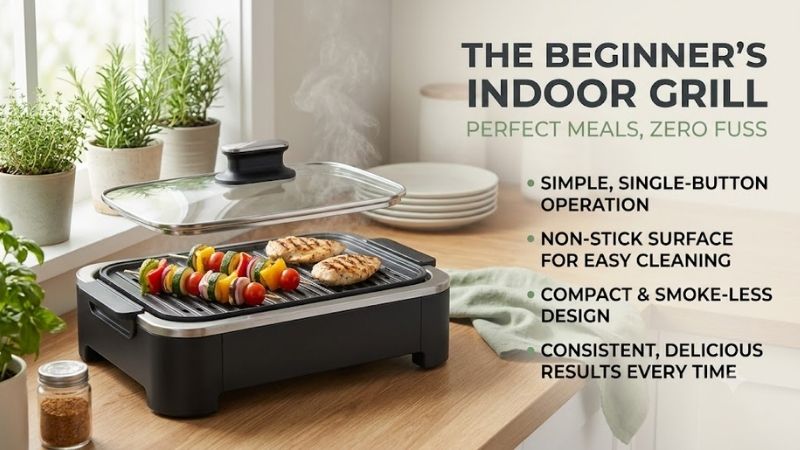
Open Electric Grills
An open indoor grill generally has a heated cooking surface resembling a grill grate or ridged plate.
Food is placed on top and cooked using heat from the surface.
Depending on the design, excess fat may drain toward a removable collection tray.
Open grills provide easy access to food, making it convenient to turn and reposition ingredients.
However, they can expose more cooking surfaces to surrounding air and may generate cooking odors or smoke.
Contact Grills
Contact grills use opposing heated plates that close around food.
This arrangement can be useful for sandwiches, thin protein portions, and certain vegetables.
Some designs have floating hinges that accommodate different thicknesses.
However, large or unevenly shaped foods may not make consistent contact with both plates.
A contact grill should not be forced closed around food that exceeds its supported thickness.
Convertible Grill and Griddle Appliances
Some indoor grills include interchangeable plates or a hinge that allows the appliance to open flat.
This can support a wider range of cooking tasks.
For example, one configuration may be appropriate for sandwiches while another supports pancakes or vegetables.
However, added versatility increases the number of components that need cleaning and storage.
Beginners should purchase these features only when they expect to use them regularly.
Electric Grills vs. Indoor Charcoal Grilling
For ordinary home kitchens, an electric grill designed and approved for indoor use is the appropriate category.
Never use an outdoor charcoal grill or an outdoor gas grill inside a home, apartment, garage, or other enclosed space.
Combustion appliances can produce dangerous carbon monoxide.
Even opening a window does not make indoor charcoal grilling safe.
Choosing the Right Cooking Surface
Nonstick-Coated Plates
Nonstick surfaces can simplify food release and cleaning.
They may be useful for delicate fish, vegetables, or foods containing marinades.
However, nonstick coatings have manufacturer-specific temperature and care limitations.
Never assume that all nonstick plates use identical materials or tolerate the same utensils.
Use approved cleaning tools and avoid overheating.
Ceramic-Coated Plates
Some indoor grills advertise ceramic-coated cooking surfaces.
The term describes a coating category, not a universal guarantee about composition, durability, or safety.
Check the manufacturer’s material documentation and care instructions.
Avoid assuming that ceramic-coated means completely chemical-free or immune to damage.
Cast Iron and Other Metal Surfaces
Some indoor grill designs use heavier metal plates.
These may have different thermal behavior and maintenance requirements than lightweight coated surfaces.
However, the actual cooking performance depends on plate construction and the appliance’s heating system.
A heavier plate is not automatically better.
Consider the additional weight and cleaning effort.
Removable vs. Fixed Plates
Removable plates are a valuable feature for beginners because they may simplify access to grease and cooking residue.
Fixed plates can also be manageable, but cleaning requires greater care around the electrical appliance.
Check whether removable plates are dishwasher safe.
Never immerse the motor or heating base unless the manufacturer’s instructions explicitly permit it.
Temperature Control and Cooking Performance
Why Adjustable Heat Matters
Different foods benefit from different cooking conditions.
Vegetables may require a different setting from burgers or sandwiches.
Adjustable temperature controls can provide useful flexibility.
However, an advertised temperature setting does not establish the exact temperature across every point on the grill surface.
Heating uniformity depends on element placement, plate construction, and operating conditions.
Preheating the Grill
Many electric grills require preheating before cooking.
Preheating allows the cooking surface to approach its intended operating temperature.
However, required time varies.
Use the manufacturer’s instructions or readiness indicator rather than assuming every grill heats at the same rate.
Avoid leaving an empty grill heating beyond the approved procedure.
Grill Marks vs. Actual Doneness
Dark grill marks indicate surface browning, not necessarily complete cooking.
Thick foods may brown externally while remaining undercooked inside.
A food thermometer is essential for verifying meat and poultry doneness.
Do not judge safety based only on grill marks or the color of juices.
Why Contact Pressure Matters
Contact grills work most effectively when the plates appropriately contact the food.
A thick sandwich may compress differently from a thin chicken cutlet.
Excessive pressure can squeeze fillings out of sandwiches or distort delicate foods.
Choose an appliance with a hinge configuration suited to your meals.
Beginner-Friendly Cooking Applications
Grilled Cheese and Sandwiches
A contact grill can be convenient for sandwiches because both sides receive heat.
However, bread thickness, filling quantity, and plate spacing influence results.
Avoid overfilling sandwiches with ingredients that may leak onto heating components.
Use appropriate settings and inspect the food during cooking.
Burgers
Indoor grills can cook burgers when the appliance supports the intended thickness and quantity.
Ground beef should reach an internal temperature of 160°F.
Ground poultry should reach 165°F.
Cooking time depends on patty thickness, starting temperature, and grill performance.
Do not rely on a fixed number of minutes as proof of doneness.
Chicken
Chicken can be prepared on an approved indoor grill.
For consistent results, use portions with reasonably uniform thickness.
However, pounding or cutting raw poultry requires careful handling to prevent cross-contamination.
Cook chicken to 165°F, measured at the thickest part.
Clean utensils and surfaces that contact raw poultry.
Vegetables
Zucchini, bell peppers, mushrooms, and other suitable vegetables are common indoor grilling ingredients.
Cut pieces large enough to remain safely on the cooking surface.
Avoid excessive oil, which may increase smoke and splattering.
Different vegetables release different amounts of moisture, so cooking results vary.
Fish
Fish can be delicate and may stick to grill plates.
Use a surface and preparation method approved by the appliance manufacturer.
Avoid forcing fish away from the plate before it releases.
For most finfish, use an internal temperature of 145°F or applicable safe doneness guidance.
Smoke, Odors, and Ventilation
Do Indoor Grills Produce Smoke?
Yes. Electric indoor grills can produce smoke, especially when grease, marinades, or food residue contact very hot surfaces.
The amount depends on cooking temperature, ingredients, grease management, and appliance design.
An electric indoor grill is not automatically smokeless.
Use it in a properly ventilated kitchen and follow the manufacturer’s placement instructions.
How to Reduce Smoke
Start with a clean cooking surface and grease tray.
Remove unnecessary excess fat when appropriate for the recipe.
Avoid excessive oil and sugary marinades that may burn.
Follow the recommended temperature settings rather than using maximum heat for every food.
Do not block ventilation or cover the appliance to contain smoke.
Can You Use an Indoor Grill in an Apartment?
Many electric indoor grills are suitable for approved residential kitchens.
However, building rules and appliance instructions may impose restrictions.
Check operating clearance, ventilation, outlet requirements, and available counter space.
Never operate the grill in a location where heat or grease could damage surrounding materials.
Cleaning and Maintenance
Grease Tray Design
An accessible grease tray is important for cooking meat and other fatty foods.
Check how grease flows into the tray and whether it can be removed without spilling.
Allow the appliance to cool before handling the tray.
Dispose of grease appropriately rather than pouring large quantities into drains.
Cleaning Grill Ridges
Ridged plates can retain residue between raised surfaces.
Use manufacturer-approved brushes or cleaning tools.
Avoid metal scraping tools on surfaces that prohibit them.
Dishwasher Safety
Some removable grill plates are dishwasher safe.
Others require handwashing.
Follow the exact product instructions.
Do not assume dishwasher compatibility from a nonstick or ceramic coating description.
Preventing Residue Buildup
Clean the grill after use, once it is safe to handle.
Dried grease and food residue can affect future cooking and contribute to smoke.
Inspect accessible channels and collection trays.
Buying for Different Households
Best for First-Time Grill Owners
Choose simple controls, removable plates, and an understandable manual.
A basic contact grill may be sufficient for sandwiches and modest portions.
Best for Small Apartments
Prioritize compact storage and convenient grease management.
Check ventilation and heat clearance.
Best for Families
Select sufficient surface area for the number of portions usually prepared.
An undersized grill may require several batches.
Best for Frequent Meal Prep
Look for plates that are easy to clean between different ingredients.
Consider whether the appliance supports your preferred protein and vegetable preparations.
Common Buying Mistakes
Selecting Only by Maximum Temperature
High heat does not automatically produce better food.
Control, surface design, and appropriate cooking technique matter.
Confusing Grill Marks With Doneness
Use a food thermometer for safety-critical foods.
Assuming Smokeless Means No Ventilation
Even appliances marketed as smokeless may release cooking fumes and odors.
Ignoring Plate Cleaning
A difficult-to-clean grill may become inconvenient for daily use.
Buying an Outdoor Grill for Indoor Use
Charcoal and outdoor gas grills are not substitutes for indoor electric grills.
Frequently Asked Questions
Is an Indoor Grill Worth It for Beginners?
It can be useful for sandwiches, vegetables, burgers, and small portions of meat, especially when outdoor grilling is unavailable.
What Is Easier to Use: Open Grill or Contact Grill?
A contact grill may simplify certain sandwiches and thin foods. An open grill offers easier access for turning and repositioning ingredients.
Do Indoor Grills Make Smoke?
They can. Smoke production depends on food, temperature, grease, and grill design.
Can I Grill Raw Chicken Indoors?
Yes, on a suitable indoor grill. Cook it to 165°F and prevent cross-contamination.
Are Indoor Grill Plates Dishwasher Safe?
Some removable plates are dishwasher safe, but the exact instructions vary by product.
Can an Indoor Grill Replace a Frying Pan?
It can replace a frying pan for certain tasks, but it is less suitable for foods requiring a deep cooking vessel, stirring, or substantial liquid.
Conclusion
The right indoor grill for beginners should be easy to control, safe to operate, and convenient to clean. A compact contact grill suits sandwiches and smaller portions, while an open electric grill offers greater flexibility for turning and arranging food. Prioritize temperature control, removable cooking surfaces, grease management, and realistic ventilation requirements rather than relying on marketing claims.








Write Your Review
No reviews yet. Be the first to share your experience!