
A waffle maker for meal prep can help you prepare several breakfasts in advance, reducing cooking work during busy mornings. However, batch capacity, cooking consistency, cleaning, and freezer storage matter more than decorative features. This guide explains how to choose a waffle maker that fits your routine, produces practical portions, and supports safe preparation and reheating.
- Quick Verdict: What Waffle Maker Is Best for Meal Prep?
- Understanding Waffle Maker Types
- Choosing Capacity for Weekly Breakfasts
- Browning Control and Cooking Performance
- Plate Construction and Cleaning
- How to Meal Prep Waffles Efficiently
- Freezing and Storage Considerations
- Meal Prep Scenarios
- Common Buying Mistakes
- Frequently Asked Questions
- Conclusion
Quick Verdict: What Waffle Maker Is Best for Meal Prep?
For regular meal preparation, choose a waffle maker with sufficient batch capacity, reliable browning controls, and cooking plates that are convenient to clean.
If you prepare breakfasts for several people, a model that produces multiple waffles per cycle may be more efficient than a single-waffle design.
For one person, a compact waffle maker may be sufficient.
| Feature | Why It Matters | Priority |
|---|---|---|
| Waffles per batch | Determines number of cooking cycles | High |
| Browning control | Helps achieve preferred texture | High |
| Plate design | Influences waffle size and thickness | High |
| Removable plates | Can simplify cleaning | Useful |
| Ready indicator | Helps coordinate batches | High |
| Overflow management | Reduces batter mess | Useful |
| Storage dimensions | Determines kitchen fit | High |
| Replacement parts | Supports long-term usability | Useful |
The best choice is not necessarily the largest waffle maker. It is the one that produces your normal batch efficiently without adding unnecessary cleanup or storage problems.
Understanding Waffle Maker Types
Classic Waffle Makers
Classic waffle makers generally produce thinner waffles with shallower pockets than Belgian-style models.
They may be convenient for people who prefer relatively thin portions.
Their shape can also make freezer stacking easier, depending on the finished waffle dimensions.
However, actual cooking speed and texture vary by appliance.
Do not assume that all classic waffle makers provide identical results.
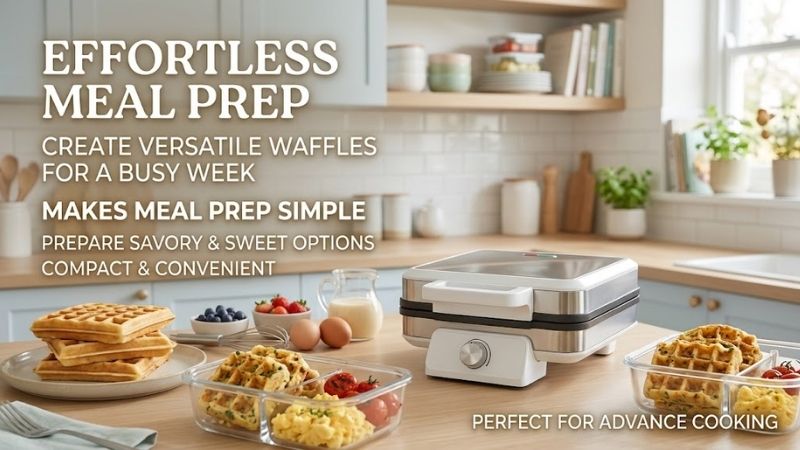
Belgian Waffle Makers
Belgian-style waffle makers commonly produce thicker waffles with deeper pockets.
These waffles can hold toppings and may be preferred for certain breakfast styles.
However, thicker waffles may take more freezer space.
They may also require different cooking times and batter quantities.
If you prepare large batches, consider whether the finished waffle size fits your freezer containers.
Mini Waffle Makers
Mini waffle makers are compact and often designed to prepare one small waffle at a time.
They may suit one-person households or occasional breakfasts.
However, producing a large meal-prep batch can require many cooking cycles.
A small purchase price does not automatically make a mini appliance the most efficient choice.
Double and Multi-Waffle Makers
Some machines prepare two or more waffles during a cooking cycle.
This can reduce the number of cycles needed for family meal preparation.
However, a larger cooking surface requires more storage space.
Check the actual usable capacity, exterior dimensions, and cleaning arrangement.
Rotating Waffle Makers
Some waffle makers rotate during cooking to help distribute batter.
This can be useful with certain batter consistencies and plate designs.
However, rotation does not automatically guarantee more even results.
The mechanism may also increase exterior dimensions or create additional cleaning areas.
Choose a rotating design only when its practical benefits justify the storage and handling requirements.
Choosing Capacity for Weekly Breakfasts
Calculate Your Typical Batch
Start by estimating how many waffles your household normally eats.
For example, if two people each eat two waffles on four mornings, the household needs 16 waffles for those breakfasts.
This is a planning example, not a recommendation for portion size.
A waffle maker producing one waffle per cycle requires more cycles than a machine producing four at a time.
However, actual total preparation time also depends on preheating, cooking duration, and batter handling.
Understand Waffles per Cycle
Manufacturers may advertise waffle capacity based on the number of individual sections or finished waffles.
Check the actual serving dimensions.
Four miniature waffles are not equivalent to four large Belgian waffles.
For meal prep, compare total finished food quantity rather than product claims alone.
Balance Capacity and Storage
A large waffle maker can reduce cooking cycles but occupy substantial cabinet space.
A compact model may require longer batch preparation but be easier to store.
Choose according to how frequently you make waffles and how much preparation time you want to spend.
Consider Batter Quantity
Different waffle makers require different batter amounts.
The ideal quantity depends on plate depth and waffle size.
Too much batter may overflow.
Too little batter can produce incomplete waffles.
Follow the manufacturer’s filling instructions and the recipe’s guidance.
Browning Control and Cooking Performance
Adjustable Browning Settings
Browning controls allow users to select different cooking results.
However, the settings do not necessarily correspond to standardized temperatures.
A setting labeled medium on one waffle maker may behave differently on another.
For meal prep, consistency matters because you want successive batches to have similar textures.
Preheating and Ready Indicators
Many waffle makers include lights or audible indicators.
Some indicate that the appliance is preheated, while others signal that a cooking cycle is complete.
The exact behavior varies.
Read the manual rather than assuming every ready light means the waffle has reached your preferred doneness.
Why Even Browning Matters
Uneven heating can produce waffles that are dark in one area and pale in another.
This may affect texture, especially after freezing and reheating.
However, plate thickness or motor wattage alone does not establish even browning.
Look for credible published cooking tests when available.
Avoid Overcooking Meal-Prep Waffles
Waffles intended for freezing should be cooked appropriately before storage.
Excessive browning may produce a dry texture after reheating.
However, undercooking batter is not a safe solution.
Follow a tested recipe and ensure the waffles are properly cooked before cooling and freezing.
Plate Construction and Cleaning
Nonstick Cooking Plates
Nonstick surfaces are common in waffle makers because they help release cooked batter.
However, coatings differ in construction and care requirements.
Do not assume that every coating is PFAS-free or universally safe based on a marketing name.
Follow manufacturer-approved temperature, utensil, and cleaning instructions.
Removable Plates
Removable plates may simplify cleaning, particularly after large batches.
Check how easily they detach and whether they are dishwasher safe.
Never remove plates while the appliance is hot unless the manufacturer explicitly provides a safe procedure.
Fixed Plates
Fixed cooking plates are common in compact waffle makers.
They may be straightforward to maintain when batter is properly measured.
However, cleaning deep pockets can require additional care.
Use approved brushes or soft cleaning tools.
Never immerse the appliance’s electrical housing.
Overflow Channels
Some waffle makers include channels intended to collect excess batter.
This may reduce countertop mess.
However, these areas can also collect cooked residue.
Choose a design that provides reasonable cleaning access.
How to Meal Prep Waffles Efficiently
Step 1: Choose a Suitable Recipe
Select a waffle recipe appropriate for the appliance.
Classic and Belgian waffle batters may differ in ingredients, thickness, and preparation technique.
Do not assume that every recipe works equally well with every plate design.
For freezing, choose a recipe with a texture that reheats acceptably.
Step 2: Prepare Ingredients Safely
Measure ingredients before preheating the waffle maker.
Keep perishable ingredients such as milk and eggs refrigerated until needed.
Use clean utensils and preparation surfaces.
Do not leave egg-containing batter sitting at room temperature for extended periods.
Step 3: Preheat the Waffle Maker
Follow the appliance’s preheating instructions.
A properly preheated machine can help produce more predictable batches.
Do not touch the cooking plates directly.
Use appropriate utensils and avoid placing the power cord near hot surfaces.
Step 4: Add the Correct Amount of Batter
Use the recommended batter quantity.
Avoid overfilling.
Close the lid according to the manufacturer’s instructions.
Do not force it closed around excessive batter.
Step 5: Cook Each Batch Properly
Follow the recipe and appliance instructions.
Use the browning setting that produces the desired result.
Do not repeatedly open the lid before the waffle is ready if the manufacturer advises against it.
Inspect the finished food before removing it.
Step 6: Cool Waffles Before Packing
Place cooked waffles on a clean cooling rack or another appropriate food-contact surface.
Allow steam to escape so that excessive condensation does not become trapped in storage packaging.
However, cooling should be prompt and food-safe.
Do not leave perishable prepared foods at room temperature beyond the applicable two-hour limit, or one hour when temperatures exceed 90°F.
Step 7: Arrange for Freezer Storage
Place cooled waffles in freezer-appropriate packaging.
Separating waffles with suitable freezer-safe material can make individual portions easier to remove.
Remove excess air from packaging where practical.
Label the contents and preparation date.
Freeze promptly at 0°F or below.
Step 8: Reheat Before Serving
Frozen waffles can often be reheated using a toaster, toaster oven, or conventional oven when the waffle size and appliance instructions permit it.
Avoid placing oversized or unsuitable waffles in a pop-up toaster.
For homemade waffles containing potentially hazardous ingredients, ensure they were fully cooked before freezing and are reheated appropriately.
Prepared frozen waffles should not be treated as raw batter.
Freezing and Storage Considerations
Why Cooling Matters
Packing very hot waffles can trap steam.
This may create condensation and affect texture.
However, prolonged countertop cooling also creates food-safety concerns.
Cool promptly using clean surfaces and refrigerate or freeze within safe time limits.
Preventing Freezer Burn
Freezer burn is primarily a quality issue caused by moisture loss and exposure to air.
Use suitable freezer packaging.
Avoid leaving containers partially open.
Smaller portions can make it easier to remove only what you need.
Freezer Space
Thick Belgian waffles may take more storage space than thinner waffles.
Before choosing a waffle maker, consider the available freezer shelf or drawer dimensions.
Large waffle portions may be inconvenient if they do not fit your normal storage containers.
Reheating Texture
Reheating texture depends on the recipe, waffle thickness, moisture content, and reheating method.
A toaster may help restore crispness to appropriately sized waffles.
An oven may be useful for reheating several portions.
Microwave reheating can produce a softer texture.
Follow the food and appliance instructions rather than assuming one method is best for every waffle.
Meal Prep Scenarios
Meal Prep for One Person
A compact waffle maker may be sufficient.
However, producing several days of breakfasts may still require repeated cycles.
Choose a model that fits your storage space and usual portions.
Meal Prep for Couples
A two-waffle or multi-waffle design may reduce preparation time.
Consider whether the extra capacity justifies the appliance’s larger footprint.
Meal Prep for Families
A larger cooking surface can be useful when preparing multiple breakfasts.
Prioritize consistent cooking and manageable cleanup.
A small machine may be frustrating when preparing several dozen waffles.
Meal Prep for Busy Weekdays
Choose a recipe that freezes and reheats well.
Prepare portions in advance and store them appropriately.
A convenient waffle maker is one part of the system; cooling, packaging, and reheating also determine whether meal prep is worthwhile.
Common Buying Mistakes
Choosing Only by Price
A low-cost waffle maker may be appropriate for occasional use.
However, frequent meal prep places greater importance on batch capacity, cleaning, and consistent operation.
Ignoring Waffle Size
Two small waffles may not equal one large serving.
Evaluate finished dimensions and portions.
Assuming More Heat Means Better Waffles
Browning quality depends on the complete heating system and recipe.
Higher temperature is not always preferable.
Freezing Waffles While Steaming Hot
Excess moisture in packaging can affect texture.
Cool promptly and safely before freezing.
Overloading the Waffle Maker
Excess batter can overflow and create difficult cleanup.
Follow the recommended fill amount.
Using Inappropriate Cleaning Tools
Metal utensils and abrasive brushes may damage certain cooking surfaces.
Use manufacturer-approved methods.
Frequently Asked Questions
Is a Waffle Maker Worth Buying for Meal Prep?
It can be worthwhile if you regularly prepare waffles in batches and freeze portions for later breakfasts.
Are Belgian or Classic Waffles Better for Freezing?
Both can be frozen. Classic waffles may be easier to stack, while Belgian waffles are thicker and may require more storage space.
Can I Freeze Homemade Waffles?
Yes. Cool them promptly, package appropriately, and freeze at 0°F or below.
Can I Reheat Frozen Waffles in a Toaster?
Often, provided the waffles fit safely and the toaster manufacturer permits their use. Avoid overstuffing slots or allowing toppings to contact heating elements.
How Many Waffles Should a Meal-Prep Maker Produce?
Choose based on your weekly serving requirements and acceptable preparation time. Multi-waffle machines can reduce the number of cooking cycles.
Are Removable Waffle Plates Worth It?
They can be useful for frequent batch cooking because they may simplify cleaning. However, dishwasher compatibility and removal procedures vary by model.
Conclusion
The best waffle maker for meal prep should produce enough waffles per batch, offer controllable browning, and remain easy to clean after repeated cooking cycles. Choose classic or Belgian plates according to your preferred portions and freezer storage needs. For a reliable weekly routine, pair the right appliance with proper cooling, freezer packaging, and appropriate reheating rather than focusing only on waffle size or cooking speed.



Write Your Review
No reviews yet. Be the first to share your experience!