
An electric lunch box for baking at home may seem like a convenient compact alternative to an oven, but most electric lunch boxes are designed to warm prepared meals rather than bake bread, cakes, or pastries. Their heating systems, temperature controls, and food containers differ from those of baking appliances. This guide explains what they can realistically do and which features to look for if you want compact home cooking equipment.
- Quick Verdict: Can You Bake in an Electric Lunch Box?
- Understanding Electric Lunch Boxes
- How to Choose the Right Appliance for Your Goal
- Compact Alternatives for Baking at Home
- What Electric Lunch Boxes Do Well
- Electrical and Thermal Safety
- Food Safety for Lunch Box Meals
- Choosing by Household Needs
- Common Buying Mistakes
- Frequently Asked Questions
- Conclusion
Quick Verdict: Can You Bake in an Electric Lunch Box?
Most ordinary electric lunch boxes should not be used for baking.
They typically contain a heating element designed to warm food inside a removable container.
Baking requires a heating environment appropriate for the recipe, sufficient thermal control, and cookware designed for the cooking temperature.
A food warmer may not provide these conditions.
If you want to bake small cakes or bread at home, a suitable compact oven, toaster oven, or manufacturer-approved baking multicooker is a better choice.
| Appliance | Intended Function | Suitable for Conventional Baking? |
|---|---|---|
| Electric lunch box | Heating or warming food | Generally no |
| Electric food warmer | Maintaining or raising food temperature according to model | Generally no |
| Portable electric cooking pot | Cooking approved meals | Only with specific manufacturer approval |
| Mini rice cooker with cake program | Cooking rice and certain approved cakes | Limited baking-style recipes |
| Compact toaster oven | Dry-heat cooking | Yes, for approved baking tasks |
| Small countertop oven | Baking and roasting | Yes, within capacity limits |
Do not choose a food warmer merely because advertising describes it as multifunctional.
Verify its actual cooking functions.
Understanding Electric Lunch Boxes
What Is an Electric Lunch Box?
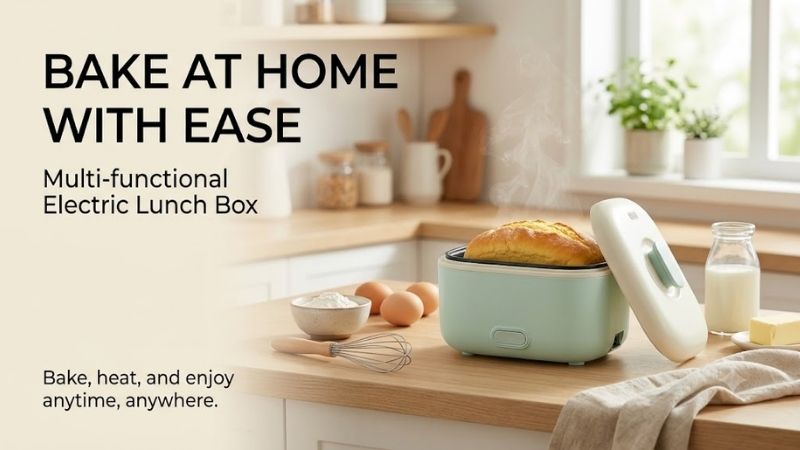
An electric lunch box is a portable appliance designed to heat or warm food.
Some models operate from a household electrical outlet.
Others support particular vehicle electrical systems.
Their containers, heating elements, and operating controls vary.
Many are intended for reheating previously cooked meals rather than preparing raw ingredients.
How Does an Electric Lunch Box Heat Food?
An electric lunch box generally transfers heat from an electrical heating component into its food container.
The exact mechanism depends on the design.
Some use direct heating through a metal container.
Others use different arrangements involving a heating plate or water-assisted heating.
These systems are not equivalent to a conventional oven.
Why Baking Requires Different Equipment
Conventional baking relies on controlled heat transfer around a food item.
An oven commonly uses a combination of radiant heat, natural convection, and sometimes fan-assisted airflow.
A lunch box may primarily heat from one area.
This can lead to uneven cooking when attempting unsupported cake or bread recipes.
A food container that is suitable for reheating may also lack the temperature resistance required for baking.
Can Electric Lunch Boxes Cook Raw Food?
Some specialized electric cooking containers support particular raw-food recipes.
However, ordinary electric lunch boxes are often designed primarily for warming.
Do not assume they safely cook raw chicken, eggs, or other ingredients.
Check the manufacturer’s approved functions and instructions.
How to Choose the Right Appliance for Your Goal
Decide Whether You Need Heating or Baking
Start with the meal you want to prepare.
If your goal is to warm cooked rice, pasta, or leftovers, an electric lunch box may be appropriate.
If you want to make muffins, cakes, cookies, or bread, choose equipment specifically designed for those cooking methods.
Buying a food warmer for baking can lead to disappointing results and unsafe experimentation.
Check Temperature Controls
Some electric lunch boxes have simple on-and-off operation.
Others offer temperature settings.
However, a temperature display does not establish oven-style baking performance.
The appliance must explicitly support the intended recipe and operating conditions.
Evaluate Container Materials
Food containers may use stainless steel or other suitable food-contact materials.
However, food-contact suitability does not automatically mean oven safety.
Plastic lids, gaskets, handles, and seals may have temperature limitations.
Never put a lunch box container into an oven unless the manufacturer explicitly approves it.
Consider Capacity
Electric lunch boxes are often intended for individual meals.
Their nominal volume may not be suitable for expanding cake batter.
Even if a cake mixture physically fits, that does not make the appliance appropriate for baking.
Use capacity information only for the intended functions.
Compact Alternatives for Baking at Home
Mini Toaster Ovens
A compact toaster oven is an appropriate category for small-scale dry-heat baking.
Many models support temperature control and baking programs.
However, interior dimensions and heat distribution vary.
Choose a model that fits the intended pan and provides adequate operating clearance.
Small Countertop Ovens
A countertop oven may offer more flexibility for cakes, cookies, and pastries.
However, it requires additional storage and countertop space.
For frequent baking, the increased capability may justify its footprint.
Rice Cookers With Cake Programs
Certain rice cookers support approved cake recipes.
However, they do not produce identical results to conventional ovens.
A dedicated cake function and validated recipe are essential.
Do not repeatedly force a basic rice cooker to restart its cooking cycle in an attempt to bake.
Multipurpose Electric Cooking Appliances
Some specialized multicookers include genuine baking functions.
However, the term multicooker does not establish oven capability.
Check exact programs, cookware requirements, and manufacturer recipes.
What Electric Lunch Boxes Do Well
Reheating Prepared Meals
A suitable electric lunch box can provide convenient warming of certain cooked foods.
However, reheating speed and capability vary.
A model intended only to keep food warm should not be used as a substitute for proper reheating.
For leftovers, use an appropriate method that brings food to 165°F.
Warming Rice and Pasta
Certain food warmers may be suitable for previously cooked rice and pasta.
These foods still require safe storage before reheating.
Cooked rice can present particular risks when left at unsafe temperatures.
Do not assume that reheating eliminates hazards created by improper storage.
Transporting Lunch
Some electric lunch boxes include sealed or covered containers designed for transportation.
However, leak resistance varies.
Food containers do not automatically maintain safe refrigeration temperatures during transport.
Use appropriate insulated bags and cold packs when needed.
Portioning Meals
An electric lunch box may simplify individual meal organization.
However, meal planning is separate from cooking capability.
Choose compartment sizes based on your normal food portions.
Electrical and Thermal Safety
Avoid Improvised Baking
Do not line an electric lunch box with unapproved foil, baking paper, or other materials to imitate an oven.
Do not obstruct vents or alter thermal sensors.
Do not operate the appliance beyond its documented heating functions.
Understand Household Voltage
Check the model’s electrical rating.
Some lunch boxes use household electricity, while others use vehicle connections or multiple power options.
Use only approved power sources.
A plug that fits does not prove electrical compatibility.
Prevent Steam Burns
Heated food containers can release hot steam when opened.
Keep hands and face away from escaping steam.
Use appropriate heat protection.
Protect Electrical Components
Keep connectors and heating elements dry.
Never immerse the electrical portion unless explicitly approved.
Stop using the appliance if its cord, housing, or heating mechanism is damaged.
Food Safety for Lunch Box Meals
Cooking vs. Reheating
These are different processes.
Cooking raw ingredients requires safe internal temperatures and suitable heating performance.
Reheating previously cooked food requires bringing it back to an appropriate safe temperature.
An appliance that warms food gradually may not accomplish either task safely.
Follow the manufacturer’s stated use and verify food temperature when needed.
Safe Storage Before Heating
Perishable foods should generally be refrigerated at 40°F or below.
Do not leave a packed lunch sitting at room temperature for several hours before switching on the heater.
A sealed container does not prevent bacterial growth.
Avoid Extended Lukewarm Holding
Food held between refrigeration and safe hot-holding temperatures can present food-safety risks.
Use the warmer only as intended.
Do not assume that an appliance’s indicator light confirms safe food temperature.
Cleaning Food Containers
Wash removable components according to the manual.
Pay attention to seals, corners, and lid openings.
Do not assume all containers or lids are dishwasher safe.
Choosing by Household Needs
Best for Reheating Leftovers
An electric lunch box may be convenient if the exact model is intended to reheat cooked food adequately.
Check heating capability and cleaning access.
Best for Small-Space Baking
A compact toaster oven or other genuinely baking-capable appliance is more appropriate.
Choose based on the recipes you prepare.
Best for Students
Confirm accommodation rules before buying electrical cooking or warming equipment.
Dormitories may restrict certain appliances.
Best for Home Meal Prep
An electric lunch box can complement advance cooking and storage.
However, it should not replace appropriate refrigeration or a suitable cooking appliance.
Common Buying Mistakes
Assuming Every Electric Lunch Box Can Bake
Most are intended for warming rather than oven-style baking.
Trusting Multifunctional Marketing
Check manufacturer-approved recipes and operating modes.
Ignoring Food Temperature
A warm-feeling container does not establish that leftovers have reached 165°F.
Using Unapproved Cookware
Food-safe materials are not automatically oven-safe.
Leaving Perishable Food Unrefrigerated
Electric heating does not correct unsafe storage practices.
Frequently Asked Questions
Can I Bake a Cake in an Electric Lunch Box?
Most ordinary electric lunch boxes are not designed for baking. Only consider cake preparation if the exact manufacturer explicitly approves it and provides a suitable procedure.
Can an Electric Lunch Box Replace a Toaster Oven?
Generally no. A lunch box is usually intended for food warming, while a toaster oven provides dry-heat baking and toasting functions.
Can I Cook Raw Eggs in an Electric Lunch Box?
Only if the appliance specifically supports cooking eggs and provides safe instructions. Do not assume a reheating function is sufficient.
Are Stainless Steel Lunch Containers Oven Safe?
Not automatically. Their handles, seals, construction, and manufacturer’s temperature limits determine suitability.
Can I Use an Electric Lunch Box for Meal Prep?
It may be useful for transporting and reheating appropriate meals, but refrigeration and food safety remain essential.
What Should I Buy for Small-Batch Baking?
A compact toaster oven, suitable countertop oven, or appliance with a verified baking program is generally more appropriate.
Conclusion
An electric lunch box for baking at home is usually the wrong appliance category when conventional baking is the goal. Most models are designed for warming or reheating food rather than baking cakes, cookies, or bread. Choose a genuinely baking-capable countertop appliance for those recipes, and consider an electric lunch box only when its documented food-heating functions match your needs.








Write Your Review
No reviews yet. Be the first to share your experience!