
A citrus juicer for large families should make it practical to prepare enough fresh orange, grapefruit, lemon, or lime juice without exhausting the person doing the squeezing. The right appliance depends on family size, how often you make juice, and how much cleanup you can manage. This guide explains capacity, juicing mechanisms, pulp control, convenience features, and safe preparation for busy households.
- Quick Verdict: What Citrus Juicer Is Best for Large Families?
- Understanding Citrus Juicer Types
- Citrus Juicer vs. Other Juicer Types
- Estimating Juice Capacity for Your Family
- Choosing the Right Juicing Cone
- Pulp Control and Juice Texture
- Understanding Juice Yield
- Motor Power and Everyday Performance
- Cleaning After Family-Sized Batches
- Fresh Citrus Juice and Food Safety
- Choosing for Different Family Situations
- Cost and Long-Term Ownership
- Common Buying Mistakes
- Frequently Asked Questions
- Conclusion
Quick Verdict: What Citrus Juicer Is Best for Large Families?
For a household that prepares several glasses of fresh citrus juice regularly, an electric citrus juicer with a suitable extraction cone, stable base, convenient pulp handling, and easy-to-clean components is a strong starting category.
If you process large quantities at a time, a press-style electric juicer may offer more comfortable operation than a small reamer.
However, a larger appliance is not automatically better. It may require more storage space, cost more, and be harder to clean.
| Family Requirement | Feature to Prioritize |
|---|---|
| Several glasses in one session | Convenient continuous juicing and adequate collection capacity |
| Oranges and grapefruits | Appropriate cone sizes and fruit clearance |
| Lemons and limes | Effective handling of smaller citrus halves |
| Different pulp preferences | Adjustable strainer or pulp-control system |
| Daily preparation | Easy assembly and washing |
| Frequent large batches | Suitable motor duty cycle and stable operation |
| Children in the household | Secure controls and safe operation |
| Limited storage space | Compact footprint and manageable components |
The most useful family juicer is one that can process your normal quantity of fruit without constant interruptions.
Understanding Citrus Juicer Types
Electric Reamer Juicers
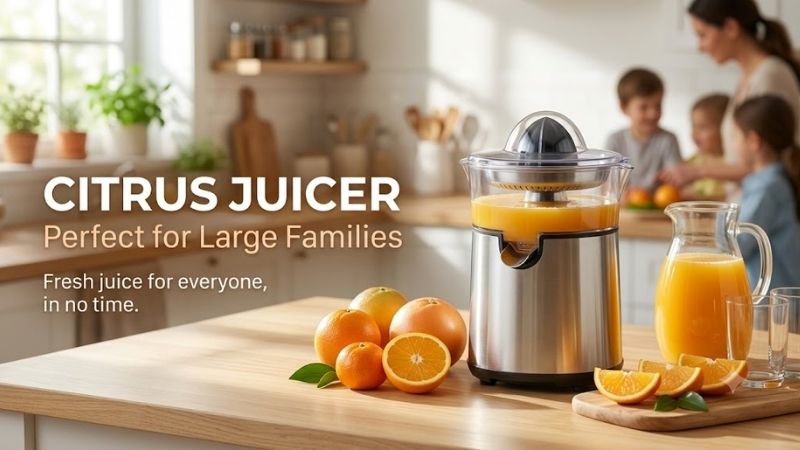
Electric reamer juicers use a rotating cone to extract juice from halved citrus fruit.
The user presses a fruit half against the cone, which rotates and separates juice from the flesh.
Juice flows through a strainer into a container or directly into a glass, depending on the design.
These machines can be relatively compact and straightforward to operate.
However, the user may still need to apply downward pressure during extraction.
For occasional family breakfasts, this may be acceptable. For large batches, repetitive hand pressure can become tiring.
Electric Press-Style Juicers
Electric press-style juicers generally use a powered reamer combined with a lever or pressing mechanism.
The lever helps apply pressure to the fruit.
This may reduce the direct hand effort required when squeezing many citrus halves.
However, the actual ergonomics depend on handle design and machine construction.
Press-style models can be taller or heavier than simple reamers.
Measure operating height and storage space before choosing one.
Manual Lever Citrus Presses
A manual lever press uses mechanical advantage rather than an electric motor.
It can be useful for preparing citrus juice without electrical power.
However, a large manual press may occupy considerable space and require substantial force.
For families, it may be convenient when several people share preparation duties.
Still, a manual press should not automatically be assumed easier to use than a motorized model.
Handheld Citrus Squeezers
Handheld squeezers are commonly used for lemons and limes.
They are compact and inexpensive compared with countertop appliances.
However, they are generally less practical for processing large quantities of oranges or grapefruits.
For a large family that only uses lemon juice in cooking, a handheld tool may be adequate.
For multiple glasses of orange juice, a countertop citrus juicer is usually more convenient.
Citrus Juicer vs. Other Juicer Types
| Juicer Type | Main Purpose | Large-Family Consideration |
|---|---|---|
| Electric citrus reamer | Juice halved citrus fruits | Practical for regular citrus-only preparation |
| Electric citrus press | Juice citrus with assisted pressing | Worth considering for frequent larger batches |
| Manual citrus press | Juice citrus without electricity | Can be sturdy but requires physical effort |
| Centrifugal juicer | Extract juice from various fruits and vegetables | More versatile, but typically requires greater preparation and cleaning |
| Masticating juicer | Extract juice from a range of produce | Versatile but not necessarily the simplest solution for citrus |
| Handheld citrus squeezer | Extract small quantities | Better for cooking or individual servings |
If your family mainly drinks orange juice, a dedicated citrus juicer may be easier to maintain than a multipurpose juicing machine.
If you regularly prepare juice from carrots, celery, apples, or leafy greens, a citrus-only machine will not meet those needs.
Estimating Juice Capacity for Your Family
Start With Serving Size
Capacity should be based on how much juice your family actually drinks.
As a planning example, six people drinking 6 fluid ounces each would require 36 fluid ounces of finished juice.
That is 4.5 US cups.
However, this is only a serving calculation. It does not tell you how many oranges are necessary.
Juice yield varies with fruit size, variety, ripeness, temperature, and extraction method.
Avoid relying on a fixed number of oranges per glass.
Collection Pitcher Capacity
Some electric citrus juicers include a built-in collection pitcher.
Others dispense juice through a spout into a separate container.
A large integrated pitcher can reduce interruptions.
However, it may also increase appliance size.
For large families, a direct-spout model may be useful if you can place an appropriately sized pitcher beneath the outlet.
Check spout height and container clearance.
Continuous Juicing Capability
A juicer that works well for one glass may be inconvenient when preparing several.
Some compact motors have limited continuous operating periods.
Others are designed for longer sessions.
Review the manufacturer’s duty-cycle instructions.
An appliance that requires frequent cooling breaks may not suit large-batch preparation.
Fruit Preparation Time
Even an efficient juicer requires fruit preparation.
Citrus fruits generally need washing and cutting before extraction.
A model that accepts large halves conveniently may save handling time.
However, more powerful extraction does not eliminate preparation or cleanup.
Evaluate the complete workflow rather than only the motor.
Choosing the Right Juicing Cone
Cone Size
Cone size influences how well fruit halves contact the extraction surface.
A small cone may be appropriate for lemons and limes.
A larger cone may work better with oranges or grapefruits.
Some appliances include multiple interchangeable cones.
Others use a cone shape intended to accommodate several citrus sizes.
Check the range of fruit sizes you regularly prepare.
Interchangeable Cones
Multiple cones can improve flexibility when your family uses different citrus fruits.
However, they create additional pieces to clean and store.
For households that only juice oranges, a single well-matched cone may be sufficient.
Cone Rotation
Some reamer designs include automatic reverse rotation or other movement patterns.
These features may influence extraction behavior.
However, they do not guarantee higher juice yield.
The relationship between cone geometry, fruit pressure, and strainer design matters.
Avoid accepting unsupported claims that a specific rotation pattern extracts a fixed percentage more juice.
Avoiding Excessive Pressure
Pressing very hard against the cone does not necessarily improve results.
It may stall the motor or create undesirable bitterness by disturbing more of the fruit’s non-juice components.
Use the amount of pressure recommended by the manufacturer.
If extraction requires uncomfortable force, the design may not be suitable for frequent family use.
Pulp Control and Juice Texture
Why Pulp Preferences Matter
Family members may prefer different juice textures.
Some like substantial pulp, while others prefer smoother juice.
A juicer with adjustable pulp control can make it easier to accommodate these preferences.
However, pulp settings vary widely.
A model described as adjustable may offer only limited control.
Strainer Design
The strainer separates juice from seeds and larger fruit particles.
Its openings influence how much pulp passes into the finished drink.
Fine strainers may produce a smoother texture but may clog more quickly.
Coarser strainers can allow more pulp through.
Consider cleaning access because citrus pulp can collect in narrow mesh openings.
Managing Seeds
Citrus seeds should be kept out of the finished juice when practical.
A suitable strainer helps collect them.
However, not every strainer captures every small seed.
Inspect juice before serving, particularly to young children.
Reducing Clogging During Large Batches
Processing many citrus halves can fill the strainer with pulp.
A removable pulp basket or easily accessible strainer is useful.
Do not attempt to clear clogged components while the motor is operating.
Stop the appliance and follow its cleaning instructions.
Understanding Juice Yield
Why Yield Varies
Juice yield depends on the fruit and appliance.
A large, juicy orange may produce more juice than a dry orange of similar external size.
Extraction technique also matters.
However, it is not accurate to claim that one category of citrus juicer always produces more juice than another without controlled comparisons.
How to Compare Extraction Efficiency
When evaluating specific models, look for tests using comparable fruit quantities and varieties.
A useful comparison should account for fruit weight and finished juice volume.
Tests using completely different oranges cannot reliably establish appliance efficiency.
Dry Pulp vs. Useful Juice
Dryer remaining pulp may suggest more liquid has been extracted.
However, it does not independently establish better flavor or overall value.
Excessive extraction pressure may also affect taste.
Evaluate yield alongside juice quality and operating effort.
Does More Expensive Mean Better Juice?
Not necessarily.
Premium construction may improve durability or comfort.
However, price does not guarantee superior flavor or extraction.
For many families, convenient cleaning and suitable batch capacity may matter more than marginal differences in yield.
Motor Power and Everyday Performance
Understanding Wattage
A juicer’s motor rating describes electrical input, not finished juice quality.
Higher wattage does not automatically guarantee better extraction.
Motor torque, cone design, transmission, and thermal protection all matter.
Choose an appliance rated for your intended workload.
Motor Heat and Cooling
Repeated juicing can warm the motor.
Some machines require operating breaks.
Follow the duty-cycle limits.
Do not continue using a machine that stalls, smells unusually hot, or shows signs of electrical trouble.
Noise
Electric juicers produce sound from the motor and fruit contact.
Noise varies by construction and operating load.
A quiet model may be desirable for early family breakfasts, but marketing descriptions such as whisper quiet are not reliable measurements.
Look for credible sound testing when noise is a major concern.
Stability
A large batch may involve repeated pressing.
A stable base and secure feet can reduce movement.
A heavy appliance may resist shifting but be more difficult to store.
Find a balance between stability and portability.
Cleaning After Family-Sized Batches
Removable Food-Contact Parts
The cone, strainer, pulp collector, and juice container should be accessible for cleaning.
Citrus pulp can dry and become difficult to remove.
A practical juicer should allow these components to be washed without complicated disassembly.
Dishwasher Compatibility
Some removable components may be dishwasher safe.
Others require handwashing.
Follow manufacturer instructions.
Do not assume that all plastic citrus juicer components tolerate high-temperature dishwasher cycles.
Pulp Strainers
Strainers can trap fibers and seeds.
Use a manufacturer-approved brush or soft cleaning tool.
Avoid forcing sharp objects through mesh openings.
Damaged strainers may allow seeds or large particles into the juice.
Cleaning the Juice Spout
Direct-spout designs can accumulate sticky citrus residue.
Choose a model with accessible spout surfaces.
Clean and dry the dispensing area after use.
Cleaning the Motor Base
Disconnect the appliance before cleaning.
Wipe the motor housing according to the manual.
Do not immerse the electrical base.
Fresh Citrus Juice and Food Safety
Wash Fruit Before Cutting
Wash citrus fruits thoroughly under running water before cutting, even when you do not intend to consume the peel.
A knife can transfer contamination from the exterior into the fruit.
Do not use soap, household detergent, or ordinary commercial cleaning products to wash produce.
Wash hands and food preparation surfaces as well.
Fresh-Squeezed Juice Is Usually Untreated
Home-squeezed juice is not ordinarily pasteurized.
Bacteria from fresh produce can enter the finished juice.
This matters particularly for young children, pregnant people, older adults, and people with weakened immune systems.
For those at greater risk of serious foodborne illness, pasteurized juice is generally the safer option.
Refrigerate Juice Promptly
Fresh juice should be prepared and stored hygienically.
Refrigerate promptly at 40°F or below.
Avoid leaving a large pitcher on the breakfast table for extended periods.
The general two-hour rule for perishable foods is a useful maximum, reduced to one hour when temperatures exceed 90°F.
Do Not Confuse Freshness With Sterility
A freshly squeezed drink is not guaranteed free of harmful microorganisms.
Taste, smell, and appearance cannot reliably establish microbiological safety.
Proper fruit handling and refrigeration are essential.
Consider Portion Size
Juice can contribute vitamins and other nutrients, but it does not offer the same fiber content as whole citrus fruit.
Large families should not assume that increasing juice consumption is always nutritionally preferable.
Whole fruit remains a useful option for everyday meals.
Choosing for Different Family Situations
Families With Young Children
Prioritize stable operation, safe storage, and easy cleaning.
Keep the motor and pressing mechanism away from children during use.
Consider whether untreated fresh juice is appropriate for every family member.
Families With Teenagers
A straightforward electric reamer may make self-service preparation more convenient.
However, younger users still need suitable instructions and supervision when appropriate.
Families That Juice Every Morning
Daily use places greater importance on comfortable operation, duty cycle, and cleanup.
A model that saves a few seconds during extraction but requires extensive washing may not be worthwhile.
Families That Entertain Frequently
A larger collection container or direct-spout system can simplify preparing juice for several guests.
Consider serving vessels, refrigeration capacity, and how far ahead the juice can be prepared safely.
Families With Limited Kitchen Space
A compact reamer may be more practical than a large lever press.
If the appliance must be stored after every use, compare weight and component count.
Cost and Long-Term Ownership
Budget Electric Reamers
Simple reamers may be sufficient for occasional use.
However, evaluate cleaning, stability, and motor operating limits.
Higher-Capacity Models
More substantial juicers may provide better ergonomics or handling for longer sessions.
However, greater size and price should be justified by regular use.
Replacement Parts
Strainers, cones, and collection containers can become damaged or misplaced.
Check replacement availability.
Fruit Costs
Fresh citrus juice requires considerable fruit.
For a large family, ongoing fruit expenses may exceed the cost of the appliance over time.
Consider how frequently you want freshly squeezed juice compared with buying pasteurized juice or serving whole fruit.
Common Buying Mistakes
Choosing a Tiny Juice Container
Frequent emptying can interrupt family breakfast preparation.
Ignoring Motor Duty Cycle
Small appliances may not support long continuous sessions.
Buying Based Only on Wattage
Electrical power does not establish extraction efficiency.
Overlooking Pulp Cleanup
A difficult-to-clean strainer can make daily juicing inconvenient.
Treating Fresh Juice as Automatically Safer
Unpasteurized juice can contain harmful bacteria.
Buying a Large Press Without Measuring Storage
Tall lever presses may not fit beneath kitchen cabinets.
Frequently Asked Questions
What Type of Citrus Juicer Is Best for a Large Family?
An electric reamer or press-style citrus juicer with suitable batch capacity, comfortable operation, and easy cleaning is a practical category to consider.
How Much Juice Can I Get From One Orange?
Yield varies significantly with orange size, variety, ripeness, and extraction method. Estimate using your usual fruit rather than assuming a fixed amount.
Is a Citrus Juicer Better Than a Regular Juicer?
A dedicated citrus juicer may be simpler for oranges, lemons, limes, and grapefruit. A multipurpose juicer is more appropriate when you also want juice from other produce.
Do I Need Adjustable Pulp Control?
It is useful when household members prefer different pulp levels, but not essential for everyone.
Can I Make Juice for the Entire Week?
Fresh unpasteurized juice has food-safety limitations and should not be assumed safe for a week of refrigerated storage. For extended planning, consider pasteurized options or validated freezing practices.
Are Electric Citrus Juicers Dishwasher Safe?
Some removable components are dishwasher safe, but the motor base generally is not. Follow the exact model’s cleaning instructions.
Conclusion
The best citrus juicer for large families should prepare enough juice for normal breakfast portions without excessive squeezing effort, interruptions, or cleanup. An electric reamer is often a practical starting choice, while a press-style model may suit frequent large batches. Compare cone sizes, collection capacity, pulp control, motor duty limits, and cleaning access, and handle fresh juice with the same food-safety care as other perishable ingredients.









Write Your Review
No reviews yet. Be the first to share your experience!