
A sous vide cooker for small spaces can help prepare precisely controlled meals without a large countertop appliance. Compact immersion circulators are particularly useful in apartments because they can work with suitable existing containers. However, water depth, electrical access, temperature control, and safe cooking procedures are essential. This guide explains how to choose a practical setup for a small kitchen.
- Quick Verdict: Which Sous Vide Cooker Is Best for a Small Kitchen?
- Understanding Sous Vide Cooking Equipment
- Choosing the Right Size
- Heating and Temperature Performance
- Essential Food Safety Considerations
- Everyday Small-Kitchen Applications
- Cleaning and Maintenance
- Common Buying Mistakes
- Frequently Asked Questions
- Conclusion
Quick Verdict: Which Sous Vide Cooker Is Best for a Small Kitchen?
For most small kitchens, a compact immersion circulator with straightforward temperature controls, secure mounting, and compatibility with an appropriately sized cooking pot is the most practical starting point.
Unlike a countertop water-bath machine, an immersion circulator typically does not require a permanently dedicated vessel.
After cooking, the device and container can be cleaned, dried, and stored separately.
The most important buying factors are:
| Feature | Why It Matters | Priority |
|---|---|---|
| Circulator dimensions | Determines storage convenience | High |
| Container compatibility | Allows use of appropriate existing cookware | Essential |
| Minimum water depth | Determines suitable pot sizes | Essential |
| Heating capacity | Affects supported water volume | High |
| Temperature control | Supports recipe requirements | Essential |
| Mounting mechanism | Keeps the device securely positioned | Essential |
| Controls | Determines ease of operation | High |
| Cleaning access | Supports maintenance | High |
Avoid choosing a cooker solely because it is physically small. It must also circulate sufficient water around the packaged food and maintain the temperature required by the recipe.
Understanding Sous Vide Cooking Equipment
How Does an Immersion Circulator Work?
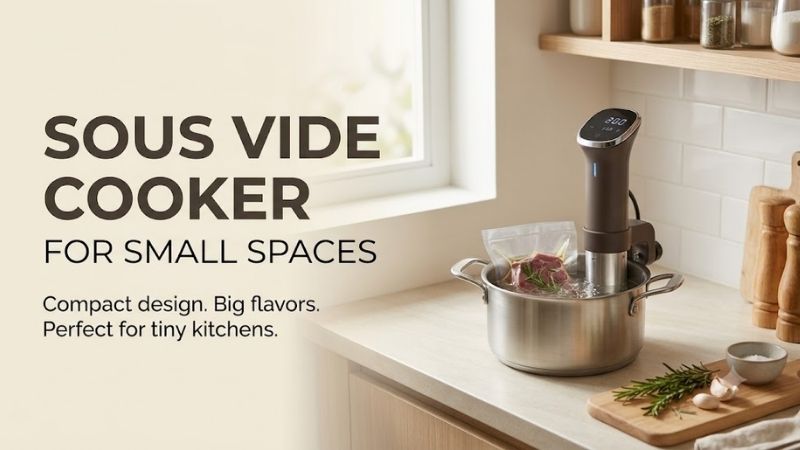
An immersion circulator heats water and circulates it through a cooking container.
The appliance uses a temperature sensor and heating control system to maintain a selected water-bath temperature.
Food is placed inside suitable cooking packaging and submerged according to the recipe and equipment instructions.
This controlled environment can reduce large temperature differences between the water bath and food surface.
However, internal food temperature depends on food thickness, starting temperature, circulation, and cooking duration.
A precisely controlled water bath does not automatically mean every food item is safe to eat.
Immersion Circulator vs. Countertop Water Bath
A countertop water-bath machine generally includes its own cooking vessel and heating system.
An immersion circulator attaches to a compatible pot or container.
| Feature | Immersion Circulator | Integrated Water-Bath Cooker |
|---|---|---|
| Storage | Device and container can be separated | Usually stored as a complete appliance |
| Container | Separate suitable vessel required | Built-in or supplied vessel |
| Flexibility | Depends on supported water volume | Limited by integrated capacity |
| Counter space | Depends on chosen pot | Fixed appliance footprint |
| Water circulation | Integrated into many models | Depends on specific design |
| Cleaning | Device and vessel require separate care | Depends on integrated construction |
An immersion circulator generally offers greater flexibility for small kitchens.
However, it still needs adequate operating space, safe mounting, and an appropriate electrical outlet.
Does Sous Vide Require Vacuum Sealing?
Not every sous vide recipe requires a machine-generated vacuum.
Some approved cooking methods use appropriately rated food-safe bags with air displaced through a controlled water-displacement process.
However, packaging must remain suitable for the intended cooking temperature and duration.
Never assume that ordinary storage bags are appropriate for prolonged heated-water cooking.
Follow the bag manufacturer’s specifications and a validated recipe.
Choosing the Right Size
Measure the Circulator
Compare the device’s height, width, and storage requirements.
A relatively slim circulator may be easier to store in a drawer or cabinet.
However, some models have large controls or mounting clamps.
Measure the complete unit rather than only the heating shaft.
Check Minimum Water Depth
Every immersion circulator has specified minimum and maximum water levels.
A shallow saucepan may not provide enough depth.
If water falls below the minimum level, the device may stop operating or fail to circulate correctly.
Choose a pot that accommodates the circulator and food while meeting its water requirements.
Choose a Suitable Container
A compatible stockpot may eliminate the need to purchase a dedicated sous vide container.
The vessel must have suitable heat resistance, sufficient depth, and stable construction.
It also needs enough room for water to circulate around the packaged food.
Do not overcrowd the container.
Consider Operating Clearance
The circulator’s upper controls and electrical components must remain protected from splashing and inappropriate heat exposure.
Follow the manufacturer’s mounting instructions.
Do not operate the device in a location where it can fall into water or be pulled from the vessel.
Heating and Temperature Performance
Temperature Accuracy
Temperature control is a central feature of sous vide cooking.
However, manufacturer-advertised accuracy does not necessarily establish uniform temperature throughout every container.
Performance depends on circulation, sensor calibration, container size, and water volume.
Compare independent measurements when available.
For safety-critical cooking, follow validated time-temperature instructions rather than relying only on an attractive precision claim.
Heating Capacity
A circulator’s electrical power rating can help identify the water volumes it is designed to heat.
However, higher wattage does not automatically guarantee better temperature stability or faster cooking under every condition.
Starting water temperature, container insulation, room temperature, and water quantity matter.
Choose a model rated for the amount of water you normally use.
Water Circulation
Circulation helps distribute heated water around the container.
If bags block the water intake or outlet, performance can suffer.
Choose an arrangement that allows adequate movement.
Some recipes benefit from suitable racks or clips that keep bags separated.
Only use accessories approved for the cooking setup.
Controls and Connectivity
Some circulators have built-in displays and buttons.
Others emphasize smartphone control.
For beginners, direct on-device controls can be convenient.
App-based systems may provide recipes or additional monitoring features, but they can also introduce software dependencies.
Do not purchase connectivity features unless they solve a real problem.
Essential Food Safety Considerations
Time and Temperature Work Together
Sous vide cooking often uses temperatures lower than those associated with conventional rapid cooking.
Food safety therefore depends on both temperature and sufficient time at the appropriate internal temperature.
A bath reaching its target setting does not prove that the center of a thick food item has reached that temperature.
Thickness, starting temperature, and heating duration must be considered.
Use validated recipes from reliable food-safety authorities or recognized technical cooking references.
Avoid Unvalidated Low-Temperature Recipes
Do not improvise long cooking periods at low temperatures.
Food may spend excessive time in conditions that permit harmful microbial growth.
Particularly vulnerable individuals, including pregnant people, older adults, young children, and people with weakened immune systems, may need additional precautions.
When uncertain, use conventional USDA-recommended cooking temperatures and appropriate cooking methods.
Packaging Safety
Use bags or containers explicitly suitable for sous vide cooking.
Never use packaging that lacks appropriate temperature and food-contact documentation.
Damaged seals may allow water into the package.
Inspect bags before use.
Cooling and Storage
If sous vide food will not be served immediately, rapid cooling and appropriate refrigeration are essential.
Reduced-oxygen packaging can create particular food-safety concerns during storage.
Home cooks should not assume that vacuum-sealed sous vide meals can be refrigerated for extended periods without a validated process.
Everyday Small-Kitchen Applications
Cooking Individual Protein Portions
A compact circulator can be useful for preparing suitable single portions.
However, the recipe must account for food type and thickness.
Use the correct time-temperature procedure.
For unfamiliar ingredients, choose an established validated recipe rather than experimenting with very low temperatures.
Preparing Vegetables
Some vegetables require relatively high cooking temperatures compared with certain protein preparations.
Choose a circulator and container capable of supporting the required conditions.
Do not assume that a setting suitable for meat will soften every vegetable.
Preparing Meals Ahead
Sous vide can fit certain meal-prep routines.
However, preparation, packaging, cooking, cooling, and refrigeration all require time.
For small households, the process may be worthwhile when consistency matters.
For quick everyday meals, conventional stovetop cooking may be simpler.
Finishing Food After Cooking
Some sous vide recipes involve searing food after the water bath.
A suitable skillet or other cooking appliance may therefore still be required.
Sous vide does not automatically replace every cooking step.
Account for the extra equipment when evaluating kitchen space.
Cleaning and Maintenance
Mineral Scale
Mineral deposits may accumulate on heating elements and other water-contact components.
Follow the manufacturer’s descaling instructions.
Avoid unauthorized disassembly or harsh chemicals.
Water Contact and Electronics
Only the designated portion of an immersion circulator should be submerged.
Keep electrical controls and connectors dry according to the manual.
Never immerse the entire appliance unless explicitly approved.
Drying Before Storage
Allow the device to cool.
Clean and dry it as instructed.
Do not store it with standing water in inaccessible components.
Container Cleaning
Wash the cooking vessel and compatible accessories after use.
Check for leaking food packages that may have contaminated the water bath.
Common Buying Mistakes
Choosing the Smallest Pot Available
A pot must meet minimum water-depth requirements and provide room for circulation.
Assuming Precise Water Temperature Guarantees Safety
Internal food temperature and holding time still matter.
Buying Incompatible Bags
Only appropriate food-contact packaging should be used for heated-water cooking.
Ignoring Water Evaporation
Long cooking cycles can lose water through evaporation.
Follow the manufacturer’s instructions for maintaining safe water levels.
Assuming Every Circulator Is Fully Waterproof
Electrical housings and controls often have strict water-exposure limits.
Frequently Asked Questions
Is a Sous Vide Cooker Worth It for a Small Apartment?
It can be, particularly when you value controlled cooking and can use an existing suitable pot. However, it requires safe counter space and storage for packaging accessories.
Do I Need a Special Sous Vide Container?
Not always. A compatible pot may work if it meets the circulator’s requirements.
Can I Use an Immersion Circulator With an Induction Pot?
A suitable induction-compatible pot can sometimes serve as the water container. The induction cooktop does not normally need to be operating when the circulator provides the heat.
Do I Need a Vacuum Sealer?
Not necessarily, but you do need packaging approved for the cooking conditions and a method that keeps food appropriately submerged.
Is Sous Vide Cooking Safe?
It can be safe when validated time-temperature procedures, suitable packaging, and proper storage are followed. Improvised low-temperature cooking can create risks.
Can I Leave a Sous Vide Cooker Running Overnight?
Only when the device, recipe, and setup support the duration and all safety requirements are met. Never ignore water-level limits or food-safety guidance.
Conclusion
The best sous vide cooker for small spaces is usually a compact immersion circulator that works securely with a suitable existing pot. Prioritize minimum water depth, dependable controls, adequate circulation, and practical cleaning over additional smart features. Most importantly, use validated cooking procedures and appropriate packaging, because accurate water temperature alone does not guarantee safe food.
Write Your Review
No reviews yet. Be the first to share your experience!