
An electric chopper for dorm rooms can help students prepare vegetables, sauces, dips, and simple ingredients without the space required for a full-size food processor. However, dormitory rules, available refrigeration, electrical access, and cleaning facilities matter as much as chopping performance. This guide explains how to choose a compact food chopper that fits student life safely and practically.
- Quick Verdict: What Electric Chopper Should Students Buy?
- Understanding Electric Food Choppers
- Checking Dormitory Appliance Rules
- Choosing the Right Bowl Capacity
- Blade Design and Chopping Quality
- Motor Power and Performance
- Corded vs. Rechargeable Electric Choppers
- Everyday Dorm-Friendly Food Preparation
- What an Electric Chopper Should Not Be Used For
- Blade Safety and Handling
- Cleaning and Storage
- Budget and Long-Term Value
- Common Buying Mistakes
- Frequently Asked Questions
- Conclusion
Quick Verdict: What Electric Chopper Should Students Buy?
A compact electric food chopper with a removable bowl, secure blade assembly, straightforward pulse control, and manageable storage dimensions is a practical option for students who have permission to operate one.
A capacity around 1.5 to 3 cups is a useful category to compare for small ingredient-preparation tasks, although the exact choice depends on serving size and the appliance’s usable fill limits.
Before purchasing, check the university’s housing regulations. Some colleges allow small blenders and food processors, while others restrict them or require their use in designated kitchens.
| Buying Factor | Recommended Priority | Reason |
|---|---|---|
| Residence-hall permission | Essential | Determines whether the appliance can be used |
| Bowl capacity | High | Matches individual meal portions |
| Pulse control | High | Helps manage chopping texture |
| Blade safety | Essential | Reduces handling hazards |
| Removable components | High | Makes washing more practical |
| Compact dimensions | High | Fits limited student storage |
| Noise | Useful | Matters in shared living spaces |
| Electrical requirements | Essential | Supports safe operation |
| Replacement parts | Useful | Improves long-term usability |
A smaller chopper is often sufficient for onions, peppers, herbs, and basic sauces. However, it should not be treated as a blender, meat grinder, or all-purpose food processor unless the manufacturer supports those functions.
Understanding Electric Food Choppers
What Is an Electric Chopper?
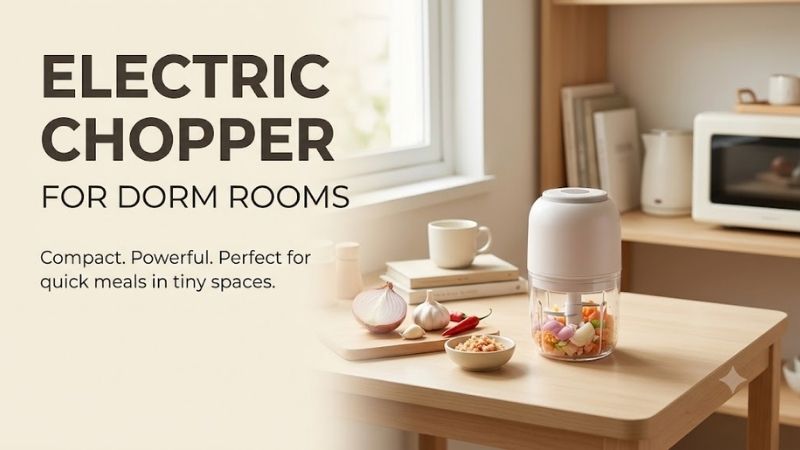
An electric food chopper is a motorized appliance that uses rotating blades to cut food into smaller pieces.
Its main purpose is ingredient preparation rather than cooking.
Many compact designs have a removable bowl that fits onto a powered base. Others position the motor in a removable top assembly.
The appliance may support chopping, mincing, or certain mixing tasks depending on its construction.
However, the term food chopper does not guarantee that the machine can make smooth purees, crush ice, knead dough, or grind raw meat.
Electric Chopper vs. Food Processor
A full-size food processor may accommodate larger quantities and support additional tasks such as slicing, shredding, or dough preparation.
A mini chopper generally focuses on simple blade-based preparation.
| Feature | Mini Electric Chopper | Full-Size Food Processor |
|---|---|---|
| Storage footprint | Usually smaller | Generally larger |
| Ingredient volume | Limited | Often greater |
| Basic chopping | Common | Common |
| Slicing discs | Uncommon | Available on certain models |
| Dough preparation | Usually limited | Available on suitable machines |
| Cleaning | Fewer components in simple designs | More accessories may require washing |
| Student suitability | Convenient when permitted | May be unnecessarily bulky |
For basic dormitory meal preparation, a small chopper may be more appropriate than a full-size processor.
Electric Chopper vs. Blender
Blenders are generally designed around moving ingredients through a blade system, often for beverages, sauces, and other mixtures.
Mini choppers are more directly suited to cutting small quantities of relatively solid ingredients.
Some tasks overlap, but results can differ.
For example, a chopper may create a coarse salsa, while a blender may produce a smoother mixture.
If smoothies are your primary goal, a suitable personal blender may be more useful.
Checking Dormitory Appliance Rules
Are Electric Choppers Allowed in Dorm Rooms?
There is no universal rule across colleges.
Some residence halls permit enclosed-blade appliances such as blenders and small food processors. Others restrict specific models or require that food preparation occur in communal kitchens.
A device being small or battery-powered does not automatically make it permitted.
Check the current housing handbook for your exact residence hall.
If the rules are unclear, ask the housing office before purchasing.
Bedroom Use vs. Shared-Kitchen Use
An institution may allow possession of a food chopper but require operation in a shared kitchen.
This distinction affects convenience.
If you must carry the appliance between your room and a kitchen, weight, cord storage, and a securely assembled bowl become more important.
A machine that is easy to move and wash may be more practical than a larger model with several attachments.
Shared-Room Noise
Electric choppers can produce noticeable noise during operation.
Noise depends on motor construction, bowl design, ingredients, and surface placement.
A higher wattage rating does not establish how loud the appliance will be.
Students sharing a room should consider operating the chopper during appropriate hours and in permitted locations.
Avoid placing it on unstable furniture that could increase vibration.
Refrigeration and Food Preparation
A chopper does not preserve food.
Freshly chopped ingredients and prepared dips may require refrigeration.
If your dorm room has limited refrigerator space, plan small portions that can be used promptly.
Do not prepare large batches of perishable food without a safe storage arrangement.
Choosing the Right Bowl Capacity
One-Cup and Very Small Choppers
A very small chopper may be convenient for garlic, herbs, small amounts of onion, or other limited tasks.
However, its usable volume may be restrictive.
Ingredients can become overcrowded, reducing chopping consistency.
Very small models may require several batches to prepare a complete recipe.
Choose one only when your normal tasks are genuinely small.
Around 1.5 to 3 Cups
This is a practical category for students preparing modest amounts of chopped vegetables, salsa, or similar ingredients.
It can offer more flexibility without requiring the footprint of a full-size processor.
However, nominal bowl capacity does not equal maximum recommended working volume for every ingredient.
Check the appliance’s fill markings and manual.
Larger Mini Choppers
Some compact food choppers offer capacities above 3 cups.
These may be useful for students sharing meals with roommates.
However, they require additional storage and cleaning space.
If you mainly prepare single servings, additional capacity may provide little benefit.
How to Estimate the Capacity You Need
Think about three common recipes you prepare.
For example, a student might regularly chop half an onion for dinner, prepare a small batch of salsa, and mince herbs for a sauce.
The ideal chopper should accommodate the largest normal task without excessive crowding.
For occasional larger recipes, working in two batches may be acceptable.
Buying for everyday use is generally more sensible than choosing the largest available bowl for rare situations.
Blade Design and Chopping Quality
Stainless Steel Blade Assemblies
Many compact choppers use stainless steel blades.
However, material alone does not establish cutting performance.
Blade shape, sharpness, motor behavior, bowl geometry, and ingredient quantity all affect the result.
A powerful motor paired with an ineffective blade arrangement may still produce inconsistent chopping.
Look for credible demonstrations involving the foods you actually prepare.
Pulse Control
Pulse operation provides short bursts of chopping.
This is useful when you want diced or coarsely chopped ingredients instead of a puree.
For example, several short pulses may offer more control when preparing onion pieces for tacos.
However, the exact number of pulses depends on ingredient size and machine design.
Do not rely on universal pulse counts.
Continuous Operation
Some choppers allow continuous running.
This can help with certain mixtures but may quickly turn soft ingredients into a paste.
If you regularly make chunky salsa or vegetable toppings, pulse control is particularly valuable.
A machine offering only continuous operation may be less forgiving for beginners.
Multi-Level Blades
Certain designs have blades positioned at different heights.
These may help move ingredients through the bowl.
However, more blades also mean more cutting edges to clean and handle.
Do not assume that an elaborate blade stack is automatically more effective than a simpler assembly.
Motor Power and Performance
Does Higher Wattage Mean Better Chopping?
Not necessarily.
Wattage describes electrical input, not the complete cutting performance of the appliance.
Results depend on motor torque, blade geometry, bowl size, and ingredient characteristics.
For soft vegetables and herbs, extreme power is rarely necessary.
For tougher ingredients, it is better to choose a machine whose manufacturer explicitly supports those tasks rather than relying only on wattage.
Operating Time Limits
Small electric choppers may have relatively short permitted run times.
A compact motor can overheat if operated continuously beyond its design limits.
Follow the manufacturer’s maximum run duration and cooling instructions.
Do not repeatedly force an overloaded motor to operate.
Overload Protection
Some devices include overload or overheating protection.
This may help protect the motor under abnormal conditions.
However, it does not mean you can ignore capacity limits.
A stalled motor, unusual noise, or burning smell should be treated as a reason to stop operation and follow troubleshooting instructions.
Corded vs. Rechargeable Electric Choppers
Corded Models
Corded choppers are convenient when a suitable outlet is available.
They avoid concerns about battery charge during food preparation.
However, students need to consider cord placement near sinks and shared preparation areas.
Follow the manufacturer’s electrical requirements.
Rechargeable Models
Rechargeable choppers can reduce the need for a nearby outlet during operation, where the manufacturer permits cordless use.
They may be useful in approved communal kitchens with limited convenient outlets.
However, battery performance and charging requirements vary.
Check the charging connector, replacement policy, and cleaning restrictions.
Which Type Is Better for Dorm Living?
A corded model is often straightforward for a designated kitchen.
A rechargeable model may be more convenient for portable preparation but can introduce battery maintenance.
Housing permission, blade safety, and cleaning convenience are more important than choosing cordless operation by default.
Everyday Dorm-Friendly Food Preparation
Chopping Onions and Garlic
A compact chopper can reduce manual cutting time for recipes that require finely chopped onions or garlic.
However, chopping results depend on the amount loaded.
Overfilling can leave large pieces near the top while ingredients near the blades become overly fine.
Work in suitable portions and use pulse control.
Preparing Fresh Salsa
Tomatoes, onions, peppers, and herbs can be combined in a suitable chopper.
However, tomatoes release liquid and can become overly smooth if processed too long.
Use short pulses and check the texture.
Refrigerate prepared salsa promptly when appropriate.
Do not assume freshly chopped salsa is shelf stable.
Making Pesto-Style Sauces
Certain choppers support suitable herb-based sauces.
However, nuts, cheese, and oil may have model-specific requirements.
Follow recipes and appliance instructions.
A very small bowl can make it difficult to achieve an even mixture.
If the chopper is not designed for thick pastes or nuts, use another approved appliance.
Preparing Vegetables for Shared Meals
A chopper may help prepare vegetables for soups, rice dishes, and other meals cooked in approved facilities.
However, it does not replace a cutting board and knife for every task.
Large or hard vegetables may need preliminary cutting.
Never insert whole ingredients larger than the supported size.
Mixing Small Dips
Some choppers can prepare hummus-style dips or other mixtures, depending on motor capacity and approved use.
However, thick ingredients may overload small machines.
Add liquids only when permitted, and do not exceed the maximum fill line.
A blender or larger processor may be more appropriate for frequent thick mixtures.
What an Electric Chopper Should Not Be Used For
Unsupported Ice Crushing
Not every chopper is designed for ice.
Ice can stress blades, motors, and bowls.
Only attempt ice crushing when the manufacturer explicitly permits it.
Grinding Raw Meat
Some specialized choppers support certain meat-processing tasks.
However, a standard mini vegetable chopper should not automatically be treated as a meat grinder.
Raw meat introduces additional cleaning and food-safety requirements.
Processing Hot Liquids
Many plastic bowls and lids are not designed for hot liquids.
Heat can damage components or create pressure and splash hazards.
Allow ingredients to cool when required, and follow the appliance’s temperature limits.
Leaving the Machine Unattended
A chopper should only operate according to its intended control system.
Do not bypass safety locks or leave the appliance running unattended.
Blade Safety and Handling
Lid Interlocks
Some food choppers include mechanisms that prevent operation unless the bowl and lid are correctly installed.
This is a valuable safety feature.
However, no interlock removes the need for careful handling.
Never tamper with the mechanism.
Removing the Blade
Detachable blades can be extremely sharp.
Follow the manufacturer-approved removal procedure.
Avoid gripping cutting edges.
Place removed blades where they cannot fall or be accidentally touched.
Cleaning Around the Blade
Do not reach blindly into a sink containing loose blades.
Clean and dry them separately using an approved method.
Store the blade in a protective arrangement when provided.
Shared Kitchen Safety
Roommates may not be familiar with the appliance.
Avoid allowing inexperienced users to operate it without instructions.
Keep the device away from the edge of shared countertops.
Cleaning and Storage
Removable Bowls
A removable bowl is important because it allows food residue to be washed away without exposing the motor to water.
Check dishwasher compatibility.
Some bowls require handwashing or have temperature limits.
Lid Seals and Crevices
Food can accumulate around lid seals and attachment points.
Inspect these areas after use.
A bowl that looks clean from the outside may still contain residue around the central spindle.
Electrical Components
Never immerse the motor base or electrical top assembly unless explicitly approved.
Use the manufacturer’s cleaning instructions.
Storage in a Dorm Room
Store the appliance where it cannot be knocked over.
Keep blades protected.
Avoid placing heavy objects on plastic bowls or lids.
Check that all components are dry before storage.
Budget and Long-Term Value
Low-Cost Mini Choppers
A basic model may be sufficient for occasional vegetables and herbs.
However, assess blade safety, bowl replacement options, and cleaning access.
A low price is not worthwhile if the appliance is difficult to maintain.
Midrange Features
A larger bowl, additional speed control, or removable blade system may provide value.
However, only pay for functions you expect to use.
Replacement Bowls and Blades
Accidents can happen in shared housing.
Check whether compatible replacement components are available.
A model with replaceable parts may be more economical over time.
Manual Alternatives
A knife and cutting board may be sufficient for students who rarely prepare chopped ingredients.
Manual pull choppers can also be considered when electricity or appliance permission is an issue, although blade handling and cleaning remain important.
Common Buying Mistakes
Ignoring Dormitory Rules
An appliance can be safe in a home kitchen yet prohibited in a specific residence hall.
Choosing a Bowl That Is Too Small
Repeated batches can reduce convenience.
Assuming Every Chopper Makes Smooth Purees
A mini chopper may be optimized for chopping rather than blending.
Overlooking Cleaning Facilities
A chopper is inconvenient without access to appropriate washing and drying space.
Buying by Wattage Alone
Motor input does not establish actual chopping quality.
Frequently Asked Questions
Are Electric Food Choppers Allowed in Dorm Rooms?
Policies vary by university and residence hall. Check the exact housing rules before purchasing or operating one.
What Size Electric Chopper Is Good for One Student?
A compact model around 1.5 to 3 cups is a useful category to evaluate for ordinary vegetable preparation, but the best size depends on your recipes.
Can a Mini Chopper Replace a Blender?
Only for certain overlapping tasks. It may not produce smooth beverages or purees as effectively as a suitable blender.
Are Rechargeable Food Choppers Worth It?
They may be convenient when portable operation is useful, but battery endurance and replacement requirements should be considered.
Can I Use an Electric Chopper for Raw Chicken?
Only when the specific appliance explicitly supports that use. Follow raw-poultry handling and cleaning precautions.
How Do I Clean an Electric Chopper Safely?
Disconnect the appliance, remove components as instructed, handle sharp blades carefully, and wash only those parts approved for water exposure.
Conclusion
The best electric chopper for dorm rooms combines manageable capacity, controlled chopping, accessible cleaning, and safe blade handling. A compact removable-bowl model can simplify everyday ingredient preparation when the college permits its use. Prioritize housing rules, realistic meal portions, and available cleaning and refrigeration facilities before spending money on extra speeds or attachments.









Write Your Review
No reviews yet. Be the first to share your experience!