
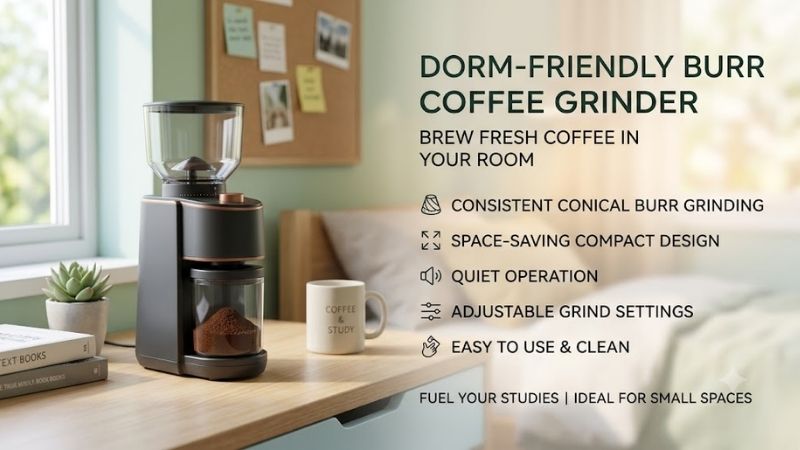
A burr coffee grinder for dorm rooms can make freshly ground coffee more accessible without requiring a large kitchen setup. However, dormitory living introduces challenges that ordinary grinder buying guides often overlook: housing restrictions, noise, limited outlets, storage, cleaning facilities, and shared spaces. This guide explains how to choose a compact burr grinder that fits student life and the coffee you actually brew.
- Quick Verdict: Which Burr Grinder Is Best for a Dorm Room?
- First: Check Your Residence Hall Rules
- Understanding Burr Coffee Grinders
- Choosing the Right Grinder Size
- Noise: A Critical Dormitory Feature
- Conical vs. Flat Burrs for Students
- Matching Grind Settings to Brewing Equipment
- Electric vs. Manual Grinders for Dorm Living
- Hopper and Bean Storage
- Grounds Retention and Dorm Cleanup
- Cleaning Without a Full Kitchen Sink
- Electrical Safety
- Choosing a Grinder on a Student Budget
- Choosing by Student Lifestyle
- Common Buying Mistakes
- Frequently Asked Questions
- Conclusion
Quick Verdict: Which Burr Grinder Is Best for a Dorm Room?
For most students who are permitted to use coffee grinders in their residence hall, a compact electric burr grinder with simple adjustment and an easy-to-clean grounds container is a practical starting point.
However, a manual burr grinder may be more suitable when counter space is extremely limited or when electrical motor noise would disturb roommates.
Before shopping, confirm the residence hall’s current appliance policy.
Some universities explicitly permit coffee grinders in student rooms, while others impose restrictions on coffee equipment or designate shared kitchens for appliance use.
| Buying Factor | Priority | Why It Matters |
|---|---|---|
| Housing permission | Essential | Determines where the grinder can be used |
| Noise | High | Protects roommate comfort |
| Compact footprint | High | Fits limited storage space |
| Burr design | High | Supports repeatable grinding |
| Grind settings | High | Must match the student’s brewing method |
| Grounds container | High | Controls coffee mess |
| Cleaning access | High | Important when sinks are shared |
| Electrical requirements | Essential | Avoids unsafe outlet use |
| Weight | Useful | Affects portability between room and kitchen |
| Price | High | Helps protect a student budget |
Best overall approach: Choose the smallest grinder that offers suitable particle-size control for your brewing method, acceptable noise, and convenient cleaning. Avoid paying for commercial-style features that your routine does not require.
First: Check Your Residence Hall Rules
Dormitory Appliance Policies Are Not Universal
A coffee grinder may be permitted in one university’s residence hall and restricted in another.
Some policies distinguish appliances with exposed heating elements from devices that operate electric motors.
Others regulate electrical power, cooking equipment, or particular appliance categories.
A burr grinder generally does not function as a cooking heater, but this does not guarantee it is permitted.
Check the current housing handbook for your specific building.
If the policy is unclear, contact residential housing staff before purchasing.
Grinder Permission Does Not Mean Coffee Maker Permission
A residence hall may allow a grinder but restrict certain coffee makers or water-heating appliances.
This distinction matters.
A grinder produces ground coffee, but a complete brewing setup may require a kettle, drip coffee maker, espresso machine, or other equipment.
Before buying, confirm that the rest of your intended coffee routine is also permitted.
If heated-water appliances are restricted to a shared kitchen, plan accordingly.
Shared-Kitchen Requirements
Some colleges require food and beverage appliances to be used in designated communal kitchens.
If you must carry the grinder between locations, choose a design that is easy to transport.
A large hopper filled with loose coffee beans may be inconvenient.
A compact grinder with a secure lid and detachable handle may work better.
However, follow the manufacturer’s instructions for transporting and storing components.
Roommate Agreements
Even when a grinder is allowed, operating it at 6:00 a.m. may disturb someone sleeping nearby.
Discuss appropriate operating times with roommates.
A grinder can be technically compliant with housing rules while still being impractical for a shared bedroom.
Noise should be treated as a central buying criterion rather than a minor comfort feature.
Understanding Burr Coffee Grinders
How Burr Grinding Works
A burr grinder passes whole coffee beans between two shaped grinding surfaces.
The burr spacing influences the resulting particle-size range.
Compared with a blade grinder, this generally provides more controllable adjustment.
However, actual results depend on burr geometry, alignment, and the grinder’s construction.
For students, consistent settings can make it easier to prepare similar coffee each morning.
Why a Burr Grinder Is Useful
Coffee extraction depends partly on grind size.
A French press generally requires a different grind from a pour-over dripper or espresso machine.
An adjustable burr grinder can provide a suitable range for several brewing methods.
However, a budget model does not automatically support traditional espresso.
Check the intended grind range before purchasing.
Burr vs. Blade Grinding
| Feature | Burr Grinder | Blade Grinder |
|---|---|---|
| Particle-size adjustment | Usually more controllable | Mainly controlled by chopping duration |
| Grind consistency | Often better | Often broader particle distribution |
| Price | Frequently higher | Often lower |
| Noise | Model-dependent | Model-dependent |
| Cleaning | Burr chamber and grounds pathway | Blade chamber |
| Espresso suitability | Certain models | Generally limited |
| Dorm convenience | Good when compact and permitted | Can be inexpensive and simple |
For a student who cares about coffee quality and brews regularly, a suitable burr grinder is generally worth evaluating.
However, a blade grinder may be adequate for an occasional user with a very limited budget.
Manual Burr Grinders
Manual grinders use a hand crank rather than an electric motor.
They can be compact and portable.
However, they require physical effort.
For students who brew one cup per day, that effort may be acceptable.
For several cups, it can become inconvenient.
Choosing the Right Grinder Size
Measure Desk and Countertop Space
Dormitory rooms often have limited surfaces.
A coffee grinder should not occupy essential study or food preparation space.
Measure the area where the machine will operate.
Also consider whether the grinder must be stored after every use.
Height Beneath Shelves
Some electric grinders have tall bean hoppers.
They may fit on a desk but interfere with overhead shelving.
Check the complete height and the clearance required to remove the hopper lid.
Grounds Container Access
A compact grinder may have a grounds container that slides forward or sideways.
Ensure that you can remove it easily.
A cramped arrangement can lead to spilled coffee grounds.
Storage in Drawers
Some manual grinders fit inside drawers.
However, measure the length including the handle.
Certain handles detach or fold, while others do not.
Store sharp or exposed grinding components safely.
Weight
A heavy grinder may be stable during use but awkward to move to a shared kitchen.
For students who need portability, manageable weight can be more useful than a large motor housing.
Noise: A Critical Dormitory Feature
Electric Motor Noise
Electric burr grinders produce noise from the motor, burrs, and coffee beans.
The sound can be sharp and noticeable in a small room.
Volume depends on machine construction, speed, bean load, and surface placement.
Do not assume that a low wattage rating guarantees quiet grinding.
Grinding Duration
A grinder that is relatively quiet but runs for a long time may still disturb others.
Consider both loudness and duration.
For one small dose, a compact electric grinder may run only briefly.
However, actual times vary by machine and grind size.
Manual Grinder Noise
Hand grinders eliminate electrical motor noise but still produce sound as beans pass through the burrs.
They are not silent.
However, they may be less disruptive in certain environments.
Vibration and Furniture
Placing a grinder on a lightweight desk or shelf may amplify vibration.
Use a stable surface.
Avoid operating it on a bed, chair, or unstable cart.
Grinding at Appropriate Hours
The simplest noise-management strategy may be using the grinder at times agreed upon by roommates.
For early mornings, an alternative is to prepare coffee with appropriately ground beans rather than running a loud grinder beside someone sleeping.
However, grinding significantly ahead of brewing can affect freshness.
Choose the compromise that best fits your living arrangement.
Conical vs. Flat Burrs for Students
Conical Burr Grinders
Conical burr designs are common among compact home grinders.
They can provide useful adjustment for many brewing methods.
However, conical geometry alone does not establish quietness, speed, or grind quality.
Choose based on actual model performance.
Flat Burr Grinders
Flat burr grinders may offer different particle distributions and adjustment systems.
However, many are larger or more specialized.
For a student using a basic drip coffee maker, an expensive flat burr grinder may be unnecessary.
Does Burr Material Matter?
Steel and ceramic burrs can both work effectively.
The complete design matters more than material labels.
A low-cost grinder with poorly supported burrs may perform inconsistently regardless of material.
What Matters Most?
For dormitory use, prioritize appropriate grind range, reliable adjustment, compact storage, noise, and cleaning.
Burr shape is secondary unless you have a specific brewing requirement.
Matching Grind Settings to Brewing Equipment
French Press
French press brewing commonly uses a relatively coarse grind.
A compact burr grinder with suitable coarse settings may be sufficient.
However, excessive fine particles can create sediment.
Choose a grinder that performs reasonably well at the required range.
Pour-Over Dripper
Pour-over brewing benefits from repeatable adjustment.
Some recipes require medium or medium-fine grinding.
A general-purpose burr grinder can be suitable.
However, the correct setting depends on the brewer and filter.
Single-Cup Drip Coffee Maker
A small drip brewer may use medium grinding.
An entry-level burr grinder can be a practical companion.
However, do not assume that a grinder’s suggested drip setting matches every coffee maker.
Cold Brew
Cold brew commonly uses relatively coarse coffee.
A grinder with a sufficient grounds capacity may be convenient when preparing several servings.
However, a tiny grinder may require multiple batches.
Espresso
Traditional espresso generally requires a finer and more precisely adjustable grind.
Not every inexpensive burr grinder is suitable.
If you own a nonpressurized espresso machine, verify that the grinder explicitly supports the necessary adjustment range.
For students who do not have an espresso machine, paying extra for espresso-specific features may not be worthwhile.
Electric vs. Manual Grinders for Dorm Living
Electric Burr Grinder Advantages
Electric grinding reduces physical effort.
It may be particularly convenient for repeated daily use.
However, it requires a suitable outlet, creates motor noise, and needs more careful electrical maintenance.
Manual Grinder Advantages
A manual grinder can be compact and requires no electrical power.
It may also be easier to carry to a shared kitchen.
However, grinding takes effort.
Hand-Grinding Time
The time needed depends on coffee dose, grind size, burr design, and user speed.
A manual grinder suitable for one cup may become tedious when grinding enough coffee for several people.
Do not rely on universal claims that every manual grinder completes a dose within a fixed number of seconds.
Which Offers Better Value?
For one cup daily and strict space constraints, a manual burr grinder can be sensible.
For frequent brewing and acceptable noise conditions, an electric grinder may be more convenient.
The best value depends on use frequency and physical comfort.
Hopper and Bean Storage
Small Hoppers
A small hopper can reduce appliance height and overall bulk.
However, it may require frequent refilling.
For one person, this is usually manageable.
Large Hoppers
A larger hopper may be convenient for several drinks.
However, storing beans in the machine for extended periods is not always ideal.
Exposure to air, light, heat, and moisture can affect coffee quality.
Single-Dosing
Students may prefer weighing one portion of beans and grinding it immediately.
This reduces the need for a large hopper.
However, a separate scale adds another item.
An approximate scoop can be a practical compromise when precision is less important.
Storage Containers
Keep beans in clean, suitable containers away from moisture and excessive heat.
Avoid placing coffee directly beside windows or heating equipment.
A bag with an effective closure may be sufficient.
There is no need to buy an elaborate storage system before purchasing a suitable grinder.
Grounds Retention and Dorm Cleanup
What Is Retention?
Some grounds remain inside a grinder after use.
These may collect in the burr chamber or chute.
Retention can affect dose consistency and create old coffee residue.
Why It Matters in a Dorm
Coffee grounds can scatter onto desks, shelves, and shared surfaces.
A grinder with a tidy dispensing system can make cleanup easier.
However, low retention does not automatically mean no mess.
Static and container fit also matter.
Static Cling
Ground coffee may cling to plastic containers or scatter around the outlet.
This can be frustrating in small rooms.
Some grinders include anti-static designs.
However, performance varies.
Grounds Cups
A removable grounds cup can simplify transferring coffee into a filter or brewer.
Check whether it fits securely.
A poorly designed cup may spill when removed.
Cleaning the Work Area
Use a stable, clean preparation surface.
Brush or wipe up stray grounds after each use.
Avoid allowing coffee dust to accumulate around electrical equipment.
Cleaning Without a Full Kitchen Sink
Removable Grounds Containers
A grounds container that is easy to remove can simplify washing.
Check dishwasher compatibility, if relevant.
However, many components only need dry cleaning or occasional approved washing.
Burr Chamber Cleaning
Coffee particles can accumulate between the burrs.
Follow the manufacturer’s cleaning instructions.
Never wash electrical components under running water unless explicitly permitted.
Cleaning Brushes
A small manufacturer-approved brush can help remove loose particles.
Store it separately from food utensils.
Shared Bathroom Sinks
A dorm bathroom sink is not always a suitable location for washing food-contact equipment.
Check housing rules and access to approved cleaning facilities.
Avoid dumping coffee grounds into drains.
Drying Before Reassembly
Allow washed components to dry fully.
Moisture inside an electrical grinder can damage the motor or create safety hazards.
Do not operate the grinder with wet burrs unless the manufacturer explicitly approves that condition.
Electrical Safety
Outlet Requirements
Use a suitable outlet that meets the grinder’s electrical rating.
Do not overload power strips.
Follow residence-hall rules.
Cord Management
Keep the cord away from liquids and walking paths.
A desk grinder should not have a dangling cord that can pull the appliance down.
Unplugging Before Cleaning
Disconnect the grinder according to its instructions before accessing the burr chamber.
Never place fingers into moving grinding components.
Overheating Protection
Some compact grinders have limits on continuous operation.
Follow duty-cycle requirements.
A motor that overheats or emits an unusual burning smell should be switched off and inspected according to the manual.
Rechargeable Grinders
Some portable electric grinders use rechargeable batteries.
These can reduce the need for a nearby outlet during operation.
However, battery charging must follow manufacturer instructions and dormitory policies.
Do not charge damaged devices or batteries.
Choosing a Grinder on a Student Budget
Entry-Level Burr Grinders
Budget burr grinders can offer a useful improvement over blade grinding.
However, not every entry-level model supports espresso.
Choose according to your brewing method.
Midrange Compact Grinders
A midrange option may offer finer adjustment and more convenient cleaning.
However, consider whether the benefit justifies the extra expense.
Premium Grinders
Premium grinding systems may provide advanced precision and low-retention designs.
However, they are rarely necessary for a student brewing ordinary drip coffee.
Used Coffee Grinders
Secondhand equipment can offer value.
However, inspect burr condition, electrical safety, missing parts, and cleanliness.
Avoid purchasing a damaged grinder merely because the price is low.
Alternative: Buy Ground Coffee
If dormitory rules, noise, or budget make grinding impractical, appropriately ground coffee is a reasonable option.
Choose a grind suited to your brewer and store it carefully.
Fresh grinding can be enjoyable, but it is not mandatory for making acceptable coffee.
Choosing by Student Lifestyle
Early-Morning Student
Consider noise above all.
A manual grinder or a pre-ground coffee routine may be more considerate of roommates.
Student Using a Shared Kitchen
A compact, portable grinder is convenient.
Keep all accessories together and clean up after use.
Student Living Alone
A small electric burr grinder may offer more convenience when noise restrictions are less demanding.
Student Preparing Cold Brew
A grinder with suitable coarse settings can help prepare coffee for refrigerated cold brewing.
However, safe storage and access to refrigeration remain necessary.
Student With an Espresso Setup
Choose a grinder capable of fine adjustment.
However, verify that the espresso machine itself is permitted in the residence.
Common Buying Mistakes
Buying Before Checking Housing Rules
A permitted grinder in one residence hall may be prohibited in another.
Assuming Burr Grinders Are Quiet
Motor and bean noise vary.
Choosing a Large Hopper for One Cup
It may waste storage space.
Buying a General-Purpose Grinder for Espresso Without Checking Adjustment
Not every burr grinder supports traditional espresso.
Ignoring Cleanup
Coffee dust can become a daily annoyance in shared rooms.
Overpaying for Features
A student making French press coffee may not need precision espresso dosing.
Frequently Asked Questions
Are Burr Coffee Grinders Allowed in Dorm Rooms?
Policies vary. Check your specific university and residence hall rules before buying.
Are Manual Coffee Grinders Quieter Than Electric Models?
They avoid electric motor noise, but still produce grinding sounds. Actual noise depends on the design and operation.
What Size Grinder Is Best for a Dorm Room?
A compact grinder sized for one or two coffee doses is often sufficient. Consider storage, portability, and bean capacity.
Do I Need an Espresso Grinder for a Dorm Coffee Maker?
Only if you use an espresso brewing system requiring fine adjustment. Ordinary drip and French press brewing have different grind requirements.
Can I Clean a Burr Grinder With Water?
Only components explicitly approved for washing should contact water. Electrical and burr assemblies commonly require dry cleaning.
Is a Burr Grinder Worth Buying for College?
It can be worthwhile for students who brew fresh coffee regularly and have permission to use it. For occasional brewing, pre-ground coffee may be simpler.
Conclusion
The best burr coffee grinder for dorm rooms combines suitable grind adjustment, manageable noise, compact storage, and easy cleaning. A small electric burr grinder can work well when housing rules permit it, while a manual grinder may be better for quiet or portable routines. Before purchasing, verify appliance permission, match the grinder to your brewing method, and consider the complete coffee setup rather than buying the grinder in isolation.








Write Your Review
No reviews yet. Be the first to share your experience!