
A coffee storage canister for meal prep can make weekday brewing easier by keeping coffee organized, accessible, and protected between uses. But the right container should do more than look attractive on a coffee bar. Capacity, lid performance, light protection, bean freshness, and portioning convenience determine whether it improves your routine. This guide explains how to choose a practical coffee container for planning breakfasts and preparing drinks efficiently.
- Quick Verdict: What Coffee Storage Canister Is Best for Meal Prep?
- What Does Meal Prep Mean for Coffee?
- What Makes a Coffee Canister Effective?
- Airtight vs. Vacuum vs. Air-Displacement Containers
- Choosing the Right Canister Capacity
- Whole Beans vs. Ground Coffee
- Canister Materials Compared
- Lid Design and Everyday Convenience
- Coffee Meal Prep With Individual Dose Containers
- A Practical Weekly Coffee Meal-Prep Routine
- Should Coffee Be Refrigerated?
- Cleaning and Maintenance
- Budget and Long-Term Value
- Common Buying Mistakes
- Frequently Asked Questions
- Conclusion
Quick Verdict: What Coffee Storage Canister Is Best for Meal Prep?
For most households preparing coffee daily, an opaque airtight canister with a dependable seal, convenient opening, and capacity matched to normal coffee consumption is a strong starting choice.
If you regularly change coffee beans, several smaller containers may be more practical than one oversized canister.
For people who prepare premeasured whole-bean portions, small food-safe containers with secure closures can simplify morning dosing.
However, transferring beans into a decorative container does not automatically preserve them better than a properly closed, high-quality coffee bag.
| Storage choice | Best use | Main advantage | Main trade-off |
|---|---|---|---|
| Airtight stainless steel canister | Everyday whole-bean storage | Durable, opaque construction | Contents are not visible |
| Airtight ceramic canister | Countertop coffee station | Protects beans from direct light | Can be heavy or fragile |
| Opaque food-safe plastic container | Budget meal-prep organization | Lightweight and often affordable | Odor retention and durability vary |
| Glass canister | Easy inventory checks | Visible contents | Requires protection from light |
| Air-displacement container | Adjusting storage volume | Can reduce the air space above beans | More components to maintain |
| Vacuum container | Users prioritizing reduced air exposure | Removes some air when sealed correctly | More expensive, with added maintenance |
| Individual dose containers | Preparing portions ahead | Simplifies repeatable brewing | More containers to fill and wash |
Best overall approach: Store coffee in a suitable container that limits unnecessary air, moisture, heat, and light exposure, while allowing you to measure daily portions without repeatedly handling the entire supply.
What Does Meal Prep Mean for Coffee?
Coffee Preparation Is Different From Food Batch Cooking
Meal prep often involves preparing several days of ingredients or finished meals.
Coffee requires a slightly different approach.
Freshly brewed coffee changes in aroma and flavor after preparation. Milk-based coffee also introduces perishable ingredients that must be stored safely.
For many home baristas, the most useful form of coffee meal prep is organizing the ingredients and equipment rather than brewing an entire week’s coffee in advance.
This may include portioning whole beans, preparing clean containers, and arranging the brewing station.
A suitable canister supports these tasks.
It does not eliminate the need to grind or brew coffee.
Why Whole-Bean Portions Are Practical
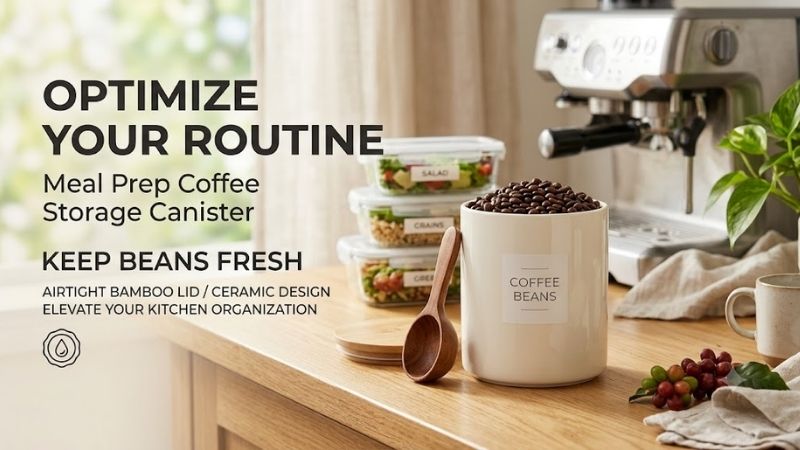
Measuring whole beans in advance can reduce morning decisions.
For example, someone who uses 20 grams for a daily pour-over could prepare several individual 20-gram portions.
The beans remain whole until they are ground for brewing.
This preserves more flexibility than grinding all portions several days ahead.
However, portion containers must be suitable for food storage and should be protected from unnecessary heat, air, and moisture.
When Ground-Coffee Storage Makes Sense
Ground coffee is convenient for households without a grinder.
It can also help simplify preparation when time is limited.
However, grinding increases coffee’s exposed surface area.
Aroma changes may occur more rapidly than with whole beans.
If you use ground coffee, choose small quantities that you can consume reasonably promptly and use a suitable airtight container.
For freshly roasted specialty coffee, grinding shortly before brewing is generally preferable when practical.
Planning Around Your Household
A single coffee drinker who prepares one espresso daily has different storage needs from a family making a large drip-coffee carafe each morning.
The best canister size depends on the amount of coffee consumed.
Buying a very large container for occasional use can create unnecessary storage space and potentially leave beans sitting for longer periods.
What Makes a Coffee Canister Effective?
Limiting Air Exposure
Oxygen contributes to changes in roasted coffee during storage.
An effective lid helps reduce uncontrolled air exchange with the surrounding room.
However, the term airtight should not be interpreted as meaning the container contains no oxygen.
Air is present inside most containers when they are closed.
Airtight describes the boundary, not a complete vacuum.
Protecting Against Moisture
Coffee should be protected from unnecessary moisture.
Humidity can affect handling and quality.
A suitable container needs a dependable lid seal and dry storage conditions.
Do not place wet measuring spoons into coffee.
Likewise, avoid storing beans beside areas where steam from kettles and cooking equipment regularly reaches the container.
Limiting Light Exposure
Light can contribute to quality changes, particularly when coffee is stored in transparent packaging.
An opaque canister protects beans from direct light.
However, a glass container can still be used effectively inside a dark cabinet.
The practical storage location matters as much as the material.
Avoiding Excessive Heat
Heat can accelerate changes in coffee quality.
Avoid storing beans beside ovens, stovetops, radiators, or hot appliance exhausts.
A cool, dry cabinet may be more appropriate than a sunny countertop.
A beautiful coffee bar is not necessarily the ideal storage environment if it is exposed to direct afternoon sunlight.
Managing Frequent Opening
Every time a canister is opened, the beans are exposed to room air.
A convenient lid is useful, but repeated opening can also affect storage conditions.
For meal prep, keeping the main supply sealed while using smaller daily portions may reduce unnecessary handling.
However, transferring coffee into multiple containers also exposes it during the initial portioning process.
The best solution depends on consumption rate and workflow.
Airtight vs. Vacuum vs. Air-Displacement Containers
Ordinary Airtight Canisters
An airtight canister uses a lid and seal to reduce air exchange.
It does not actively remove the air already inside.
This simple design can be inexpensive and easy to maintain.
For coffee used regularly, a suitable airtight container may provide sufficient convenience and protection.
Vacuum Canisters
Vacuum designs attempt to remove some air from the container.
They may use manual pumping, lid rotation, or electric mechanisms.
Reducing oxygen exposure can be a reasonable preservation strategy.
However, vacuum performance and seal retention vary.
A vacuum label does not establish a specific extension of coffee freshness.
Air-Displacement Containers
Some canisters use an adjustable inner lid positioned closer to the coffee.
This reduces unused air space above the beans.
However, it does not necessarily create a vacuum.
It may also introduce additional surfaces to clean.
Which Is Best for Meal Prep?
For many households, an ordinary well-sealed opaque canister is practical.
If coffee is purchased in larger quantities and consumed more slowly, an effective vacuum or air-displacement design may be worth comparing.
However, the improvement must justify the extra cost and maintenance.
A higher-priced preservation system is not automatically necessary for coffee consumed shortly after purchase.
Choosing the Right Canister Capacity
Start With Weekly Coffee Consumption
Instead of selecting capacity by appearance, calculate the coffee you use.
For example, a person who prepares one 18-gram espresso dose daily uses approximately 126 grams over seven days.
A household preparing two such doses each day uses approximately 252 grams per week.
For filter coffee, the amount depends on beverage volume and brewing ratio.
This calculation helps determine whether a small, medium, or large container is appropriate.
Example Capacity Planning
| Household routine | Illustrative daily coffee use | Seven-day total |
|---|---|---|
| One 18-g espresso dose | 18 g | 126 g |
| Two 18-g espresso doses | 36 g | 252 g |
| Two 20-g pour-over doses | 40 g | 280 g |
| One 55-g drip-coffee batch | 55 g | 385 g |
| Two 55-g batches | 110 g | 770 g |
These are calculation examples, not recommended intake amounts or universal brewing recipes.
Why Liters Do Not Translate Directly Into Grams
Canisters are commonly sold by volume.
Coffee beans are sold by weight.
The weight that fits in a particular container depends on bean size, roast development, density, and how the beans settle.
A one-liter container does not hold exactly one kilogram of whole beans.
When possible, use the manufacturer’s approximate coffee-bean capacity rather than relying only on liquid volume.
Headspace Considerations
An oversized container may have substantial empty space after some beans have been used.
That space contains air unless the container uses a mechanism to reduce it.
However, choosing a very small container can require frequent refilling.
The goal is a practical balance.
Choosing Several Smaller Containers
Smaller containers are useful when you purchase multiple coffees or prepare different doses.
However, more containers mean more lids, seals, and cleaning work.
Avoid creating an elaborate storage system when one simple canister would work.
Whole Beans vs. Ground Coffee
Why Whole Beans Are Usually Preferred
Whole roasted beans expose less surface area than ground coffee.
This can help preserve aroma before brewing.
A whole-bean storage strategy is particularly useful for people with burr grinders.
However, beans still change with time and storage conditions.
No ordinary canister freezes freshness indefinitely.
Ground Coffee for Convenience
If you use pre-ground coffee, a small airtight container can simplify dosing.
However, choose a grind appropriate for the brewing method.
Do not assume the same grind works equally well for espresso, French press, and drip coffee.
Is a Separate Container Needed for Decaf?
If several people use different coffee beans, separate containers help avoid mixing them.
This can be useful for regular and decaffeinated coffee.
However, label each container clearly.
Cross-mixing can create confusion, especially in households where caffeine intake matters.
Coffee Blends
A prepared blend can be stored together when the recipe and preference support it.
However, mixing old and new beans does not restore freshness.
For repeatable brewing, track the coffee type and purchase or roast date when available.
Canister Materials Compared
Stainless Steel
Stainless steel canisters are generally durable and opaque.
They are suitable for many countertop environments.
However, not every stainless steel canister has a high-quality lid seal.
Inspect the gasket and closure system.
Ceramic
Ceramic canisters can look attractive and protect coffee from direct light.
However, they may be relatively heavy and vulnerable to chipping.
The lid and gasket still determine much of the sealing performance.
A decorative ceramic jar without a dependable closure may be less useful than a simple sealed container.
Glass
Glass makes it easy to see when coffee is running low.
It also allows owners to distinguish different beans visually.
However, clear glass should be kept away from strong light.
A glass canister is more practical in a shaded cabinet than on a sunny windowsill.
Plastic
Food-safe plastic canisters may be lightweight and affordable.
However, construction, seal durability, odor retention, and scratch resistance vary.
Choose a product intended for food storage.
Do not assume a generic decorative container is appropriate for prolonged coffee storage.
Which Material Offers Best Value?
No material guarantees coffee freshness on its own.
Choose based on lid performance, light protection, durability, cleaning, and placement.
For meal prep, practical access often matters more than appearance.
Lid Design and Everyday Convenience
Screw-Top Lids
A screw-top closure can provide a secure seal when properly designed.
However, it may require several rotations to open and close.
For someone preparing coffee every morning, this may be acceptable.
Clamp Lids
Clamp lids can be quick to operate.
However, sealing performance depends on the gasket and closure tension.
A loose clamp or damaged gasket can reduce effectiveness.
Push-Button Lids
Some lids use buttons or locking mechanisms.
These can be convenient, but they introduce moving parts.
Check how the mechanism is cleaned.
Vacuum Pump Lids
A vacuum lid adds a separate sealing step.
This may be worthwhile for certain storage routines.
However, the mechanism can create maintenance concerns.
If easy daily access is the priority, compare opening and resealing time.
Seal Replacement
Silicone or other gaskets may wear or become damaged.
A canister with available replacement seals can provide better long-term ownership value.
Coffee Meal Prep With Individual Dose Containers
Why Pre-Portioning Can Help
Pre-portioning can reduce morning weighing.
It may be useful for households that use a consistent espresso or filter-coffee recipe.
For example, seven small containers can hold seven prepared whole-bean doses.
However, this system creates a greater number of pieces to wash and store.
Choosing Dose Container Size
The container should hold the intended coffee dose without excessive crowding.
However, bean volume varies.
A container suitable for 18 grams of one roast may have a different fill level with another.
Sealing Individual Portions
Choose secure lids that resist accidental opening.
Do not use containers with damaged seals.
Protect portions from sunlight and moisture.
Labeling Portions
Simple labels can help distinguish regular coffee, decaf, roast dates, and grind requirements.
However, a complex labeling system is unnecessary when you use one coffee regularly.
When Not to Pre-Portion
If you frequently change dose or brewing method, individual dose containers may create additional work.
Keeping whole beans in one suitable canister and weighing each dose when needed can be simpler.
A Practical Weekly Coffee Meal-Prep Routine
Step 1: Estimate the Week’s Coffee Use
Count expected brewing sessions.
Choose an appropriate quantity of beans.
Step 2: Check Coffee Packaging
Inspect the roast or best-by information when provided.
Avoid buying more coffee than you can reasonably use.
Step 3: Choose the Storage Method
Use the original resealable bag when appropriate or transfer beans into a suitable canister.
Step 4: Prepare Clean, Dry Containers
Inspect seals and lids.
Make sure no moisture remains inside.
Step 5: Portion Whole Beans if Desired
Measure individual doses when doing so makes your mornings easier.
Step 6: Label Different Coffees
Distinguish regular and decaf beans or multiple roast types.
Step 7: Store in a Suitable Location
Use a cool, dry, shaded environment.
Avoid heat and moisture from cooking equipment.
Step 8: Grind Near Brewing Time
When practical, grind whole beans shortly before preparing the beverage.
Step 9: Reclose Containers Promptly
Avoid leaving lids open while preparing other breakfast items.
Step 10: Reevaluate Quantity
At the end of the week, check whether your planned coffee amount matched actual consumption.
Adjust future purchases to reduce stale inventory.
Should Coffee Be Refrigerated?
Ordinary Refrigerator Storage
Refrigerators contain moisture and a variety of food odors.
Repeatedly moving coffee between cold storage and room temperature can also create condensation concerns.
For everyday coffee accessed frequently, a suitable room-temperature storage location is often more practical.
Freezing Whole Coffee Beans
Freezing may be useful for longer-term storage when coffee is properly packaged and protected from moisture and air.
However, the best method depends on packaging and how the coffee will be used.
Repeatedly opening frozen storage can create handling issues.
Follow a suitable preservation method rather than treating an ordinary container as automatically freezer safe.
Does an Airtight Lid Make Refrigeration Safe?
An airtight closure does not guarantee complete protection from condensation or odors under every condition.
Container temperature, seal integrity, and opening behavior still matter.
Choosing the Simplest Practical Method
For coffee consumed regularly, a cool, dry, shaded cabinet is generally a convenient starting point.
Use specialized storage only when it solves a meaningful preservation problem.
Cleaning and Maintenance
Cleaning Before First Use
Wash the container according to the manufacturer’s directions.
Remove packaging dust and residue.
Dry it fully before adding coffee.
Removing Coffee Oils
Some dark-roasted beans leave oil on storage surfaces.
Over time, these oils can produce odors.
Clean the canister when residue accumulates or when changing coffees.
Gasket Care
Food residue can collect around the lid gasket.
If the gasket is removable, follow the instructions for cleaning and reinstallation.
Dishwasher Compatibility
Some containers are dishwasher safe.
Others require handwashing.
A metal body being durable does not mean its lid or seal can tolerate a dishwasher.
Drying Completely
Never place coffee into a damp container.
Allow all approved washed surfaces to dry before storage.
Avoiding Scented Residue
Strong cleaning-product fragrances may be undesirable inside a coffee container.
Use appropriate food-contact cleaning products and rinse as directed.
Budget and Long-Term Value
Basic Airtight Canisters
A simple food-safe container with a dependable gasket may provide good value.
Midrange Coffee Canisters
Improved closure mechanisms, opaque bodies, and replaceable seals can justify additional cost.
Vacuum and Specialty Containers
These may offer additional air-management functions.
However, actual freshness benefits vary, and mechanisms require maintenance.
Multiple Dose Containers
Individual portions can improve organization but add cumulative cost and cleaning.
What Should Be Purchased First?
If your coffee station lacks a suitable grinder or a reliable brewing method, those may deserve priority over an expensive storage canister.
Common Buying Mistakes
Buying an Oversized Canister
Unused capacity may create unnecessary headspace.
Assuming Airtight Means Vacuum-Sealed
An airtight closure does not remove the air already inside.
Choosing Clear Glass for a Sunny Counter
Light exposure should be considered.
Storing Beans Near Cooking Heat
Convenient placement can still be unsuitable.
Preparing Too Much Ground Coffee Ahead
Ground coffee may lose aroma more quickly.
Forgetting Gasket Cleaning
A dirty or damaged seal can reduce performance.
Assuming Every Coffee Bag Must Be Replaced
A suitable original bag may already provide effective storage.
Frequently Asked Questions
What Is the Best Coffee Storage Canister for Meal Prep?
An opaque airtight canister with a dependable seal and capacity suited to normal coffee use is a practical choice. Individual dose containers may help when preparing measured portions ahead.
Should I Store Coffee Beans or Ground Coffee?
Whole beans are generally preferable when you plan to grind near brewing time. Ground coffee offers convenience but can change more rapidly during storage.
How Large Should My Coffee Canister Be?
Estimate weekly consumption in grams, then choose a container with appropriate coffee-bean capacity. Do not treat container liters as an exact bean-weight measurement.
Is a Vacuum Coffee Canister Necessary?
No. It may reduce air exposure, but a well-sealed conventional container can be sufficient for everyday use.
Can I Put Coffee Beans in the Refrigerator?
For frequently accessed coffee, cool, dry room-temperature storage is often simpler. Refrigeration introduces moisture and odor concerns.
Are Individual Coffee Dose Containers Worth It?
They can make routine brewing faster, but they require extra containers and cleaning. Their value depends on your daily workflow.
Conclusion
The best coffee storage canister for meal prep helps you organize coffee without creating unnecessary freshness or cleaning problems. A properly sealed, opaque container is a practical starting point for whole beans, while small portion containers can simplify repeatable morning brewing. Match capacity to actual consumption, protect coffee from moisture and heat, and avoid assuming expensive storage technology can replace fresh beans and appropriate handling.




Write Your Review
No reviews yet. Be the first to share your experience!