
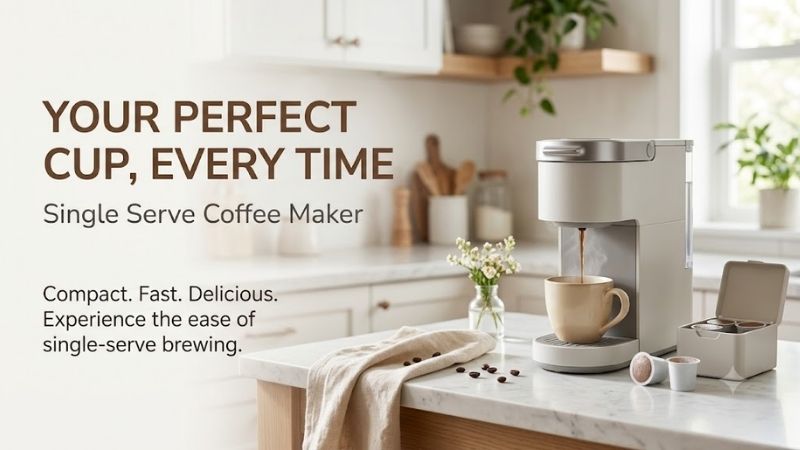
A single serve coffee maker should deliver the right cup without unnecessary brewing steps, wasted coffee, or frustrating cleanup. We compare six machines for pods, fresh grounds, small kitchens, and different drink sizes, helping you choose a brewer that fits your morning routine, counter space, and long-term coffee budget.
Quick Verdict: Which Single Serve Coffee Maker Should You Buy?
Best Overall: Ninja Pods & Grounds Specialty Single-Serve Coffee Maker (PB051). It accommodates both compatible pods and ground coffee, offers four brew styles, and can produce servings ranging from a small cup to a substantial travel mug when using grounds. Its fold-away frother also makes it unusually flexible for a machine that brews one serving at a time.
The best choice changes when your priorities are narrower. The Keurig K-Elite emphasizes familiar K-Cup convenience and a large reservoir. Hamilton Beach The Scoop avoids proprietary capsules, while the Keurig K-Mini conserves counter space. The Nespresso Essenza Mini is better suited to smaller concentrated drinks than ordinary mugs of filter coffee.
Quick Comparison Table
| Coffee Maker | Best For | Coffee Format | Standout Feature | Main Limitation |
|---|---|---|---|---|
| Ninja Pods & Grounds Specialty PB051 | Best overall | K-Cup-compatible pods and grounds | Four brew styles, fold-away frother | More accessories to maintain |
| Keurig K-Elite | Daily pod convenience | K-Cup pods | 75-oz reservoir, strength and iced settings | Recurring pod cost |
| Hamilton Beach The Scoop 49981A | Ground-coffee simplicity | Loose ground coffee | Reusable scoop filter | Grounds cleanup after each use |
| Keurig K-Mini | Very small kitchens | K-Cup pods | Less than 5 inches wide | Refill water for each cup |
| Technivorm Moccamaster Cup-One | Premium single-cup drip coffee | Ground coffee | Dedicated 10-oz filter-coffee brewing | No pods or larger batch options |
| Nespresso Essenza Mini | Espresso-style small drinks | Nespresso Original capsules | Compact espresso and lungo programs | Not a full-mug coffee brewer |
How We Selected the Best Single Serve Coffee Makers
A single-serve brewer should be evaluated around the complete routine, not just the time between pressing a button and obtaining coffee. Some machines save preparation time but require frequent capsule purchases. Others eliminate pods but demand more effort measuring grounds and washing filters.
We considered the following factors:
Coffee compatibility. We looked at whether each brewer uses proprietary capsules, broadly available pod formats, loose grounds, or more than one preparation method. Format affects coffee selection, future costs, and waste.
Serving size. A machine designed for espresso and lungo should not be compared as though it performs the same function as one that fills a large insulated travel mug. We prioritized fit between intended beverage size and actual brewing design.
Daily convenience. Reservoir size, accessible controls, cup clearance, and the number of components needing cleaning influence whether a brewer remains practical after the novelty wears off.
Extraction and beverage options. We considered whether a machine provides useful brew-strength adjustments, iced settings, or a more deliberate single-cup drip-brewing method. Extra settings only matter when users will actually benefit from them.
Ownership considerations. The initial appliance price is one part of the decision. Coffee, pods, filters, water treatment, replacement components, and cleaning requirements contribute to longer-term costs.
These selections reflect manufacturer-documented features and editorial analysis of typical household use cases. They are not presented as independent measurements of brew temperature, extraction yield, flavor rankings, or durability.
Detailed Reviews of the Best Single Serve Coffee Makers
1. Ninja Pods & Grounds Specialty PB051 — Best Overall
Best For: Households that alternate between K-Cup-compatible pods and fresh ground coffee and enjoy different drink styles.
Why We Picked It
The Ninja PB051 addresses the biggest limitation of many single-serve brewers: forcing buyers to commit to one coffee format. With this machine, convenience and ingredient flexibility are not mutually exclusive.
A pod is useful before an early commute, while ground coffee lets you choose a preferred roast or grind beans just before brewing. Dedicated iced and concentrated-coffee modes add versatility without requiring a separate coffee system.
Key Specifications
- Model: PB051
- Brewing formats: Compatible coffee pods and grounds
- Brew styles: Classic, Rich, Over Ice, Specialty
- Pod serving sizes: 6, 8, 10, and 12 oz
- Ground-coffee serving sizes: 6, 8, 10, 12, 14, 18, and 24 oz
- Reservoir: 56 oz, removable
- Frother: Fold-away, removable
- Grinder: Not included
Features and Benefits
The ability to prepare a 24-ounce grounds-based beverage is meaningful for someone who carries coffee to work. It is not a reason to assume that every pod can produce a satisfactory 24-ounce drink; the machine’s pod serving sizes are more limited.
The Rich mode adjusts brewing to provide a more concentrated cup. Specialty brewing creates concentrated coffee suitable for adding milk or ice, but this is not traditional pressure-extracted espresso.
The built-in frother can aerate hot or cold milk. It does not function as a steam wand, so users should not assume it independently heats milk.
Performance and Practical Use
The Ninja works particularly well when different people in a household have different preferences. One person can use an economical ground coffee blend while another prefers the simplicity of a pod.
For iced coffee, brewing a suitably concentrated beverage over ice helps account for dilution as the ice melts. That process is distinct from making cold brew, which extracts coffee using cool water over an extended period.
The main trade-off is operational complexity. Users need to select and install the correct brewing accessories, dispose of grounds or pods, and clean the frother.
What Makes It Different
Its combination of brewing formats, serving sizes, and drink styles is more comprehensive than that of a basic pod-only brewer.
Pros
- Uses both compatible pods and ground coffee.
- Flexible cup sizes with grounds.
- Separate styles for classic, rich, iced, and specialty drinks.
- Built-in fold-away frother.
- Removable water reservoir.
Cons
- Multiple accessories require storage and cleaning.
- More controls than a simple pod machine.
- No integrated bean grinder.
- Specialty coffee should not be confused with espresso.
Buy If: You want a single-serving machine that accommodates changing coffee preferences.
Skip If: You only need one ordinary K-Cup every morning or want the fewest possible components.
2. Keurig K-Elite — Best for Everyday K-Cup Convenience
Best For: People who already enjoy K-Cup coffee and prefer simple operation with a large water reservoir.
Why We Picked It
The K-Elite is not trying to replace every brewing method. Instead, it makes a familiar pod-based routine more convenient through multiple serving sizes, a strong-brew control, and an iced-coffee option.
Key Specifications
- Coffee format: K-Cup pods
- Reservoir: 75 oz
- Brew sizes: 4, 6, 8, 10, and 12 oz
- Strong-brew setting: Yes
- Iced-coffee setting: Yes
- Hot-water dispensing: Supported
- Grinder: None
Features and Benefits
The 75-ounce removable reservoir reduces repeated trips to the sink, particularly when more than one person uses the machine.
A Strong setting provides an alternative brewing profile for users who find their standard cup insufficiently concentrated. The smaller serving sizes may also be helpful when stronger perceived flavor is preferred.
Hot-water dispensing adds utility for suitable beverages beyond coffee.
Performance and Practical Use
The K-Elite is suited to a predictable workday routine: fill the reservoir, insert a pod, select a cup size, and brew.
However, K-Cup convenience limits control over coffee dose and grind. A stronger setting cannot increase the amount of coffee sealed inside a capsule.
It is also important to distinguish iced coffee from cold brew. The K-Elite’s iced function prepares coffee for serving over ice; it does not steep coffee grounds in cold water overnight.
What Makes It Different
Its strength is an uncomplicated K-Cup experience with practical adjustments, rather than a broad collection of specialty functions.
Pros
- Large reservoir.
- Five serving-size selections.
- Strong and iced settings.
- Straightforward day-to-day operation.
Cons
- Ongoing capsule expense.
- Disposable packaging.
- No fresh-ground coffee workflow without a compatible reusable accessory.
- Does not make traditional espresso.
Buy If: You value predictable K-Cup convenience and brew several cups throughout the day.
Skip If: You want to grind fresh beans for every serving.
3. Hamilton Beach The Scoop 49981A — Best for Ground Coffee
Best For: Coffee drinkers who want a reusable-filter brewer rather than a capsule ecosystem.
Why We Picked It
The Scoop is a useful contrast to pod machines. Its brewing basket also functions as a coffee scoop, simplifying measurement and eliminating proprietary coffee capsules.
Key Specifications
- Coffee format: Ground coffee
- Brewing filter: Reusable scoop-style mesh filter
- Serving format: Single cup or compatible travel mug
- Regular and bold options: Available on this design
- Grinder: Not included
- Disposable capsules: Not required
Features and Benefits
Using ordinary coffee grounds expands the selection beyond prepackaged pods. Households can purchase coffee from local roasters, choose decaffeinated options, or grind whole beans themselves.
The reusable filter reduces reliance on disposable capsules, although it requires cleaning after brewing.
Performance and Practical Use
For best results, users should select an appropriate drip-coffee grind and follow the filter’s fill markings.
Overfilling the scoop does not guarantee a stronger beverage and can cause brewing problems. Very fine grounds may also interfere with filtration.
This design suits an individual who values coffee selection more than automated convenience.
The important distinction is that a ground-coffee single-serve brewer still makes one cup at a time. It is not a substitute for a large automatic drip machine when serving several people.
What Makes It Different
It offers a simple, reusable coffee-preparation system without a capsule adapter or proprietary pod format.
Pros
- No proprietary capsule purchases.
- Reusable filter.
- Freedom to choose ground coffee.
- Straightforward preparation.
Cons
- Grounds must be discarded after every use.
- Reusable filter needs washing.
- Less convenient than sealed pods during a rushed morning.
- Does not offer multiple specialty beverages.
Buy If: You buy ground coffee and want a dedicated one-cup machine.
Skip If: You prefer the tidiness of sealed capsules.
4. Keurig K-Mini — Best for Small Countertops
Best For: Small apartments, dorm rooms where permitted, or occasional-use office spaces.
Why We Picked It
The K-Mini prioritizes physical size over elaborate functionality. Its narrow housing and single-use reservoir make it easier to fit into crowded spaces.
Key Specifications
- Coffee format: K-Cup pods
- Width: Less than 5 inches
- Reservoir: Single-use
- Brew size: Approximately 6–12 oz
- Brew controls: Basic
- Cord storage: Included
Features and Benefits
Because water is added before each brewing cycle, the machine does not need a large permanent tank.
This is convenient when coffee preparation is infrequent and counter space is scarce.
The small body also makes occasional storage easier.
Performance and Practical Use
The K-Mini is best for one person brewing one cup at a time.
It becomes less convenient when several people prepare drinks consecutively because the reservoir requires refilling for each brew.
The minimal controls may appeal to users who dislike navigating beverage menus, but they also limit customization.
What Makes It Different
Its defining advantage is the narrow footprint, not brewing sophistication.
Pros
- Compact width.
- Simple operation.
- Useful for occasional brewing.
- No large reservoir to maintain.
Cons
- Refill before each beverage.
- Limited customization.
- Uses K-Cup capsules.
- Not ideal for multiple consecutive servings.
Buy If: Counter space is more important than reservoir convenience.
Skip If: Several household members brew coffee throughout the day.
5. Technivorm Moccamaster Cup-One — Best Premium Ground-Coffee Brewer
Best For: People who want one cup of carefully brewed filter coffee without using capsules.
Why We Picked It
The Cup-One is a different proposition from pod-based machines. It is a dedicated small-batch drip brewer built around fresh ground coffee and a controlled brewing process.
Key Specifications
- Coffee format: Ground coffee
- Brew volume: Approximately 10 oz
- Brewer type: Automatic single-cup drip
- Paper filters: Required
- Carafe: No full-size carafe
- Grinding: Separate grinder or pre-ground coffee
- Certification: Listed among SCA-certified home brewers
Features and Benefits
The Cup-One suits a coffee drinker who values the flavor potential of a freshly ground roast but does not want to perform manual pour-over brewing every morning.
Its dedicated serving volume avoids the compromises of running a very small batch through a large carafe machine.
Performance and Practical Use
The Cup-One is most relevant when coffee quality and repeatability matter more than broad beverage flexibility.
Users still need to measure coffee, use the correct paper filter, and dispose of spent grounds.
The fixed single-cup design also means it is not suitable for brewing a large carafe for visitors.
What Makes It Different
It emphasizes automatic single-cup filter coffee rather than capsule convenience or specialty beverage presets.
Pros
- Dedicated small-batch drip brewing.
- Uses fresh ground coffee.
- No proprietary pods.
- Suitable for coffee enthusiasts.
Cons
- Limited beverage size.
- No iced or milk-drink system.
- Requires paper filters.
- Premium positioning for one-cup brewing.
Buy If: You want one carefully prepared cup of filter coffee each morning.
Skip If: You need several beverage formats or a large travel mug.
6. Nespresso Essenza Mini — Best for Espresso-Style Single Servings
Best For: People who prefer small concentrated coffee drinks over full mugs of filter coffee.
Why We Picked It
The Essenza Mini provides a compact way to prepare Nespresso Original espresso and lungo beverages.
It is included because single-serve coffee buyers do not all share the same drink preference.
Key Specifications
- Capsule format: Nespresso Original
- Beverage programs: Espresso and lungo
- Advertised pump rating: 19 bar
- Housing: Compact
- Grinder: None
- Milk system: Separate accessory needed
Features and Benefits
Two straightforward beverage selections keep operation simple.
The small housing suits limited counter space, and compatible Original capsules provide a range of coffee styles.
Performance and Practical Use
The Essenza Mini is sensible for someone who drinks a small concentrated coffee after breakfast.
It is less appropriate for a household expecting a large 12-ounce mug from every brew.
The advertised pump-pressure figure does not establish the exact pressure at the coffee throughout extraction.
Milk-based drinks require separate frothing equipment.
What Makes It Different
Its focus on small espresso-oriented drinks differentiates it from ordinary single-cup drip and K-Cup brewers.
Pros
- Compact size.
- Simple espresso and lungo settings.
- Wide Original-compatible capsule category.
Cons
- Not suited to large filter-coffee servings.
- No integrated milk frother.
- Ongoing capsule expense.
Buy If: Your preferred morning beverage is a small concentrated coffee.
Skip If: You usually fill a large travel mug.
Single Serve Coffee Maker Buying Guide
1. Start With Your Preferred Coffee Format
The most important choice is not the machine brand. It is whether you want to use pods, ground coffee, or both.
Pods simplify preparation and cleanup. Ground coffee gives users more control over roast selection and freshness. Hybrid machines support both but may require storing multiple brewing accessories.
If you already buy whole beans, a grounds-compatible machine is likely to fit your existing routine better than an exclusively pod-based system.
2. Know the Difference Between Coffee and Espresso
Most single-serve drip machines produce ordinary filter-style coffee.
Espresso-oriented capsule systems produce smaller, more concentrated drinks using different extraction designs.
A machine’s Specialty or Rich setting does not automatically convert drip coffee into traditional espresso.
Buy according to the beverage you actually drink rather than the marketing label.
3. Compare Useful Brew Sizes
A machine advertised as capable of many serving sizes is not necessarily ideal for every size.
Increasing water volume without increasing coffee dose can dilute a beverage.
For large servings, consider whether the brewer supports an appropriate quantity of grounds.
For small concentrated drinks, a dedicated espresso-style capsule system may be more suitable.
4. Choose the Right Reservoir
A large reservoir saves repeated refilling. It is helpful when several household members use the machine.
A single-use reservoir reduces appliance size and can be convenient for occasional brewing.
Also consider reservoir placement: a rear-mounted tank may be difficult to refill under low cabinets.
5. Understand Coffee Strength Controls
Strength settings can alter how a machine extracts coffee, but they cannot change the fixed dose inside a sealed pod.
The roast level and coffee blend also influence how strong a drink tastes.
When experimenting, change one variable at a time: serving size, coffee selection, or brew mode.
6. Consider Iced Coffee Requirements
An iced brew setting is useful when you regularly pour hot-extracted coffee over ice.
The beverage should be concentrated enough to account for melting ice.
Cold brew is different: coffee grounds steep in cool water for an extended period.
Do not buy an iced-coffee pod machine expecting it to perform overnight cold extraction.
7. Calculate Cost Per Serving
Estimate your actual annual consumption.
One coffee every day amounts to approximately 365 servings per year. Two daily coffees total about 730 servings.
A seemingly small difference in per-serving cost can therefore matter more than a modest difference in initial machine price.
Include pods, filters, grounds, and cleaning materials.
8. Assess Cleanup Realistically
Pod systems reduce loose-ground handling, but drip trays, capsule compartments, water tanks, and internal water paths still need cleaning.
Ground-coffee systems require more immediate basket cleanup.
For hybrid systems, check whether unused attachments can be stored conveniently.
9. Measure Space and Mug Clearance
Exterior width is only one dimension.
Check whether the machine can fit your preferred travel mug, whether the brew head can open beneath a cabinet, and whether the reservoir can be removed without moving the appliance.
10. Consider Environmental Trade-Offs
Reusable filters can reduce disposable capsule waste.
However, they require water and effort to clean.
Capsule recycling depends on materials and local programs.
Choose a format that meets your needs without assuming every reusable or disposable solution has identical environmental effects.
Common Problems and Practical Fixes
Coffee Tastes Too Weak
Use a smaller serving or a machine-supported stronger setting. Check whether the coffee dose is adequate for your desired cup size.
Coffee Tastes Bitter
Try a different roast or coffee blend. On a grounds-compatible machine, review grind size and brewing instructions.
Water Flow Becomes Slow
Mineral buildup or obstruction may be responsible. Follow the manufacturer-approved cleaning and descaling procedure.
Coffee Grounds Reach the Mug
Check grind size, filter fit, coffee quantity, and basket installation.
The Machine Is Inconvenient to Refill
A larger reservoir or more accessible tank layout may suit your kitchen better than a compact rear-fill system.
Frequently Asked Questions
What is the best single serve coffee maker for ground coffee?
Hamilton Beach The Scoop is a straightforward choice for users who primarily brew grounds. The Ninja PB051 offers more beverage flexibility if you also use pods.
Are single-serve coffee makers worth buying?
They are useful for individuals and households that frequently prepare one serving at a time. Value depends on convenience, coffee consumption, and recurring costs.
Can a single-serve coffee maker fill a travel mug?
Some models can. Confirm the supported brew volume and physical mug clearance before buying.
Are reusable pods cheaper than disposable pods?
They can reduce ongoing consumable costs, depending on the coffee selected. They also require cleaning and compatible equipment.
Can single-serve machines make iced coffee?
Yes, several models offer iced-coffee settings. That does not mean they perform cold-brew extraction.
Does a single-serve coffee maker need descaling?
Yes, most water-heating coffee machines require periodic maintenance. Follow the exact manual and account for local water hardness.
Is Nespresso the same as Keurig?
No. Nespresso Original and K-Cup use different capsule designs and brewing approaches.
Should I buy a single-serve machine with a grinder?
An integrated grinder can improve convenience for whole-bean users, but many single-serve machines require a separate grinder. Consider whether the extra equipment fits your routine.
Conclusion
The Ninja Pods & Grounds Specialty PB051 is the best single serve coffee maker for flexible pod and ground-coffee brewing. Choose the Keurig K-Elite for everyday K-Cup convenience, Hamilton Beach The Scoop for reusable-filter brewing, or the K-Mini for tight spaces. Prioritize your drink size, coffee format, and ongoing costs.
Write Your Review
No reviews yet. Be the first to share your experience!