
To descale a De’Longhi espresso machine, remove the water filter, fill the tank with De’Longhi descaling solution to the marked level plus water, start the descaling programme, then rinse the tank twice with fresh water and reset the descale light. The full cycle takes roughly 20 to 45 minutes depending on your model, and De’Longhi tells owners to use its own descaler because the wrong product, or the wrong procedure, can cause faults that the guarantee does not cover. Because the button sequence differs between the Dedica, Stilosa, Magnifica, Dinamica, La Specialista and Linea Classic lines, always check your manual for the exact keys. This guide covers what is common, what differs and what trips people up.
- When Does a De’Longhi Need Descaling?
- What You Need
- Step-by-Step: Descaling a De’Longhi Espresso Machine
- Time and Container Needs by Machine Family
- Can You Use Vinegar or Citric Acid?
- Water Filter and Hardness Settings
- Milk System and Steam Wand
- Troubleshooting
- Keeping Scale Away Between Descales
- Safety Notes
- Before You Start: A Quick Pre-Check
- After Descaling: Get the Most From the Clean Machine
- FAQ
- Quick Checklist
Disclosure: some links on this page are affiliate links, so we may earn a small commission on qualifying purchases at no extra cost to you.
When Does a De’Longhi Need Descaling?
Most De’Longhi machines tell you. An indicator, often an orange or flashing descale light, comes on when scale has built up, and De’Longhi’s own instructions say descaling is required when that indicator lights. Many machines base the alert on the water hardness setting you programmed, so a correct hardness setting matters.
Watch for these signs, which published guides list as symptoms of limescale:
- Slower water flow or longer brew times
- Weaker pressure or less heat in the cup
- Unusual noises from the pump
- A change in coffee taste
- Leaking
Some models count cups instead of time. One guide says the Stilosa should be descaled every 200 coffees. For other machines, guides give a wide range of two to five months, which is why hardness matters more than the calendar.
| Water type | How often to expect the descale light | What to do |
|---|---|---|
| Soft water | Less often | Follow the machine’s prompt |
| Medium-hard water | Every few months with regular use | Use the water filter if your model takes one |
| Hard water | More often | Set hardness correctly, filter, and do not ignore the light |
De’Longhi sells SoftBalls test strips to test hardness; the brand’s guide to the La Specialista Opera mentions them as the way to set the correct level.
What You Need
- De’Longhi EcoDecalk descaler. The brand’s instructions say to use De’Longhi descaler. It is sold in single-use and multi-use packs.
- Containers. Guides say to prepare about 1 litre for Dedica and Stilosa style machines and about 2 litres for bean-to-cup models, placed under the coffee spouts, hot water spout and steam wand or milk system.
- Fresh water for two rinses.
- A soft cloth to wipe the drip tray and surfaces.

DeLonghi Eco Descaling Solution 5513291781 (Pack of 2)
Included for 'How to Descale a De'Longhi Espresso Machine, Step by Step' as a representative home product in this roundup; selection reflects the product set returned for this topic.
View on AmazonThe listing for this card is the DeLonghi Eco Descaling Solution in a pack of two. A second option is the single-serve mini pack, which the listing describes as a 3.4 ounce mini descaler, 8 count.

DeLonghi Eco 3.4 Ounce Mini Descaler, 8 Count
Included for 'How to Descale a De'Longhi Espresso Machine, Step by Step' as a representative home product in this roundup; selection reflects the product set returned for this topic.
View on AmazonStep-by-Step: Descaling a De’Longhi Espresso Machine
The following steps follow De’Longhi’s published instructions for the Linea Classic (EM450) and the La Specialista Opera, which share the same pattern as most models. The Linea Classic cycle takes about 25 minutes and the Opera about 20 minutes, according to the brand.
- Prepare the machine. Turn it on and wait until it is ready, or follow your manual. Empty the drip tray and grounds container and put them back.
- Remove the water filter. If your tank has a water softener filter, take it out first. Both De’Longhi guides require this.
- Add descaler and water. Pour the descaler into the empty tank up to level A. De’Longhi’s Linea Classic guide specifies a 100 ml pack, then adds 1 litre of water up to level B. Put the tank back.
- Set up containers. Detach the portafilter. Place a container of at least 1 litre under the hot water outlet and coffee spouts, and a 2 litre minimum container under the steam wand or milk system if your model has one.
- Start the programme. On the Linea Classic, press the descale button to dispense the solution through the spouts, then open the steam dial until the flow stops. On the La Specialista Opera, press and hold the descaling button until the indicator blinks, then press OK. The machine then runs and pauses by itself.
- Empty, refill and rinse. When the descaler is used up, empty the containers, rinse the tank and fill it with fresh water (to MAX on many models). Start the rinse. On the Linea Classic, run the second cycle with fresh water and open the steam dial again at the end.
- Repeat the rinse. A published guide says the most common reason the descale light stays on is that the rinse was not finished, and recommends two full rinses with the tank filled to MAX each time.
- Reset if needed. On the Linea Classic, hold the button for 10 seconds until the orange light flashes and then the white light flashes. This indicates that the descaling alarm is reset.
- Refill with clean water and reinstall the filter (if used).
Do not interrupt the rinse. De’Longhi notes that the La Specialista Opera descale cycle can be stopped by holding the button for 10 seconds, but the rinse cannot be interrupted.
Time and Container Needs by Machine Family
| Machine family | Typical time (guides) | Container size (guides) | Notes |
|---|---|---|---|
| Dedica, Stilosa and similar manual machines | About 20 to 40 minutes | About 1 litre | Stilosa: about every 200 coffees |
| Linea Classic EM450 | About 25 minutes | 1 litre plus 2 litre | Reset: hold button 10 seconds |
| La Specialista Opera | About 20 minutes | Under each outlet | Press and hold button, then OK |
| Magnifica Evo, Dinamica and other bean-to-cup | Up to about 45 minutes | About 2 litres | Two full rinses to MAX |
Can You Use Vinegar or Citric Acid?
Many websites suggest white vinegar, lemon juice or citric acid. De’Longhi’s position is different. The brand says to use its own descaler, and a guide summary notes that De’Longhi advises against vinegar, citing possible damage to metal components and risk of leaving a residual taste. Another guide warns that vinegar may void your warranty. One hunker-style guide suggests one tablespoon of vinegar or lemon juice per five cups of water for a drip coffee maker, but that advice is for simple drip machines, not pressure espresso machines with boilers and valves.
| Descaler | Pros | Cons |
|---|---|---|
| De’Longhi EcoDecalk | Made for the machine; matches the brand’s instructions | Costs more per cycle |
| Third-party descaler labelled for De’Longhi | Cheaper multi-use bottles | Warranty position is the maker’s choice; check the label |
| White vinegar | Cheap and available | Brand warns against it; smell and taste may linger |
| Citric acid or lemon juice | Natural option | Efficiency varies; not recommended by the brand |
If your machine is out of warranty and you want to use a third-party descaler, read its label for compatibility with espresso machines and follow its dosage. Our espresso machine descaler guide compares options, and the general coffee maker descaling guide covers drip machines. Cleaning tablets are a different category, covered in our coffee maker cleaning tablets list.
Water Filter and Hardness Settings
A softener filter reduces how quickly scale builds up, though it does not replace descaling. De’Longhi’s DLSC002 filter fits many bean-to-cup machines such as the Magnifica Evo and ECAM-series, according to listings; confirm with your manual. Remember to take the filter out before descaling and put a fresh one in afterwards if it is due.
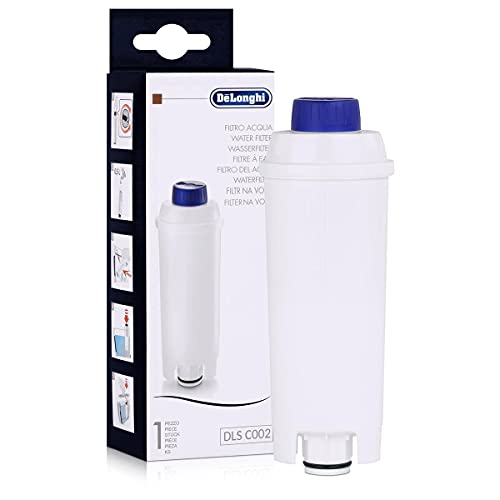
DE'LONGHI WATER FILTER SOFTENER DLSC002 (Pack of 1)-White
Included for 'How to Descale a De'Longhi Espresso Machine, Step by Step' as a representative home product in this roundup; selection reflects the product set returned for this topic.
View on AmazonMilk System and Steam Wand
Descaling does not clean away milk residue. Rinse and clean the steam wand or milk carafe after each use and use a dedicated milk cleaner on a schedule. De’Longhi sells a universal cleaner for the frother and steam wand.

De'Longhi Universal Espresso Machine Cleaner for Frother/Steam Wand Removes Milk Residue & Buildup from your Espresso & Cappuccino Maker, Eco-Friendly, 8.5 oz
Included for 'How to Descale a De'Longhi Espresso Machine, Step by Step' as a representative home product in this roundup; selection reflects the product set returned for this topic.
View on AmazonTroubleshooting
| Problem | Likely cause | Fix |
|---|---|---|
| Descale light stays on | Rinse not finished | Run two full rinses with the tank filled to MAX, then reset if your manual says so |
| Little or no water flow | Heavy scale or air in the pump | Repeat descaling, then rinse; if flow is still poor, contact De’Longhi |
| All lights flash at once (Dedica) | General alarm | Contact De’Longhi support |
| Water leaks outside the drip tray | Seal or hardware fault | Stop using the machine and contact De’Longhi |
| Coffee tastes sour or metallic after descaling | Descaler residue | Run extra fresh-water cycles |
Keeping Scale Away Between Descales
Descaling is a reset, not a cure. The best long-term protection is to use the right water. Set the hardness level on machines that offer it, use the softener filter where one is supported, and avoid leaving water standing in the tank for days. Empty and rinse the tank weekly, and refill with fresh cold water rather than topping up old water. If you live in a very hard-water area, consider filtered water for every refill, and do not ignore the descale light even if the coffee still tastes fine, since scale builds up inside the boiler and lines where you cannot see it.
Safety Notes
- Never drink the descaling solution that comes out of the spouts; throw it away.
- Keep the descaler away from children and pets, and do not mix it with other cleaning products.
- Do not use the machine for coffee while descaling.
- Wipe spills promptly because acidic descaler can mark some surfaces.
- If you are unsure about your model, read the manual or contact De’Longhi.
Before You Start: A Quick Pre-Check
A few minutes of preparation prevents most descaling problems. Read the section of your manual that covers descaling, because button names differ even between machines that look alike. Make sure the machine is switched on and ready, and that you have time to finish both the descale and the rinse in one go. Interrupting the rinse is the mistake that most often leaves a machine with a stubborn alarm.
Check that the drip tray is not already full, since a full tray will overflow during the cycle. Place the machine where you can step away from it safely. Descaler is acidic, so protect worktops that can stain and keep a cloth nearby.
After Descaling: Get the Most From the Clean Machine
Once the cycle is done, run a couple of cups of hot water through the group and hot water outlet to be sure that no descaler taste remains. Reinstall a fresh water filter if your model uses one, and wipe the tank before refilling. Then wash the removable parts: the drip tray, grounds container, portafilter and baskets. If your machine froths milk, clean the steam wand or milk container too, because descaling does not remove milk residue.
Finally, note the date. A small label on the machine or a calendar reminder tells you when the last descale was done, which helps if you ever need to show regular maintenance to the maker. Set the water hardness on the machine if it has that option, and revisit the setting whenever you move house or change your water source.
FAQ
How often should I descale a De’Longhi espresso machine?
When the descale indicator comes on. Guides suggest roughly every two to five months, depending on water hardness and use, while the Stilosa is advised about every 200 coffees.
How long does descaling take?
About 20 to 25 minutes on the Opera and Linea Classic according to De’Longhi, and up to roughly 45 minutes on some bean-to-cup models, plus rinsing time.
Can I use vinegar to descale a De’Longhi?
De’Longhi advises using its own descaler, and guides report that the brand warns against vinegar. Using the wrong descaler may cause faults not covered by the guarantee.
Why is my descale light still on after descaling?
Usually the rinse was not completed. Run two full rinses with the tank filled to MAX, and follow your model’s reset step if there is one.
Do I remove the water filter before descaling?
Yes. De’Longhi’s instructions say to remove the water softener filter before starting.
Is descaling the same as cleaning?
No. Descaling removes mineral scale inside the boiler and lines. You also need to clean the brew group, drip tray, portafilter and milk system on their own schedules.
What if my machine won’t start the descale programme?
Check your manual for the exact button combination, make sure the tank is filled to the correct level and the drip tray is in place. If it still fails, contact De’Longhi.
Quick Checklist
- Remove the filter.
- Descaler to level A, water to level B.
- Containers under all outlets.
- Run the programme.
- Rinse twice, to MAX.
- Reset the light and refill.
For coffee-station upkeep beyond descaling, see our espresso machine guide.
Last updated: October 2026





Write Your Review
No reviews yet. Be the first to share your experience!