
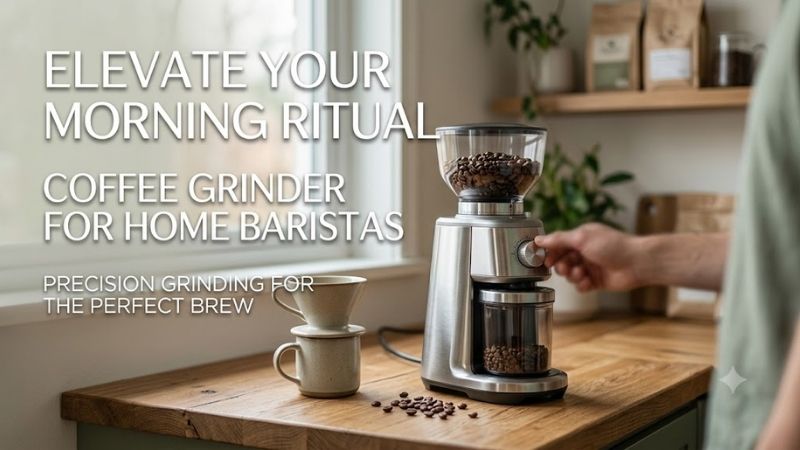
A coffee grinder for home baristas is one of the most important tools for controlling flavor and extraction. Yet choosing one can be confusing: burr shape, grind adjustment, retention, motor design, and dosing systems all affect daily use. An expensive grinder is not automatically the right choice for every brewing method. This guide explains how to match a grinder to your coffee preferences, equipment, skill level, and budget.
- Quick Verdict: What Coffee Grinder Should Home Baristas Buy?
- Why Grinding Matters So Much
- Blade Grinders vs. Burr Grinders
- Conical vs. Flat Burrs
- Espresso Grind Adjustment
- Filter Coffee Grind Requirements
- Understanding Dosing Systems
- Coffee Retention and Exchange
- Static, Clumping, and Grounds Handling
- Grinder Size and Countertop Space
- Noise and Early-Morning Coffee
- Cleaning and Maintenance
- Choosing a Grinder for Home Espresso
- Choosing a Grinder for Filter Coffee
- Budget and Long-Term Value
- Common Buying Mistakes
- Frequently Asked Questions
- Conclusion
Quick Verdict: What Coffee Grinder Should Home Baristas Buy?
For most people preparing fresh coffee at home, an adjustable burr grinder is the strongest starting category.
However, the ideal grinder depends on how you brew.
If you mainly make espresso, prioritize fine adjustment, repeatable dosing, and suitability for a traditional espresso basket.
If you primarily prepare pour-over, drip, or French press coffee, prioritize a useful range of filter-coffee settings, manageable grounds retention, and consistent everyday operation.
A grinder that excels at espresso is not automatically the best value for filter coffee, and a filter-focused grinder may lack the precision needed for espresso.
| Buyer Type | Most Important Features | Practical Starting Category |
|---|---|---|
| Espresso beginner | Fine adjustment, consistent dosing, low retention | Espresso-capable electric burr grinder |
| Pour-over enthusiast | Controlled medium-fine grinding, repeatability | Filter-focused burr grinder |
| French press drinker | Appropriate coarse range, low excessive fines | General-purpose burr grinder |
| Mixed brewing household | Broad adjustment range, easy switching | Versatile burr grinder |
| Small apartment | Compact dimensions, manageable noise | Compact electric or manual burr grinder |
| Frequent coffee host | Adequate throughput and easy dosing | Electric burr grinder with sufficient capacity |
| Budget-conscious beginner | Reliable burrs and adjustment | Entry-level burr grinder rather than a blade chopper |
Best overall approach: Buy for your primary brewing method first. A grinder that performs well for the coffee you make every day is more useful than one advertising dozens of settings you will never use.
Why Grinding Matters So Much
Grinding Changes Coffee Extraction
Coffee beans contain soluble compounds that contribute flavor, aroma, bitterness, acidity, and body.
Grinding increases the surface area exposed to brewing water.
Smaller particles generally create more available surface area.
However, particle size also affects how water moves through a coffee bed.
For espresso, grind size strongly influences resistance and flow.
For immersion methods such as French press, it influences extraction behavior and filtration.
The grinder therefore controls more than convenience; it changes the conditions under which coffee is brewed.
Why Pre-Ground Coffee Behaves Differently
Grinding increases the amount of coffee surface exposed to air.
Some desirable aromatic compounds can diminish during storage.
For home baristas seeking repeatable flavor, grinding relatively close to brewing can be useful.
However, the benefit depends on the beans, packaging, storage, and time involved.
Freshly ground coffee is not a guarantee of good extraction if the grinder produces an unsuitable particle distribution.
Grind Consistency and Flavor
A coffee grinder produces particles of different sizes.
A broad distribution may include both very fine particles and much coarser pieces.
These can interact with brewing water differently.
For some brewing systems, excessive fines can contribute to clogging, slow drainage, or sediment.
However, a grinder does not need to create identical particles to produce excellent coffee.
Useful consistency must be evaluated in relation to the brewing method.
Why Technique Still Matters
Even a capable grinder cannot correct every brewing problem.
Coffee dose, water temperature, ratio, filter design, puck preparation, and brew time also matter.
The grinder is an essential part of the process, but it should not be treated as a shortcut around brewing technique.
Blade Grinders vs. Burr Grinders
How Blade Grinders Work
Blade grinders use rapidly rotating blades to chop coffee beans.
They are often relatively inexpensive.
However, grind size depends heavily on operating time and bean movement.
A blade grinder may produce a mixture of fine powder and large fragments.
This makes precise extraction control difficult, especially for espresso.
For occasional brewing where cost matters more than precision, a blade grinder may still be usable.
How Burr Grinders Work
A burr grinder passes coffee between two shaped grinding surfaces.
The distance between those surfaces influences the particle-size range.
This makes adjustment more controllable than simply changing blade-chopping time.
However, burr grinders vary substantially in quality.
Burr alignment, manufacturing tolerances, geometry, motor design, and adjustment mechanisms all affect performance.
Why Burr Grinding Is Usually Preferred
Burr grinders generally offer more useful control over particle size.
That makes it easier to match coffee to a particular brewing method.
For someone learning espresso, fine control can be particularly important.
For filter coffee, repeatable settings can make brewing more consistent.
However, burr grinders require cleaning and may cost more initially.
When a Blade Grinder May Be Enough
If you occasionally prepare coffee using a forgiving immersion method and have a very limited budget, a blade grinder may be acceptable.
However, it is not the ideal category for developing precise espresso recipes.
Consider whether purchasing appropriately ground coffee or a modest burr grinder would provide better value.
Conical vs. Flat Burrs
Conical Burrs
Conical burr grinders use a cone-shaped burr working against a surrounding burr.
They appear in both manual and electric machines.
Some designs are compact and suitable for home use.
However, conical geometry does not guarantee low noise, low retention, or a particular flavor profile.
These properties depend on the entire grinder.
Flat Burrs
Flat burr grinders use opposing burr surfaces.
They are common in certain espresso and filter-focused machines.
Some designs offer distinctive adjustment and grinding characteristics.
However, flat burrs do not automatically produce more uniform particles than every conical grinder.
Burr diameter, geometry, alignment, and operating conditions matter.
Is One Better for Espresso?
Both conical and flat burr grinders can produce excellent espresso.
The right choice depends on the specific machine, adjustment system, grind distribution, and desired workflow.
Do not assume that conical burrs always produce more body or that flat burrs always produce greater flavor clarity.
Such characteristics are influenced by many brewing variables.
Is One Better for Filter Coffee?
Both designs can be appropriate.
A grinder optimized for medium and coarse settings may be more useful for filter brewing than an espresso-focused model, regardless of burr shape.
Compare actual performance at the grind sizes you use.
Burr Material
Steel and ceramic burrs are common.
Both can perform well when properly designed.
Wear resistance, impact behavior, manufacturing precision, and replacement cost vary.
A particular material alone does not determine grinding quality.
Espresso Grind Adjustment
Why Espresso Needs Fine Control
Traditional espresso uses finely ground coffee packed into a filter basket.
Small changes in grind size can significantly affect the rate at which water flows through the puck.
A grinder with very large adjustment steps may make it difficult to reach the desired extraction.
For espresso, adjustment precision is therefore especially important.
Stepped Adjustment
Stepped grinders use defined positions.
These can make settings easy to remember.
However, the distance between steps determines how much control is available.
A grinder with many settings is not automatically suitable for espresso.
The distribution of those settings across the grind range matters.
Stepless Adjustment
Stepless grinders allow adjustment without fixed detents.
This can provide fine control.
However, some mechanisms may be harder to reproduce exactly after large changes.
A clearly marked adjustment system can help.
Microadjustment Systems
Certain grinders offer primary adjustments plus smaller secondary movements.
This can support espresso dialing in.
However, additional controls may create complexity.
Choose a system that is easy to understand and repeat.
Dialing In Espresso
Dialing in involves adjusting grind and other variables to achieve a desired extraction.
A common starting approach is to choose a coffee dose and beverage yield, then adjust grind according to the result.
For example, a double-shot recipe might use 18 grams of coffee to produce approximately 36 grams of espresso.
However, this is only an illustrative 1:2 ratio.
Basket design, roast level, and taste preferences affect the appropriate recipe.
The grinder should make useful adjustments possible without unpredictable jumps.
Filter Coffee Grind Requirements
Pour-Over Coffee
Pour-over brewing often requires a grind in the medium-fine to medium range, depending on the dripper and recipe.
Particle distribution influences drainage and extraction.
If the grind is too fine for the setup, the brew may drain slowly.
If it is too coarse, the extraction may be weak or uneven.
Choose a grinder that offers repeatable adjustment across your intended filter range.
Automatic Drip Coffee
Drip machines vary in filter-basket geometry and water distribution.
The ideal grind depends on the brewer.
A general-purpose burr grinder may be sufficient for many drip machines.
However, consistency at medium settings matters more than whether the grinder advertises espresso capability.
French Press
French press brewing often uses relatively coarse grinding.
Excessive fine particles can increase sediment and make the plunger more difficult to lower.
However, an extremely coarse grind is not always desirable.
Choose a suitable starting setting and adjust according to the recipe.
Cold Brew
Many immersion cold-brew recipes use coarse coffee.
A grinder should be able to produce an appropriate range without excessive fine sediment.
However, cold brew does not require one universal grind size.
Filter design and extraction time also influence the result.
Switching Between Methods
A household that makes espresso on weekdays and French press on weekends may need a broad adjustment range.
However, switching from very fine to coarse settings can change retained coffee and require recalibration.
If you brew multiple methods frequently, choose a grinder with a convenient and repeatable adjustment system.
Understanding Dosing Systems
Hopper-Based Grinding
A hopper stores coffee beans above the burrs.
The grinder dispenses ground coffee through an outlet.
This can be convenient for households that use one coffee regularly.
However, beans may remain in the hopper for extended periods.
A hopper-based system may also retain some coffee in the grinding pathway.
Single-Dose Grinding
Single dosing involves measuring a portion of whole beans before grinding.
For example, you may weigh 18 grams for an espresso recipe and grind that specific portion.
This can reduce the need to keep a large quantity of beans in the hopper.
It can also simplify switching between coffees.
However, actual output may differ from input because some grounds remain inside the machine.
Timed Dosing
Some grinders dispense coffee based on a programmed grinding duration.
This can be convenient.
However, the output weight may change with bean density, roast, grind setting, and hopper fill.
A timer is not a direct weight measurement.
For greater precision, periodically verify output using a scale.
Grind-by-Weight Dosing
Certain grinders use integrated scales or weight-based dosing systems.
These can simplify repeatability.
However, they may cost more and require additional maintenance or calibration.
For home baristas, a separate scale can provide a practical alternative.
Dosing Cups and Portafilter Holders
A dosing cup collects grounds before they are transferred into a brewer or portafilter.
Direct portafilter holders can streamline espresso preparation.
However, fit varies by portafilter diameter and handle design.
Check compatibility before purchasing.
Coffee Retention and Exchange
What Is Grinder Retention?
Retention describes coffee grounds that remain inside the grinder after a grinding cycle.
Some grounds may collect around the burrs, chute, or dispensing area.
This can affect dosing consistency and coffee freshness.
However, retention values depend on how they are measured.
Total Retention vs. Exchange
A grinder may hold some coffee internally without releasing all of it during the next cycle.
Exchange describes the portion of old retained coffee displaced by new grounds.
This distinction is important.
A grinder with low measured output variation may still contain retained material.
Look for clear testing methods when comparing retention claims.
Why Retention Matters for Espresso
Espresso recipes often use relatively precise doses.
A difference between input and output can influence brewing.
Retention may also complicate switching between coffee beans.
However, a small amount of retention is not automatically noticeable in every cup.
Consider its importance relative to your workflow.
Bellows and Other Retention Tools
Some grinders include bellows intended to push retained grounds toward the outlet.
Their effectiveness depends on design.
Use only manufacturer-approved accessories and methods.
Do not use compressed air, improvised tools, or cleaning devices that could damage the grinder.
Should You Purge Coffee After Adjusting?
Some grinders may retain grounds from the previous setting.
A small purge can help when changing grind size or beans, depending on the equipment.
However, purging consumes coffee.
For home use, evaluate whether the benefit justifies the waste.
Static, Clumping, and Grounds Handling
Why Static Occurs
Grinding can create electrostatic charge.
This may cause grounds to cling to containers or scatter around the outlet.
The amount varies with beans, humidity, grinder materials, and operating conditions.
Static does not necessarily indicate a defective grinder.
Anti-Static Features
Some grinders include design features intended to reduce static.
However, effectiveness varies.
Compare actual behavior rather than relying solely on marketing descriptions.
Clumping
Some finely ground coffee forms clumps.
This can affect distribution in an espresso basket.
However, clumping is influenced by coffee characteristics and grinder design.
A grinder producing visible clumps is not automatically incapable of making good espresso.
Evaluate extraction consistency.
Grounds Distribution
For espresso, consistent puck preparation can help manage extraction.
Some users use approved distribution tools.
However, unnecessary accessories can complicate the routine.
Start with a suitable grinder, consistent dose, and repeatable preparation method.
Grinder Size and Countertop Space
Measuring the Complete Grinder
Check width, depth, height, and hopper dimensions.
A compact grinder may fit beneath cabinets but require more clearance when refilling beans.
Hopper Removal
Some grinders have removable hoppers.
However, removing a hopper may require closing a gate or emptying beans.
Check the procedure before buying.
Dosing Access
The grinder should provide comfortable access to the grounds outlet.
A low cabinet or neighboring appliance may make it difficult to position a portafilter.
Cord Placement
Keep cords away from sinks and hot equipment.
Do not trap electrical connections beneath appliances.
Storage Between Uses
A grinder can be heavy or awkward to lift.
If you must store it after each use, choose manageable weight and a suitable housing.
Frequent movement may be less convenient than a slightly smaller permanent coffee station.
Noise and Early-Morning Coffee
Motor Noise
Electric grinders generate motor sound during use.
Actual volume depends on construction, burrs, motor speed, and grinding load.
A high price does not guarantee quiet operation.
Grinding Duration
A quieter grinder running for a long time may still be noticeable in a shared home.
Consider both sound level and duration.
Vibration
A stable surface can reduce rattling.
However, avoid placing the grinder on unstable improvised pads.
Follow manufacturer guidance.
Manual Grinders
Hand grinders eliminate electric motor noise but still generate mechanical grinding sounds.
They may be useful in apartments or during travel.
However, they require more physical effort for larger doses.
Cleaning and Maintenance
Burr Cleaning
Coffee particles and oils accumulate inside grinders.
Follow the manufacturer’s cleaning instructions.
Some burr sets can be removed for cleaning.
Others require service procedures.
Never reach into moving burrs.
Grind Chute Cleaning
The chute can retain coffee.
A suitable approved brush may help remove residue.
Avoid inserting metal tools into electrical mechanisms.
Hopper Cleaning
Keep the hopper clean and dry.
Do not allow water to enter the burr chamber unless the manufacturer explicitly approves it.
Using Grinder Cleaning Products
Some manufacturers approve particular grinder-cleaning products.
Others prohibit them.
Use only products and procedures supported by the exact model.
Burr Replacement
Burrs wear over time.
Service life depends on material, construction, coffee volume, and use.
Check whether replacement burrs are available and whether the user can install them.
Calibration and Alignment
Some advanced grinders allow alignment or calibration procedures.
However, these are not necessary for every home user.
Do not modify a grinder without proper instructions.
Choosing a Grinder for Home Espresso
Beginner Espresso
Prioritize fine adjustment, predictable dosing, and ease of use.
A midrange espresso-capable burr grinder may provide more value than an expensive machine with complicated workflow options.
Intermediate Espresso
As technique develops, retention, dosing consistency, and adjustment repeatability may become more important.
Consider whether the grinder supports your preferred basket and recipe style.
Advanced Espresso
Experienced users may evaluate burr geometry, pressure-profile compatibility, grind distribution, and workflow speed.
However, price does not eliminate the need for careful brewing technique.
Milk-Based Drinks
If you primarily drink lattes, a reliable espresso grind remains important.
However, the differences between grinders may be less obvious in heavily milk-based drinks than in some straight espresso comparisons.
Choose according to your own priorities.
Choosing a Grinder for Filter Coffee
Daily Drip Coffee
A general-purpose burr grinder with accessible medium settings may be sufficient.
Pour-Over Enthusiasts
Repeatability and grind adjustment become more important when experimenting with different beans and drippers.
French Press Households
An appropriate coarse range with manageable sediment is useful.
Cold Brew Meal Prep
A grinder that handles larger coarse batches may be convenient.
However, grinding large quantities can stress small motors if operating limits are exceeded.
Budget and Long-Term Value
Entry-Level Burr Grinders
These can provide a meaningful improvement in grind control compared with many blade grinders.
However, adjustment range and consistency may be limited.
Check whether the grinder supports your primary brewing method.
Midrange Grinders
A midrange electric burr grinder may add finer adjustment, improved dosing, and more practical maintenance.
For many committed home baristas, this category can offer a strong balance of performance and value.
Premium Grinders
Premium models may offer specialized burrs, advanced adjustment, precision dosing, or refined construction.
However, not every feature improves every brewing method.
Avoid paying for espresso-focused features when you brew only French press coffee.
Repairability
A grinder with replaceable burrs, accessible support, and serviceable components may offer better long-term value.
The Grinder vs. Espresso Machine Budget
For semi-automatic espresso, the grinder can be as important as the brewing machine.
A more balanced budget may produce better results than spending almost everything on the espresso machine and choosing an unsuitable grinder.
Common Buying Mistakes
Buying Based on Burr Shape Alone
Conical and flat burrs can both perform well.
Counting Grind Settings Without Considering Range
Many settings do not guarantee appropriate espresso adjustment.
Ignoring Retention
Ground coffee left in the machine can affect dosing and switching between beans.
Buying an Espresso Grinder for Filter Coffee Without Checking Its Range
Some grinders are optimized for particular brew methods.
Overlooking Noise
Grinding may be the loudest part of the morning routine.
Assuming Expensive Means Low-Maintenance
Premium grinders still need cleaning and may require service.
Frequently Asked Questions
What Type of Coffee Grinder Is Best for Home Baristas?
An adjustable burr grinder is a strong starting point. Choose an espresso-capable model for traditional espresso or a filter-focused model for pour-over and drip coffee.
Are Flat Burrs Better Than Conical Burrs?
Not universally. Performance depends on burr geometry, alignment, motor design, adjustment, and brewing method.
Do I Need a Special Grinder for Espresso?
Traditional nonpressurized espresso generally benefits from a grinder offering sufficiently fine and precise adjustment.
What Does Low Retention Mean?
It refers to a grinder designed to leave relatively little coffee inside after grinding. Actual measurements depend on testing methods.
Are Manual Coffee Grinders Good Enough for Espresso?
Some are capable of espresso grinding, but they require physical effort and may be slow for repeated doses.
How Often Should I Clean My Coffee Grinder?
Follow the manufacturer’s recommendations, considering coffee volume, roast characteristics, and observed residue. Do not apply one universal schedule to every model.
Conclusion
The best coffee grinder for home baristas should provide suitable particle-size control, repeatable dosing, manageable retention, and a comfortable daily workflow. Espresso drinkers need fine adjustment, while filter-coffee enthusiasts should prioritize performance across their preferred brew range. Choose based on actual brewing needs, assess cleaning and replacement-part availability, and avoid assuming that burr shape, price, or an impressive setting count guarantees better coffee.







Write Your Review
No reviews yet. Be the first to share your experience!