
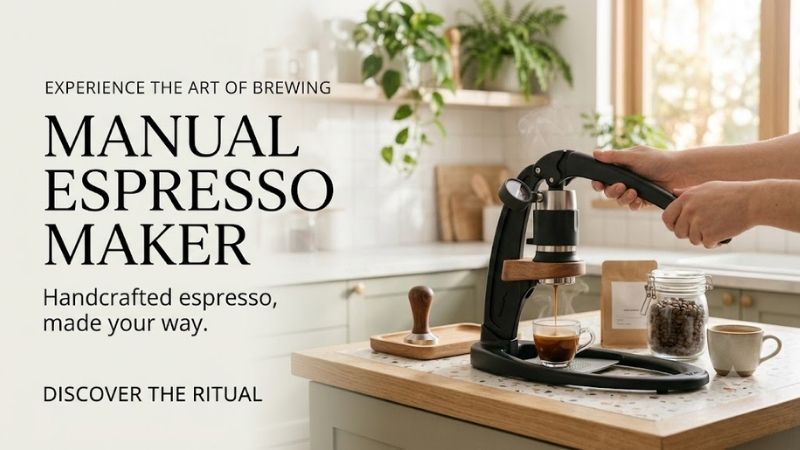
A manual espresso maker gives users direct control over the pressure used to extract coffee. Unlike electric pump machines, these devices rely on hand-operated levers or compact pumping mechanisms. That makes them attractive to coffee enthusiasts who enjoy adjusting their technique. Manual designs can also be useful when traveling or working with limited counter space. However, manual espresso makers are not necessarily easier than electric machines. Users must still manage grinding, coffee dosing, water temperature, extraction, and cleaning. Some models require electricity for preheating, while others can operate without electrical power once hot water is available. This guide compares six manual espresso makers, including full-size lever platforms and compact travel-oriented devices.
Quick Verdict
Best Overall: Flair 58 Plus 2. Its 58mm basket, integrated preheating controls, pressure gauge, and lever operation make it an excellent option for enthusiasts seeking hands-on extraction.
- Best Overall for Home Enthusiasts: Flair 58 Plus 2 — Direct pressure control and 58mm brewing system.
- Best for Mechanical Simplicity: Cafelat Robot Barista — Manual levers with minimal brewing electronics.
- Best Entry-Level Lever: Flair Classic — Traditional manual lever experience at a smaller scale.
- Best for Serious Travel Espresso: Wacaco Picopresso — Compact hand-powered extraction with a nonpressurized basket.
- Best for Easy Portable Espresso: Wacaco Nanopresso — Small pump-driven maker with a convenient travel format.
- Best Countertop Lever Experience: ROK EspressoGC — Hand-operated dual-arm construction for home use.
Quick Comparison Table
| Product | Pressure Method | Main Features | Best For | Trade-Off |
|---|---|---|---|---|
| Flair 58 Plus 2 | Manual lever | 58mm basket, gauge, preheat | Enthusiasts | Separate grinder and kettle |
| Cafelat Robot Barista | Dual levers | Pressure gauge, mechanical construction | Minimalist brewing | Requires careful manual technique |
| Flair Classic | Manual lever | Compact frame, pressure kit options | Beginner lever users | More preheating and assembly steps |
| Wacaco Picopresso | Hand pump | Compact, nonpressurized basket | Travel espresso enthusiasts | Demanding grind preparation |
| Wacaco Nanopresso | Hand pump | Compact travel design, pressurized system | Portable convenience | Less direct puck control |
| ROK EspressoGC | Dual arms | Countertop lever body | Tactile home brewing | Requires space and manual effort |
How We Selected These Manual Espresso Makers
We considered brewing mechanics, portability, heating requirements, pressure feedback, basket design, compatible accessories, and cleaning.
Manual espresso is highly dependent on the user’s technique. The ability to apply pressure does not automatically guarantee excellent extraction.
An appropriate grinder is particularly important with nonpressurized baskets.
We focused on meaningful workflow differences rather than relying on manufacturer pressure claims as proof of espresso quality.
Detailed Product Reviews
1. Flair 58 Plus 2 — Best Overall for Home Enthusiasts
Best For: Home baristas who want direct control over brewing pressure and the flexibility of a standard-size espresso basket.
Why We Picked It: The Flair 58 Plus 2 combines manual lever operation with a pressure gauge and integrated preheating.
Key Specifications
- Type: Manual lever espresso maker
- Basket: 58mm
- Pressure gauge: Included
- Brewing pressure: Hand-generated
- Brew chamber: Electrically preheated
- Milk system: None
- Grinder: Separate
- Hot water: Separate source
Features & Benefits
The lever allows users to change the pressure applied to the coffee puck throughout extraction.
The pressure gauge provides feedback about brewing conditions.
The electrical preheating system helps maintain suitable brew-chamber temperature during preparation.
Performance & Practical Use
The Flair 58 Plus 2 is particularly relevant to enthusiasts experimenting with preinfusion and pressure profiles.
Users can deliberately begin extraction with gentler pressure and then adjust as the shot progresses.
However, its manual flexibility requires practice.
A capable espresso grinder and consistent dose remain essential.
What Makes It Different: Direct pressure profiling combined with a 58mm brewing system.
Pros
- Manual pressure control.
- Pressure gauge.
- Standard-size basket.
Cons
- Requires separate grinding and hot-water equipment.
- No milk steaming.
- More involved brewing workflow.
Buy If: You want to actively shape espresso extraction.
Skip If: You prioritize quick automatic cappuccinos.
2. Cafelat Robot Barista — Best for Mechanical Simplicity
Best For: Espresso enthusiasts who want a manual lever system with relatively few electrical components.
Why We Picked It: The Cafelat Robot Barista uses two hand-operated arms and a pressure gauge.
Key Specifications
- Type: Manual dual-lever espresso maker
- Pressure gauge: Included in Barista configuration
- Brewing: Hand-generated pressure
- Boiler: None
- Integrated grinder: No
- Milk system: None
- Heating: Hot water supplied separately
Features & Benefits
The Robot uses a piston-and-basket brewing arrangement.
Users apply pressure through the two arms rather than an electric pump.
Its relatively simple mechanical design reduces the number of powered systems involved in brewing.
Performance & Practical Use
The Robot is a strong option for people who appreciate a minimalist brewing routine.
However, it still requires suitable grinding and puck preparation.
The absence of an internal heater makes appropriate hot-water preparation important.
Its manual arm arrangement can also feel different from a traditional single-lever machine.
What Makes It Different: An almost entirely mechanical brewing system.
Pros
- Simple manual construction.
- Pressure feedback.
- No pump motor.
Cons
- Separate grinder and kettle needed.
- No integrated milk system.
- Manual technique required.
Buy If: You value mechanical simplicity and hands-on brewing.
Skip If: You want automatic temperature and pressure management.
3. Flair Classic — Best Entry-Level Lever
Best For: New manual espresso enthusiasts who want to learn lever brewing.
Why We Picked It: The Flair Classic offers a smaller manual lever platform with fewer advanced features than the Flair 58 series.
Key Specifications
- Type: Manual lever espresso maker
- Portability: Detachable frame
- Pressure generation: Hand lever
- Heating: External hot-water source
- Grinder: Separate
- Accessories: Compatible pressure-gauge configurations
Features & Benefits
The Flair Classic allows users to experience manual pressure-based extraction.
Its detachable design is useful for storage or occasional transport.
It provides an introduction to lever technique without requiring a full-size electric espresso machine.
Performance & Practical Use
Users must prepare the coffee puck, heat the brewing chamber as appropriate, add hot water, and operate the lever.
The workflow can be rewarding, but repeated preheating and assembly may be inconvenient for several consecutive drinks.
What Makes It Different: A more accessible introduction to manual lever preparation.
Pros
- Compact manual design.
- Direct extraction control.
- No electric pump required.
Cons
- Requires manual preheating steps.
- Separate grinder needed.
- Slower multi-drink workflow.
Buy If: You want to learn manual espresso techniques.
Skip If: You need a rapid morning routine.
4. Wacaco Picopresso — Best for Serious Travel Espresso
Best For: Travelers who want to prepare traditional-style espresso using a compact hand-powered device.
Why We Picked It: The Picopresso combines portable pumping with a nonpressurized brewing basket.
Key Specifications
- Type: Portable manual espresso maker
- Pressure generation: Hand pump
- Basket: Nonpressurized
- Grinder: Separate fine-adjustment grinder required
- Heating: External hot water
- Power: Manual
- Travel storage: Compact carrying format
Features & Benefits
The hand pump generates extraction pressure without electricity.
Its nonpressurized basket gives users more direct influence over extraction through coffee grind and puck preparation.
The compact format makes it suitable for travel.
Performance & Practical Use
The Picopresso can deliver a hands-on espresso experience away from home.
However, it is less forgiving of unsuitable grinding.
A coarse or inconsistent grind can produce poor extraction, regardless of how strongly the user operates the pump.
The device also requires careful cleaning and thorough drying before storage.
What Makes It Different: Portable operation combined with a nonpressurized espresso basket.
Pros
- Compact.
- No electric pump needed.
- Greater control than many pressurized travel makers.
Cons
- Requires a suitable grinder.
- More involved than ordinary travel coffee.
- Multiple small components to clean.
Buy If: Espresso quality and technique matter during travel.
Skip If: You want the easiest possible portable coffee maker.
5. Wacaco Nanopresso — Best for Easy Portable Espresso
Best For: Travelers wanting a compact manually pumped espresso maker with a more forgiving preparation approach.
Why We Picked It: The Nanopresso is designed around portable espresso preparation and a pressurized brewing system.
Key Specifications
- Type: Portable hand-pump espresso maker
- Power: Manual
- Water heating: External
- Coffee preparation: Ground coffee
- Basket system: Pressurized design
- Storage: Compact travel format
Features & Benefits
The Nanopresso uses repeated manual pumping to extract coffee.
Its compact design allows it to fit into travel bags more easily than a countertop espresso machine.
The pressurized basket is generally more forgiving of some grind differences than an unpressurized basket.
Performance & Practical Use
The Nanopresso is suited to occasional travel coffee rather than large household preparation.
Users must supply hot water and ground coffee.
It also needs regular cleaning, and accessories should be dried before packing.
What Makes It Different: A travel-oriented system emphasizing portable convenience.
Pros
- Small format.
- Hand-powered operation.
- Suitable for occasional travel.
Cons
- Requires manual pumping.
- Limited beverage capacity.
- No milk steaming.
Buy If: You want compact espresso-style coffee away from home.
Skip If: You mainly brew at a kitchen counter.
6. ROK EspressoGC — Best Countertop Lever Experience
Best For: Home users who want a tactile dual-arm espresso machine without an electric brewing pump.
Why We Picked It: The ROK EspressoGC combines two operating arms with a countertop frame.
Key Specifications
- Type: Manual dual-arm espresso maker
- Brewing pressure: Hand-generated
- Heating: External hot water
- Grinder: Separate
- Milk system: None
- Design: Countertop lever-style appliance
Features & Benefits
The two arms allow the user to control extraction pressure through physical movement.
Its countertop format provides a dedicated brewing station rather than a travel-only device.
Performance & Practical Use
The ROK is useful for users who enjoy the physical process of espresso preparation.
However, repeatability depends on grind, dose, water preparation, and consistent lever technique.
It is not a substitute for an automatic milk-drink machine.
What Makes It Different: A distinctive dual-arm countertop espresso experience.
Pros
- Manual control.
- No powered brewing pump.
- Dedicated countertop design.
Cons
- Requires an appropriate grinder and kettle.
- No steam wand.
- Manual operation takes practice.
Buy If: You value tactile espresso preparation at home.
Skip If: You want automatic extraction and milk drinks.
Manual Espresso Maker Buying Guide
Lever vs. Hand-Pump Pressure Generation
Manual lever machines create pressure through a larger mechanical arm.
Hand-pump machines use repeated pumping actions.
Lever machines generally provide more direct feedback and can make pressure profiling easier.
Hand-pump models emphasize portability.
Neither method guarantees espresso quality without suitable coffee preparation.
Pressurized vs. Nonpressurized Baskets
Pressurized baskets can be more forgiving of some grind inconsistencies.
Nonpressurized baskets provide greater control over extraction but require a capable grinder and consistent puck preparation.
Users interested in developing traditional barista skills often prefer nonpressurized brewing systems.
Pressure Gauges
A pressure gauge displays pressure within the machine’s measurement arrangement.
It can be helpful for learning lever technique and comparing extraction profiles.
However, the gauge does not directly measure beverage flavor or extraction quality.
Water Temperature
Manual makers often lack their own water heater.
Users must heat water separately and account for heat loss when transferring it into the brewing chamber.
Preheating may be necessary to maintain suitable extraction conditions.
Grinder Requirements
A grinder with fine adjustment is essential for many unpressurized manual espresso makers.
A blade grinder or ordinary drip-coffee grinder may not provide the consistency required.
Budget for grinding equipment before buying a demanding manual brewing system.
Milk Drinks
Most manual espresso makers do not include steam wands.
For cappuccinos or lattes, a separate milk heater, frother, or steaming system is needed.
Portability
A compact travel maker may pack easily, but users still need hot water, coffee, and cleaning supplies.
Evaluate the entire travel setup rather than only the espresso device’s dimensions.
Cleaning
Clean coffee-contact components after brewing.
Remove grounds carefully and wash or wipe components according to the manual.
Allow travel makers to dry fully before storing them in a sealed bag.
Common Manual Espresso Mistakes
Applying Maximum Pressure Immediately
A controlled extraction may benefit from a more deliberate pressure profile, depending on the coffee and recipe.
Neglecting Preheating
Cold brewing components can affect extraction temperature.
Using an Unsuitable Grinder
Fine grind control is important for nonpressurized espresso baskets.
Expecting a Manual Machine to Be Faster
Manual espresso often involves more preparation than push-button coffee systems.
Frequently Asked Questions
Can manual espresso makers produce real espresso?
Yes. Suitable manual devices can generate the pressure required for espresso extraction.
Do manual espresso makers need electricity?
Some operate entirely without electricity, while certain models use electric preheating. Hot water usually must be supplied separately.
Is a pressure gauge necessary?
It is useful for learning and comparing pressure profiles but is not mandatory on every manual espresso maker.
Are manual espresso makers good for beginners?
They can be, although users should expect a learning curve.
Can you make a latte with a manual espresso maker?
Yes, by preparing espresso and using separate equipment to heat and texture milk.
What grinder works best for manual espresso?
A grinder with fine espresso-range adjustment is particularly useful for nonpressurized baskets.
Conclusion
The Flair 58 Plus 2 is our best overall manual espresso maker for enthusiasts who want pressure feedback and a standard-size brewing basket.
The Cafelat Robot Barista emphasizes mechanical simplicity, while the Flair Classic offers a more accessible lever experience.
For portable coffee, choose between the more demanding Wacaco Picopresso and the more forgiving Nanopresso. The ROK EspressoGC provides another distinctive countertop lever workflow.
The right manual espresso maker depends on how much involvement you enjoy, your grinder quality, and whether brewing at home or traveling is your primary goal.








Write Your Review
No reviews yet. Be the first to share your experience!