
A manual espresso maker for families can offer hands-on control and an enjoyable coffee ritual, but preparing several drinks takes more planning than making one espresso. Lever force, water heating, shot capacity, grinder quality, and milk preparation all affect convenience. This guide explains which manual espresso designs suit households with multiple coffee drinkers and when another brewing system may be more practical.
- Quick Verdict: Is a Manual Espresso Maker Right for a Family?
- What Is a Manual Espresso Maker?
- Types of Manual Espresso Makers
- Choosing for Family Size
- Understanding Shot Capacity
- Pressure Control and Extraction Quality
- Grinder Requirements
- Water Heating and Temperature Management
- Milk Drinks for the Family
- Ergonomics and Physical Effort
- Cleaning and Maintenance
- Durability and Construction
- Budgeting for the Complete Family Setup
- When a Manual Espresso Maker Is Not the Best Choice
- Common Buying Mistakes
- Frequently Asked Questions
- Conclusion
Quick Verdict: Is a Manual Espresso Maker Right for a Family?
A manual espresso maker can be rewarding for families that enjoy the process of preparing coffee and do not mind making drinks individually.
However, it is rarely the fastest option for households that need several coffees at once.
For families with two or more regular espresso drinkers, a sturdy countertop manual lever machine with repeatable operation and a suitable brewing capacity is a reasonable starting category.
For occasional family espresso, a compact handheld manual device may be sufficient.
If your priority is serving several drinks quickly, a pump-driven semi-automatic or automatic espresso machine may be more practical.
| Buying Factor | Why It Matters for Families |
|---|---|
| Shot capacity | Determines how many extractions are needed |
| Required hand force | Affects comfort during repeated use |
| Brew pressure control | Influences repeatability and extraction |
| Water heating method | Determines preparation requirements |
| Grinder compatibility | Supports consistent espresso |
| Refill and reset process | Affects consecutive drink preparation |
| Milk preparation | Important for family lattes and cappuccinos |
| Stable construction | Essential during manual pressure application |
| Cleaning access | Reduces maintenance after multiple drinks |
| Storage dimensions | Determines whether the complete setup fits |
A manual espresso maker is best purchased for control and the enjoyment of preparation, not as an automatic labor-saving appliance.
What Is a Manual Espresso Maker?
Understanding Manual Pressure Generation
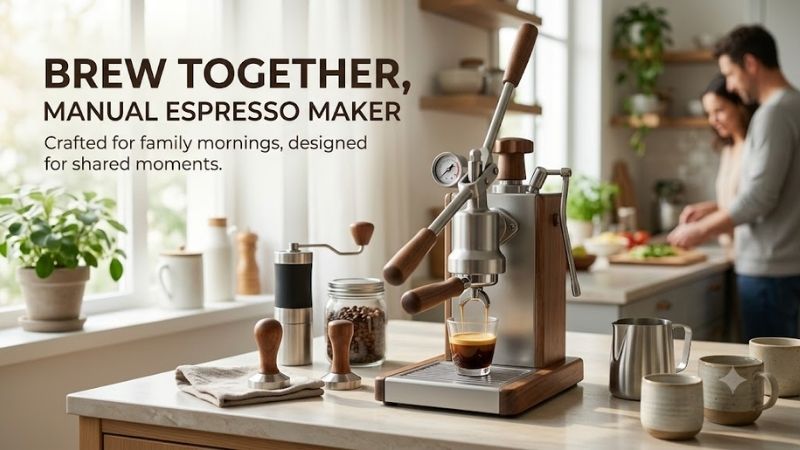
A manual espresso maker uses human force to generate the pressure needed for extraction.
Depending on the design, the user operates a lever, piston, hand pump, or another pressure mechanism.
The heated water passes through ground coffee to produce a concentrated beverage.
Unlike an electric pump-driven espresso machine, some manual devices require no electricity for pressure generation.
However, they often depend on a separate kettle or water-heating system.
This means the overall setup may still require electrical equipment.
Manual Espresso vs. Automatic Brewing
Automatic machines handle more of the brewing process.
Manual devices require the user to control additional variables.
These can include pressure, flow rate, and sometimes preinfusion.
This control is appealing to coffee enthusiasts.
However, greater control also creates more opportunities for inconsistent results.
If multiple family members will use the machine, each person may produce a different shot until they develop a repeatable technique.
Manual Espresso vs. Moka Pot Coffee
A stovetop moka pot uses pressure generated by heating water in a lower chamber.
It produces concentrated coffee but is not equivalent to traditional high-pressure espresso extraction.
Some people informally call moka pots stovetop espresso makers.
However, that terminology can create confusion.
If you want a manual espresso device capable of conventional espresso-style brewing pressure, verify the machine’s extraction mechanism rather than buying based on the word espresso alone.
Manual Espresso vs. Portable Coffee Presses
Some handheld pressure devices are marketed for travel or camping.
They may be useful for occasional espresso-style preparation.
However, their small brewing chambers and repetitive pumping processes can be inconvenient when preparing several family drinks.
A portable device should not automatically be treated as the best family option simply because it is compact.
Types of Manual Espresso Makers
Direct-Lever Machines
A direct-lever manual machine uses the operator’s movement to drive a piston or pressure mechanism.
The user can influence pressure during extraction through lever force.
This allows significant hands-on control.
However, it may require practice to achieve repeatable results.
For family use, ergonomics and stability are important because the lever may need to be operated multiple times during a preparation session.
Spring-Lever Machines
Certain manual espresso machines use a spring to generate pressure after the lever is operated.
This differs from direct lever designs because the spring influences the pressure profile.
However, spring-lever machines may use boilers or other heating components.
They are not necessarily compact or electricity-free.
The spring mechanism can also require specialized service.
Handheld Manual Pump Devices
These devices use hand-operated pumping or similar systems to build pressure.
They can be compact and portable.
However, many have limited brewing capacity.
Preparing drinks for several people may require repeated refilling, cleaning, and pumping.
If portability is the main goal, they can be practical.
If family throughput matters, consider a more stable countertop arrangement.
Countertop Manual Lever Devices
Countertop lever makers may provide a stable base and greater ergonomic leverage than handheld devices.
Some use a separate kettle for hot water.
Others incorporate additional heating systems.
Check the full product design.
A machine that does not heat water internally may be smaller but still require room for a kettle and grinder.
Choosing for Family Size
One or Two Coffee Drinkers
A manual espresso maker can be a practical choice for a household with one or two regular coffee drinkers.
Preparing individual shots allows each person to choose their preferred beans or recipe.
However, even two drinks require resetting the equipment.
Consider whether this ritual fits your morning schedule.
Family With Several Espresso Drinkers
When three or four people want coffee together, repeated extractions become more demanding.
You may need to prepare several coffee doses, refill the brew chamber, remove spent grounds, and reheat components.
The time spent on these tasks can exceed the extraction itself.
A manual device can still work, but users should enjoy the process rather than expect push-button convenience.
Family With Different Drink Preferences
One person may prefer espresso, another a latte, and another an Americano.
A manual espresso maker provides the concentrated coffee component.
However, milk steaming and hot-water preparation may require separate equipment.
Think about the complete drinks menu.
A household with many milk-drink preferences may find an integrated pump-driven machine more convenient.
Families That Entertain Guests
A manual machine can be an enjoyable conversation piece for occasional guests.
However, making several drinks consecutively can become time-consuming.
If hosting often involves serving six or more coffee drinks at once, throughput should strongly influence the buying decision.
Understanding Shot Capacity
Single-Shot Devices
Some manual devices prepare only small coffee portions.
The amount of coffee they accommodate depends on the basket or brewing chamber.
However, manufacturers may define single and double shots differently.
Do not assume that every manual maker uses the same coffee dose or beverage volume.
Double-Shot Capacity
A larger basket may allow a greater dose.
However, actual compatibility depends on the machine.
More coffee in the basket does not automatically mean better extraction.
The grind, water quantity, pressure profile, and puck geometry must be appropriate.
Consecutive Brewing
Family use involves more than brewing one shot.
Consider how quickly the device can be reset.
Questions worth examining include whether the brewing chamber is easy to empty, whether the device must cool before disassembly, and whether additional hot water is required for each cycle.
A machine that produces excellent espresso but requires several awkward reset steps may not fit a busy morning.
Planning Multiple Drinks
As a simple example, a household with four people each requesting one double espresso needs four separate extraction cycles if the device produces one double shot at a time.
Additional time is required for grinding, puck preparation, water handling, and cleaning.
A manual espresso maker should be evaluated as a full workflow rather than by the extraction duration alone.
Pressure Control and Extraction Quality
What Does Brewing Pressure Do?
Espresso extraction requires water to pass through a finely ground coffee puck under pressure.
Traditional espresso commonly operates around 9 bars at the coffee bed, although manual pressure profiles can vary.
The relationship between pressure and flow is influenced by puck resistance.
A high peak-pressure claim does not establish superior flavor.
Pressure Gauges
Some manual lever machines include pressure gauges.
A gauge can provide useful feedback during extraction.
However, it may measure pressure at a location other than the coffee bed.
Its interpretation depends on the machine’s design.
Use it as one source of feedback alongside flow, beverage weight, and taste.
Preinfusion
Preinfusion involves wetting the coffee puck before the main extraction pressure is applied.
Some manual systems allow the user to control this stage.
It may affect extraction behavior, particularly with different coffee grinds and roast levels.
However, longer preinfusion is not automatically better.
Use an appropriate recipe and adjust based on results.
Pressure Profiling
Manual devices can allow changes in pressure during extraction.
This is one reason enthusiasts enjoy lever machines.
However, pressure profiling is an advanced variable.
For family buyers seeking consistency, it may be more important to establish a repeatable technique before experimenting with complex pressure patterns.
Consistency Between Users
Different family members may apply different force or timing.
A gauge or clear operating method can help improve repeatability.
However, manual espresso will always involve some degree of operator technique.
If identical results with minimal effort are the priority, automatic brewing may be preferable.
Grinder Requirements
Why Manual Espresso Still Needs Good Grinding
The machine may be manually operated, but espresso still requires an appropriate grind.
A poor grinder can make extraction inconsistent.
An unsuitable grind may cause water to pass too quickly or create excessive resistance.
For most traditional manual espresso systems, an espresso-capable grinder is important.
Hand Grinder vs. Electric Grinder
A hand grinder can reduce electrical equipment needs.
However, grinding enough coffee for several family drinks can require considerable manual effort.
An electric grinder may be more practical for repeated preparation.
The best choice depends on family size, available time, and enjoyment of the process.
Grind Adjustment
A suitable grinder should allow sufficiently precise adjustment for espresso.
Large grind steps may make dialing in difficult.
However, adjustment numbers are not standardized across grinders.
Choose a system with enough control for the coffee and basket you use.
Pre-Measured Whole Beans
Families can organize coffee doses ahead of time.
Pre-measured whole beans may reduce morning preparation steps.
However, grinding shortly before brewing generally helps preserve aroma.
Do not assume that keeping pre-ground coffee exposed overnight produces equivalent results.
Water Heating and Temperature Management
Separate Kettles
Many manual espresso makers require heated water from an external source.
This adds another appliance.
A suitable electric kettle can provide convenient hot water.
However, the correct water temperature depends on the coffee, recipe, and brewer.
Heat Loss During Preparation
Water can lose heat while being transferred into the brewing chamber.
The brewer’s materials and starting temperature also influence extraction.
Some manual devices require preheating.
Follow the manufacturer’s instructions.
A compact metal brewing chamber may cool the water differently from a large heated machine.
Temperature Repeatability
For multiple shots, the brewing equipment may heat up or cool down between cycles.
This can affect results.
A predictable preheating and refill routine helps.
However, do not assume that every manual maker has built-in temperature stability.
Water Quality
Water influences coffee extraction and machine maintenance.
Use water suitable for drinking and consistent with the brewer’s material requirements.
Avoid unnecessarily mineral-heavy water when the manufacturer warns about scale.
Do not assume distilled water is appropriate for every brewing system.
Milk Drinks for the Family
Manual Espresso Does Not Always Mean Milk Steaming
Many manual espresso makers do not include steam wands.
If your family enjoys cappuccinos or lattes, additional equipment may be needed.
This is a significant purchasing consideration.
A compact manual espresso device may seem inexpensive until you account for milk preparation.
Automatic Milk Frothers
An automatic electric milk frother can prepare warm or cold foam, depending on the model.
This can simplify certain drinks.
However, automatic foam texture may differ from steam-generated microfoam.
For traditional latte art, the result may be less suitable.
Handheld Frothers
Handheld whisks are compact and affordable in many cases.
However, they usually do not heat milk.
They may be useful for basic foam toppings or mixing.
Steam Equipment
Some households may already own an espresso machine with a steam wand or another approved milk-steaming appliance.
In that case, a manual brewer can complement the setup.
However, buying a separate steaming system solely for manual espresso can add cost and clutter.
Preparing Multiple Milk Drinks
If several people want lattes, the milk preparation process may take longer than espresso extraction.
Estimate the complete workflow.
A family that values convenience may be better served by a pump-driven machine with an integrated steam system.
Ergonomics and Physical Effort
Lever Force
Manual espresso machines vary in mechanical advantage.
Some require substantial downward or upward force.
Others use different mechanisms to reduce effort.
Check the manufacturer’s operating method and available demonstrations.
A machine that is comfortable for one person may be difficult for another.
Countertop Stability
A lever machine must remain stable while pressure is applied.
A secure base is essential.
Do not operate a manual espresso maker on an unstable cart or narrow shelf.
Follow mounting instructions when applicable.
Repetitive Use
Making one shot occasionally is different from preparing several every morning.
Repeated lever operation or hand pumping may become tiring.
Consider whether the machine will be comfortable for the person who prepares most of the household’s coffee.
Accessibility
Some manual designs require grip strength, coordination, and controlled force.
Others may be easier to operate.
If physical comfort is a priority, evaluate the actual operating motion rather than buying based only on appearance.
Cleaning and Maintenance
Removing Spent Coffee
After extraction, used grounds must be removed from the brewing chamber or basket.
The process varies.
Some devices use conventional portafilters.
Others have removable baskets or chamber assemblies.
Choose a design that is convenient to reset between family drinks.
Cleaning the Brewing Chamber
Coffee oils and fine particles can accumulate.
Follow the manufacturer’s cleaning procedure.
Do not immerse parts containing electrical or non-waterproof components.
Seals and Gaskets
Manual machines may use seals that experience mechanical pressure and heat.
These can wear over time.
Check replacement-part availability.
Do not operate a leaking or damaged pressure system.
Lubrication and Mechanical Service
Certain lever mechanisms require manufacturer-approved maintenance.
Others are relatively simple.
Do not apply ordinary household lubricants to food-contact or pressure components unless expressly permitted.
Descaling
Some manual brewers use heated water but contain no internal boiler.
Others incorporate heating systems and may require descaling.
Maintenance depends on the design.
Follow the manual rather than applying a generic espresso-machine procedure.
Durability and Construction
Metal Frames
Some manual espresso makers use substantial metal frames.
These may provide stability.
However, material and weight alone do not establish long-term reliability.
Check assembly quality, mechanical stress points, and available replacement components.
Plastic Components
Portable manual brewers may contain engineered plastic components.
These can reduce weight.
However, temperature and pressure ratings are important.
Do not assume all plastic components are unsuitable, nor that all metal components are automatically superior.
Pressure-Rated Parts
Manual pressure systems must use appropriately designed components.
Never modify the mechanism or substitute unapproved pressure-bearing parts.
Spare Parts
Replacement seals, baskets, springs, and other components can influence service life.
A well-supported machine may offer better value than a visually impressive device with no replacement options.
Budgeting for the Complete Family Setup
Cost of the Brewer
Manual espresso makers range from compact devices to substantial lever machines.
However, purchase price does not include every necessary accessory.
Grinder Cost
A suitable grinder is important.
For several daily drinks, an electric grinder may be worthwhile.
Kettle Cost
A separate water-heating device may be required.
Choose one that safely supports your brewing routine.
Milk Equipment
If your household drinks lattes, include the cost of a suitable milk frother or steamer.
Cleaning and Replacement Parts
Budget for seals, cleaning supplies, and other maintenance items where applicable.
Time Investment
Manual espresso involves learning and preparation.
This can be enjoyable, but it should be considered part of the cost of ownership.
When a Manual Espresso Maker Is Not the Best Choice
Several Drinks Needed Immediately
Manual preparation may create a bottleneck.
An automatic or pump-driven machine may provide better throughput.
Households Wanting Push-Button Convenience
A manual machine requires active involvement.
Do not choose one if nobody wants to learn the process.
Frequent Milk-Based Drinks
A manual brewer without a steam system creates an additional step.
Very Limited Preparation Space
The brewer may be small, but the grinder, kettle, scale, and milk equipment still occupy space.
Users With Physical Limitations
Certain manual systems require significant force or repetitive movement.
Choose an appropriate ergonomic alternative when necessary.
Common Buying Mistakes
Assuming Manual Means Simple
The device may be mechanically straightforward but require substantial technique.
Ignoring Family Throughput
One-shot capacity can create repeated work.
Forgetting the Kettle
Some manual espresso makers cannot heat water.
Underbudgeting for the Grinder
Grind quality strongly influences espresso results.
Choosing a Heavy Lever Machine Without Stable Space
Manual pressure requires suitable placement.
Buying for Appearance Alone
A beautiful lever machine may not fit your family’s routine.
Frequently Asked Questions
Is a Manual Espresso Maker Good for Families?
It can be when family members enjoy hands-on preparation and do not need several drinks immediately. For fast service, a semi-automatic or automatic machine may be more practical.
Do Manual Espresso Makers Need Electricity?
Some do not need electricity for extraction, but may require separate water heating. Other manual lever machines incorporate electrical heating.
Can a Manual Espresso Maker Make Cappuccinos?
It can prepare the espresso component. Milk steaming or frothing may require separate equipment.
How Many Shots Can a Manual Espresso Maker Make at Once?
Capacity varies by design. Many prepare one extraction at a time, so several family drinks require multiple cycles.
Are Manual Espresso Makers Difficult to Clean?
Cleaning complexity varies. Some have simple removable chambers, while others use seals, levers, and other components requiring periodic maintenance.
Is a Manual Lever Espresso Maker Better Than a Pump Machine?
Neither is universally better. Manual devices offer hands-on control, while pump machines may provide more convenient repetition and integrated milk preparation.
Conclusion
The best manual espresso maker for families should match the household’s drink volume, available preparation time, physical comfort, and preferred level of control. A stable countertop lever machine can be rewarding for people who enjoy manual extraction, but it may not be the most efficient option for several consecutive drinks. Consider the complete setup—including grinder, kettle, milk equipment, cleaning, and replacement parts—before deciding that manual espresso fits your family’s routine.






Write Your Review
No reviews yet. Be the first to share your experience!