
A coffee bean vacuum container for easy cleaning should protect whole coffee beans without creating a complicated maintenance routine. Vacuum canisters are designed to remove some air from the storage chamber, but their pumps, valves, filters, and gaskets require proper care. Not every container is dishwasher safe, and some mechanisms can be damaged by water or coffee dust. This guide explains how to choose a vacuum canister that balances freshness, convenient access, and practical cleaning.
- Quick Verdict: What Vacuum Coffee Container Is Easiest to Clean?
- What Is a Vacuum Coffee Canister?
- Why Easy Cleaning Matters
- Manual vs. Electric Vacuum Canisters
- Vacuum Seal Indicators
- Understanding Coffee Degassing
- Whole Beans vs. Ground Coffee in Vacuum Storage
- Choosing the Right Capacity
- Materials and Cleaning Trade-Offs
- Removable Gaskets and Filters
- Cleaning the Vacuum Lid Safely
- Cleaning the Container Body
- How Often Should You Clean a Vacuum Canister?
- A Practical Daily Coffee Storage Routine
- Troubleshooting Common Vacuum Container Problems
- Budget and Long-Term Value
- Common Buying Mistakes
- Frequently Asked Questions
- Conclusion
Quick Verdict: What Vacuum Coffee Container Is Easiest to Clean?
For most home coffee drinkers, a vacuum container with a wide opening, removable or accessible gasket, simple interior, and clearly documented lid-cleaning instructions is the strongest category to consider.
A manual vacuum mechanism may suit someone who wants to avoid charging and batteries.
An electric vacuum lid may simplify sealing, but it introduces electronic components that need protection from moisture.
The easiest-cleaning container is not necessarily the one with the most advanced pump.
| Feature | What to prioritize | Why it matters |
|---|---|---|
| Wide container opening | Easy access to interior walls | Simplifies washing and drying |
| Removable gasket | Manufacturer-approved removal and reinstallation | Helps clean trapped residue |
| Vacuum mechanism | Clear operation and maintenance procedure | Reduces misuse |
| Lid construction | Protected pump or valve components | Prevents cleaning damage |
| Seal indicator | Clear vacuum-status feedback when provided | Improves usability |
| Bean capacity | Matches normal consumption | Avoids oversized storage |
| Materials | Appropriate food-contact construction | Affects durability and cleaning |
| Replacement seals | Available compatible components | Supports long-term ownership |
| Whole-bean compatibility | Explicit manufacturer support | Protects vacuum mechanism |
| Cleaning restrictions | Clear handwashing or dishwasher instructions | Prevents accidental damage |
Best overall approach: Select a vacuum canister whose sealing components are easy to maintain, then follow the exact cleaning procedure. A simple, well-supported vacuum lid is more valuable than one that is difficult to repair or wash.
What Is a Vacuum Coffee Canister?
How Vacuum Storage Works
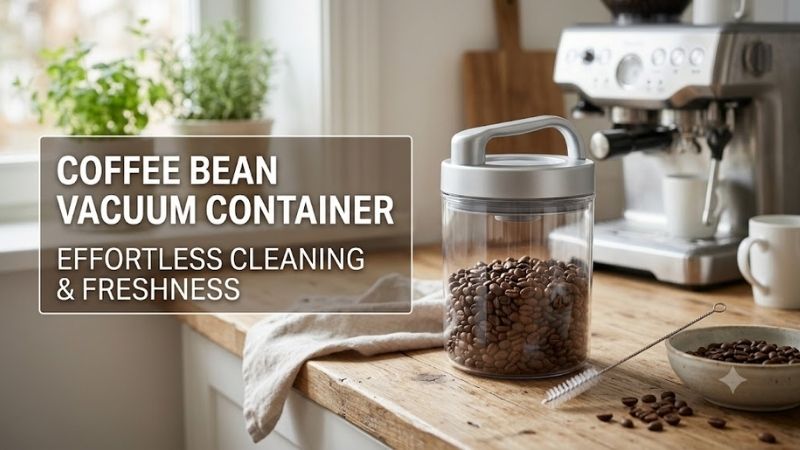
A vacuum canister uses a mechanism to remove some air from the container after closing.
Depending on the design, the user may twist the lid, operate a hand pump, or activate an electric pump.
Reducing the amount of air inside can reduce oxygen exposure under suitable conditions.
However, a consumer coffee canister does not necessarily create a perfect vacuum.
Its effectiveness depends on the pump, gasket, valve, container construction, and how long the seal remains intact.
Vacuum storage is a way to manage the surrounding environment. It does not stop every process associated with coffee aging.
Vacuum vs. Airtight
An ordinary airtight container attempts to prevent uncontrolled air exchange once sealed.
However, it usually leaves the existing air inside.
A vacuum container attempts to remove some of that air.
This is a meaningful design difference.
However, a vacuum canister is not automatically superior in every household.
Coffee used within a short period may not benefit enough from the added mechanism to justify higher cost and maintenance.
Vacuum vs. Air Displacement
Some coffee storage systems use a movable inner lid to reduce unused air space above the beans.
This can reduce the volume of trapped air.
However, it does not necessarily use a vacuum pump.
Do not confuse an adjustable inner lid with a system that actively removes air.
Both can be considered for coffee storage, but cleaning requirements differ.
What Vacuum Storage Cannot Do
A vacuum canister does not sterilize coffee.
It does not remove all moisture from beans.
It cannot restore flavor lost before storage.
It does not guarantee that old or damaged coffee becomes fresh again.
Claims about extending freshness by a specific number of days should be supported by controlled evidence involving the exact product and storage conditions.
Why Easy Cleaning Matters
Coffee Beans Leave Residue
Whole coffee beans can leave oils and fine particles on container surfaces.
Dark-roasted beans may have noticeable surface oils.
Fine dust can also accumulate during transferring and scooping.
Over time, residue may collect around the lid and sealing surfaces.
A container that is difficult to clean can become inconvenient, even if it initially offers good air protection.
Vacuum Lids Have Additional Components
A basic jar may contain only a lid and gasket.
A vacuum canister may include a pump, valve, filter, release button, or electronic mechanism.
These components add functionality.
They can also create spaces where fine residue collects.
The buyer should understand which pieces can be removed and which must remain dry.
Why Dishwasher Claims Matter
Some vacuum canisters are not dishwasher safe, especially when their lids contain pump mechanisms or electronics.
A dishwasher can expose components to water, heat, detergent, and pressure.
Do not assume that a stainless steel or glass canister is dishwasher safe because of its body material.
The lid and container may have different care requirements.
Cleaning Simplicity vs. Sealing Performance
A simple jar is often easier to wash.
A vacuum mechanism may provide additional storage functionality.
The right choice depends on whether the owner values the sealing feature enough to perform the required maintenance.
For daily coffee use, a lid that is quick to open and easy to wipe may offer greater practical value than an elaborate mechanism that requires frequent attention.
Manual vs. Electric Vacuum Canisters
Twist-Activated Manual Vacuum Lids
Some manual vacuum lids remove air through repeated twisting.
This can avoid external pumps, batteries, and charging cables.
However, the user must perform the sealing action correctly.
The lid may also require periodic resealing.
Check how the mechanism indicates that an appropriate vacuum has been created.
Pump-Style Manual Vacuum Lids
Other designs use a separate or integrated hand pump.
These may provide a straightforward method for removing air.
However, a detachable pump introduces another component to store.
Check how the valve is cleaned and whether the pump can be maintained.
Electric Vacuum Lids
Electric models use a motorized pump to remove air.
Some activate through a button or automatic sensor.
These can reduce manual effort.
However, the lid may include a rechargeable battery, electronics, and seals that must remain dry.
An electric canister is not inherently easier to clean.
Which Is Better for Daily Use?
A manual mechanism may be practical for one canister opened once or twice daily.
An electric design may appeal to households managing several containers.
However, charging, battery condition, and replacement availability affect long-term convenience.
Choose the mechanism that you will actually use consistently.
Vacuum Seal Indicators
What Does an Indicator Show?
Some containers provide a visual indication that the lid has reached a particular sealing state.
This may be a colored marker, button position, or electronic signal.
The exact meaning depends on the design.
A visual indicator is useful feedback, but it does not independently measure all aspects of freshness.
Manual Seal Checks
Some lids provide resistance or a release mechanism that indicates a vacuum condition.
However, do not force the lid open.
Follow the manufacturer’s release procedure.
Automatic Resealing
Certain electric models may monitor or maintain a vacuum condition.
However, the feature should be verified for the exact product.
Automatic resealing does not eliminate gasket cleaning or battery maintenance.
Seal Loss Over Time
A vacuum can diminish because of small leaks, changes in internal pressure, or normal operation.
Fresh roasted coffee can also release gas after roasting.
The interaction between degassing and vacuum storage depends on the coffee and container.
Check the manufacturer’s guidance on resealing frequency.
Understanding Coffee Degassing
What Is Degassing?
Roasted coffee beans release gases, including carbon dioxide, after roasting.
The rate varies with roast development, bean characteristics, storage conditions, and time.
This is a normal part of roasted coffee behavior.
Why Degassing Matters for Vacuum Containers
A container’s internal pressure can change as coffee releases gas.
That can influence the condition of the vacuum seal.
Some manufacturers recommend checking or renewing the vacuum periodically.
However, the appropriate schedule is product-specific.
Freshly Roasted Beans
Very fresh beans may release substantial gas.
Follow the canister manufacturer’s instructions regarding suitable coffee and sealing procedure.
Do not assume that every vacuum container should be filled immediately with hot, freshly roasted beans.
Allow coffee to cool and handle it according to suitable storage guidance.
One-Way Valve Coffee Bags
Some roaster bags include a one-way valve.
These are intended to allow gas to leave while limiting air entry under suitable conditions.
A quality original bag can be an effective storage option.
Transferring beans to a vacuum canister is a choice, not a universal requirement.
Whole Beans vs. Ground Coffee in Vacuum Storage
Why Many Vacuum Containers Prefer Whole Beans
Fine ground coffee can enter small valve openings or pump pathways.
Some manufacturers expressly recommend using whole beans rather than ground coffee or powder.
That distinction is especially important when choosing a container for easy cleaning.
What Happens if Grounds Enter the Valve?
Fine particles may interfere with proper sealing.
They can also be difficult to remove from narrow internal passages.
A user may mistake a clogged valve for a defective gasket or pump.
Avoid using a vacuum container for ground coffee unless its manufacturer explicitly supports it.
Does Whole-Bean Storage Guarantee Freshness?
No.
Whole beans still change with time.
Vacuum storage may reduce certain exposure, but temperature, moisture, original coffee quality, and repeated opening also matter.
Pre-Ground Coffee Alternatives
If you mainly buy ground coffee, a simple airtight canister or suitable original packaging may be more practical.
This avoids selecting a vacuum mechanism that is not designed for fine particles.
Choosing the Right Capacity
Daily Espresso Drinkers
A person using 18 grams of beans daily consumes approximately 126 grams per week.
A relatively small canister may be sufficient.
Choosing a large vacuum jar for such a small quantity can create unnecessary empty space.
Couples
Two people using a combined 36 grams daily consume approximately 252 grams per week.
A medium container may be practical.
However, capacity should match the coffee packages normally purchased.
Filter Coffee Households
A household brewing a full carafe might use 55 grams or more per session, depending on the recipe.
Consumption can therefore be substantially higher.
Choose capacity according to actual daily use.
Volumetric Capacity vs. Bean Weight
A canister’s capacity may be expressed in liters.
However, different beans occupy different volumes.
Roast level and density influence how much weight fits.
Use the manufacturer’s approximate whole-bean capacity as a starting point.
Avoiding Oversized Containers
A large container can be convenient for bulk coffee.
However, it may be harder to wash and dry.
It also takes up more cabinet space.
Choose the smallest practical size that accommodates your normal purchase quantity without excessive crowding.
Materials and Cleaning Trade-Offs
Stainless Steel Bodies
Stainless steel canisters can provide durable, opaque construction.
They are often suitable for countertops where light protection matters.
However, their finish can be scratched by abrasive cleaning tools.
Follow the manufacturer’s care instructions.
Glass Bodies
Glass makes it easy to see the quantity of beans remaining.
It can also simplify visual inspection for residue.
However, clear glass should be protected from strong light, and breakage remains a concern.
A vacuum glass vessel should never be used when cracked or chipped.
Plastic Components
Many lids contain plastic mechanisms even when the body is metal or glass.
These parts may have different cleaning requirements.
Check temperature restrictions and whether the materials are approved for food contact.
Silicone Gaskets
Silicone and similar flexible materials are common in sealing systems.
They can accumulate coffee dust near their edges.
A removable gasket may simplify cleaning, but only if it can be reinstalled correctly.
Exterior Coatings
Matte and painted finishes may require gentle cleaning.
A rough sponge can damage decorative surfaces.
For everyday use, prioritize durable, low-maintenance finishes rather than appearance alone.
Removable Gaskets and Filters
Why Removable Gaskets Are Useful
A gasket creates a seal between the lid and container.
Coffee residue may collect around it.
If the gasket can be removed, the underlying surfaces can sometimes be cleaned more thoroughly.
However, removal should be performed only as instructed.
Cleaning the Gasket
Use the manufacturer-approved method.
A mild food-contact detergent may be suitable for certain components.
Rinse and dry as directed.
Inspecting for Wear
A damaged, torn, stretched, or incorrectly positioned gasket can reduce sealing performance.
Inspect it periodically.
Replaceable Filters
Some vacuum lids contain filters intended to protect the pump or valve from particles.
These may require cleaning or replacement.
Check whether compatible parts are available.
Reassembly
A clean lid can still fail to seal if its gasket or filter is incorrectly installed.
Follow the manufacturer’s sequence.
Do not improvise missing components.
Cleaning the Vacuum Lid Safely
Check the Manufacturer’s Instructions First
Vacuum lids differ significantly.
Some can be partially disassembled.
Others contain sealed pump assemblies.
Never assume an instruction for one brand applies to another.
Keep the Pump Dry When Required
A vacuum pump or electronic lid may not tolerate running water.
For such designs, use a damp cloth or sponge as directed.
Do not immerse the lid.
Avoid Excessive Water
Water entering a pump mechanism can interfere with operation.
A lid that looks washable from the outside may contain hidden valves.
Avoid Abrasive Cleaning
Rough brushes and cleaning pads can damage seals, finishes, or valve components.
Use approved tools.
Do Not Force the Valve
A blocked or malfunctioning valve should be handled according to the troubleshooting instructions.
Avoid inserting sharp objects or forcing internal parts.
Drying the Lid
Allow approved cleaned surfaces to dry before use.
Moisture trapped inside a sealing mechanism can create problems.
Cleaning the Container Body
Empty the Beans
Transfer beans into a suitable temporary container when necessary.
Keep them protected from moisture.
Remove Loose Residue
Use an appropriate dry cloth or cleaning method before washing.
Avoid spreading coffee dust into sealing mechanisms.
Wash According to Material
Follow the instructions for glass, steel, or plastic bodies.
Use suitable detergent when permitted.
Inspect Corners and Seams
Fine coffee dust can collect near the bottom and around internal edges.
A wide opening makes inspection easier.
Dry Completely
Do not return beans to a damp container.
Allow the body to dry thoroughly.
Recheck the Seal
After reassembly, test the lid using the manufacturer’s normal sealing method.
If the vacuum cannot be maintained, inspect gasket alignment before assuming the pump has failed.
How Often Should You Clean a Vacuum Canister?
After Every Opening?
A full wash is generally unnecessary after every opening when the container is clean and used properly.
However, wipe away visible spills or residue when needed.
When Changing Beans
Cleaning between different coffees can reduce old oil residue and flavor carryover.
This can be useful when switching from a dark, oily roast to a lighter coffee.
When the Seal Becomes Unreliable
A poorly maintained gasket or obstructed valve may interfere with vacuum performance.
Follow the manufacturer’s troubleshooting procedure.
During Longer Storage
If the canister will remain empty for an extended period, clean and dry it according to the manual.
Do not store a damp lid in a closed container.
After Accidental Contamination
If liquids, fine powder, or other unsuitable substances enter the pump mechanism, stop using it and follow manufacturer guidance.
Do not assume ordinary rinsing will restore the device.
A Practical Daily Coffee Storage Routine
Step 1: Start With Clean, Dry Equipment
Inspect the container and lid.
Check for damage.
Step 2: Add Whole Beans
Use the type and quantity permitted by the manufacturer.
Do not overfill.
Step 3: Close the Lid Correctly
Seat it fully.
Make sure no beans or particles obstruct the seal.
Step 4: Activate the Vacuum
Use the manual or electric mechanism according to its instructions.
Step 5: Confirm the Seal
Check the appropriate indicator or other approved feedback.
Step 6: Store the Container Properly
Choose a cool, dry place away from direct sunlight and cooking heat.
Step 7: Release Before Opening
Use the pressure-release function when required.
Do not pry a vacuum lid off forcefully.
Step 8: Measure the Coffee
Remove the desired bean quantity using a clean, dry tool.
Step 9: Reseal Promptly
Restore the vacuum as instructed.
Step 10: Inspect and Maintain
Check the gasket and cleaning requirements regularly.
A simple repeatable routine is more valuable than an elaborate system that is rarely maintained.
Troubleshooting Common Vacuum Container Problems
The Lid Will Not Seal
Check for coffee fragments on the rim.
Inspect gasket placement.
Confirm that the lid is fully seated.
The Vacuum Disappears Quickly
Possible causes include gasket problems, valve contamination, or normal changes in internal pressure.
Follow the manufacturer’s troubleshooting guidance.
The Release Button Is Difficult to Operate
Do not force it.
Check the manual.
Coffee Dust Is Visible Near the Pump
Stop using the container with unsuitable fine particles.
Clean only by the approved method.
The Electric Lid Will Not Activate
Check battery charge and the manufacturer’s power instructions.
Do not expose charging contacts to water.
Unpleasant Odors Remain
Inspect the body, gasket, and accessible lid surfaces.
Clean and dry appropriately.
Do not apply perfumes or household odor-masking chemicals inside food-storage equipment.
Budget and Long-Term Value
Entry-Level Manual Vacuum Canisters
These may offer a straightforward air-removal mechanism without electronic components.
However, durability varies.
Midrange Containers
Better lid construction, accessible seals, and replacement parts may justify a higher price.
Electric Vacuum Containers
Motorized sealing offers convenience but introduces charging and repair concerns.
Replacement Parts
Check gasket, filter, lid, and battery serviceability where applicable.
Cost per Use
A container used daily may justify a higher purchase price if it remains convenient and functional.
However, expensive storage equipment should not consume the budget needed for fresh coffee or an appropriate grinder.
Common Buying Mistakes
Assuming Vacuum Means No Maintenance
Pumps, valves, and seals require care.
Washing an Electronic Lid Under Running Water
Many powered lids are not waterproof.
Putting Ground Coffee Into a Whole-Bean-Only Container
Fine particles may clog valves.
Ignoring Gasket Replacement
A damaged seal can undermine the vacuum system.
Believing Vacuum Storage Makes Coffee Last Indefinitely
Storage only addresses part of the freshness problem.
Choosing an Oversized Container
A large body can be harder to wash and store.
Buying Based Solely on a Freshness Multiplier Claim
Such claims depend on testing conditions and should not be generalized.
Frequently Asked Questions
Are Vacuum Coffee Containers Better Than Airtight Containers?
They can remove some air rather than merely sealing it inside, but the practical benefit depends on the coffee, storage conditions, and container design.
Can I Wash a Vacuum Coffee Container in the Dishwasher?
Only if the exact manufacturer approves it. Many vacuum lids and some container bodies are not dishwasher safe.
Can I Store Ground Coffee in a Vacuum Container?
Only when the manufacturer explicitly supports it. Fine particles can clog certain vacuum valves.
Why Does My Vacuum Coffee Canister Lose Its Seal?
Possible causes include gasket problems, valve residue, changes in internal pressure, and normal product-specific behavior. Follow the manufacturer’s instructions.
Are Electric Vacuum Lids Easier to Maintain?
Not necessarily. They may simplify pumping but add batteries and moisture-sensitive components.
What Is the Easiest Vacuum Canister to Clean?
Look for a wide opening, accessible sealing surfaces, manufacturer-approved gasket removal, and clear instructions for maintaining the pump or valve.
Conclusion
The best coffee bean vacuum container for easy cleaning should provide practical air management without demanding complicated maintenance. Choose a suitable capacity, wide opening, accessible gasket, and clearly documented lid care. Manual systems avoid batteries, while electric designs may simplify sealing but require additional protection from moisture. Use whole beans when required, clean sealing components correctly, and remember that vacuum storage supports good coffee handling rather than replacing it.









Write Your Review
No reviews yet. Be the first to share your experience!