
A cast iron skillet for limited counter space should cook satisfying meals without dominating a small kitchen. The right size, handle shape, and storage plan matter as much as searing ability. This guide explains how to choose compact cast iron, use it safely on smaller burners, and keep it accessible without sacrificing precious workspace.
Why compact cast iron cookware makes sense in small kitchens
Limited counter space changes how cookware is selected, stored, and used. A skillet may perform beautifully on the stove but become inconvenient when its long handle blocks neighboring appliances or its weight makes cabinet storage difficult. Choosing compact cast iron requires balancing cooking performance with the practical dimensions of the kitchen.
Understand the difference between pan diameter and total footprint
A skillet’s advertised diameter describes only part of the space it occupies. Handles, pouring spouts, and supporting grips can extend well beyond the cooking vessel. For small kitchens, buyers should measure the complete pan rather than relying on a nominal eight-inch or ten-inch size printed on the packaging.
A 10-inch skillet may have a total length exceeding 15 inches once its handle is included. This matters when storing cookware in narrow cabinets or placing it near a backsplash.
Begin by measuring the available countertop depth and width. Include the distance between the burner and neighboring objects, especially coffee machines, utensil holders, or electrical appliances.
The pan must have enough clearance for its handle to remain away from direct heat and walkways. A handle that extends beyond the stove edge can become a safety concern, particularly in kitchens where people regularly pass close to the cooking area.
Cabinet storage introduces another consideration. A skillet that fits comfortably on the burner may be too wide to lie flat inside a shallow drawer.
Check the internal cabinet dimensions, including hinges and shelf supports. These obstacles can reduce usable space more than expected.
If storing the skillet vertically, measure the height of the pan with its handle positioned upward. A wall-mounted rack may work well, but only when the mounting hardware supports the skillet’s weight.
The best buying decision begins with accurate measurements rather than assumptions about compact product descriptions.
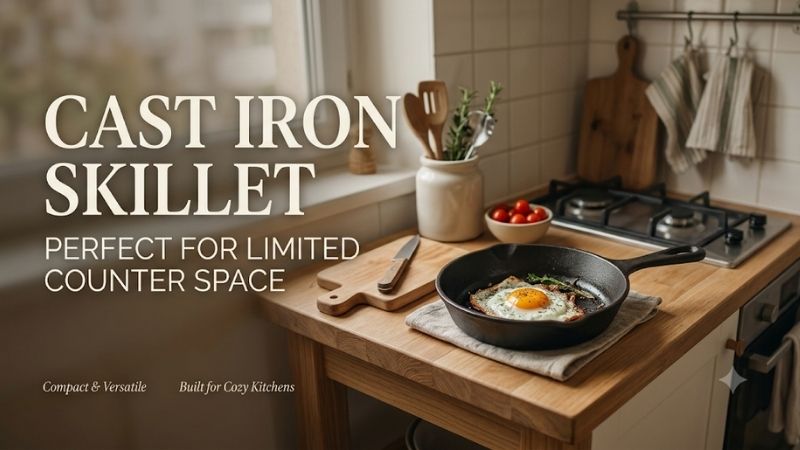
Choose a skillet that can replace multiple cooking tools
A compact kitchen benefits from cookware that performs several tasks instead of requiring separate pans for every recipe. Cast iron can sear meat, sauté vegetables, bake cornbread, and prepare simple one-pan meals. Selecting a versatile skillet may reduce the number of other cooking tools occupying limited cabinet space.
For example, a 10-inch cast iron skillet can prepare breakfast eggs, brown chicken thighs, and bake a small skillet cookie.
It can also move from the stove to the oven when the manufacturer approves that use. This flexibility reduces the need to transfer ingredients into a separate baking dish.
However, cast iron should not automatically replace every pan in the kitchen.
Traditional seasoned cast iron is less convenient for prolonged acidic cooking. Tomato-based sauces and vinegar-heavy reductions may weaken the seasoning and produce an undesirable reaction with exposed iron.
For those recipes, stainless steel or enameled cookware can be more practical.
A well-seasoned cast iron surface also becomes increasingly useful for foods such as potatoes, pancakes, and certain egg preparations.
Nevertheless, beginners may find a conventional nonstick pan easier for particularly delicate foods.
The purpose of multipurpose cookware is to reduce unnecessary duplication, not to force one material into unsuitable tasks.
Identify the three or four recipes prepared most frequently. If those meals involve browning, baking, and everyday sautéing, compact cast iron may provide excellent value.
If most meals consist of acidic sauces or quick low-temperature preparations, another cookware material may deserve priority.
Balance heat retention with manageable weight
Cast iron is valued for its ability to retain heat, but its substantial weight can create challenges in cramped kitchens. Heavy cookware may be difficult to lift from low cabinets or maneuver around closely positioned appliances. Buyers should consider whether a lighter skillet provides sufficient cooking performance with better handling comfort.
A traditional 10.25-inch Lodge skillet weighs approximately 5.66 pounds before food is added.
That may not seem excessive when the pan is empty, but the weight becomes more noticeable when carrying a prepared meal.
A lightweight alternative such as the Lodge Blacklock 10.25-inch skillet reduces some of that burden through thinner construction.
Field Company also offers relatively lightweight cast iron designs intended for frequent everyday handling.
However, reducing weight changes the pan’s thermal characteristics.
A heavier skillet generally stores more heat when fully preheated, which can be useful for searing a thick steak.
A lighter skillet may respond more quickly to changes in burner output and feel easier to maneuver.
Neither quality is universally superior.
A person preparing eggs and vegetables every morning may value comfortable lifting more than maximum thermal mass.
Someone who frequently sears substantial portions of meat may prefer a heavier pan.
When comparing options, imagine lifting the skillet from its storage location while holding a utensil or oven mitt.
If the movement feels awkward, the pan may not be practical for everyday use.
How to choose a cast iron skillet for limited counter space
Compact cast iron skillets differ in shape, handle length, cooking area, and storage convenience. A suitable model should fit the burner while still offering enough room for ordinary meals. Buyers should prioritize functional dimensions and comfortable handling rather than assuming the smallest skillet automatically provides the best solution.
Choose between eight-inch and ten-inch skillet sizes
An eight-inch skillet is useful for small portions and individual breakfasts, while a ten-inch model offers greater flexibility for complete meals. The right size depends on serving requirements, burner dimensions, and how frequently the pan must be stored. Choosing too small can create almost as much inconvenience as choosing too large.
An eight-inch skillet works well for one or two eggs, a small serving of vegetables, or an individual baked dessert.
Its smaller dimensions make it easier to place inside cabinets or on compact stovetops.
However, the usable flat cooking area is substantially smaller than the outer rim measurement.
A steak or large chicken breast may occupy nearly the entire cooking surface.
When ingredients are crowded, released moisture accumulates and interferes with browning.
A ten-inch skillet offers a more useful compromise for many small households.
It can accommodate two moderate portions of meat, a larger omelet, or a complete one-pan breakfast.
The additional space also improves access with a spatula.
However, it requires more storage room and may be heavier.
For people cooking one small meal at a time, an eight-inch pan can be sufficient.
For couples or individuals who regularly prepare leftovers, a ten-inch skillet is usually more versatile.
Before buying, compare the flat cooking diameter rather than relying only on the nominal size.
A pan with steeply sloped sides may provide less usable floor space than expected.
Consider shorter handles and double-handle designs
Handle geometry can determine whether a skillet fits inside a narrow cabinet or safely occupies a small burner. Traditional long handles provide leverage, but they may extend beyond limited work surfaces. Alternative designs use shorter grips or two opposing handles to reduce overall length while preserving control.
A double-handle skillet, sometimes called a loop-handle or serving skillet, can offer a compact storage profile.
Instead of a long projecting handle, it uses two smaller grips on opposite sides.
This arrangement can be convenient for oven cooking and presentation.
However, lifting generally requires two hands and appropriate heat protection.
Short loop handles also provide less leverage when tilting a pan to distribute cooking oil.
For frequent stovetop sautéing, a conventional long handle may be more comfortable.
A compact double-handle design becomes especially useful when the skillet will be stored inside an oven or narrow cabinet.
Buyers should examine the complete width, including both handles.
Two handles can reduce total length but increase overall width.
A pan that fits one storage orientation may not fit another.
Long handles also vary considerably between manufacturers.
Some premium lightweight skillets use extended handles that improve comfort but increase the storage footprint.
The right design depends on how often the pan is lifted, how much room is available, and whether stovetop or oven cooking is the primary use.
Evaluate lightweight models without sacrificing durability
Lightweight cast iron is attractive for small kitchens because it is easier to move, hang, and store. However, buyers should compare construction and cooking performance rather than assuming every thinner pan offers identical benefits. A well-designed lightweight skillet should balance practical handling with sufficient stability during heating.
Lodge Blacklock and Field Company are examples of cookware lines that emphasize reduced weight.
Their designs offer an alternative to substantial traditional cast iron without abandoning the material’s basic characteristics.
Lighter cookware can be particularly beneficial when the storage location is above shoulder height.
However, storing any heavy pan on an elevated shelf requires careful consideration.
The shelf must be structurally suitable, and the pan should be easy to retrieve without stretching or losing balance.
A lighter skillet may also be easier to clean in a small sink.
This can reduce accidental contact with nearby dishes or countertops.
Nevertheless, thin cast iron should be heated thoughtfully.
Rapid exposure to extreme heat can create uneven temperatures, especially when using powerful induction burners.
Preheat gradually and use a burner appropriate for the pan’s base.
Durability also depends on the quality of casting and finishing.
Inspect product information for handle design, seasoning, and manufacturer care recommendations.
A premium lightweight pan may be worthwhile for someone cooking daily, but a conventional budget skillet can provide excellent service when its weight is manageable.
Cooking efficiently with a compact cast iron skillet
A small skillet can produce excellent meals when its cooking area and heat characteristics are used correctly. Compact cookware rewards careful ingredient preparation, portion management, and gradual preheating. These techniques help reduce overcrowding, improve browning, and limit unnecessary movement around a small kitchen.
Preheat cast iron properly on smaller burners
Cast iron retains heat effectively but distributes it relatively slowly. This characteristic becomes especially important when the cookware is placed over a compact burner. Gradual preheating helps reduce temperature differences across the cooking surface and makes browning more predictable.
Begin by placing the skillet centrally over an appropriately sized burner.
Use low or medium heat initially rather than immediately selecting the highest setting.
Allow several minutes for the iron to warm.
The required time depends on skillet thickness, burner output, and surrounding conditions.
A heavier pan usually takes longer to reach a relatively even temperature.
Excessively rapid heating can create a hot center while the outer cooking area remains cooler.
This can make eggs cook unevenly or cause meat to brown inconsistently.
Once the pan is appropriately heated, add a suitable quantity of cooking fat.
For steak, allow the oil to become fluid and distribute across the surface without smoking excessively.
For eggs, use a lower temperature and enough butter or oil to support release.
Avoid assuming that cast iron must always be used at maximum heat.
Most everyday recipes benefit from deliberate temperature control.
When cooking several portions, monitor how the pan responds after the first batch.
The stored heat may reduce the preheating required for subsequent servings.
Prevent overcrowding with smarter meal preparation
The cooking area of a small skillet is limited, so ingredient preparation matters as much as burner temperature. Trying to cook too much food at once can create steam, prevent browning, and extend total cooking time. Smaller batches and appropriate ingredient sizes often produce better results than filling the skillet completely.
For example, two large chicken thighs may fit a ten-inch skillet comfortably.
Adding a third or fourth piece could eliminate the space needed for moisture to evaporate.
Instead of developing crisp skin, the chicken may begin cooking in accumulated liquid.
Cooking in two batches can improve texture.
Prepare vegetables before heating the pan so ingredients can be added efficiently.
Cut pieces into reasonably uniform sizes to support consistent cooking.
For mushrooms or zucchini, avoid adding large quantities of wet ingredients simultaneously.
Allow one batch to develop color before introducing more.
A compact skillet can also support one-pan cooking when ingredients are added in stages.
Brown the protein first, remove it temporarily, then cook the vegetables.
Return the protein when appropriate to complete the meal.
This approach uses the limited cooking area more effectively.
A small pan does not necessarily require complicated recipes.
It requires choosing portion sizes and cooking sequences that match the available surface.
Use stovetop-to-oven recipes to save preparation space
One advantage of cast iron is its suitability for recipes that begin on the stove and finish in the oven. This reduces the need for a separate baking dish and can simplify cleanup. In small kitchens, using one piece of cookware for multiple preparation stages can free valuable counter and sink space.
A compact skillet can be used for a small frittata, cornbread, baked vegetables, or an oven-finished chicken dinner.
For a frittata, begin by cooking vegetables on the stovetop.
Add beaten eggs and allow the mixture to begin setting.
Transfer the skillet to the oven if its manufacturer permits the required temperature.
This produces a complete meal without using a second baking dish.
For cornbread, preheating the skillet can help develop a browned crust.
However, the iron becomes extremely hot and must be handled carefully.
Check that the skillet fits inside the oven with enough clearance around its handle.
This is particularly important in compact countertop ovens.
Do not assume every silicone handle cover is suitable for oven use.
Remove accessories when the manufacturer requires it.
Prepare a heat-safe landing area before removing the skillet.
A small kitchen becomes easier to manage when the cooking sequence is planned before the pan is heated.
Storage, cleaning, and maintenance in limited spaces
A compact skillet is only convenient when it can be stored safely and cleaned without creating additional clutter. Cast iron requires more attention to moisture than stainless steel, but the routine is straightforward. Good storage practices protect seasoning, reduce rust risk, and keep the cookware accessible for regular meals.
Store cast iron vertically when cabinet space is limited
Vertical storage can free valuable cabinet space by moving cookware onto walls, racks, or dedicated shelving. However, cast iron is heavy, so storage hardware must be selected carefully. A convenient arrangement should support the full weight of the skillet without creating risks when cookware is removed.
Wall-mounted hooks can be useful when attached to appropriate structural supports.
However, ordinary adhesive hooks may not be rated for the weight of a cast iron skillet.
Verify the manufacturer’s load rating and installation requirements.
A freestanding rack may be another option when wall drilling is undesirable.
It should have a stable base and enough clearance for the skillet’s handle.
Avoid positioning heavy cookware where it could fall onto a person or valuable appliance.
Inside cabinets, vertical organizers can separate pans and make individual pieces easier to retrieve.
Some designs support skillets by their rims, while others use flat shelves.
Choose a system suitable for cast iron weight.
If hanging cookware, consider the handle shape and balance.
A narrow hanging hole may not fit every hook.
For kitchens with particularly limited space, storing the skillet inside a conventional oven may be possible, but it must always be removed before the oven is activated.
Safety and accessibility should take priority over decorative display.
Clean and dry the skillet without damaging seasoning
Traditional cast iron cookware relies on seasoning to protect the metal and support food release. Cleaning should remove food residue without unnecessarily damaging that protective layer. In a small kitchen, a predictable washing and drying routine can prevent the skillet from becoming an inconvenient item left beside the sink.
Allow the pan to cool sufficiently for safe handling.
Use warm water and a suitable brush or sponge to remove ordinary residue.
A small amount of mild dish soap is generally compatible with established seasoning.
Avoid prolonged soaking, because exposed iron can rust when left wet.
For stubborn food deposits, use an appropriate pan scraper rather than aggressive scraping with unsuitable tools.
After cleaning, dry the skillet thoroughly.
A clean towel removes most surface moisture.
Brief heating over a low burner can help evaporate remaining water when performed carefully.
Apply a very thin oil film if recommended by the manufacturer.
Wipe away excess oil to prevent sticky residue.
Do not place a damp skillet into a tightly enclosed cabinet.
Moisture trapped against cookware can encourage rust.
If stacking the pan with other items, use a suitable separator to protect the cooking surface and allow airflow.
Know when a smaller skillet is not the best investment
Compact cookware is convenient, but selecting a skillet that is too small can create repeated frustrations. Buyers should consider whether limited capacity will increase cooking time or encourage the purchase of additional pans. Sometimes one moderately sized skillet provides better space efficiency than several specialized small models.
An eight-inch skillet is ideal for individual portions, but it may not accommodate an entire dinner.
If the user frequently cooks for two or three people, repeated batches can become time-consuming.
A ten-inch model may offer enough additional flexibility to replace the need for another frying pan.
However, a larger skillet requires more room for storage and cleaning.
The decision should reflect normal meal sizes.
Consider how frequently the household prepares food for guests.
Occasional larger meals may be manageable through batch cooking rather than buying oversized cookware.
For everyday acidic recipes, an enameled or stainless steel pan may be more practical than traditional seasoned cast iron.
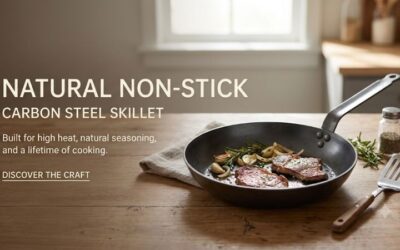
For people who dislike heavy cookware, a lightweight carbon steel skillet may offer more comfortable handling.
The right purchase is not necessarily the smallest possible cast iron pan.
It is the skillet that provides useful cooking capacity while remaining easy to retrieve, clean, and store.
Conclusion
The best cast iron skillet for limited counter space balances compact dimensions with enough cooking area for regular meals. An eight-inch model suits individual portions, while a ten-inch skillet offers greater everyday versatility. Measure the full footprint, including handles, and consider lightweight or double-handle designs where storage is restrictive. With gradual preheating, careful cleaning, and secure storage, compact cast iron can deliver dependable cooking performance without overwhelming a small kitchen.



Write Your Review
No reviews yet. Be the first to share your experience!