
A flat bottom wok for everyday use needs to handle more than an occasional restaurant-style stir-fry. It should sit securely on the burner, heat quickly enough for vegetables, and be manageable for noodles, eggs, or a one-pan dinner. Here is how to select a versatile design and maintain it for the meals you actually cook.
Choosing a flat bottom wok for everyday use at home
A wok used several times each week should match the kitchen equipment and the meals being prepared. Traditional design is important, but convenience also matters. The right pan needs a stable base, manageable weight, enough cooking space, and a surface that the owner can maintain without excessive effort.
Start with stovetop compatibility before choosing a brand
A flat-bottom design solves some of the stability problems associated with traditional round-bottom woks, but it does not guarantee compatibility with every burner. Gas, radiant electric, and induction cooktops have different heating requirements, so the cookware must be selected around the appliance actually used.
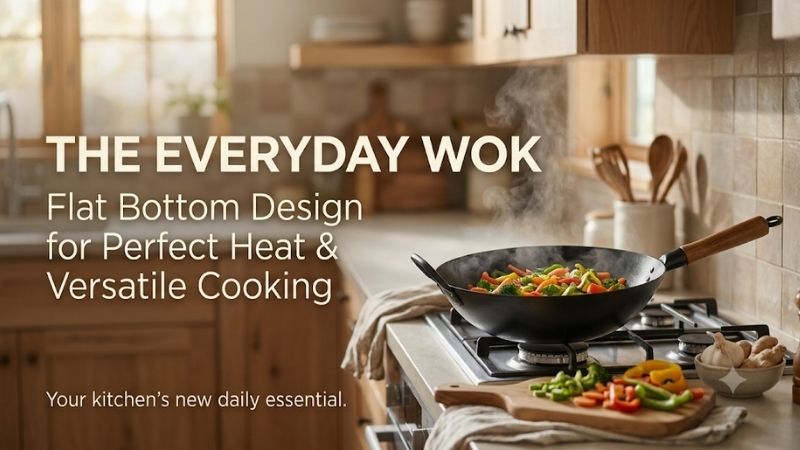
On a gas stove, a flat-bottom wok usually sits directly on the burner grate.
This makes it convenient for everyday cooking without a separate wok ring.
Gas flames may heat the base and lower sidewalls, depending on their distribution and intensity.
On a radiant electric cooktop, the wok benefits from a flat base that maintains stable contact with the heating zone.
A base that is excessively small may receive limited heat and make cooking slower.
Induction cooktops require compatible magnetic material.
Carbon steel and cast iron are usually suitable in principle, but the base must meet the appliance’s contact and minimum-diameter requirements.
A small flat base may not activate every induction zone.
Check the cooktop manual before purchasing.
For households expecting to move between different kitchens, a verified induction-compatible flat-bottom wok provides greater flexibility.
Avoid choosing a round-bottom model unless the stove is specifically designed or safely configured to support it.
What diameter and flat-base size work best for daily meals?
The best wok diameter depends on household size, burner power, and cooking habits. A larger upper bowl provides more room for mixing ingredients, but the flat base determines how much food receives direct heat. Choosing the right proportions is more useful than simply buying the largest available pan.
A 12-inch wok is appropriate for small kitchens and one- or two-person meals.
Its compact dimensions make storage and washing easier.
However, the smaller bowl can become crowded when preparing large portions of noodles or vegetables.
A 13- to 14-inch wok offers more room for stirring.
This size is particularly practical for households that prepare several servings but still want cookware that fits a standard home range.
The flat-base diameter should be evaluated separately.
Some woks have narrow flat bottoms that focus heat near the center, while others provide broader contact areas.
A narrow base can be useful for concentrated stir-frying but limits the amount of protein that can brown simultaneously.
A broad base provides additional direct cooking area but may reduce some of the traditional curved-wok behavior.
For everyday use, choose a wok that comfortably handles the most frequently prepared meal rather than an occasional oversized gathering.
How handle design influences comfort and storage
A wok is frequently moved, tilted, and lifted during cooking, so its handle design matters more than it might on a stationary stockpot. A comfortable long handle gives the cook control, while a helper handle improves stability when transferring food. Overall length also affects cabinet storage and burner clearance.
Wooden handles are common on traditional carbon steel woks.
They provide a comfortable grip during normal stovetop cooking, although the metal connector can become hot.
Stainless steel handles are durable and may allow broader oven compatibility on certain models.
However, metal handles should always be treated as potentially hot during extended heating.
A second helper handle is useful for large or heavy woks.
It allows the cook to lift the pan with both hands, particularly when carrying food to a serving area.
Handle attachment should feel secure.
Loose connections can make maneuvering dangerous when the pan contains hot oil or liquid.
Storage is another consideration.
A 14-inch wok with a long handle may require significantly more space than its bowl diameter suggests.
Measure the cabinet or drawer before purchasing.
For frequent use, prioritize comfortable handling and easy storage over decorative appearance.
Choosing the best wok material for daily cooking
Material selection determines how the wok responds to heat, how easily food releases, and what maintenance is required. Carbon steel, stainless steel, cast iron, and nonstick-coated alternatives can all prepare stir-fries, but each favors different cooking habits. Understanding these differences prevents buying cookware that becomes inconvenient after the first few meals.
Carbon steel for responsive heating and traditional cooking
Carbon steel is a practical choice for frequent stir-frying because it responds relatively quickly to heat changes and develops a seasoned surface. It is generally lighter than cast iron of comparable size, allowing the cook to move ingredients without repeatedly lifting an excessively heavy pan.
A carbon steel wok is useful for fried rice, vegetables, noodles, and thinly sliced meat.
Its cooking surface can tolerate temperatures that are inappropriate for many conventional nonstick coatings.
When properly seasoned, the surface also provides some protection against sticking.
However, seasoning is not permanent.
It can be affected by acidic ingredients, prolonged soaking, or inappropriate cleaning.
For households using a wok several times each week, continued cooking often helps develop the surface.
A well-maintained carbon steel wok can remain functional for many years because the seasoning can be renewed.
The primary disadvantage is maintenance.
The wok must be dried thoroughly after washing, and occasional oiling may be necessary.
Rust can develop if exposed metal remains wet.
Carbon steel is therefore best suited to cooks who value traditional technique and are comfortable performing a short cleaning routine after each meal.
Stainless steel and cast iron as durable alternatives
Stainless steel and cast iron offer different advantages from carbon steel. Stainless steel avoids seasoning maintenance, while cast iron retains heat effectively and provides a durable cooking surface. However, differences in weight, temperature response, and food release can make these materials less convenient for rapid stir-frying.
Stainless steel is particularly useful for dishes involving acidic sauces.
Tomato, vinegar, and wine-based ingredients do not create the same seasoning concerns associated with bare carbon steel.
Its surface also tolerates normal stirring and deglazing.
However, delicate foods can stick more readily when temperature and cooking fat are poorly managed.
Cast iron behaves differently.
Its substantial thermal mass helps retain heat, but the material is heavy and slower to respond when burner settings change.
A cast iron wok may be useful for stationary cooking, where ingredients are moved using a spatula.
It is less convenient for repeated one-handed tossing.
Both materials can be worthwhile for specific households.
Choose stainless steel when low-maintenance cleaning and acidic recipes are priorities.
Choose cast iron when heat retention matters more than maneuverability.
For traditional rapid stir-frying, carbon steel usually offers a more convenient balance.
When a nonstick wok is worth considering
A nonstick wok can simplify everyday cooking by reducing the effort required to release delicate foods and clean the surface. However, the coating changes which cooking techniques are appropriate. Buyers should consider whether convenience is more important than the ability to use the intense heat associated with traditional stir-frying.
Conventional PTFE-based nonstick cookware is effective for eggs, fish, and other delicate ingredients.
Ceramic nonstick surfaces provide another option, including products manufactured without intentionally added PFAS.
Both types can reduce the amount of sticking experienced during lower-temperature cooking.
However, they require attention to manufacturer-specified temperature limits.
Aggressive high-temperature preheating, particularly when the pan is empty, can damage coatings or create other safety concerns.
Coated cookware should therefore be used at controlled temperatures.
Nonstick woks may be suitable for vegetable dishes, noodles, and gentle stir-fries where intense searing is not essential.
They are less appropriate for cooks seeking traditional high-temperature wok techniques.
Another consideration is replacement.
A damaged nonstick coating generally cannot be restored in the same way as carbon steel seasoning.
For occasional cooking and easy cleanup, nonstick may be convenient.
For long-term traditional use, uncoated carbon steel is often the more flexible choice.
Cooking everyday meals in a flat-bottom wok
A wok can handle far more than quick stir-fries when its size, surface, and burner compatibility are suitable. It can also be used for sautéing vegetables, preparing noodles, shallow frying, and certain steaming tasks. The key is choosing techniques that match the cookware’s shape and heating characteristics.
How to cook vegetables without steaming them
Vegetables release moisture during cooking, and overcrowding can cause that moisture to accumulate. A wok works best when ingredients contact a sufficiently hot surface and released water evaporates quickly. Controlling batch size, cutting vegetables consistently, and adding sauces at the right time are essential.
Begin by washing vegetables and drying them thoroughly.
Excess surface water can reduce the temperature of the cooking area.
Cut ingredients into pieces of reasonably uniform size.
This helps the vegetables cook at similar rates.
Preheat the wok appropriately for its material and add a suitable amount of oil.
Cook vegetables in manageable portions rather than filling the entire bowl.
Dense vegetables such as carrots may need more time than tender ingredients such as snow peas.
Add them in stages when necessary.
Use a spatula to move ingredients through the hottest part of the wok.
If liquid begins collecting at the bottom, reduce the batch size or allow the moisture to evaporate before adding more food.
Sauces should generally be introduced near the end when rapid browning is desired.
This helps preserve texture and prevents unnecessary steaming.
Preparing noodles, fried rice, and one-pan dinners
A flat-bottom wok is useful for everyday meals because it provides space to combine ingredients after they have been cooked separately. Noodles, fried rice, and protein-based stir-fries all benefit from organized preparation. The main challenge is maintaining enough heat when several ingredients are added.
For fried rice, begin with cooked rice that has been cooled and stored safely.
Refrigerated rice often has less surface moisture than freshly cooked rice, which can help individual grains separate during stir-frying.
Cook eggs, vegetables, or proteins separately when necessary.
Combine them once the main ingredients are nearly finished.
For noodles, prepare the noodles according to the recipe before adding them to the wok.
Excessively wet noodles can dilute sauces and interfere with browning.
Drain them appropriately.
When preparing a chicken stir-fry, cook chicken in manageable portions.
Remove it temporarily while vegetables are prepared.
Return the chicken and add sauce toward the end.
Ensure poultry reaches a safe internal temperature of 165°F.
This sequence allows a single wok to prepare a complete meal without requiring every ingredient to cook simultaneously.
Using a wok for steaming, shallow frying, and simmering
The sloping sides and relatively deep bowl of a wok make it useful beyond stir-frying. With appropriate accessories, it can steam vegetables or dumplings, hold a modest amount of frying oil, and simmer certain dishes. However, each technique has specific safety requirements and may be better suited to particular wok materials.
For steaming, use a properly fitting rack or basket that keeps food above the water level.
Add enough water to maintain steam during cooking without allowing it to boil dry.
Cover the wok with a compatible lid.
For shallow frying, use an appropriate quantity of oil and avoid overcrowding.
The wok must remain stable on the burner, especially when hot oil is present.
Never fill a wok excessively with oil.
Hot oil expands, bubbles when food is added, and can cause serious burns if the vessel is overfilled.
Use a thermometer and follow safe frying practices.
For simmering, consider the cooking surface.
Stainless steel and appropriate nonstick cookware can be convenient for acidic dishes.
Bare carbon steel is less suitable for prolonged acidic simmering because the ingredients may affect the seasoning.
A wok is versatile, but it should not automatically replace every specialized piece of kitchen equipment.
Cleaning and maintaining a flat bottom wok for everyday use
Daily cookware should be easy to maintain without requiring complicated restoration after every meal. The correct cleaning routine depends on the material, and different surfaces have different vulnerabilities. Carbon steel requires rust prevention, stainless steel tolerates more thorough cleaning, and coated cookware needs protection against abrasion.
Daily cleaning routines for different wok materials
Cleaning methods should match the wok’s cooking surface. A routine that is appropriate for stainless steel may damage a coated pan, while leaving carbon steel wet can cause rust. Understanding these differences helps preserve cookware performance and reduces the need for premature replacement.
For carbon steel, wash the wok with warm water and a suitable sponge or brush.
Mild dish soap can be used when necessary without automatically destroying well-established seasoning.
Dry the surface completely.
Apply a very thin protective oil layer when appropriate.
For stainless steel, warm soapy water is generally suitable.
Stubborn food residue can be loosened through soaking or gentle heating with water.
For nonstick cookware, avoid abrasive pads and harsh scraping.
Allow the pan to cool before cleaning.
Use utensils compatible with the manufacturer’s coating recommendations.
Regardless of material, avoid placing a very hot wok under cold water.
Sudden temperature changes can create unnecessary thermal stress.
A short, consistent cleaning routine is usually more effective than waiting until residue becomes difficult to remove.
How to prevent rust, warping, and coating damage
The most common long-term wok problems are related to moisture, temperature changes, and surface wear. Carbon steel may rust if left wet, thin cookware can distort after uneven heating, and nonstick coatings can deteriorate through overheating or abrasion. Preventing these issues is easier than repairing them.
For carbon steel, remove residual water immediately after washing.
Dry the wok thoroughly and store it in a clean, dry location.
If the seasoning becomes damaged, clean the affected area and restore it according to the manufacturer’s guidance.
For all thin-metal cookware, avoid extreme temperature changes.
A hot pan should not be shocked with cold water.
On induction, use a compatible cooking zone and avoid beginning with unnecessarily high power.
For nonstick surfaces, choose wooden or silicone utensils when possible.
Do not heat an empty coated wok over excessive heat.
Avoid stacking rough metal cookware directly against delicate coated interiors.
Protective separators can reduce abrasion during storage.
Inspect the cooking surface regularly.
A wok with a severely warped base may no longer sit safely on the burner and may need replacement.
When should an everyday wok be replaced?
A good wok does not necessarily need replacement because its cooking surface has changed color or become less attractive. Bare carbon steel and cast iron can often be restored, while coated cookware has different limitations. Understanding which problems are cosmetic and which affect safe cooking helps avoid unnecessary purchases.
Darkening is normal for seasoned carbon steel.
Uneven brown and black areas can develop through repeated cooking.
Minor rust can often be removed before the surface is re-seasoned.
A sticky seasoning layer may also be corrected by removing excess residue and restoring a thin protective finish.
However, severe warping can compromise stability on a flat cooktop.
A loose handle is another concern, particularly when the wok contains hot food or oil.
For nonstick cookware, substantial peeling, flaking, or deep coating damage is a stronger reason to retire the pan.
A significant decline in food release may also indicate coating deterioration.
For stainless steel, discoloration and ordinary cooking marks do not necessarily affect performance.
The decision to replace cookware should be based on structural condition, cooking behavior, and safety rather than appearance alone.
Conclusion
A flat bottom wok for everyday use should provide stable burner contact, comfortable handling, enough room for typical meals, and a surface that fits your maintenance preferences. Carbon steel is an excellent choice for traditional stir-frying, stainless steel suits low-maintenance and acidic cooking, and coated alternatives prioritize convenient food release. For many households, a 13- to 14-inch flat-bottom carbon steel wok offers the strongest balance of responsiveness, versatility, and durability. Match the base to your stove, cook in manageable batches, and maintain the surface consistently.



Write Your Review
No reviews yet. Be the first to share your experience!