
Disclosure: As an Amazon Associate, this site earns from qualifying purchases made through links on this page.
An immersion blender and a countertop blender both turn solid food into smooth blends, yet they work in very different ways. One is a slim wand that drops into a pot or cup. The other is a heavy base with a fixed jar that sits on the counter. Picking the wrong one leads to thin soups that never smooth out, or to a bulky machine that stays in a cabinet for months at a time.
This guide compares the two designs on power, batch size, texture, cleanup, storage, and everyday uses, and looks at five real models, three wands and two countertop machines, so you can see the trade-offs in practice.
What an Immersion Blender Is
An immersion blender, also called a hand blender or stick blender, is a long wand with a motor in the handle and a small blade at the bottom. You hold it in one hand, lower the blade into a pot, bowl, or tall cup, and blend where the food already sits. Most models have a detachable shaft, and many come with extra attachments such as a whisk or a small chopper bowl.
The wand design is the whole point. There is no jar to fill and no pouring step. You can puree a pot of soup right on the stove, whip cream in a measuring jug, or mix a single smoothie in the same glass you drink from. The blade sits close to the food, so even a small amount blends well.
The wand suits small jobs: a single serving of sauce, a pot of soup, or a jar of homemade mayo. It struggles with large, dry, or very hard loads, and pushing it there can overheat the motor or leave uneven chunks behind.
What a Countertop Blender Is
A countertop blender is a motor base with a removable jar that locks on top. You load ingredients into the jar, fit the lid, and let the machine run while you watch from the side. Jars usually hold between 48 and 72 ounces, and the blade assembly sits at the bottom of the jar, pulling food down into a vortex.
The fixed jar is both the strength and the limit of this design. It holds a large batch, keeps hot liquid contained, and lets the motor run hands-free. That makes it the better tool for family-size smoothies, frozen drinks, and big batches of soup.
The trade-off is size and cleanup: a countertop blender takes up counter space, and every blend means washing a jar, a lid, and a blade assembly.
Power and Texture
Power decides how smooth a blend gets and how hard the food can be. Countertop blenders usually run on larger motors, often rated from 1000 watts and up, with wide blades that move a lot of food at once. That extra muscle shows up in frozen fruit, ice, raw vegetables, and fibrous greens. A strong countertop model turns a frozen smoothie silky in under a minute.
Immersion blenders run on smaller motors, often between 200 and 800 watts, with a compact blade guard. They handle soft cooked food, liquids, and emulsions with ease. Soup, sauces, and soft fruit become smooth quickly. Hard frozen chunks take longer and need more liquid to move, and the result may stay a little coarse compared with a full-size machine.
Texture control also differs. With a wand, you move the blade through the food by hand, so you can leave a soup a little chunky or blend one corner more than another. With a countertop blender, the vortex does the work, and the result tends toward uniform smoothness. If you like a rustic, half-blended soup, the wand gives more control. If you want a perfectly even smoothie, the jar wins.
Batch Size
Batch size is the simplest way to choose. An immersion blender works in any container, from a small cup to a large stockpot, and it blends whatever amount is in front of it. There is no minimum fill line to worry about, which makes it ideal for one or two servings.
A countertop blender needs enough liquid and food to feed the blades. Most jars need at least a cup of ingredients before the vortex forms, and a single small smoothie can spin without catching. For a family of four, though, the jar is far faster than blending four separate cups with a wand.
If most of your blends are single servings or one pot at a time, the wand fits. If you blend for a household, the jar saves time and effort.
Cleanup and Storage
Cleanup is where the wand pulls ahead. The blending shaft detaches and rinses under the tap in seconds, and many shafts are dishwasher safe. The motor handle never touches food, so it only needs a quick wipe. There is no jar, no lid seal, and no blade assembly to take apart.
A countertop blender has more parts. The jar, lid, and blade base all need washing, and the blade assembly can trap food around the seal. Many jars are dishwasher safe, and some models clean themselves with a drop of soap and warm water run on high, but the process still takes longer than rinsing a wand.
Everyday Uses Compared
Both tools cover the basics, but each has jobs where it clearly leads.
An immersion blender leads for hot soup in the pot, quick sauces, salad dressings, whipped cream, baby food in small batches, and anything you want to blend in its own container. It is also the safer choice for hot liquid, since there is no sealed jar that can build pressure.
A countertop blender leads for frozen smoothies, crushed ice drinks, large batches, and anything you want perfectly uniform, such as a smooth green smoothie or a creamy frozen dessert base.
Many cooks end up owning both, using the wand for daily small jobs and the jar for weekend batches. If you must pick one, match it to the job you do most often, not the job you imagine doing someday.
Immersion Blenders Worth a Look
1. Mueller Ultra-Stick Immersion Hand Blender

The Mueller Ultra-Stick is a straightforward wand with a 500-watt copper motor and eight speed settings plus a turbo mode. It comes with a blending shaft, a whisk, a milk frother, and a measuring beaker, so one handle covers blending, whipping, and frothing.
Specs
- Power: 500 watts, copper motor
- Speeds: 8 plus turbo mode
- Attachments: blending shaft, whisk, milk frother, measuring beaker
- Shaft: stainless steel, detachable
- ASIN: B075X1KPLZ
The eight speeds give fine control over texture, from a gentle stir to a full puree. The whisk handles cream and egg whites, and the frother covers milk for coffee drinks.### 2. KitchenAid KHB1231ER 2-Speed Hand Blender
The KitchenAid KHB1231ER is a simple two-speed wand in Empire Red, with an 8-inch removable stainless steel blending arm and a fixed S-blade. It includes a 3-cup BPA-free blending jar with a lid, so you can blend, then store the result in the same jar.
Specs
- Speeds: 2, variable
- Blending arm: 8-inch removable stainless steel
- Blade: fixed stainless steel S-blade
- Included: 3-cup BPA-free blending jar with lid
- ASIN: B005GFXK1K
Two speeds sound limited, but the design is honest about what a wand does best: quick, simple blending without fuss. The low speed stirs and mixes, the high speed purees, and the jar with a lid is handy for sauces and dressings you want to keep in the fridge.
3. Mueller Multistick 800W 5-in-1 Immersion Blender

The Mueller Multistick is a heavier-duty wand with an 800-watt copper motor, 12 speeds, and a turbo boost. It is a 5-in-1 set with a blending shaft, whisk, milk frother, beaker, and chopper, so it covers more jobs than a basic wand.
Specs
- Power: 800 watts, copper motor
- Speeds: 12 plus turbo boost
- Attachments: blending shaft, whisk, milk frother, beaker, chopper
- Blades: titanium-reinforced stainless steel
- ASIN: B0DQ935FFC
The extra power shows up in thicker blends, such as hummus or a dense vegetable puree, where a weaker wand can bog down. The chopper attachment handles onions, herbs, and nuts in small amounts, which adds a food-processor touch without a second machine.
Countertop Blenders Worth a Look
4. Ninja BN701 Professional Plus Blender
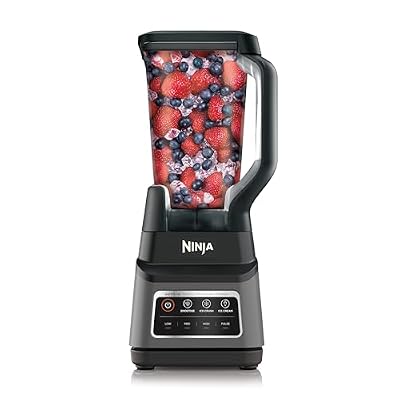
The Ninja BN701 Professional Plus is a 1400 peak watt countertop blender with a 72-ounce Total Crushing pitcher and three Auto-iQ preset programs for smoothies, frozen drinks, and ice cream. The presets run timed patterns of pulsing and blending, so you press one button and let the machine work.
Specs
- Power: 1400 peak watts
- Pitcher: 72-ounce Total Crushing pitcher with lid
- Programs: 3 Auto-iQ presets for smoothies, frozen drinks, and ice cream
- Blade: stacked Total Crushing blades
- ASIN: B0855B5Z6F
The large pitcher handles family-size batches, and the stacked blade design pulls ice and frozen fruit down into the blend instead of letting it ride on top. The presets take guesswork out of timing, which helps when you want the same result every morning.### 5. Oster Pro 1200 Blender with Glass Jar
The Oster Pro 1200 pairs a 1200-watt motor with a 6-cup Boroclass glass jar and a 24-ounce smoothie cup. It has seven speeds and three pre-programmed settings for smoothies, salsa, and milkshakes, plus a dual-direction blade system that reverses to pull food back into the blades.
Specs
- Power: 1200 power watts, 900 watts ice crushing power
- Jar: 6-cup Boroclass glass jar, dishwasher safe
- Extra: 24-ounce smoothie cup included
- Speeds: 7, with 3 pre-programmed settings
- ASIN: B00XHXN54K
The glass jar is the standout feature. Glass resists stains and odors better than plastic, and it handles hot soup without worry about warping. The smoothie cup is a practical extra for single servings, since you can blend in the cup and take it with you.
Side by Side
| Point | Immersion Blender | Countertop Blender |
|---|---|---|
| Best batch size | Single serving to one pot | Family-size batches |
| Power | 200 to 800 watts | 1000 watts and up |
| Texture | Hand-controlled, can stay chunky | Uniform and silky |
| Hot soup | Blend right in the pot | Needs cooling and careful lid venting |
| Frozen drinks | Needs extra liquid, slower | Built for ice and frozen fruit |
| Cleanup | Rinse the shaft in seconds | Jar, lid, and blade assembly |
| Storage | Drawer or hook | Counter or deep cabinet |
| Extra jobs | Whisk, frother, small chopper | Presets, large batches, nut butter |
How to Choose
Pick an immersion blender if you cook for one or two, blend soup in the pot, make sauces and dressings often, have limited storage, or want the fastest cleanup. The wand is the everyday tool for small, frequent jobs, and the attachments stretch it further than its size suggests.
Pick a countertop blender if you make smoothies for a household, blend frozen fruit and ice often, want perfectly smooth textures, or cook in large batches. The jar, the power, and the presets repay their size when the load is big or hard.
If your kitchen sees both patterns, the pair works well together. Use the wand on weekdays for soup and sauces, and bring out the countertop blender for weekend smoothies and frozen treats. If space forces one choice, count your last ten blends. The tool that would have handled most of them is the one to buy.
FAQ
Can an immersion blender replace a countertop blender?
It can for soft foods, soups, sauces, and single servings. It cannot match a countertop blender for large frozen batches, crushed ice drinks, or long blends that need sustained power.
Can you use an immersion blender in a hot pot?
Yes. Blend directly in the pot on the stove, keeping the blade head fully under the surface to avoid splashing. This is one of the main advantages over a jar blender, which needs hot liquid cooled and vented first.
Why does my countertop blender leave chunks in smoothies?
Frozen fruit and ice can ride above the blades when there is not enough liquid. Add liquid first, load soft items next, and put frozen items on top so the vortex pulls them down.
Which blender is easier to clean?
An immersion blender is easier. The shaft detaches and rinses in seconds, while a countertop blender needs the jar, lid, and blade assembly washed. Many countertop jars are dishwasher safe, which closes the gap, but the wand still takes less time.
Write Your Review
No reviews yet. Be the first to share your experience!