
A pellet smoker and a charcoal smoker both turn out real barbecue, but they ask for very different things from the cook. One runs on compressed hardwood pellets fed by an electric auger and a digital controller. The other burns charcoal and wood, and the cook manages the fire by hand. This guide compares the two styles, then looks at three pellet smokers and two charcoal smokers, each with its own specifications, so you can match the machine to the way you like to cook.
- Pellet vs Charcoal at a Glance
- How a Pellet Smoker Works
- How a Charcoal Smoker Works
- Pellet Smokers
- Charcoal Smokers
- Flavor: Charcoal Wins on Depth, Pellet Wins on Cleanliness
- Ease of Use: Pellet by a Wide Margin
- Running Cost and Upkeep
- Capacity and Footprint
- Which Smoker Fits Your Yard
- Common Mistakes to Avoid
- FAQ
- Final Thoughts
As an Amazon Associate, I earn from qualifying purchases. This disclosure applies to the product links in this article.
Pellet vs Charcoal at a Glance
| Pellet Smoker | Charcoal Smoker | |
|---|---|---|
| Fuel | Compressed hardwood pellets | Charcoal plus wood chunks or chips |
| Temperature control | Digital controller and fan | Dampers and fire management |
| Flavor | Clean wood smoke, milder | Stronger, deeper smoke flavor |
| Attention needed | Low, set the temperature and walk away | Higher, the fire needs tending |
| Power needed | Yes, an outlet is required | No, fire alone |
| Best for | Weeknight cooks and long sessions without babysitting | Cooks who enjoy tending a fire |
How a Pellet Smoker Works
A pellet smoker stores hardwood pellets in a hopper. An auger moves pellets into a fire pot, a hot rod lights them, and a fan feeds air to hold the set temperature. A digital controller adjusts the feed rate to hold that temperature with little input from the cook. Most pellet grills also work as grills, roasters, and ovens. The trade-off is dependence on electricity and a milder smoke flavor than a charcoal fire produces. Pellet smokers also need regular ash cleanout, and damp pellets can jam the auger, so dry storage matters.
How a Charcoal Smoker Works
A charcoal smoker burns charcoal in a firebox or a ring at the bottom of the cooker, and smoke from wood chunks or chips flavors the food as it rises. The cook controls temperature with intake and exhaust dampers: open them to raise heat, close them to lower it. A water pan, where fitted, adds moisture and steadies the temperature. Charcoal smokers deliver a deeper smoke flavor and need no power, which suits patios without an outlet. The trade-off is attention. A long brisket cook means checking the fire, adding fuel, and adjusting dampers through the session.
Pellet Smokers
1. Traeger Pro 575 Wood Pellet Grill and Smoker

The Traeger Pro 575 is the classic mid-size pellet grill, built around the D2 controller with WiFIRE app control. Two tiers of porcelain-coated steel grates give 575 square inches of cooking space, and the 18-pound hopper covers long low-and-slow sessions. The temperature range runs from 165 to 500 degrees Fahrenheit, so it smokes, bakes, roasts, and grills. Traeger lists this model as retailer-only now, with the newer Westwood series taking its place in the main lineup, so confirm the exact model and finish before ordering.
Specs:
– Cooking area: 575 square inches (418 main grate plus 157 upper rack)
– Hopper capacity: 18 pounds of wood pellets
– Temperature range: 165 to 500 degrees Fahrenheit
– Controller: D2 with WiFIRE app control
– Grates: 2 tiers, porcelain-coated steel
– Meat probe: 1 included
– Weight: 124 pounds
– Model number: TFB57GLE
– ASIN: B07T2FWL8Q
2. Pit Boss Austin XL 1000 Wood Pellet Grill

The Pit Boss Austin XL is the big-capacity pick of this group, with about 1,000 square inches of cooking space across two porcelain-coated tiers. A 31-pound hopper feeds long sessions, and a flame broiler slides open for direct-flame grilling when you want a sear after the smoke. The digital control board with an LED readout sets temperatures from 150 to 500 degrees Fahrenheit. It weighs around 179 pounds, so plan its spot on the patio before assembly. The Austin XL skips Wi-Fi, which keeps the design simple and the focus on capacity.
Specs:
– Cooking area: about 1,000 square inches across two tiers (930 direct cooking surface)
– Hopper capacity: 31 pounds of wood pellets
– Temperature range: 150 to 500 degrees Fahrenheit
– Flame broiler: yes, for direct-flame grilling
– Grates: porcelain-coated steel
– Output: 20,700 BTU
– Weight: about 179 pounds
– Warranty: 5-year limited warranty
– Model number: Austin XL
– ASIN: B079RNJ7HV
3. Camp Chef Woodwind 24 WiFi Pellet Grill and Smoker

The Camp Chef Woodwind 24 pairs a PID controller with Wi-Fi and Bluetooth control, plus a Slide and Grill lever that opens a direct-flame path for searing up to 650 degrees Fahrenheit. Total cooking space is 811 square inches, split between a 429-square-inch lower rack and a 382-square-inch upper rack, and the 22-pound hopper swallows a full 20-pound bag of pellets. Four meat probes come in the box, and a patented ash cleanout pulls ash from the fire pot with a lever instead of a vacuum.
Specs:
– Cooking area: 811 square inches (429 lower rack plus 382 upper rack)
– Hopper capacity: 22 pounds of wood pellets
– Temperature range: 160 to 500 degrees Fahrenheit (up to 650 with direct flame)
– Controller: PID with Wi-Fi and Bluetooth
– Meat probes: 4 included
– Features: Slide and Grill direct-flame searing, ash cleanout system
– Chamber capacity: 4,850 cubic inches
– Weight: about 150 pounds
– Model name: Woodwind 24
– ASIN: B081P7SJ3V
Charcoal Smokers
4. Char-Broil American Gourmet Offset Smoker 12201570-A1

The Char-Broil American Gourmet is a compact offset smoker that also works as a charcoal grill. The main chamber gives 290 square inches of cooking surface, and the offset firebox adds 140 square inches that doubles as a direct-heat grill, for 430 square inches in total. A built-in temperature gauge sits on the lid, an adjustable damper controls airflow, and porcelain-coated grates clean up easily after a cook. Cool-touch handles and a side shelf for sauces and rubs round out a practical design. Note that some roundups quote larger cooking areas for Char-Broil smokers; the figures here follow the Amazon listing for this exact model number.
Specs:
– Cooking area: 430 square inches total (290 main chamber plus 140 firebox)
– Fuel: charcoal, with wood chunks or chips for smoke
– Body: alloy steel with porcelain-coated grates
– Features: built-in temperature gauge, adjustable damper, side shelf, cool-touch handles, clean-out door
– Dimensions: 17.5 by 46.25 by 44.75 inches
– Weight: 41 pounds
– Model number: 12201570-A1
– ASIN: B00365FI9E
5. Royal Gourmet CC1830S Barrel Charcoal Grill with Offset Smoker
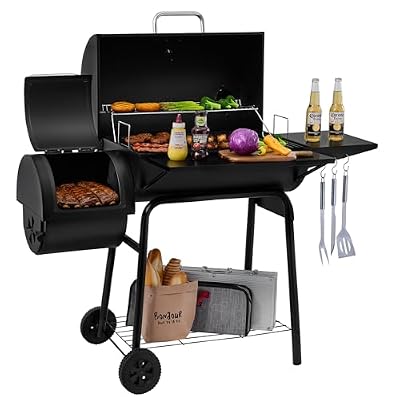
The Royal Gourmet CC1830S is a barrel grill with an offset firebox bolted to the side, so one unit grills and smokes. Total cooking area is 823 square inches: a 475-square-inch porcelain-enameled main grate, a 151-square-inch chrome warming rack, and a 197-square-inch offset chamber that also works as a small grill. A two-level adjustable charcoal pan moves the coals closer or farther from the food, and a lid thermometer tracks the temperature. The side door on the firebox lets you add charcoal and rake out ash without lifting the lid. The CC1830SC is the same grill with a cover included, so confirm you are looking at the CC1830S listing without the cover.
Specs:
– Cooking area: 823 square inches total (475 main grate plus 151 warming rack plus 197 offset chamber)
– Fuel: charcoal, with wood chunks or chips for smoke
– Grates: porcelain-enameled steel main grate, chrome-plated warming rack
– Features: 2-level adjustable charcoal pan, lid thermometer, firebox side door, front and side tables, bottom shelf rated to 20 pounds
– Dimensions: 51.69 by 28.56 by 46.89 inches
– Weight: 45.2 pounds
– Model number: CC1830S
– ASIN: B07FKLK6DG
Flavor: Charcoal Wins on Depth, Pellet Wins on Cleanliness
Charcoal plus wood chunks gives a stronger, more complex smoke flavor, because the fire itself produces the smoke and the cook can add chunks through the session. Pellet smoke is cleaner and more consistent, which suits cooks who want a gentle wood note rather than a heavy smoke ring. If you smoke brisket and pork shoulder most weekends and judge the result by the smoke, charcoal has the edge.
Ease of Use: Pellet by a Wide Margin
A pellet smoker holds a set temperature with an auger, a fan, and a controller. Fill the hopper, set the temperature, and the grill does the rest, with an app alert when the meat probe hits its target on the Wi-Fi models. A charcoal smoker needs the cook to light the fire, bring the chamber to temperature, and adjust dampers as the weather and the fuel change. For a first smoker, or for anyone who cooks while doing other things, pellet is the easier path.
Running Cost and Upkeep
Pellets cost more per cook than charcoal by weight, and a pellet smoker also uses a small amount of electricity. Charcoal is cheaper per session, and lump charcoal or briquettes are available everywhere. On upkeep, both styles need ash removal after every few cooks. Pellet grills add auger and fire-pot cleaning, and pellets must stay dry or they swell and jam. Charcoal smokers add grate seasoning and rust watch on thin steel, especially on budget offsets.
Capacity and Footprint
The pellet picks here run from 575 to about 1,000 square inches, and the charcoal picks from 430 to 823 square inches. A 575-square-inch pellet grill handles a family cook and a couple of racks of ribs. The Austin XL and the Royal Gourmet barrel suit larger groups and full packer briskets. Footprint matters too: the Char-Broil offset is the lightest and narrowest pick here, while the Royal Gourmet barrel is over 51 inches wide and needs a dedicated spot. Measure the patio before ordering, and leave room behind the unit for the lid and the firebox door.
Which Smoker Fits Your Yard
Choose a pellet smoker if you want set-and-forget temperature control, Wi-Fi monitoring, and one cooker that also grills, roasts, and bakes. Choose a charcoal smoker if you want the deepest smoke flavor, no need for an outlet, and a lower fuel bill per cook. Cooks who smoke once a month and want reliable results will be happier with pellet. Cooks who smoke every weekend and enjoy fire management will get more from charcoal.
Common Mistakes to Avoid
First, do not buy a pellet tube and expect it to work as a pellet smoker. A tube adds smoke to a grill, but it has no auger, no controller, and no cooking chamber of its own. Second, do not pick an offset smoker when you have no room for its firebox and chimney; the footprint is wider than the listing photo suggests. Third, do not skip the thermometer check. Lid gauges read the top of the chamber, which runs hotter than grate level, so a probe at the grate tells the truth. Fourth, do not store pellets in a damp garage. Swollen pellets jam the auger and turn a simple cook into a repair job.
FAQ
Does a pellet smoker taste as good as a charcoal smoker?
A pellet smoker gives a clean, consistent wood flavor that suits most cooks, while a charcoal smoker gives a deeper and more complex smoke flavor. The gap is real but smaller than many cooks expect.
Can I use a pellet smoker without Wi-Fi?
Yes. Every pellet smoker here runs from its onboard controller, and Wi-Fi only adds remote monitoring and temperature changes from a phone. The Pit Boss Austin XL has no Wi-Fi at all and works the same way from its digital control board.
How long does a hopper of pellets last?
At smoking temperatures around 225 degrees Fahrenheit, a full hopper lasts many hours, and the 31-pound hopper on the Austin XL runs longest. At grilling temperatures the burn rate rises sharply, so check the level before a high-heat cook.
Do charcoal smokers need electricity?
No. A charcoal smoker runs on fire alone, which is one reason it suits patios without an outlet and cooks who want a simple setup. The only power you might add is a battery fan or a probe thermometer, and neither is required.
Final Thoughts
Pellet and charcoal smokers both make excellent barbecue, and the right choice comes down to how you like to cook. Pellet gives you steady temperatures, app control, and easy weeknight sessions. Charcoal gives you deeper flavor, no power cord, and the satisfaction of managing a live fire. Pick the side that matches your routine, measure your patio, and confirm the exact model and listing before ordering.

Write Your Review
No reviews yet. Be the first to share your experience!