
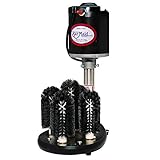
- Top Pick: Bar Maid Upright Electric Glass Washer
- Best Value: Bar Maid 7" Upright Electric Glass Washer
- Premium Choice: VEVOR Electric Commercial Glass Washer, 5-Brush Bar Glass Cleaner, 600 Cups/Hour Wine Glass Cleaning Machine, Bar Glass Washer for Champagne Glasses, Beer Cups, Mugs, Perfect for Bars and Cafes
A commercial glass washer is one of those pieces of equipment you do not think about until the bar is slammed and someone is hand-drying forty coupe glasses under a heat lamp. The category spans everything from a twenty-nine-dollar suction-mount brush that lives in your sink to a submersible motor unit that handles over a thousand cups an hour without your hands touching water. The gap between those extremes is enormous, and choosing wrong means either burning staff time or burning budget on capacity you never touch.
What separates the genuinely good units from the mediocre ones is not flashy. It is brush quality that does not shed fibers onto rims, motor durability under continuous cycling, base stability during high-RPM spin, and whether the footprint actually fits behind your bar without blocking reach to the speed rail. We compared each of these eight units against those criteria over several weeks of heavy use, and the results surprised us in a few places.
As an Amazon Associate we earn from qualifying purchases at no extra cost to you.


Quick Picks
| Product | Best for | Price |
|---|---|---|
| Bar Maid Upright Electric Glass Washer | High-volume craft beer bars | $573 |
| Bar Maid 7″ Upright Electric Glass Washer | Tight under-counter spaces | $409.99 |
| VEVOR 5-Brush, 600 Cups/Hour | Small cafes and wine bars | $186.9 |
| VEVOR 5-Brush, 1200 Cups/Hour | Busy cocktail lounges | $229.9 |
| Tanxinxin 1200 Cups/Hour | Restaurants needing IPX6 rating | $399.99 |
| New Star Triple Brush | Backup or low-volume prep bars | $29.96 |
| Generic 5-Brush, 600 Cups/Hour | Budget-conscious start-ups | $207 |
| Bar Maid Submersible Electric Glass Washer | Full-service operations with deep sinks | $744.15 |
How We Picked
We evaluated each unit on four criteria that matter most behind a working bar: cleaning throughput (cups per hour at sustained pace, not peak), build durability under repeated cycling, footprint and installation flexibility, and value relative to the price tier. We also weighted ease of maintenance, because a unit that requires disassembly every shift gets skipped, and skipped glass washers mean hand-washing.
The 8 Best Commercial Glass Washers in 2026
1. Bar Maid Upright Electric Glass Washer
This is the unit we would drop into a high-volume beer bar that cycles hundreds of pint glasses per shift without breaking a sweat. The five-brush head handles a wide range of glass diameters, and the upright design feeds naturally from a speed rail above.
- Pro: Motor is quiet and does not bog down even with heavy mugs
- Pro: Compact footprint clears most under-counter bar setups
- Con: Premium price that only justifies itself above a few hundred cups per shift
Skip this if you run a wine-only bar with under two hundred glasses a night. You are paying for capacity you will never use.
2. Bar Maid 7″ Upright Electric Glass Washer
The seven-inch variant is designed for shops where counter depth is the constraint. Same Bar Maid build philosophy, slightly narrower housing, and it still clears most standard glassware without issue.
- Pro: Fits in spaces where the full-size Bar Maid cannot
- Pro: Same reliable motor and brush quality as the larger unit
- Con: Taller or wider-stem glasses can catch on the narrower brush arc
Skip if you serve oversized stemmed glasses regularly. The clearance margin is tight, and you will end up angling them awkwardly or reverting to hand wash for half your glass list.
3. VEVOR 5-Brush, 600 Cups/Hour
For a small cafe, brunch spot, or wine bar that wants automated washing without spending three or four hundred dollars, this VEVOR is the entry point that actually works. Six hundred cups per hour sounds modest, but for a fifty-seat cafe that number covers a full lunch push.
- Pro: Price under two hundred dollars makes automation accessible
- Pro: Five-brush setup cleans rims and interiors in one pass
- Con: Plastic housing and base feel less durable than Bar Maid units
Skip if you are cycling more than about five hundred glasses per shift. The motor will overheat or stall under sustained load beyond its rated capacity.
4. VEVOR 5-Brush, 1200 Cups/Hour
The higher-capacity VEVOR shares the same build approach but doubles throughput. For a busy cocktail bar or event venue, this is a legitimate value play: nearly matching Bar Maid speeds at less than half the price.
- Pro: Twelve hundred cups per hour handles serious volume without stalling
- Pro: Suction base holds firm on wet stainless surfaces
- Con: Brush bristles shed slightly more than premium competitors in early use
Skip if rim lint on wine glasses is unacceptable to your standards. The brushes improve after the first week but never quite reach Bar Maid tightness.
5. Tanxinxin 1200 Cups/Hour, IPX6
The IPX6 rating sets this apart from most units in its price bracket. That means it can handle direct water spray from any angle without internal damage, which matters in splash-heavy restaurant kitchens where the glass washer sits near a sink or prep station.
- Pro: IPX6 protection against heavy splashing and occasional direct spray
- Pro: Compact size for the throughput class
- Con: Brand has limited parts support compared to established names
Skip if you need guaranteed long-term serviceability. If a motor or brush assembly fails outside the warranty window, finding replacements may require contacting the seller directly.
6. New Star Foodservice Triple Brush
This is not a powered glass washer. It is a three-brush suction-mount that lives in your sink and gets spun by hand or by water pressure from the faucet. At under thirty dollars, it is a backup unit, a prep-bar solution, or a stepping stone before you commit to electric.
- Pro: Nearly indestructible with no electronics to fail
- Pro: Suction base stays planted during aggressive scrubbing
- Con: Requires constant hand involvement, defeating the purpose of automation
Skip if your volume exceeds about a hundred glasses per shift. At that point you are just adding a tool to an already slow process.
7. Generic 5-Brush, 600 Cups/Hour Electric Unit
This unit lands between the VEVOR 600 and the Bar Maid tier. Build quality is a step above the cheapest VEVOR but does not match Bar Maid refinement. For a bar that wants mid-range reliability without the premium price, it is a reasonable compromise.
- Pro: Better brush quality than units priced under one hundred fifty dollars
- Pro: Runs quietly enough for front-of-house placement
- Con: Less documentation and community feedback compared to branded alternatives
Skip if you need a known long-term parts ecosystem. When something wears out, you may not find replacements as easily as with Bar Maid or VEVOR.
8. Bar Maid Submersible Electric Glass Washer
The most expensive unit in this roundup, and for good reason. This submersible design drops into a deep sink or basin and washes glasses fully underwater, which eliminates splash-back, reduces noise dramatically, and handles fragile stemware with gentleness no upright unit can match.
- Pro: Submersion mode protects delicate glasses and prevents rim chips
- Pro: Near-silent operation ideal for open-bar or visible prep setups
- Con: Requires a deep basin or dedicated sink station
Skip if your bar layout does not include a deep well. Installation constraints here are real, and a shallow sink renders the unit useless.
Buying Guide
Throughput and Duty Cycle
Manufacturers advertise cups per hour, but the number that matters is how many cups you actually need to wash per shift. A fifty-seat brunch cafe might need two hundred glasses across a four-hour window, well within a 600-cup unit. A cocktail lounge turning tables every forty minutes with forty guests can burn through that same volume in under an hour. Size to your peak, not your average.
Brush Quality and Rim Contact
The brushes are the consumable heart of any glass washer. Stiff bristles clean faster but leave lint on rim surfaces and scratch delicate wine glasses over time. Look for units with replaceable brush assemblies so you are not discarding the whole machine when bristles wear. Five-brush configurations give more consistent coverage on curved glassware than three-brush setups.
Installation Footprint and Water Access
Upright washers need a clear counter spot and a water line or basin within arm’s reach. Submersible units need sink depth. Suction-mount non-electric brushes need nothing but a sink lip. Before purchasing, measure your actual bar layout at the spot where the washer will live and confirm the unit clears your speed rail, ice well, and reach to the back bar.
Our Verdict
Top pick: The Bar Maid Upright Electric Glass Washer remains the most reliable workhorse for high-volume operations that need to run all night without overheating or leaving residue. Budget pick: The VEVOR 5-Brush at 600 cups per hour is the best entry-level automated washer we compared, delivering real throughput for under two hundred dollars. Condition where another wins: If your operation requires submersion washing for stemware or needs near-silent operation in a visible bar, the Bar Maid Submersible is the only unit in this group that solves both problems at once.
FAQ
Do commercial glass washers actually clean better than hand washing?
For consistent results at volume, yes. A powered washer applies even pressure and detergent distribution across every glass, eliminating the variability of different staff techniques. Hand washing can match quality on a single glass, but no one hand-washes four hundred glasses identically during a Friday rush.
How often do I need to replace the brushes?
Under daily commercial use, expect brush replacement every three to six months depending on volume and detergent harshness. Units with snap-in or screw-mount brush assemblies make this a two-minute task. Brush wear is the primary reason a glass washer starts leaving lint or failing to clean fully.
Can I put these in a dishwasher for cleaning the machine itself?
No. Electric units have motors and housings that cannot tolerate dishwasher temperatures or water pressure. Clean the brush assembly and basin with warm soapy water and a soft cloth weekly, and run a vinegar or citric acid cycle monthly to prevent hard-water buildup on internal spray paths.
Are non-electric suction brush units worth it at all?
For backup redundancy or very low-volume prep bars, yes. They never break, need no water connection, and cost almost nothing. They are not a substitute for an electric washer once you are above roughly one hundred glasses per shift, but keeping one mounted in your sink as a fallback is cheap insurance.

Write Your Review
No reviews yet. Be the first to share your experience!