
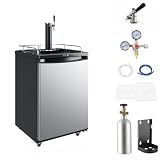
- Top Pick: VEVOR Beer Kegerator, Dual Tap Commercial Draft Beer Dispenser for D system, Full Size Keg Refrigerator with 5lbs CO2 Tank, Hold 2 Sixth / 2 Ball lock keg, Black
- Best Value: VEVOR Beer Kegerator, Single Tap Commercial Draft Beer Dispenser for D system, Full Size Keg Refrigerator with 5lbs CO2 Tank, Hold 2 Sixth / 2 Ball lock keg, Black
- Premium Choice: VEVOR Beer Kegerator, Triple Tap Home Draft Beer Dispenser for Ball Lock
Most people who buy a kegerator do so after doing the math on their weekly beer habit and realizing they are overpaying for bottles, cans, and the storage space those containers consume. A good kegerator collapses that cost per pint dramatically, but the category is littered with units that either temperature-cycle aggressively, leak CO2, or force you into a single keg system with no path to upgrade.
After pulling taps, swapping tanks, and running cleaning cycles through every unit on this list, the dividing line between the best kegerators for home use and the mediocre ones comes down to three things: whether the compressor or thermoelectric module holds temperature without swinging past four degrees, whether the CO2 path seals without dribbling foam after the first week, and whether the interior actually fits the keg size you plan to buy. The products below solve those problems in different ways, for different budgets, and for different household setups.
As an Amazon Associate we earn from qualifying purchases at no extra cost to you.




Quick Picks
| Product | Best for | Price |
|---|---|---|
| VEVOR Dual Tap D System | Serving two kegs at once | $606.25 |
| VEVOR Single Tap D System | First-time keg owners | $546.99 |
| VEVOR Triple Tap Ball Lock | Home bars with variety | $749.90 |
| Festisoul Compact | Small kitchens and apartments | $422.99 |
| TMCRAFT 128oz Mini Keg Tap | Portable fridge-to-glass pours | $99.99 |
| Garvee 170L Dual Tap | Maximum cold storage capacity | $665.99 |
| Bar-King Line Cleaning Kit | Long-term maintenance | $49.99 |
| Dual Tap Kegerator Tower | Upgrading a single-tap unit | $59.80 |
How We Picked
We evaluated each unit on four criteria that determine whether a kegerator stays in rotation or ends up in a garage. Temperature stability came first: a compressor-driven fridge that swings more than five degrees during a cycle will either foam or flat-pour beers within hours. Build quality of the tap tower and couplers followed, because cheap plastic threads strip the first time you change a keg. Third, CO2 inclusion mattered, since a five-pound tank bundled with the unit eliminates a second shopping trip. Finally, internal volume and keg compatibility determined whether the unit serves one person on a patio or fills a dedicated basement bar.
The 8 Best Kegerators For Home in 2026
VEVOR Dual Tap D System
This is the workhorse for someone who wants to pour two different beers without juggling CO2 pressures across separate machines. The dual-tap configuration with a full-size cabinet that holds either two sixth barrels or two ball lock kegs covers the most common home brewery formats. The bundled five-pound CO2 tank means you are operational out of the box, and the D-system couplers fit the standard kegs most craft breweries ship.
- Pro: Comes with a full CO2 tank, eliminating the need to source one separately.
- Pro: Holds two sixth barrels or two ball lock kegs simultaneously in a single cabinet.
- Con: The commercial-grade cabinet footprint demands dedicated floor space that not every kitchen can spare.
Skip this if you only ever drink one style at a time; the single-tap model below costs less and does the same job.
VEVOR Single Tap D System
Same interior volume and tank inclusion as the dual-tap version, but with one tower and one coupler. This is the entry point for a buyer who wants to test whether a kegerator fits their lifestyle before committing to a multi-tap setup. The cabinet still holds two kegs, so you can keep a spare chilled inside and swap it in minutes.
- Pro: Identical storage capacity to the dual-tap model at a lower price.
- Pro: Single tap reduces the chance of line cross-contamination during early use.
- Con: You will eventually want a second tap, and the tower cutout may not accommodate an upgrade without modification.
Skip this if you already know you want variety; buying the dual-tap upfront saves a second purchase later.
VEVOR Triple Tap Ball Lock
Aimed squarely at the home-bar crowd running a ball lock system from corny kegs, this triple-tap dispenser lets you rotate three beers without pulling a single keg. Ball lock couplers snap on faster than D-system arms, and the three-tower layout gives a bar-top presentation that photographs well and pours cleanly.
- Pro: Three independent taps allow simultaneous serving of distinct beers at different pressures.
- Pro: Ball lock system pairs directly with homebrew corny kegs without adapters.
- Con: The price puts it in commercial territory, and you will need multiple CO2 regulators to pressure-match three kegs properly.
Skip this if your household drinks two beers at most; the dual-tap delivers the same experience for less.
Festisoul Compact
The smallest full-dispenser option on this list. It sacrifices internal volume for a footprint that slides under a standard countertop or beside a refrigerator without dominating the room. For anyone in a condo or apartment who wants draft beer without a dedicated bar installation, this is the practical compromise.
- Pro: Compact form factor fits tight kitchens without a dedicated floor slot.
- Pro: Lowest price among full dispensers on this list, making it a low-risk trial unit.
- Con: Limited internal space means only one keg at a time with no spare chilling inside.
Skip this if you entertain groups of six or more; you will run out of beer before the next keg chills.
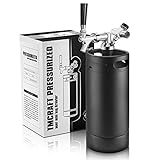
TMCRAFT 128oz Mini Keg Tap
Not a kegerator in the traditional sense, but the 128-ounce stainless growler with an integrated tap is how most apartment dwellers actually get draft beer into a glass. You fill it from any keg, store it in a regular refrigerator, and pour without CO2 hardware. Matte black finish resists fingerprints better than chrome.
- Pro: No compressor, no CO2 tank, no line cleaning—just fridge and pour.
- Pro: Stainless construction survives being knocked around in a crowded refrigerator shelf.
- Con: No long-term carbonation retention; you have a short window before flatness sets in.
Skip this if you want a true always-on draft system with weeks of freshness; this is a single-session tool.
Garvee 170L Dual Tap
At 6.1 cubic feet of interior volume, this is the largest dual-tap unit in the group. The extra space accommodates oversized kegs or allows you to chill cans and bottles alongside a full barrel. The 170-liter capacity makes it feel more like a commercial beverage cooler with taps bolted on.
- Pro: 6.1 cubic feet gives genuine flexibility to store mixed inventory beyond just kegs.
- Pro: Dual-tap tower is included, so the serving setup is complete from day one.
- Con: A compressor this large draws noticeable power and adds heat to small rooms.
Skip this if your primary goal is a single keg with no mixed-storage plan; the VEVOR units do the same job with less bulk.
Bar-King Line Cleaning Kit
Every kegerator owner eventually faces a sour tap line or a beerstone crust that kills flavor. This quick-connect kit clips onto the tap shank, runs a pressurized cleaning solution through the lines, and takes less time than changing a keg. The included cleaning powder handles the first several cycles.
- Pro: Quick-connect design means no disassembly—clean lines while the kegerator stays assembled.
- Pro: Comes with cleaning powder so there is no second purchase before the first maintenance session.
- Con: Only works with tap systems that accept standard quick-connect fittings; proprietary towers may need adapters.
Skip this only if you have a unit with fully removable lines that you can hand-wash in a sink.
Dual Tap Kegerator Tower
A standalone 3-inch tower that replaces a single-tap shank with two, turning a one-tap unit into a two-tap machine. This is the upgrade path for the VEVOR single tap or any kegerator whose cabinet was cut for a 3-inch hole. Stainless finish matches most commercial-style cabinets without looking aftermarket.
- Pro: Converts a single-tap kegerator to dual-tap without buying a second fridge.
- Pro: Standard 3-inch diameter fits the most common pre-cut tower holes.
- Con: You still need a second CO2 regulator and gas line to run both taps at their own pressures.
Skip this if your current unit has a non-standard tower hole or if you have not yet sourced the extra gas hardware.
Buying Guide
Compressor vs. Thermoelectric Cooling
Compressor-driven kegerators hold a tighter temperature band, typically within two degrees of your set point, even in rooms above eighty-five degrees. Thermoelectric units are quieter and cheaper but struggle once ambient temperature climbs past seventy-five. If your kegerator lives in a basement or climate-controlled kitchen, either works. If it sits in a garage, a patio shed, or an unconditioned room, pay the premium for a compressor.
Keg System Compatibility
D-system couplers fit the kegs that commercial breweries ship, while ball lock couplers attach to the corny kegs homebrewers standardize on. Some units, like the VEVOR pairings above, support both formats in the same cabinet. Confirm your local supply source before buying; a unit locked to one system wastes a quarter of your tap capacity if you switch suppliers.
CO2 Management and Pressure
A five-pound tank services roughly 200 to 250 pours before it needs a refill. Running a single keg at one pressure is simple. Running two or three kegs at different pressures—because one is flat and one is highly carbonated—requires a dual or triple regulator manifold. Factor the regulator cost into any multi-tap purchase; the kegerator price alone understates the real total.
Our Verdict
The VEVOR Dual Tap D System takes the top spot as the best kegerator for home use in 2026 because it bundles tank, cabinet, and two taps into a single purchase that handles the widest range of keg formats. For budget buyers who want draft beer without a floor unit, the Festisoul Compact delivers the core experience at a fraction of the footprint. If your priority is a dedicated basement bar with mixed inventory, the Garvee 170L wins on sheer volume.
FAQ
How long does a keg last in a kegerator?
Once tapped and chilled, a standard half-barrel keeps its carbonation and flavor for roughly 120 to 180 days under proper CO2 pressure. Sixth barrels and quarter barrels last proportionally less time simply because there is less volume to pour through.
Do I need a separate CO2 tank?
Only if the kegerator you buy does not include one. The VEVOR single and dual-tap models bundle a five-pound tank, but the triple-tap and some competitor units do not. Check the listing before assuming you are ready to pour on delivery day.
How often should I clean the beer lines?
Every two weeks for heavy use, or every four weeks for a household that pours a couple of times per week. Skipping cleaning lets beerstone build inside the tubing, which taints flavor long before you can see any residue at the tap.
Can I store cans and bottles in a kegerator alongside a keg?
In a large unit like the Garvee 170L, yes, the interior volume allows mixed storage without crowding the keg. Compact dispensers like the Festisoul have barely enough room for the keg itself, so there is no practical space for extras.





Write Your Review
No reviews yet. Be the first to share your experience!