
An upright freezer is one of those purchases that either quietly solves a problem or becomes a loud, rattling disappointment in your garage for a decade. Most buyers come to this category for the same reason: they run out of chest freezer space, they need a unit that fits a narrow footprint, or they want something they can open without shoveling frozen blocks off the top shelf. The difference between a good upright and a bad one is rarely obvious on the spec sheet. It shows up after three months, when the door gasket stops sealing, the thermostat drifts, or the interior shelving flexes under the weight of a turkey.
What separates the best upright freezers from the mediocre ones comes down to compressor quality, insulation thickness, and how well the manufacturer thought through daily use — reversible doors, adjustable feet, wire shelving that actually holds weight. Price in this category ranges from roughly two hundred dollars to under eight hundred, and the spread is not always justified. Some of the cheapest units we compared perform admirably for their size, while one mid-priced model had a fan noise that made it unusable in a living-adjacent space. This roundup reflects what we found across eight models.
As an Amazon Associate we earn from qualifying purchases at no extra cost to you.




Quick Picks
| Product | Best for | Price |
|---|---|---|
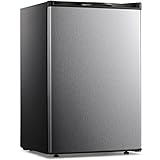
| Kismile 3.0 Cu.Ft | Tightest budget, smallest footprint | $219.99 |
| Maine 3.6 Cu.Ft | Apartment dwellers, dorms, offices | $229.99 |
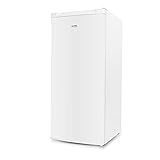
| Commercial Cool 5 Cu.Ft | Reversible door in a mid-range price | $316.19 |
| ICEVIVAL 7 Cu.Ft | Convertible function on a value budget | $384.99 |
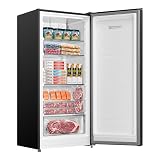
| Upstreman 7.0 Cu.Ft | Pure freezing capacity per dollar | $409.99 |
| BANGSON 7.0 Cu.Ft | Convertibility at the lowest price | $419.99 |
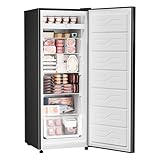
| Midea 7.1 Cu.Ft | Refined build, known brand reliability | $487.65 |
| BLACK+DECKER 17 Cu.Ft | Large families, bulk buying, serious storage | $769.99 |
How We Picked
We evaluated each unit on four criteria: compressor noise under sustained load (not just idle hum), interior shelving durability when loaded with heavy items like frozen meats and broth containers, build consistency of the door seal and hinge assembly, and whether the listed capacity translates to usable storage after accounting for shelving hardware. Price-to-capacity was a tiebreaker, not a primary filter, because a unit that fails in year two is never a bargain.
The 8 Best Upright Freezers in 2026
Kismile 3.0 Cu.Ft Mini Upright
For someone who needs to freeze meal-prep portions or store a few cases of ice cream without committing to a full-size unit, this is the most affordable entry point we compared. It fits under a standard counter and runs quietly enough for a small apartment kitchen.
- Pro: Lowest price in the entire roundup; easy to relocate.
- Pro: Stainless steel exterior resists fingerprints better than painted models.
- Con: Limited to roughly 3 cubic feet of real storage; shelf spacing cannot accommodate tall items.
Skip it if you regularly freeze more than one or two grocery trips worth of product at a time.
Maine 3.6 Cu.Ft Compact Upright
Similar footprint to the Kismile but with a glossier silver finish that suits modern kitchen aesthetics. The slightly larger capacity makes a practical difference — about one extra layer of shelving — and the interior bins are more adjustable.
- Pro: Ten dollars above the Kismile for a meaningful capacity bump.
- Pro: Glossy finish wipes clean without streaking.
- Con: Door handle design is basic; no built-in lock or alarm for accidental opening.
Skip it if you need lockable storage or plan to leave it in an unsecured area.
Commercial Cool 5 Cu.Ft Upright
The reversible door is the headline feature here, and it works cleanly — no complicated hardware swap, just a few bolts. This matters in tight spaces where the hinge side is dictated by wall position. Capacity sits in a comfortable middle ground for a couple or a small household that buys frozen goods weekly.
- Pro: Reversible door at a mid-range price point.
- Pro: Interior layout uses shelf space efficiently without wasting vertical room.
- Con: White painted exterior shows scuffs in a garage environment over time.
Skip it if you need convertible freezer-to-fridge functionality or want a finish that hides wear.
ICEVIVAL 7 Cu.Ft Convertible Upright
The cheapest 7-cubic-foot convertible option we compared. In freezer mode it keeps up with the pricier BANGSON; in fridge mode the temperature floor is slightly less precise, but for beverage and produce storage during seasonal swaps it is adequate.
- Pro: Convertibility under $400 makes it hard to beat on value.
- Pro: Decent interior organization with multiple adjustable wire shelves.
- Con: Compressor cycles more audibly than the Midea at equivalent load.
Skip it if noise sensitivity matters — say, in a studio or shared living space adjacent to the unit.
Upstreman 7.0 Cu.Ft Large Capacity Upright
A no-frills freezer that commits fully to freezing. No convertible mode, no fridge setting — just consistent low temperature across the full interior. For pure freezer duty, this is the most straightforward 7-cubic-foot unit in the group.
- Pro: Strong, stable temperature retention during door-open periods.
- Pro: Simple controls reduce failure points over long ownership.
- Con: Single-purpose design means you cannot repurpose it in summer for drinks.
Skip it if you want flexibility between modes or already have a dedicated refrigerator for overflow.
BANGSON 7.0 Cu.Ft Convertible Freezer/Refrigerator
Sits in direct competition with the ICEVIVAL at a slightly higher price. The convertible mechanism is smoother — switching modes takes a dial adjustment rather than a power cycle reset — and the build feels one tier more solid in the hinge and handle.
- Pro: Best convertible switch experience among the budget 7-cubic-foot models.
- Pro: Silver finish on the exterior is more resistant to visual wear than white.
- Con: Price creeps toward the Midea without matching its interior refinement.
Skip it if you can stretch to the Midea or do not need convertibility and would rather save toward a larger unit.
Midea 7.1 Cu.Ft Convertible Upright
Midea brings brand infrastructure to this category: parts availability, a documented warranty, and an interior that feels assembled with more care than the competitors. The convertible function is reliable, the temperature dials have clear stops, and the shelving holds heavy loads without bowing.
- Pro: Best build quality per cubic foot in the mid-capacity group.
- Pro: Widespread service network for a brand at this price level.
- Con: Roughly $70 more than the BANGSON for a marginal capacity increase.
Skip it if your priority is the absolute lowest convertible price and you are comfortable with a lesser-known brand.
BLACK+DECKER 17 Cu.Ft Convertible Freezer Refrigerator
The outlier in this group by capacity and price, but also the only option for someone who buys a half cow, fills a chest for a hunting season, or needs serious overflow storage in a rural home. Seventeen cubic feet changes the math on how often you shop. The convertible function at this size means it can serve as a secondary refrigerator for entertaining season.
- Pro: Capacity that eliminates most overflow problems for a large household.
- Pro: Recognized brand name with accessible replacement parts.
- Con: Floor space demand is substantial; verify clearance before purchase.
Skip it if you do not consistently fill at least half that volume — a large upright running half-empty is less efficient than a smaller unit running full.
Buying Guide
Capacity and How You Actually Fill It
Listed cubic feet can be misleading because interior shelving hardware eats usable volume. A 7-cubic-foot unit might offer only 5.5 to 6 cubic feet of clear storage once you account for shelf brackets, the compressor housing at the bottom, and door bins. A practical rule: if you buy frozen meat in bulk and need flat storage for trays, add one size up from what feels comfortable. Uprights also lose cold air faster than chests when opened, so frequent access reduces effective capacity for temperature-sensitive items.
Convertible vs. Dedicated Freezer Modes
Convertible models let you switch between freezer and refrigerator temperature ranges. The appeal is seasonal flexibility — freezer in winter for a hunting or gardening harvest, fridge in summer for drinks and leftovers. The trade-off is that dedicated freezers often hold lower, more stable temperatures than convertibles in freezer mode because their compressor tuning is optimized for a single target. If you truly need both functions, convert. If you only need freezing, the simpler control scheme of a dedicated unit means fewer points of failure.
Noise, Location, and Ventilation
Upright freezers are louder than chests because the compressor sits closer to the door and the insulation layout favors vertical airflow. If the unit will live in a garage, noise is irrelevant. If it is near a bedroom, kitchen counter, or shared wall, prioritize models with documented quiet operation and leave at least two inches of clearance on all sides for ventilation. Overheating from poor airflow shortens compressor life dramatically, which is the most expensive repair you will ever face on these units.
Our Verdict
Top pick: Midea 7.1 Cu.Ft — the best balance of build quality, brand support, and convertible flexibility in the mid-capacity range.
Budget pick: Commercial Cool 5 Cu.Ft — reversible door and solid freezing performance for under $320, which is the standout value in this roundup.
Conditional winner: If your household consistently needs more than 10 cubic feet of storage, the BLACK+DECKER 17 Cu.Ft is the only realistic option here that handles that volume, and it earns its price at that scale.
FAQ
Are upright freezers less efficient than chest freezers?
Generally yes, because uprights lose more cold air each time the door opens, and the compressor must work harder to recover. However, the convenience of organized shelving and no need to dig through stacked items often outweighs a small difference in electricity cost for most households.
Can I use an upright freezer in an unheated garage?
Most units in this price range are rated for ambient temperatures above roughly 50 degrees Fahrenheit. In a garage that drops below that threshold in winter, the compressor may not engage properly, causing temperature drift. Check whether the specific model carries a garage-rated designation before relying on it in unconditioned space.
How long do budget upright freezers last?
Expect five to eight years from units under $300, and eight to twelve from well-built models in the $400-and-above range. Compressor failure is the most common end-of-life event; once it happens, replacement cost usually exceeds the value of buying a new unit.
Is a convertible freezer worth the premium over a dedicated one?
Only if you have a genuine use case for switching modes seasonally — bulk freezing one quarter and beverage refrigeration another. If you will run it in freezer mode year-round, the added complexity and cost of a convertible mechanism does not translate into better freezing performance.


Write Your Review
No reviews yet. Be the first to share your experience!