
A breakfast sandwich maker for home cooking can simplify the process of combining bread, eggs, cheese, and cooked breakfast fillings in a compact appliance. However, sandwich makers differ in their cooking systems, ingredient capacities, and cleaning requirements. This guide explains how to select one that produces practical breakfasts without adding unnecessary preparation work.
Quick Verdict: What Should You Buy?
For households that regularly prepare individual breakfast sandwiches, a dedicated layered breakfast sandwich maker with clearly documented egg-cooking instructions and removable food-contact components can be convenient.
However, it is not necessarily the best choice for everyone.
If you already own a skillet, toaster, and microwave, a dedicated sandwich maker may duplicate equipment you use comfortably.
| Feature | Why It Matters | Priority |
|---|---|---|
| Sandwich capacity | Determines portions per cycle | High |
| Egg cooking design | Affects preparation workflow | Essential |
| Bread compatibility | Determines which bread fits | High |
| Removable cooking rings | Simplifies cleaning | High |
| Nonstick surfaces | Supports food release | High |
| Ready indicator | Helps coordinate operation | Useful |
| Storage footprint | Important for small kitchens | High |
| Manufacturer recipes | Clarifies approved ingredients | High |
Choose a machine based on the breakfast you actually eat rather than how many ingredients its advertising shows.
Understanding Breakfast Sandwich Makers
What Is a Breakfast Sandwich Maker?
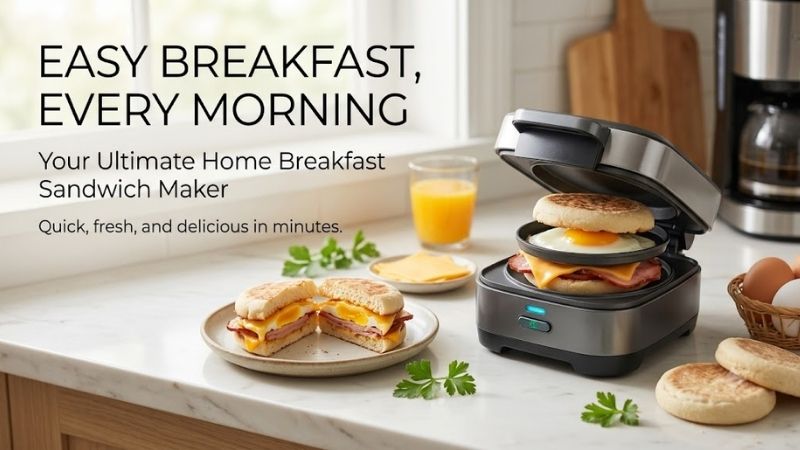
A breakfast sandwich maker is a countertop electric appliance designed to assemble and heat sandwich ingredients.
Some dedicated models feature cooking rings and multiple heated surfaces.
Others operate more like compact contact grills.
The exact cooking method varies.
Certain appliances can cook an egg within a designated section while heating bread and approved fillings.
Others are intended mainly to toast sandwiches assembled from already-cooked ingredients.
Read the instructions carefully before purchasing.
Layered Sandwich Maker vs. Contact Grill
A layered sandwich maker uses compartments or rings to hold ingredients in a particular arrangement.
A contact grill compresses and heats an assembled sandwich.
| Feature | Layered Sandwich Maker | Contact Grill |
|---|---|---|
| Egg cooking | Available on certain designs | Usually not a dedicated function |
| Bread shape | Often more restrictive | Generally flexible within plate size |
| Sandwich assembly | Uses a defined sequence | Typically assembled before cooking |
| Cleaning | Rings and plates may need attention | Plates and grease areas need cleaning |
| Versatility | Focused on breakfast sandwiches | Often supports broader sandwich types |
A layered design can simplify a familiar breakfast routine.
A contact grill may offer more flexibility if you frequently prepare different sandwiches.
Single vs. Dual Sandwich Models
Some appliances prepare one sandwich at a time, while others support multiple portions.
Single-sandwich models may be compact and convenient for one person.
Dual-sandwich designs can reduce repeated cooking for couples or families.
However, actual cooking capacity and footprint vary.
Check the complete appliance dimensions and storage requirements.
Egg Cooking: The Most Important Feature
How Do Egg Cooking Compartments Work?
Certain breakfast sandwich makers provide a heated compartment for cooking an egg.
The user typically assembles ingredients in a specified order and operates the appliance according to its instructions.
This arrangement can reduce the need for a separate skillet.
However, the egg-cooking system is model-specific.
Do not assume every sandwich maker safely cooks raw eggs.
Whole Eggs vs. Scrambled Eggs
Different appliances may support whole eggs, beaten eggs, or both.
The cooking compartment must accommodate the ingredient quantity.
Adding too much egg can cause overflow.
Follow manufacturer-approved recipes and fill limits.
For egg safety, ordinary shell eggs should be cooked until both yolk and white are firm; egg dishes generally require an internal temperature of 160°F.
Can the Machine Cook Raw Bacon or Sausage?
Do not assume that it can.
Some sandwich makers are intended to warm fully cooked breakfast meats rather than safely cook raw products.
Raw bacon or sausage may require a separate cooking process.
Ground pork or beef sausage generally requires 160°F, while poultry sausage requires 165°F.
Follow the exact product instructions.
Food Temperature vs. Indicator Lights
A ready light may indicate appliance temperature or the end of a heating cycle.
It does not necessarily prove that an egg or meat filling is fully cooked.
Use appropriate food-safety methods.
Never rely solely on bread browning or melted cheese to determine whether raw ingredients are safe.
Bread and Filling Compatibility
English Muffins
English muffins are common in layered breakfast sandwich makers because of their shape.
However, diameter and thickness vary.
Check the permitted bread dimensions.
Oversized muffins may prevent proper closure or cause ingredients to spill.
Bagels and Biscuits
Some machines support bagels, biscuits, or other bread types.
Others have limited vertical clearance.
A thick biscuit may prevent correct assembly.
Check the manufacturer’s approved ingredients.
Do not force the lid closed.
Cheese and Vegetables
Cheese, spinach, tomatoes, and other suitable ingredients may be used when the appliance supports them.
However, moisture can affect bread texture.
Overfilling increases the chance of leakage.
Prepare ingredients in appropriate quantities.
Frozen Ingredients
Frozen bread or frozen fillings may require different handling.
Do not assume that a standard cooking cycle safely heats frozen meat or egg products.
Thaw, pre-cook, or reheat ingredients according to the appliance and food manufacturer’s instructions.
Choosing by Breakfast Routine
One-Person Breakfasts
A compact single-sandwich appliance may be sufficient.
Choose simple assembly and easy cleaning.
If you only prepare breakfast sandwiches occasionally, traditional kitchen tools may be more economical.
Couples
A dual-sandwich model can reduce repeated cycles when both people eat together.
However, it may occupy more counter space.
Consider whether the additional capacity is used regularly.
Families
For several family members, a machine preparing only one sandwich per cycle may be inefficient.
A larger appliance or conventional skillet and toaster arrangement may accommodate more portions.
Compare actual preparation time, not just automatic cooking features.
Busy Weekday Mornings
The most useful appliance is one that minimizes total work.
Consider ingredient preparation, assembly, cooking, serving, and washing.
A dedicated machine may reduce active handling while still requiring substantial cleaning afterward.
Cleaning and Maintenance
Removable Cooking Rings
Removable rings can simplify cleaning around egg compartments.
Check whether they detach without tools.
Follow the approved procedure and allow the appliance to cool first.
Nonstick Cooking Plates
Nonstick surfaces can help prevent eggs and cheese from sticking.
Use approved utensils.
Avoid abrasive cleaning materials that could damage the coating.
Hinges and Grooves
Food residue may accumulate around ring supports, hinges, and lid edges.
These areas should be accessible for cleaning.
Do not immerse electrical components.
Storage
Consider the complete appliance height and width.
Some designs may have locking mechanisms for storage.
Do not assume a sandwich maker can be stored upright unless the manufacturer permits it.
Operating Safely
Prevent Burns
Cooking surfaces and metal rings can become very hot.
Use designated handles and appropriate heat protection.
Keep fingers away from the cooking compartments during operation.
Avoid Overflow
Too much egg or filling can escape the intended cooking area.
Follow the specified ingredient quantities.
Do not modify removable cooking rings.
Use a Suitable Outlet
Check electrical ratings and cord placement.
Avoid overloaded extension cords or power strips.
Keep the appliance away from sinks and water.
Clean After Handling Raw Eggs
Wash surfaces and utensils that contact raw eggs.
Avoid transferring raw egg residue to finished sandwiches.
Store perishable ingredients appropriately.
Common Buying Mistakes
Assuming All Sandwich Makers Cook Eggs
Some only toast assembled sandwiches.
Verify the exact cooking system.
Buying for Bread That Does Not Fit
Large bagels or thick biscuits may exceed the appliance’s capacity.
Overestimating Family Convenience
A single-sandwich maker may require several cycles for a family breakfast.
Ignoring Cleaning Complexity
Multiple removable rings can create additional washing work.
Treating Heating Lights as Food Thermometers
Cooking indicators do not universally confirm safe internal temperatures.
Frequently Asked Questions
Are Breakfast Sandwich Makers Worth Buying?
They can be worthwhile for households that prepare similar breakfast sandwiches frequently. Occasional users may prefer a skillet and toaster.
Can Breakfast Sandwich Makers Cook Raw Eggs?
Certain models can, using designated egg-cooking compartments. Follow the exact manufacturer’s instructions and safe doneness guidance.
Can I Use Frozen Sausage Patties?
Only when the appliance explicitly supports the preparation method. Otherwise, cook or reheat the patties separately according to food-safety instructions.
Are Breakfast Sandwich Makers Easy to Clean?
Some have removable rings and coated surfaces, but hinges and narrow compartments may require additional attention.
Can I Make Two Sandwiches at Once?
Only when the appliance has sufficient designated cooking capacity. Check the model’s specifications.
Can I Meal Prep Breakfast Sandwiches?
Yes. Cook ingredients safely, cool promptly, refrigerate or freeze appropriately, and reheat leftovers to 165°F before serving.
Conclusion
The best breakfast sandwich maker for home cooking should match your preferred bread, ingredient choices, and daily serving requirements. A dedicated layered model can simplify individual egg sandwiches, while a contact grill may offer greater flexibility. Prioritize verified egg-cooking capability, suitable bread dimensions, accessible cleaning, and safe food preparation over convenience claims alone.


Write Your Review
No reviews yet. Be the first to share your experience!