
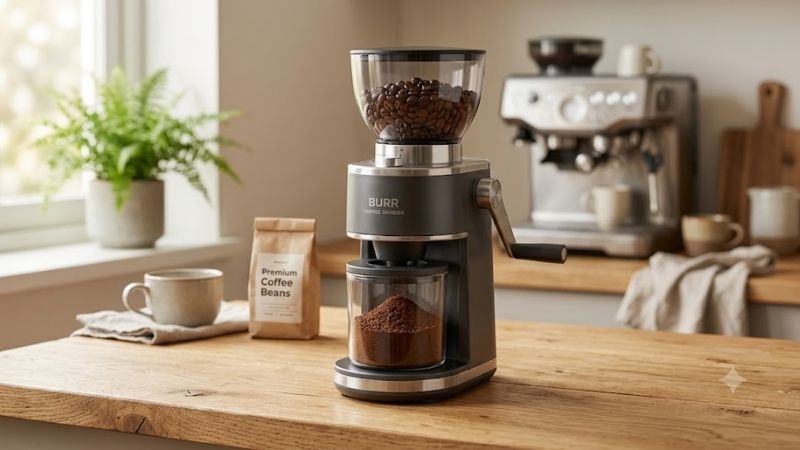
A burr coffee grinder helps control particle size more consistently than a basic blade grinder, but the right burr design depends on how you brew. We compare six grinders for espresso, pour-over, drip coffee, and larger batches, focusing on adjustment precision, flat versus conical burrs, dose retention, ease of cleaning, and long-term value.
Quick Verdict: Best Burr Coffee Grinders
Best Overall: Baratza Encore ESP. It provides a practical combination of fine espresso-range adjustment and broader settings for ordinary brewed coffee.
However, buyers who exclusively make pour-over or automatic drip coffee may prefer the Fellow Ode Gen 2. Serious espresso users should consider the Eureka Mignon Specialità or Baratza Sette 270, while households seeking straightforward filter grinding can look at the OXO Brew Conical Burr Grinder.
Quick Comparison Table
| Grinder | Best For | Burr Design | Adjustment Style | Main Limitation |
|---|---|---|---|---|
| Baratza Encore ESP | Overall versatility | 40mm conical steel | Stepped, espresso-focused section | Not a premium dedicated espresso grinder |
| Fellow Ode Gen 2 | Premium filter coffee | 64mm flat steel | Stepped | Not designed for espresso |
| Eureka Mignon Specialità | Dedicated espresso | 55mm flat steel | Stepless micrometric | Less convenient for frequent large grind changes |
| Baratza Sette 270 | Espresso dosing control | 40mm conical steel | Macro and micro adjustments | Distinctive mechanism and operating noise |
| OXO Brew Conical Burr Grinder | Everyday drip brewing | Conical stainless steel | Stepped | Limited fine espresso precision |
| Baratza Virtuoso+ | Timed filter grinding | Conical steel | 40-step adjustment | Primarily oriented toward nonespresso brewing |
How We Selected These Burr Grinders
A burr grinder’s most important function is to make coffee preparation repeatable.
However, repeatability is more complicated than choosing the largest burr diameter.
Particle-size distribution depends on burr geometry, manufacturing tolerances, alignment, coffee characteristics, grinding speed, and other mechanical details.
Adjustment precision matters particularly for espresso.
A grinder can offer a very broad overall range yet lack the small increments necessary to control extraction in a traditional espresso basket.
Retention also deserves attention. Grounds remaining inside the machine can affect the next dose, especially when switching between different coffees.
For this roundup, we separated filter-focused grinders, espresso-focused machines, and general-purpose alternatives.
We evaluated published product specifications, adjustment architecture, cleaning access, dosing approach, and the types of brewing each grinder is designed to serve.
We did not independently measure particle distributions, extraction yield, static, sound pressure, grinding speed, or long-term reliability.
Detailed Reviews of the Best Burr Coffee Grinders
1. Baratza Encore ESP — Best Overall
Best For: Households wanting one burr grinder for espresso and filter brewing.
Why We Picked It
The Encore ESP provides a particularly useful adjustment layout for people using different brewing methods.
Its first 20 settings are intended for finer espresso grinding, while settings 21 through 40 cover broader brewing needs.
This design addresses a real limitation of many conventional all-purpose grinders.
Key Specifications
- Burrs: 40mm M2 conical steel
- Grind settings: 40
- Adjustment: Espresso-focused and filter-focused sections
- Hopper: Approximately 300 grams
- Grounds bin: Approximately 120 grams
- Operation: Electric
- Burr access: Quick-release
- US voltage: 100–120V
Features and Benefits
The fine adjustment section makes it easier to change espresso flow without jumping between overly large grind increments.
For drip coffee, users can make broader adjustments to accommodate different filters and recipes.
Baratza’s accessible support and replacement-part ecosystem also contribute to ownership value.
Performance and Practical Use
The Encore ESP is practical for someone who prepares espresso during the week and French press on weekends.
However, switching from espresso to very coarse settings and back may require recording favorite positions and purging some retained coffee.
Its overall versatility should not be mistaken for the precision, workflow, or capacity of a commercial espresso grinder.
What Makes It Different
A grind-adjustment system specifically intended to serve two distinct parts of the coffee-brewing spectrum.
Pros
- Espresso-oriented adjustment.
- Broad brewing compatibility.
- Removable burr assembly.
- Service and parts support.
Cons
- Retention management can matter when switching methods.
- Less specialized than high-end dedicated machines.
- Manual dosing rather than integrated weight-based dosing.
Buy If: You want one grinder for several coffee methods.
Skip If: You only make espresso and want a highly specialized workflow.
2. Fellow Ode Brew Grinder Gen 2 — Best Flat-Burr Filter Grinder
Best For: Coffee enthusiasts who prepare pour-over, automatic drip, French press, or cold brew.
Why We Picked It
The Ode Gen 2 offers a dedicated filter-brewing grinder with large flat burrs.
Its deliberate exclusion of traditional espresso is important: the grinder does not try to satisfy every possible coffee method.
Key Specifications
- Burrs: 64mm flat steel Gen 2
- Intended methods: Pour-over, drip, immersion, cold brew
- Espresso: Not recommended
- Dosing: Single-dose-oriented hopper
- Adjustment: Stepped
- Static management: Anti-static technology
- Catch cup: Included
Features and Benefits
The Gen 2 burr set is designed to support a broad range of brewed-coffee grind sizes.
The single-dose approach works well for people who enjoy switching between coffee varieties.
Anti-static technology aims to reduce mess around the collection area.
Performance and Practical Use
The Ode Gen 2 is most useful in a kitchen built around filter coffee.
Someone using a Chemex, V60, or high-quality automatic drip machine may appreciate its brewing focus.
However, it would be a poor purchase for someone expecting to add a traditional espresso machine without buying another grinder.
What Makes It Different
Large flat burrs and a filter-exclusive design distinguish it from general-purpose conical grinders.
Pros
- Designed specifically for brewed coffee.
- 64mm flat burrs.
- Single-dose workflow.
- Anti-static system.
Cons
- Not intended for espresso.
- Premium price.
- Smaller-batch focus.
Buy If: Filter coffee is your main interest.
Skip If: Espresso capability is essential.
3. Eureka Mignon Specialità — Best for Dedicated Espresso
Best For: Home baristas who want precise adjustment for traditional espresso.
Why We Picked It
The Mignon Specialità combines flat burrs with stepless micrometric grind adjustment.
That is a practical combination for espresso because small changes in grind size can significantly affect shot flow.
Key Specifications
- Burrs: 55mm flat hardened steel
- Grind adjustment: Stepless micrometric
- Dosing: Timed dosing
- Controls: Touch display
- Burr grinding: Electric
- Primary use: Espresso
Features and Benefits
Stepless adjustment allows gradual grind changes without relying on fixed numbered steps.
The timed interface provides a way to repeat a familiar dose duration.
The machine’s compact housing suits many home espresso stations.
Performance and Practical Use
The Specialità makes sense when paired with a semi-automatic espresso machine.
However, stepless micrometric systems can be inconvenient when switching frequently from espresso to French press and back.
The adjustment may require multiple turns, and returning to an exact former setting can take practice.
Timed dosing also does not guarantee exact output mass.
What Makes It Different
It emphasizes fine espresso adjustment rather than maximum convenience across widely different brew methods.
Pros
- Stepless adjustment.
- Dedicated espresso workflow.
- Flat steel burrs.
- Programmable timed dosing.
Cons
- Less convenient for frequent brew-method changes.
- Higher purchase price.
- Time-based dosing can vary by bean.
Buy If: Espresso is your main daily beverage.
Skip If: You constantly alternate between espresso and coarse immersion coffee.
4. Baratza Sette 270 — Best for Espresso Dosing Flexibility
Best For: Home espresso users wanting fine control and a distinctive dosing arrangement.
Why We Picked It
The Sette 270 uses a specialized conical-burr mechanism and a combined macro/micro adjustment system.
It is designed to provide the fine setting changes necessary for espresso.
Key Specifications
- Burrs: 40mm conical steel
- Adjustment: 30 macro settings and nine micro positions
- Dosing: Time-based
- Coffee output: Grounds delivered through a direct path
- Portafilter support: Model-supported holder
- Primary use: Espresso and suitable finer brewing
Features and Benefits
The macro and micro settings help users approach the desired grind in two stages.
The output design aims to reduce unnecessary accumulation of grounds within the grinding path.
Direct grinding into compatible espresso accessories can simplify puck preparation.
Performance and Practical Use
The Sette 270 is attractive to someone who regularly adjusts espresso recipes.
However, its grinding mechanism and motor have a distinct operating sound.
Users should also confirm maintenance procedures and replacement-part availability.
What Makes It Different
Its direct-output design and combined adjustment system distinguish it from conventional hopper grinders.
Pros
- Fine espresso adjustment.
- Direct dosing workflow.
- Conical burr system.
- Suitable for traditional espresso preparation.
Cons
- Operating noise may be noticeable.
- Specialized mechanism requires appropriate maintenance.
- Less suitable for buyers who want one simple drip-coffee grinder.
Buy If: You want an espresso-oriented machine with detailed adjustment.
Skip If: Quiet, simple filter grinding is the priority.
5. OXO Brew Conical Burr Grinder — Best Everyday Value
Best For: Households primarily making automatic drip coffee, French press, and pour-over.
Why We Picked It
OXO’s conical burr grinder emphasizes a straightforward user experience with accessible settings.
It is particularly appealing to people replacing a blade grinder.
Key Specifications
- Burrs: Stainless steel conical
- Primary settings: 15
- Additional microsettings: Supported
- Controls: Timed grinding
- Hopper: Removable
- Grounds container: Included
- Intended use: General coffee brewing
Features and Benefits
Its stepped controls are easy to understand.
The timer can help users prepare consistent approximate quantities for familiar recipes.
The removable hopper and grounds container support routine cleaning.
Performance and Practical Use
The OXO is suitable for a household making a full pot of drip coffee each morning.
It is less suitable for someone seeking very fine control over traditional espresso extraction.
Do not confuse the presence of fine grind settings with guaranteed precision espresso capability.
What Makes It Different
It offers a practical burr-grinding upgrade without emphasizing specialized espresso features.
Pros
- Accessible controls.
- Suitable for regular filter brewing.
- Conical burr system.
- Convenient hopper-based operation.
Cons
- Limited espresso-specific precision.
- Timed dosing is not weight dosing.
- Grounds cleanup remains necessary.
Buy If: You want dependable everyday grinding for nonespresso methods.
Skip If: You need to dial in unpressurized espresso shots.
6. Baratza Virtuoso+ — Best for Timed Filter Grinding
Best For: People who regularly grind similar quantities of coffee for drip or pour-over brewing.
Why We Picked It
The Virtuoso+ combines a traditional burr grinder layout with digital timing.
Its main advantage is convenient repeatability for users who prepare a similar batch every day.
Key Specifications
- Burrs: Conical steel
- Grind settings: 40
- Dosing: Digital timer
- Controls: Display and adjustment dial
- Hopper: Included
- Burr access: Serviceable design
- Primary range: Filter-oriented brewing
Features and Benefits
The digital timer allows users to repeat a preferred grinding duration.
The adjustment range supports multiple nonespresso methods.
The accessible design also makes periodic burr cleaning more straightforward than in some sealed grinders.
Performance and Practical Use
The Virtuoso+ is a good match for a household that weighs out its coffee or uses a familiar timed setting for daily brewing.
However, a timed dose may change in weight when beans differ in density or flow behavior.
It is also not the ideal choice when fine espresso adjustment is the primary requirement.
What Makes It Different
Its combination of conventional grinder design and digital timing suits stable everyday routines.
Pros
- Digital timer.
- Broad filter-brew range.
- Familiar hopper workflow.
- Supportable construction.
Cons
- Primarily filter-oriented.
- Timed dose variation.
- Less useful for switching beans every cup than dedicated single-dose systems.
Buy If: You value convenience and consistent routines for filter coffee.
Skip If: You need espresso-specific grind adjustment.
Burr Coffee Grinder Buying Guide
1. What Is a Burr Coffee Grinder?
A burr grinder uses two surfaces to reduce coffee beans into particles.
One burr generally moves relative to the other, while an adjustment mechanism controls the gap or burr relationship.
This provides more deliberate grind control than a rotating blade.
However, burr grinders differ significantly in precision and intended use.
2. Flat vs. Conical Burrs
Flat burrs use opposing flat cutting surfaces.
Conical burrs use nested cone-shaped geometry.
Neither arrangement universally produces better coffee.
Particle-size distribution depends on burr design, alignment, manufacturing precision, and other mechanical variables.
The best choice depends on the actual grinder, not the simple category label.
3. Burr Material
Steel burrs are common in household and specialty grinders.
Ceramic burrs are also used in certain designs.
Each material has different manufacturing and wear characteristics.
However, burr material alone does not establish grind quality or lifespan.
4. Burr Diameter
Larger burrs can offer certain mechanical advantages, but they do not automatically produce better-tasting coffee.
Motor design, rotational speed, cutting geometry, and alignment also influence performance.
Do not purchase based on diameter alone.
5. Espresso Adjustment Precision
Traditional espresso is sensitive to grind changes.
A small difference in particle size can alter water flow through the puck.
Stepless systems allow continuous adjustments, while finely stepped systems provide repeatable discrete positions.
Either can work when designed appropriately.
6. Filter Brewing Adjustment
Pour-over, drip, and French press generally require coarser ranges than espresso.
Users preparing only brewed coffee may be better served by a grinder designed around those methods.
There is little reason to pay for espresso-specific functionality that will never be used.
7. Grind Retention
Some coffee remains inside many grinders after use.
This retained coffee can affect the next dose.
Retention is particularly important for users frequently switching between beans.
Single-dose and direct-output designs may help, but no grinder should be assumed to have zero retention.
8. Static Electricity
Static can cause ground coffee to cling to plastic and metal surfaces.
Humidity, bean characteristics, roast level, and machine design influence the problem.
Some grinders offer anti-static technologies.
Use approved cleaning methods and avoid introducing water into electrical components.
9. Timed vs. Manual Dosing
Timed grinding helps repeat a brewing routine.
Manual dosing gives users direct control over when grinding stops.
Neither guarantees a specific coffee mass.
For precise ratios, weigh coffee using a suitable scale.
10. Single-Dose Workflow
Single dosing means measuring one batch of beans before grinding.
It is useful for people who regularly switch coffee varieties.
A larger hopper is more convenient when repeatedly making the same coffee.
11. Grinder Cleaning
Unplug the machine before maintenance.
Follow the manufacturer’s directions for removing burrs and clearing accumulated coffee.
Avoid submerging non-washable burr assemblies.
12. Burr Wear and Replacement
Burrs are consumable mechanical components over very long use.
Replace them according to manufacturer guidance and actual wear.
A grinder with available replacement parts can be a better long-term purchase than an unsupported sealed design.
13. Noise and Vibration
Grinding coffee creates sound.
Burr diameter alone does not predict loudness.
If noise is a priority, seek credible testing of the exact model rather than assuming expensive machines are quiet.
14. Cost vs. Brewing Benefits
A premium espresso grinder may be worthwhile for someone preparing several shots daily.
For ordinary drip coffee, a less expensive burr grinder may already meet the household’s needs.
Spend according to the brewing method, not the maximum feature count.
Common Burr Grinder Problems
Grind Size Changes Unexpectedly
Check whether the adjustment mechanism is correctly seated and whether maintenance has been performed according to instructions.
Espresso Runs Too Fast
A finer grind may help, but coffee dose, puck preparation, bean freshness, and other factors also influence extraction.
Espresso Runs Too Slowly
A coarser grind may be needed. Do not assume grind is the only variable.
Grounds Cling to the Container
Static may be responsible. Follow model-specific approved cleaning and anti-static guidance.
The Grinder Seems Clogged
Stop operation and follow the manufacturer-approved clearing procedure. Do not insert tools into a powered grinder.
Frequently Asked Questions
Are burr grinders worth it?
They are generally useful for coffee drinkers seeking more controlled grind adjustment and repeatable brewing.
Are flat burrs better than conical burrs?
Not universally. Overall grinder design and brewing method matter more than the basic burr shape.
What is the best burr coffee grinder for espresso?
The Eureka Mignon Specialità and Baratza Sette 270 are both espresso-oriented options. The Encore ESP offers broader versatility.
Can a burr grinder grind for French press?
Many can. Confirm the coarser adjustment range for the exact model.
Do burr grinders need cleaning?
Yes. Coffee oils and particles accumulate during operation.
How long do burrs last?
Lifespan depends on material, design, usage, coffee type, and operating conditions. Follow manufacturer maintenance guidance.
Is a manual burr grinder as accurate as an electric one?
A well-designed manual grinder can offer fine adjustments. Electric grinders are more convenient for larger quantities.
Does a bigger burr grind better?
Not necessarily. Geometry, alignment, motor behavior, and adjustment are also important.
Conclusion
The Baratza Encore ESP is our best burr coffee grinder for espresso and filter-coffee versatility. Choose Fellow Ode Gen 2 for dedicated filter brewing, Eureka Mignon Specialità for precise espresso adjustment, OXO Brew for everyday drip coffee, or Baratza Sette 270 for espresso-focused dosing. Prioritize the grind range and workflow your brewer requires.



Write Your Review
No reviews yet. Be the first to share your experience!