
An electric tea kettle for easy storage should heat water reliably without taking over a small kitchen. Compact bases, manageable handles, concealed cords, and practical capacities can make daily brewing much easier in apartments, dorms, and shared spaces. This guide explains which designs save room, which compromises matter, and how to choose a kettle that fits your routine.
Why storage-friendly electric kettles are worth considering
Small kitchens create challenges that larger households may rarely notice. Appliances compete for counter space, cabinets have limited height, and electrical outlets may be inconveniently located. Choosing a kettle with practical dimensions and simple storage features can improve daily organization without compromising basic brewing performance.
Measure the actual footprint before comparing kettles
A kettle’s advertised capacity does not reveal how much counter or cabinet space it requires. Two models holding the same amount of water may have different widths, handle projections, and base dimensions. Buyers should evaluate the complete assembled appliance rather than relying on the size of the water container alone.
Start by measuring the surface where the kettle will normally sit.
Include the width of the handle, the outward projection of the spout, and the electrical base.
A kettle with a narrow body but an oversized handle may occupy more horizontal space than a wider cylindrical model.
Cabinet height is equally important.
If the kettle will be stored beneath a shelf, measure the total height with its lid fully closed.
Allow additional clearance when the lid must open for filling.
Some removable-lid kettles are easier to place in low cabinets because the lid can be taken off completely.
Others require vertical clearance for an attached lid to swing upward.
Also consider how the kettle will be lifted out of storage.
A tightly packed shelf may create unnecessary handling risks, particularly if the kettle is heavy.
A practical storage location should allow the appliance to be removed without scraping neighboring items or pulling on the power cord.
Product dimensions should always be checked against the manufacturer’s specifications before purchasing.
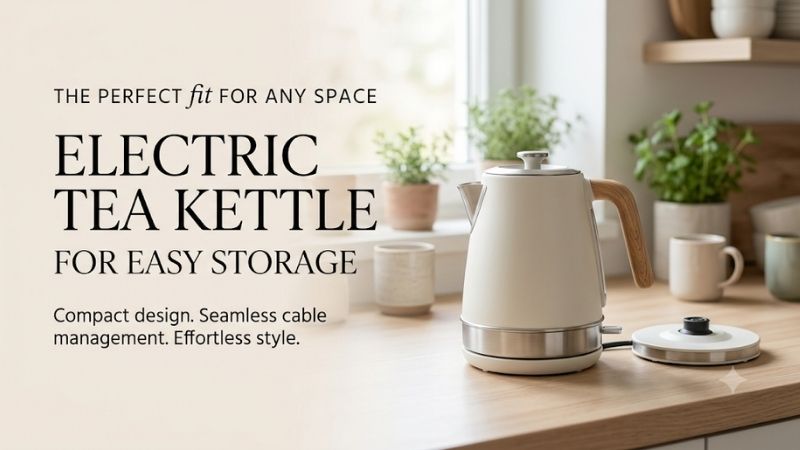
Choose a compact base with convenient cord management
The electrical base is an easily overlooked part of a kettle’s storage footprint. A kettle may appear compact until its power cord extends across a crowded countertop or becomes tangled with other appliances. A well-designed base should support safe operation while allowing unused cord length to be organized neatly.
Many electric kettles use a separate power base that remains connected to the outlet.
The kettle itself lifts away for serving, which improves pouring convenience.
However, the base and cord still require a suitable position.
Some models provide cord storage beneath the base, allowing excess cable to be wrapped or guided into a designated channel.
This can reduce visual clutter and prevent the cord from becoming tangled during storage.
Buyers should verify whether the selected model actually includes this feature rather than assuming all cordless-serving kettles do.
A 360-degree swivel connector can also improve convenience.
It allows the kettle to be placed on the base from different directions, which is helpful when the countertop is narrow.
Avoid tightly bending or compressing the cord beyond the manufacturer’s instructions.
A damaged cable can create electrical hazards and should not be repaired with improvised coverings.
For daily use, a compact base with organized cable routing may offer more practical value than decorative styling.
Balance lightweight handling with enough brewing capacity
A storage-friendly kettle should be easy to move, but an extremely small model can become inconvenient if it requires repeated heating. Capacity and weight must therefore be evaluated together. The goal is to find a size that supports the user’s normal number of servings without becoming difficult to lift or store.
For a single person preparing one or two mugs, a kettle around 0.8–1.0 liters may provide sufficient capacity.
Couples may prefer approximately 1.0–1.5 liters, depending on serving size.
Larger households often benefit from capacities closer to 1.7 liters.
However, a larger kettle becomes heavier when filled.
Water weighs approximately one kilogram per liter, so the handling difference between a small and large kettle can be substantial.
A compact model may be particularly convenient for users who frequently move the appliance between a cabinet and countertop.
The handle should allow a secure grip without forcing the wrist into an uncomfortable position.
Look for a stable lid and predictable pouring action.
Avoid selecting a very small kettle solely because it appears easier to store.
If the appliance cannot prepare the user’s usual drinks in one batch, repeated operation may become frustrating.
The best size balances capacity, storage space, and comfortable handling.
Which electric tea kettle designs are easiest to store?
Storage convenience varies considerably between conventional kettles, compact cylindrical models, and specialty gooseneck designs. Each category has advantages depending on kitchen layout and brewing habits. Understanding these differences helps buyers avoid selecting an appliance that looks small in photographs but proves awkward in everyday use.
Compact cylindrical kettles for narrow countertops
Cylindrical electric kettles often provide efficient use of horizontal space because their water containers rise vertically instead of spreading outward. This design can work well in apartment kitchens with limited counter depth, although handle placement and total height still determine whether the appliance fits comfortably.
A cylindrical kettle may sit neatly beside a coffee machine or other small appliance.
Its rounded water chamber can provide useful capacity without requiring an excessively broad base.
However, not every cylindrical design is equally compact.
Some have handles that project outward, while others include wide lids or decorative bases.
Check the complete dimensions rather than the body diameter alone.
A narrow kettle can also become tall, making it unsuitable for low cabinet shelves.
Buyers should consider whether the appliance will remain on the counter or be stored after each use.
If the kettle stays visible, a slim profile may improve organization.
If it is stored in a cabinet, overall height and handle clearance may matter more.
Cleaning access should not be sacrificed for a narrow design.
An opening that is too small can make it difficult to remove mineral deposits or inspect the interior.
Choose a shape that fits the available space while remaining comfortable to fill, pour, and maintain.
Gooseneck kettles for small specialty brewing stations
Gooseneck kettles are popular among tea enthusiasts and home coffee brewers because they provide controlled water flow. Their relatively small capacities can make them practical for individuals, but the long spout creates a wider overall footprint than the water chamber alone suggests. Storage measurements are therefore especially important.
Many electric gooseneck kettles hold approximately 0.8–1.0 liters.
This is sufficient for individual tea sessions and small manual coffee preparations.
The narrow spout helps direct water into compact teapots, pour-over drippers, and other brewing accessories.
However, the spout extends away from the main body.
A kettle that appears compact from the front may require considerably more shelf width when viewed from above.
The handle also needs clearance for lifting and repositioning.
Buyers should measure the distance from the outermost tip of the spout to the back of the handle.
A gooseneck model is most practical when the user actually benefits from controlled pouring.
If the main purpose is filling ordinary mugs quickly, a conventional compact kettle may be more convenient.
The narrow spout can also be harder to inspect during cleaning.
Follow manufacturer guidance when removing mineral deposits.
A gooseneck kettle is an excellent specialty tool, but it is not necessarily the easiest shape to store in every kitchen.
Collapsible kettles for travel and occasional use
Collapsible electric kettles are designed to reduce storage height when not in use. Their flexible bodies can be attractive for travel, temporary accommodation, or very limited cabinet space. However, folding construction introduces additional material and safety considerations that buyers should evaluate carefully before choosing this design.
Many collapsible kettles use heat-resistant silicone sections combined with rigid heating components.
When collapsed, the body occupies less vertical space than a conventional kettle.
This can be useful inside luggage or a compact travel cupboard.
However, the flexible construction must be appropriate for repeated contact with hot water.
Buyers should verify the product’s stated temperature limits, electrical rating, and applicable safety certifications.
A collapsible kettle may have a smaller capacity than a conventional household model.
Its folding joints also require careful cleaning and drying.
Moisture trapped within folds can create unpleasant odors or make storage inconvenient.
The appliance should never be collapsed while hot or filled with water unless the manufacturer explicitly permits that action.
Electrical compatibility is another essential consideration for travel.
Voltage requirements differ between countries, and a simple plug adapter does not convert voltage.
For everyday permanent kitchen use, a conventional compact kettle may be more durable and easier to maintain.
Collapsible models make the most sense when portability or reduced storage height is the primary requirement.
Practical features that improve small-kitchen convenience
Compact size alone does not guarantee a good ownership experience. A kettle that fits inside a cabinet but is difficult to fill, clean, or pour may create more inconvenience than it solves. Buyers should examine the lid, handle, temperature controls, and electrical design alongside physical dimensions.
Removable lids and wide openings for easier cleaning
Kettles used regularly develop mineral deposits, particularly in areas with hard water. A compact model should still provide adequate access for cleaning and inspection. A removable lid or sufficiently wide opening can make routine maintenance easier without requiring specialized tools or complicated procedures.
Some compact kettles use fully removable lids.
These allow users to inspect the entire opening while filling or cleaning the appliance.
Other models have hinged lids that remain attached to the body.
Hinged lids can be convenient because they eliminate the possibility of misplacing a separate component.
However, they may restrict access if the opening angle is limited.
Consider whether the lid can be opened comfortably beneath the kitchen cabinets.
If the kettle is stored in a low space, a removable lid may be more practical.
Interior surfaces should be smooth and accessible.
Models with narrow openings or complicated internal structures can be difficult to descale.
Follow the manufacturer’s cleaning instructions and avoid placing electrical components in water.
A kettle with a simple interior may provide better long-term convenience than one with additional features that complicate cleaning.
Automatic shutoff and safe storage habits
Safety remains essential even when purchasing a small kettle for occasional use. Automatic shutoff and boil-dry protection are common features that reduce certain operating risks. However, a compact appliance must still be placed correctly, filled within its markings, and allowed to cool before being stored.
Automatic shutoff is intended to stop heating when the kettle reaches its designed endpoint.
Boil-dry protection can interrupt heating when insufficient water is present.
These systems are useful, but users should never deliberately operate an empty kettle.
Place the appliance on a stable, dry surface away from the edge of the counter.
Keep the cord away from burners, sinks, and locations where it might be pulled.
Do not store the kettle immediately after boiling if its exterior remains dangerously hot.
Allow it to cool according to the manufacturer’s instructions.
Emptying leftover water may be appropriate before longer storage periods, but follow product guidance regarding routine handling.
Dry the exterior and electrical contact area before putting the kettle away.
Avoid placing heavy cookware on top of a stored kettle, especially if it has a glass body or delicate lid.
A safe storage location should protect both the appliance and the surrounding items.
Temperature presets versus basic boiling controls
Variable-temperature kettles provide useful flexibility for people who prepare several tea varieties. However, advanced controls can increase price and sometimes introduce larger bases or displays. Small-kitchen buyers should decide whether accurate temperature selection is essential or whether simple boiling meets their needs.
Green tea often benefits from water below boiling, although the preferred temperature varies between varieties.
Black tea generally tolerates hotter water.
Oolong and white tea preparation depends on leaf type and processing.
A temperature-controlled kettle makes these adjustments more convenient.
Some models offer several presets, while others allow users to choose a target temperature.
However, a simple one-button kettle may be sufficient for people who mainly prepare black tea, instant coffee, or hot water for cooking.
Temperature control is not necessarily associated with a larger kettle.
Compact gooseneck models can offer sophisticated settings despite their modest capacity.
The key is to evaluate actual dimensions and features together.
A buyer should not reject a useful variable-temperature model solely because it contains electronics.
Likewise, there is little reason to pay for advanced controls that will rarely be used.
Evaluate glass, stainless steel, and insulated designs
The material of a kettle influences its weight, handling, appearance, and cleaning requirements. Stainless steel, glass, and double-wall constructions can all work in compact kitchens, but each introduces different trade-offs. Choosing the right material should depend on practical use rather than appearance alone.
Stainless steel is widely used because it is durable and suitable for repeated heating.
However, a single-wall metal exterior may become hot.
Glass kettles allow users to see the water level and observe visible deposits.
They can also be more vulnerable to breakage if dropped or stored carelessly.
Double-wall kettles may provide improved exterior insulation, depending on their construction.
The additional layer can increase body thickness and overall dimensions.
Some designs also combine stainless steel interiors with plastic outer shells.
Buyers should check the manufacturer’s information about materials that contact the water.
A material described as BPA-free does not necessarily mean every part of the kettle is made from the same substance.
For cramped cabinets, weight and resistance to accidental knocks may be particularly important.
The ideal material supports comfortable handling, easy cleaning, and reliable use in the intended storage location.
How to organize, clean, and store an electric kettle
A storage-friendly kettle is most useful when it fits into a repeatable daily routine. Organizing the brewing area, managing moisture, and protecting electrical components can prevent common frustrations. Simple habits also reduce clutter and help the appliance remain ready for use without occupying valuable space unnecessarily.
Create a dedicated tea station without permanent clutter
Small kitchens often work best when frequently used items have predictable locations. A tea station does not need a dedicated cabinet or large countertop organizer. It can simply consist of a kettle, a few mugs, and neatly stored tea supplies positioned near a safe electrical outlet.
Choose a stable surface where the kettle can operate without touching nearby objects.
Allow sufficient clearance for steam and lid movement.
Do not place the kettle directly beneath materials that could be damaged by repeated exposure to moisture.
Keep tea leaves and infusers in a nearby drawer or storage container.
This reduces the need to move the kettle around the kitchen while it contains hot water.
If the kettle is stored after use, designate a cabinet location that can be accessed without shifting several heavy objects.
A small tray may help organize accessories, but it should not interfere with ventilation or electrical safety.
Avoid overcrowding the area with decorative items that complicate cleaning.
The most effective arrangement is one that supports a complete brewing routine with minimal movement.
Descale regularly and dry before storage
Mineral buildup is a normal consequence of repeatedly heating water containing dissolved minerals. In compact kettles, deposits may be especially noticeable because the heating chamber is small. Regular inspection and appropriate cleaning help preserve a clean interior and reduce inconvenient maintenance sessions.
Check the interior periodically for white or chalky residue.
The frequency of descaling depends on local water hardness and the number of heating cycles.
Follow the manufacturer’s recommended procedure.
Do not assume every acid-based cleaning solution is compatible with the kettle’s materials.
Avoid abrasive pads that can damage coatings or interior surfaces.
After descaling, rinse thoroughly and complete any recommended boil-and-discard cycles.
Let the kettle cool before cleaning or moving it into storage.
Wipe exterior moisture and ensure the electrical connection area is dry.
If the appliance will be unused for an extended period, clean and dry it before storing.
A damp cabinet or enclosed container can encourage unpleasant odors.
Routine care is generally easier than removing heavy deposits after months of neglect.
Know which storage compromises are worth accepting
Small appliances frequently involve trade-offs between capacity, convenience, and compactness. The smallest kettle may be inconvenient for several servings, while a larger model could fit perfectly if its base and handle are well designed. Buyers should decide which limitations are acceptable before making a purchase.
For a single tea drinker, limited capacity may be a reasonable compromise.
For a family, frequent refilling can become frustrating.
A compact gooseneck model is useful when controlled pouring matters more than speed.
A conventional kettle may be easier to store when its spout does not project as far.
Removable lids improve cleaning access but introduce an additional piece to manage.
Hinged lids remain attached but may require more vertical clearance.
A collapsible kettle saves height but can require additional cleaning around flexible joints.
No single design provides every advantage.
The goal is to select a kettle whose limitations do not interfere with the user’s normal routine.
A practical choice should feel convenient after several weeks of use, not merely appear compact in a product photograph.
Conclusion
The best electric tea kettle for easy storage combines a compact footprint, appropriate capacity, manageable cord, and reliable safety features. A small conventional kettle suits everyday boiling, while a compact gooseneck model is better for controlled specialty brewing. Measure the full appliance, including its base, handle, and spout, before purchasing. Choose simple construction and easy cleaning over unnecessary features, and allow the kettle to cool and dry before storing it.









Write Your Review
No reviews yet. Be the first to share your experience!