
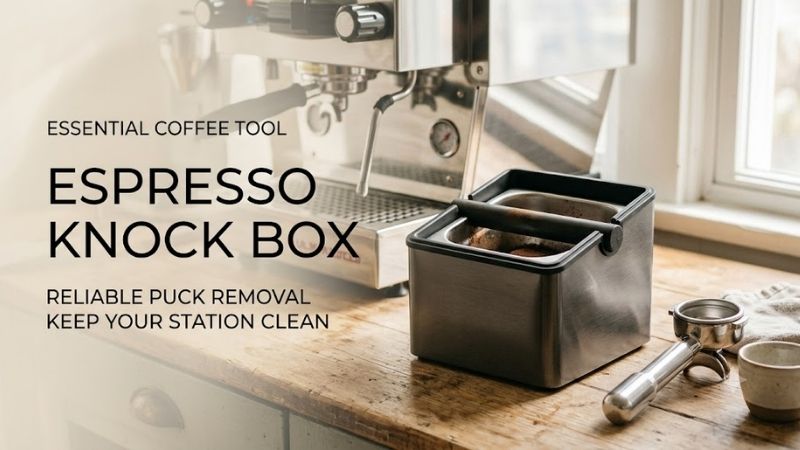
An espresso knock box makes it easier to remove used coffee pucks from a portafilter without repeatedly striking a trash can or scraping grounds into the sink. We compare six designs for compact kitchens and dedicated coffee stations, focusing on stability, knock-bar protection, capacity, cleaning access, noise, and whether a countertop bin or drawer fits your workflow.
Quick Verdict: Which Espresso Knock Box Is Best?
Best Overall: Breville Knock Box 10. Its compact housing, removable knock bar, nonslip base, and advertised capacity of up to ten used espresso pucks make it practical for many home setups.
For a particularly small coffee station, the Dreamfarm Grindenstein is a useful alternative. A stainless steel model such as the ECM Knock Box may better suit buyers who prioritize substantial construction.
Quick Comparison Table
| Knock Box | Best For | Design | Main Advantage | Main Limitation |
|---|---|---|---|---|
| Breville Knock Box 10 | Best overall | Compact countertop bin | Removable bar, nonslip base | Limited capacity for high-volume use |
| Dreamfarm Grindenstein | Small kitchens | Low-profile bin | Compact storage | Frequent emptying |
| Fellow Espresso Knock Box | Design-focused stations | Countertop bin | Coordinated coffee-station styling | Premium price |
| Rattleware Basic Knock Box | Practical durability | Commercial-style countertop bin | Straightforward construction | Utilitarian appearance |
| ECM Stainless Steel Knock Box | Premium stainless steel | Metal countertop container | Robust construction | Higher cost and weight |
| Eureka Mignon Knock Box Drawer | Space under grinder | Drawer-style container | Stores below compatible grinder setups | Requires drawer clearance |
How We Selected These Espresso Knock Boxes
A knock box has a simple purpose: provide a stable container with a suitable bar for removing spent espresso pucks.
However, not every design works equally well in a home kitchen.
An unstable container can slide when struck.
A poorly protected bar can damage the portafilter.
A container that is difficult to empty may become unpleasant to maintain.
We evaluated construction, bar design, stability, capacity, footprint, and cleaning.
We also considered different espresso-station layouts. A small countertop bin suits a compact setup, while a drawer-style knock box can reduce clutter in a dedicated coffee area.
These recommendations reflect published product design and practical considerations. We have not independently researched noise levels, impact durability, or exact puck capacity under different coffee doses.
Detailed Espresso Knock Box Reviews
1. Breville Knock Box 10 — Best Overall
Best For: Home espresso users who prepare several drinks daily and want a compact dedicated puck bin.
Why We Picked It
The Breville Knock Box 10 offers the features most home users need without excessive size.
Its removable knock bar simplifies emptying and cleaning.
The nonslip base helps the container remain stable while the user removes a spent puck.
Key Specifications
- Product: Breville Knock Box 10
- Advertised capacity: Up to 10 espresso pucks
- Dimensions: Approximately 4.4 × 4.8 × 4.8 inches
- Construction: Stainless steel and plastic
- Knock bar: Removable
- Base: Nonslip
- Warranty: One year, according to Breville’s US listing
Features and Benefits
The removable knock bar is a significant convenience.
Instead of trying to wash around a fixed horizontal bar, users can remove it when cleaning the inner vessel.
The nonslip base helps reduce unwanted movement when tapping the portafilter.
The compact footprint also suits many Breville home espresso stations.
Performance and Practical Use
The Knock Box 10 is appropriate for households preparing a few espresso drinks each day.
Its ten-puck rating describes a nominal capacity, but the actual number of pucks accommodated depends on basket size, dose, and whether the pucks break apart.
A knock box should not be filled until coffee residue interferes with the bar or disposal.
What Makes It Different
It combines compact size, practical cleaning access, and recognizable compatibility with many home espresso routines.
Pros
- Removable knock bar.
- Nonslip base.
- Compact footprint.
- Advertised ten-puck capacity.
- Straightforward cleaning.
Cons
- Not intended for very high-volume commercial use.
- Requires regular emptying.
- Mixed construction may not suit buyers wanting all-metal housing.
Buy If: You want a convenient home espresso knock box with easy cleaning.
Skip If: You prepare large quantities of espresso continuously.
2. Dreamfarm Grindenstein — Best for Small Kitchens
Best For: People who want a compact puck-disposal container that does not dominate the coffee station.
Why We Picked It
The Grindenstein is designed around a low, relatively compact container.
Its form factor makes it attractive for kitchens with limited space.
Key Specifications
- Type: Countertop espresso knock box
- Body: Compact container
- Knock bar: Cushioned
- Base: Stable countertop design
- Storage: Low-profile format
- Main purpose: Small home espresso stations
Features and Benefits
The compact size helps keep puck disposal near the espresso machine.
A cushioned bar reduces direct contact between the portafilter and hard container material.
Performance and Practical Use
The Grindenstein makes sense for one-person or two-person households preparing a limited number of daily drinks.
Because of its smaller size, users should expect to empty it frequently.
That can actually be beneficial if it encourages prompt disposal of wet coffee residue.
What Makes It Different
It emphasizes small-space convenience rather than maximum capacity.
Pros
- Compact footprint.
- Cushioned bar.
- Simple operation.
- Suitable for smaller espresso setups.
Cons
- Limited capacity.
- Frequent emptying.
- Less appropriate for heavy daily use.
Buy If: Your coffee station has very little available space.
Skip If: You want to collect a large number of pucks before emptying.
3. Fellow Espresso Knock Box — Best for a Design-Focused Coffee Station
Best For: Coffee enthusiasts who want a dedicated puck bin with coordinated countertop styling.
Why We Picked It
Fellow’s knock box offers a purpose-built alternative to improvised puck disposal while fitting into a modern coffee setup.
Key Specifications
- Type: Countertop knock box
- Puck disposal: Protected horizontal bar
- Design: Dedicated home espresso accessory
- Cleaning: Removable components, depending on configuration
- Main purpose: Daily puck disposal
Features and Benefits
A purpose-built knock box helps keep used coffee away from the sink and nearby preparation tools.
Its coordinated appearance may also be desirable in a coffee station where the grinder, kettle, and espresso machine remain permanently on display.
Performance and Practical Use
The key buying question is whether the design adds practical value.
A stylish knock box still needs to be stable and easy to clean.
Users should prioritize bar construction, container access, and dimensions rather than appearance alone.
What Makes It Different
It offers a design-focused alternative to purely utilitarian espresso accessories.
Pros
- Dedicated puck-disposal design.
- Suitable for a coordinated coffee setup.
- Convenient countertop access.
- More appropriate than tapping a portafilter against a sink edge.
Cons
- Styling can increase cost.
- No direct improvement to espresso extraction.
- Requires routine cleaning.
Buy If: You want a visually coordinated home espresso station.
Skip If: Function and low cost are your only priorities.
4. Rattleware Basic Knock Box — Best for Practical Durability
Best For: Home baristas who prefer a straightforward commercial-style container.
Why We Picked It
Rattleware is associated with conventional café accessories, and its basic knock-box design emphasizes practical puck disposal.
Key Specifications
- Product: Rattleware Basic Knock Box
- Approximate configuration: 6 × 5.5 × 4 inches
- Construction: Commercial-style container
- Knock bar: Cushioned
- Operation: Countertop
- Main purpose: Espresso puck disposal
Features and Benefits
The straightforward container provides a dedicated place to remove grounds.
A protected knock bar helps reduce direct impact on the portafilter.
Performance and Practical Use
This is useful for buyers who prefer a functional tool rather than a highly styled accessory.
Its size can accommodate repeated puck disposal, though actual capacity depends on puck dimensions.
The main concern is ensuring the container remains stable on the intended surface.
What Makes It Different
It emphasizes a conventional café-style arrangement with minimal unnecessary features.
Pros
- Straightforward construction.
- Protected knock bar.
- Practical for repeated use.
- Utilitarian design.
Cons
- Less decorative than premium models.
- May be larger than necessary for small kitchens.
- Puck capacity varies.
Buy If: You want a simple tool with a traditional café appearance.
Skip If: You prefer the smallest possible container.
5. ECM Stainless Steel Knock Box — Best Premium Metal Construction
Best For: Espresso enthusiasts who want a substantial stainless steel countertop accessory.
Why We Picked It
The ECM Knock Box is appealing to buyers who prefer metal construction and a more permanent coffee-station setup.
Key Specifications
- Brand: ECM
- Construction: Stainless steel
- Format: Countertop knock box
- Knock bar: Protected bar arrangement
- Main purpose: Espresso puck disposal
- Design: Premium metal housing
Features and Benefits
Stainless steel construction provides a durable housing material.
It also coordinates with many traditional stainless steel espresso machines.
Performance and Practical Use
The ECM is suitable for coffee stations where the knock box remains beside the espresso machine.
However, a premium metal body does not necessarily improve puck removal compared with a well-designed plastic container.
Bar protection and stability remain more important than the external finish.
What Makes It Different
Its premium stainless steel construction is the main distinction.
Pros
- Metal housing.
- Suitable for permanent countertop placement.
- Coordinated appearance with metal espresso machines.
- Dedicated disposal design.
Cons
- Premium pricing.
- Heavier than small plastic bins.
- Does not improve coffee extraction.
Buy If: You want a premium metal accessory to match your espresso station.
Skip If: You simply need an inexpensive puck-disposal container.
6. Eureka Mignon Knock Box Drawer — Best for Under-Grinder Storage
Best For: Coffee stations that benefit from keeping the knock box beneath a grinder.
Why We Picked It
A drawer-style knock box uses horizontal space differently from a conventional open-top container.
Instead of occupying a separate area beside the machine, it can sit beneath a suitable grinder.
Key Specifications
- Type: Drawer-style knock box
- Construction: Metal housing
- Disposal: Sliding collection drawer
- Knock bar: Protected
- Intended layout: Under compatible grinder setups
- Main benefit: Space organization
Features and Benefits
A drawer helps consolidate grinding and puck disposal within the same station.
It can be particularly useful on wider counters where vertical organization is preferable.
Performance and Practical Use
The drawer arrangement has an important limitation: it needs room to open.
A setup positioned too close to the counter edge, espresso machine, or other accessories can make emptying inconvenient.
Users should also verify that the grinder’s weight and dimensions are compatible with the drawer’s intended arrangement.
What Makes It Different
It organizes puck disposal beneath a grinder rather than beside the espresso machine.
Pros
- Space-efficient station layout.
- Dedicated collection drawer.
- Useful for permanent espresso setups.
- Metal construction.
Cons
- Requires clearance to open.
- Larger overall footprint than it may initially appear.
- Compatibility with grinder placement must be checked.
- More surfaces to clean.
Buy If: You have a dedicated espresso station and want under-grinder storage.
Skip If: You need a portable compact bin that can be moved easily.
Espresso Knock Box Buying Guide
Why Use a Knock Box?
A knock box provides a dedicated surface for removing used coffee pucks.
It reduces the temptation to strike the portafilter against the kitchen sink, trash can, or countertop.
However, it remains important to use appropriate force and protect the portafilter from damage.
Countertop Bin vs. Drawer
A countertop bin is easy to access and move.
A drawer can save some visible counter space when positioned beneath a grinder.
The best arrangement depends on station layout and how often the container is emptied.
Choosing Capacity
Small households may only need room for several pucks.
A high-volume espresso station benefits from a larger container.
However, greater capacity also encourages longer storage of wet coffee waste, which may become unpleasant.
Knock-Bar Material
A suitable bar should protect the portafilter from direct impact against rigid metal.
Rubber or cushioned coverings are common.
The protection material should remain secure during use and be replaceable where possible.
Stability and Nonslip Bases
A knock box should not slide when used.
Nonslip feet, appropriate weight, and a broad base can help.
Place the box on a stable surface rather than a narrow or unstable shelf.
Noise
Removing a puck involves impact and may be audible.
Cushioned bars can reduce harsh contact sounds, but noise also depends on the portafilter, technique, and countertop.
Do not expect complete silence from a knock box.
Cleaning Access
Wet grounds and coffee oils accumulate in the container.
A removable bar makes cleaning easier.
Wash the box according to its instructions and dry thoroughly.
Countertop Clearance
Measure space beside the espresso machine.
For drawer models, confirm that the drawer can open completely.
For open bins, check whether your portafilter can be positioned comfortably above the bar.
Portafilter Compatibility
Most ordinary knock boxes can be used with several portafilter diameters.
However, handle shape, spouts, and basket configuration may affect how comfortably the tool is used.
Avoid striking delicate or unsupported components.
Should You Leave Coffee Pucks Overnight?
Used grounds remain moist and can develop unpleasant odors.
Empty the container regularly, especially in warm or humid conditions.
Do not allow used pucks to accumulate indefinitely.
Disposal and Composting
Coffee grounds may be compostable depending on local composting guidance.
However, large quantities should be managed appropriately.
Do not routinely flush used espresso grounds into a sink drain because they can contribute to blockages.
Knock Boxes and Bottomless Portafilters
A bottomless portafilter can usually be used with a suitable knock box, but care is important.
Avoid excessive impact around exposed basket edges.
The goal is to release the puck, not strike the portafilter as hard as possible.
Common Knock Box Problems
The Box Slides During Use
Check the nonslip base and countertop condition. A heavier or broader container may be preferable.
The Puck Does Not Release
Let the portafilter drain and use appropriate controlled tapping. Do not repeatedly strike it with excessive force.
Grounds Scatter Around the Box
Position the basket over the container before tapping and consider a larger opening.
The Box Develops an Odor
Empty it more frequently and clean coffee residue from the container and bar.
The Drawer Is Hard to Open
Check whether the grinder placement or nearby objects obstruct the drawer.
Frequently Asked Questions
What is the best espresso knock box overall?
The Breville Knock Box 10 offers a practical combination of compact size, removable bar, and nonslip construction.
Do you really need an espresso knock box?
It is not absolutely necessary, but it can make puck disposal cleaner and protect nearby surfaces.
Can a knock box damage a portafilter?
Excessive force or an unprotected bar can cause damage. Use a suitable cushioned bar and controlled tapping.
How often should you empty a knock box?
Empty it regularly based on use. Avoid storing wet grounds for extended periods.
Is a metal knock box better than plastic?
Not automatically. Stability, bar protection, and cleaning matter more than body material alone.
Are drawer-style knock boxes practical?
They can be, particularly in permanent espresso stations with enough room for the drawer to open.
Can you compost used espresso pucks?
Coffee grounds can be used in appropriate composting systems, subject to local guidelines.
Should you wash the knock bar?
Yes. Coffee residue accumulates on and around the bar. Follow the manufacturer’s cleaning instructions.
Conclusion
The Breville Knock Box 10 is our best espresso knock box for compact home stations, with a removable bar and nonslip base. Choose Dreamfarm Grindenstein for smaller counters, ECM for premium stainless steel, Rattleware for straightforward durability, or Eureka’s drawer for under-grinder storage. Prioritize stability, cleaning access, and appropriate capacity.






Write Your Review
No reviews yet. Be the first to share your experience!