
A gooseneck kettle for small spaces should provide controlled pouring without taking over a crowded kitchen counter. Whether you make pour-over coffee every morning or occasionally prepare tea, the kettle’s footprint, capacity, handle design, and heating method affect everyday convenience. This guide explains how to choose a compact gooseneck kettle without sacrificing practical usability.
- Quick Verdict: What Makes a Good Compact Gooseneck Kettle?
- Understanding Gooseneck Kettles
- Measuring Your Kitchen Space
- Choosing the Right Capacity
- Electric vs. Stovetop Gooseneck Kettles
- Temperature Control and Brewing
- Materials and Construction
- Cleaning and Maintenance
- Choosing for Different Brewing Habits
- Common Buying Mistakes
- Frequently Asked Questions
- Conclusion
Quick Verdict: What Makes a Good Compact Gooseneck Kettle?
For a small kitchen, prioritize a kettle with an appropriate capacity, stable base, comfortable handle, and spout that provides predictable water flow.
Choose an electric gooseneck kettle when you want a dedicated brewing station with convenient heating controls.
Choose a stovetop gooseneck kettle when you prefer to use your existing burner and avoid another electrical appliance base.
| Feature | Compact Electric Gooseneck | Compact Stovetop Gooseneck |
|---|---|---|
| Heating | Dedicated powered base | Compatible stovetop |
| Counter footprint | Kettle plus electrical base | Kettle uses burner during heating |
| Temperature selection | Available on certain models | Usually controlled through cooktop |
| Automatic shutoff | Common, depending on model | Generally requires manual control |
| Portability | Requires a suitable outlet | Requires a compatible heat source |
| Storage | Must account for power base and cord | No separate electric base |
| Best for | Frequent controlled brewing | Minimal appliance clutter |
The best choice is the one that fits your physical space and brewing routine, not necessarily the kettle with the greatest number of controls.
Understanding Gooseneck Kettles
What Is a Gooseneck Kettle?
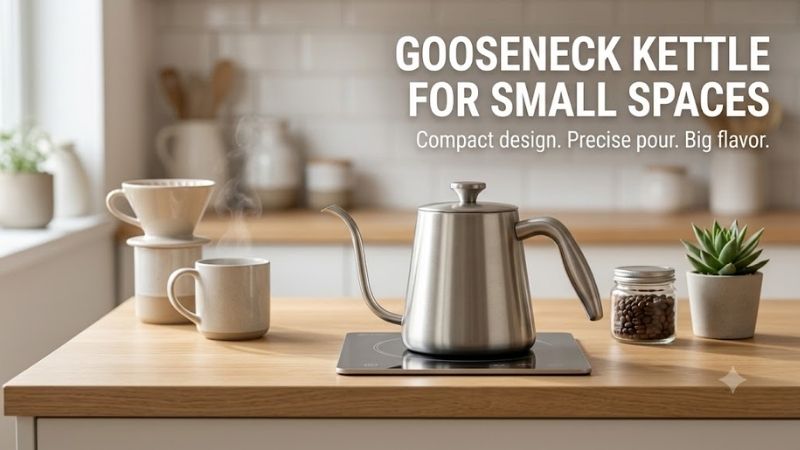
A gooseneck kettle has an elongated, narrow pouring spout designed to help the user control water flow and placement.
This shape is particularly useful for pour-over coffee, where the position and rate of pouring can influence how water moves through the coffee bed.
However, a gooseneck kettle is not essential for every brewing method.
For French press coffee, tea, or simply filling a mug, a conventional kettle may be equally practical.
Why Does the Spout Design Matter?
A well-designed gooseneck spout can make it easier to pour small quantities of water with deliberate movements.
Spout geometry, handle balance, fill level, and the user’s technique all influence actual control.
A narrow spout does not automatically guarantee perfect pouring.
Some designs may drip at very low flow rates, while others become difficult to control when the kettle is nearly empty.
Look for credible demonstrations or published evaluations of pouring behavior rather than relying on appearance alone.
Does a Smaller Kettle Improve Pouring?
A smaller kettle may be easier for some users to maneuver because it weighs less when filled.
However, reduced capacity means more frequent refilling.
Balance and handle positioning are as important as volume.
A compact kettle with poor ergonomics may be less comfortable than a slightly larger, well-balanced model.
Measuring Your Kitchen Space
Check the Complete Footprint
Measure the available width and depth of your brewing area.
For electric models, include the power base, cord routing, and any manufacturer-required clearance.
Do not measure only the round bottom of the kettle.
The spout and handle often extend well beyond the body.
A kettle may fit on a shelf but become awkward to retrieve because its spout protrudes into nearby objects.
Consider Overhead Cabinets
The kettle must be easy to fill, lift, and pour.
Overhead cabinets may limit lid access, especially when the kettle sits on its powered base.
Steam can also affect nearby cabinets and surfaces.
Follow the manufacturer’s placement requirements, and avoid using the kettle where escaping steam contacts vulnerable materials.
Think About Storage Between Uses
If you brew coffee daily, leaving the kettle in a dedicated safe location may be convenient.
If you use it only occasionally, consider whether it fits inside a cabinet.
A narrow spout can be vulnerable to damage when stored carelessly.
Avoid squeezing it between heavy cookware or positioning it where the spout may be bent.
Choosing the Right Capacity
Small Capacity for One Person
A compact gooseneck kettle can be useful for preparing one or two modest beverages.
However, the appropriate capacity depends on your brewing recipe and the amount of water needed for rinsing a filter or warming equipment.
Consider the total water required for your routine, not just the amount that ends up in your cup.
A very small kettle may require repeated heating.
Medium Capacity for Shared Brewing
If two people regularly prepare pour-over coffee, a medium-sized kettle may reduce refilling.
However, greater capacity increases weight and can make controlled pouring more demanding.
Choose a handle and spout arrangement that remains comfortable when the kettle is filled to a normal working level.
Why Maximum Capacity Is Not the Whole Story
Kettles generally have minimum and maximum water-level requirements.
A kettle advertised with a particular capacity may not be designed to operate with extremely small quantities.
If you regularly heat only a little water, check the minimum fill requirement.
Overfilling can also create spill and scalding risks.
Electric vs. Stovetop Gooseneck Kettles
Electric Gooseneck Kettles
Electric models use their own heating system.
Some offer temperature presets, digital controls, or a keep-warm function.
These features can be useful when preparing different coffee or tea recipes.
However, controls add complexity and may increase the size of the base.
Check actual dimensions, cleaning procedures, and whether the display or control arrangement is convenient.
Stovetop Gooseneck Kettles
Stovetop models use an external heat source.
They can be practical when kitchen space is limited and you already have a suitable burner.
However, cooktop compatibility must be verified.
A stovetop kettle that works on gas or radiant electric heat may not work on induction.
Do not assume compatibility based solely on stainless steel construction.
Which Type Is Better for Apartments?
An electric model may be convenient when counter space is available near an outlet and the stove is frequently occupied.
A stovetop model may reduce permanent countertop clutter.
However, both require safe working space.
Choose according to where you will heat, fill, pour, and store the kettle.
Temperature Control and Brewing
Do You Need Variable Temperature Settings?
Variable temperature control can be useful for people who prefer different brewing temperatures for various beverages.
For example, some coffee and tea preparation methods call for water below a full boil.
However, temperature recommendations vary with ingredients, brewing technique, and personal preference.
A variable-temperature kettle provides convenience but does not automatically improve every beverage.
Understanding Temperature Accuracy
A digital display may show the target temperature, measured temperature, or both, depending on the model.
Actual water-temperature accuracy can vary.
Do not assume that every kettle maintains the selected setting precisely.
If temperature accuracy is important, look for credible controlled measurements.
Is Keep-Warm Worth Having?
A keep-warm function can be convenient for repeated brewing sessions.
However, it consumes electricity and has model-specific operating limits.
For one quick cup each morning, the feature may provide little value.
If you frequently prepare several drinks over a longer period, it may be more useful.
Materials and Construction
Stainless Steel Interiors
Stainless steel is common in gooseneck kettles.
It can provide durable construction and relatively straightforward cleaning.
However, material grade, finish, and contact surfaces vary.
A stainless steel body does not prove induction compatibility or establish a universal temperature limit.
Check manufacturer documentation.
Handle Design
The handle should allow a comfortable and secure grip while pouring.
Consider finger clearance and balance when filled.
Some handles incorporate heat-resistant materials, but the degree of heat protection varies.
Follow the kettle’s handling instructions and use appropriate protection when necessary.
Lid Fit
A secure lid is important during heating and pouring.
An excessively loose lid can create a spill risk.
However, the lid must also allow proper steam management according to the kettle design.
Never block steam outlets or modify the lid.
Cleaning and Maintenance
Removing Mineral Deposits
Mineral scale can accumulate inside kettles, particularly when using hard water.
Follow the manufacturer’s descaling instructions.
Use only approved cleaning agents and rinse thoroughly as directed.
Do not mix cleaning chemicals.
Cleaning a Narrow Spout
A long, narrow spout can be more difficult to inspect than an ordinary kettle spout.
Use manufacturer-approved cleaning methods and accessories.
Avoid forcing rigid objects into the spout, which may damage its interior or shape.
Caring for Electric Bases
Keep electrical connectors and controls dry.
Allow the kettle to cool before cleaning.
Never immerse the powered base.
Inspect the cord for damage and discontinue use if electrical components appear unsafe.
Choosing for Different Brewing Habits
Best for Single-Cup Pour-Over Coffee
Prioritize comfortable balance, controlled flow, and enough capacity for the complete brewing process.
A compact electric model may be convenient for daily use.
Best for Tea Drinkers
A temperature-controlled electric kettle may be useful when preparing different types of tea.
However, a gooseneck spout is not essential for ordinary tea preparation.
If controlled pouring is unnecessary, a conventional kettle may offer better value.
Best for Minimalist Kitchens
A stovetop model can reduce countertop equipment when you have a compatible burner.
Choose a capacity that meets your needs without excessive storage requirements.
Best for Coffee Enthusiasts
Prioritize pour control, comfortable handling, and credible temperature performance.
Additional electronic features should support your actual brewing routine.
Common Buying Mistakes
Choosing the Smallest Kettle Available
Very small capacity may lead to repeated heating or inadequate water for a complete brewing process.
Choose based on total water use.
Ignoring the Spout and Handle
The spout and handle extend beyond the main body and affect storage as well as ergonomics.
Measure the complete kettle.
Assuming Every Stovetop Model Works on Induction
Induction requires a suitable magnetic base and compatible dimensions.
Check both kettle and cooktop requirements.
Paying for Unnecessary Smart Features
Connected controls and elaborate displays may not improve basic brewing convenience.
Prioritize practical features.
Frequently Asked Questions
Are Gooseneck Kettles Good for Small Kitchens?
Yes, compact models can fit small brewing areas. However, the spout, handle, and electric base must be included when measuring available space.
Is a Gooseneck Kettle Better for Pour-Over Coffee?
A well-designed gooseneck spout can make water placement and flow easier to control, which is useful for pour-over brewing.
Can a Gooseneck Kettle Be Used on Induction?
Only if the specific stovetop model is induction compatible. Ordinary electric gooseneck kettles must be used with their designated powered bases.
Do I Need Temperature Control for Coffee?
Not necessarily. Temperature control can improve convenience, but it is not essential for every brewing method.
How Do I Clean a Gooseneck Spout?
Follow the manufacturer’s approved cleaning instructions. Avoid forcing tools into the narrow spout or using inappropriate chemical mixtures.
Is a Small Gooseneck Kettle Enough for Two People?
It depends on the water quantity required for both servings. Calculate your total brewing needs before choosing capacity.
Conclusion
The best gooseneck kettle for small spaces balances a manageable footprint with useful capacity, comfortable pouring, and appropriate heating controls. Choose an electric model for convenient temperature selection or an induction-compatible stovetop model when reducing permanent countertop clutter matters most. Measure the full kettle, including its spout and handle, and prioritize practical brewing needs over unnecessary features.

Write Your Review
No reviews yet. Be the first to share your experience!