
Shopping for a wine cooler often feels needlessly complicated, filled with marketing jargon about microclimates, vibration dampening, and custom compressors. If your goal is simply to keep your bottles at an optimal drinking temperature and prevent premature aging, you do not need an engineering degree. You just need to understand the structural realities of freestanding appliances and match them to your home layout, drinking habits, and budget.
Freestanding models offer tremendous flexibility because they do not require custom cabinetry or specialized under-counter electrical work. However, treating a freestanding unit like a built-in appliance remains the single most common mistake homeowners make. As you evaluate your options in 2026, focusing on airflow clearance, cooling mechanics, zone utility, and shelf layout will ensure your investment genuinely protects your collection rather than quietly cooking it.
As an Amazon Associate we earn from qualifying purchases at no extra cost to you.
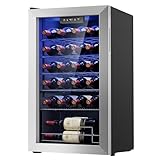
Freestanding vs. Built-In: The Critical Clearance Rule
The primary engineering distinction between a freestanding wine cooler and a built-in model lies entirely in heat dissipation. Freestanding wine refrigerators exhaust their waste heat through external coils located along the back and sides of the cabinet. Built-in units utilize front-facing vents along the kickplate, pulled by dedicated intake and exhaust fans.
Because of this rear-and-side ventilation, a freestanding unit requires breathing room. As a universal standard, you must leave a minimum of two to three inches of open space behind the unit, and at least two to four inches along both sides and above the top. Shoving a freestanding cooler into an enclosed kitchen island or between pantry cabinets traps heat against the chassis. This causes the compressor to run continuously, driving up your power bill, generating internal temperature spikes, and ultimately leading to premature component failure within two to three years.
Compressor vs. Thermoelectric Cooling
Wine coolers generally rely on one of two technologies: traditional vapor-compression systems or solid-state thermoelectric chips. Choosing the wrong mechanism for your intended room environment will lead to persistent frustration.
Compressor-based coolers function identically to a standard kitchen refrigerator. They rely on refrigerant, a pump, and internal coils to move heat rapidly out of the cabinet. These units offer wide temperature ranges, easily pull temperatures down to cellar levels even in warm rooms, and recover quickly after the door is opened. Their drawbacks are mechanical hum and faint vibration, though modern dampers mitigate most movement.
Thermoelectric coolers use the Peltier effect, creating a heat sink via an electric current without moving parts beyond a small internal circulation fan. They operate almost completely silently and emit zero vibrations. However, thermoelectric cooling power is strictly relative to the ambient room temperature. If the room warms up, a thermoelectric cooler cannot keep pace, rarely dropping more than twenty degrees below the surrounding environment. Unless your cooler will live in a strictly climate-controlled space that never exceeds standard living temperatures, a compressor-driven model is by far the safer choice.
Single Zone vs. Dual Zone Realities
Dual-zone coolers divide the interior chamber into two isolated compartments, each governed by its own thermostat. This configuration allows you to chill crisp whites and sparkling wines down to serving temperatures in one section while preserving reds at cellar temperature in the other. While versatile, dual-zone architecture introduces tradeoffs in both usable capacity and interior airflow.
The internal dividing partition and secondary fan assembly take up physical volume, reducing the total bottle capacity compared to an identically sized single-zone cabinet. Furthermore, temperature bleed between compartments is common in budget units. If you collect wine for long-term aging rather than immediate serving, a single-zone unit set permanently to a baseline cellar temperature is mechanically simpler, holds more bottles per dollar, and maintains a more stable climate across the entire cabinet.
Understanding Bottle Capacity and Shelf Geometry
Manufacturer capacity ratings are universally based on standard 750ml Bordeaux-style cylinders placed neck-to-base. The moment you introduce Pinot Noir, Champagne, Syrah, or wide-base Chardonnay bottles into your collection, stated capacities decline steeply.
Thicker bottles cause shelves to scrape labels or jam against the shelf above, often forcing you to remove entire racks to fit wide-shouldered bottles. Removing one shelf can instantly erase fifteen to twenty percent of a cooler’s advertised storage volume. When evaluating interior racks, look for scalloped wire racks with adequate vertical spacing or telescoping wooden shelves with deep grooves that accommodate varied bottle circumferences without forcing you to dismantle the interior layout.
Door Construction and Light Defense
Ultraviolet rays degrade wine by reacting with natural amino acids, creating volatile sulfur compounds that produce dull flavors and unpleasant aromas—a flaw commonly referred to as lightstruck wine. Solid doors block light entirely, but most homeowners prefer glass doors to display their collection.
If you select a glass-door unit, ensure it features double-pane or triple-pane tempered glass with dedicated UV-filtering film or tinting. Beyond light protection, multi-pane glass containing argon gas between layers dramatically improves thermal insulation. In humid climates, low-emissivity glass also prevents exterior condensation from pooling onto your hardwood floors during the summer months.
When It Makes Sense to Spend More
Entry-level wine coolers perform adequately for short-term bottle staging over six to twelve months, but long-term aging requires mechanical consistency that budget units rarely deliver. Higher-tier investments justify their price tags through specific structural upgrades rather than cosmetic finishes.
Consider spending more if you live in an area with dry winters, where high-end charcoal filtration and passive humidity reservoirs prevent corks from drying out and oxidizing the wine. Premium units also feature variable-speed inverter compressors, which cycle smoothly at lower power levels rather than abruptly jarring on and off, eliminating sudden temperature drops and mechanical vibration that disturb sediment in mature vintages.
Related Guides
If you are ready to evaluate top-performing models across different cooling layouts, check out our roundup of the Best Freestanding Wine Coolers in 2026, explore flexible multi-temperature cabinets in our review of the Best Dual Zone Wine Coolers in 2026, or upgrade your home hydration station by browsing the Best Water Coolers in 2026.
FAQ
Can I put a freestanding wine cooler inside an existing cabinet opening?
No, you should never place a freestanding wine cooler inside an enclosed under-counter cabinet opening. Freestanding units vent heat from their sides and back, meaning restricted airflow will overheat the compressor and ruin the unit. Built-in units with front-facing kickplate ventilation are required for enclosed installations.
What temperature should I set my wine cooler to if I drink both red and white wine?
If you own a single-zone cooler and store a mixed collection, set the thermostat to a standard cellar baseline between fifty-three and fifty-seven degrees Fahrenheit. This temperature safely preserves all wine varieties indefinitely. You can easily chill whites in the kitchen refrigerator for twenty minutes before serving or let reds warm briefly on the counter.
Why is my freestanding wine cooler running constantly?
Continuous running typically indicates inadequate ventilation clearance around the back and sides, causing heat to build up around the condenser coils. It can also stem from a worn magnetic door gasket that lets warm room air seep inside, or an environment where ambient room temperatures exceed the cooling mechanism’s operating limits.
Do wine coolers dry out natural corks over time?
Basic wine coolers lack active humidity controls, which can lead to low interior humidity levels during cold winter months when indoor heating is running. Premium wine refrigerators combat this with internal moisture-retention designs or integrated water reservoirs to keep relative humidity above fifty percent, preventing corks from shrinking and letting in air.



Write Your Review
No reviews yet. Be the first to share your experience!