
A panini press for families can simplify grilled sandwiches, wraps, and quick lunches, but the right model must handle more than a single small sandwich. Cooking area, hinge flexibility, heat control, and cleaning access determine how convenient it will be for busy households. This guide explains how to choose a family-friendly panini press without paying for unnecessary features.
- Quick Verdict: What Should Families Buy?
- Understanding Panini Press Designs
- Choosing Capacity for Your Family
- Hinge Design and Sandwich Thickness
- Temperature Control and Cooking Performance
- Practical Family Meals
- Cleaning and Maintenance
- Choosing for Different Families
- Common Buying Mistakes
- Frequently Asked Questions
- Conclusion
Quick Verdict: What Should Families Buy?
For regular family lunches, a contact-style panini press with enough usable cooking space for multiple sandwiches, a floating hinge, and accessible grease management is a practical starting point.
Families preparing several sandwiches simultaneously may benefit from a larger cooking surface, while households with limited counter space may prefer a compact model and accept cooking in batches.
| Feature | Importance | Practical Benefit |
|---|---|---|
| Usable cooking area | Essential | Determines sandwiches per batch |
| Floating hinge | High | Accommodates different thicknesses |
| Adjustable temperature | Useful | Supports different breads and fillings |
| Removable plates | High for regular use | Simplifies washing |
| Grease tray | Useful | Collects melted fat and drips |
| Ready indicator | Useful | Helps coordinate cooking |
| Storage orientation | Useful | May save cabinet space |
| Compatible replacement plates | Useful | Supports long-term ownership |
Avoid choosing entirely by the advertised number of sandwiches. Bread dimensions and sandwich thickness vary.
Understanding Panini Press Designs
What Is a Panini Press?
A panini press is a heated cooking appliance that presses food between upper and lower cooking surfaces.
Most electric models use a hinged lid with heated plates.
The combination of heat and contact can toast bread, warm fillings, and produce grill markings when ridged plates are used.
However, results depend on bread thickness, filling moisture, temperature, and plate geometry.
A panini press is not automatically suitable for every sandwich or cooking task.
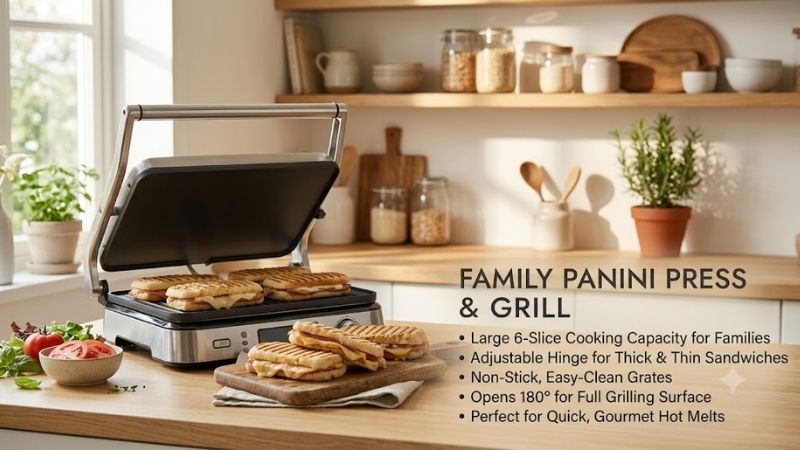
Basic Contact Press vs. Multipurpose Contact Grill
A basic panini press may have fixed heating plates and straightforward controls.
A multipurpose contact grill may provide adjustable temperatures, removable plates, or an open-flat configuration.
The additional functions can support other cooking tasks, but may increase size, cost, and cleaning complexity.
Choose a multipurpose design when your family regularly cooks foods beyond sandwiches.
For occasional grilled cheese or panini, a simpler appliance may be enough.
Ridged vs. Flat Plates
Ridged plates produce characteristic grill marks and reduce continuous contact between food and the cooking surface.
Flat plates provide more even contact for foods such as quesadillas or certain toasted sandwiches.
Some appliances offer interchangeable plates.
However, removable and reversible plates must be compatible with the exact model.
Do not assume that third-party accessories will fit safely.
Choosing Capacity for Your Family
How Many Sandwiches Fit at Once?
Evaluate actual plate width and depth.
A manufacturer may describe an appliance as holding two sandwiches, but that claim may assume standard sandwich bread.
Large sourdough slices, ciabatta, or generously filled panini may occupy more room.
Before purchasing, compare the plate dimensions with the bread your family normally uses.
Also consider whether sandwiches can be positioned without protruding from the heated area.
Choosing for a Family of Four
A press that accommodates several sandwiches simultaneously can reduce cooking cycles.
However, a larger appliance occupies more storage and counter space.
If family members eat at different times, a smaller press may be sufficient.
When everyone eats together, cooking capacity becomes more important.
Understanding Batch Cooking
Suppose your family needs six sandwiches but the press holds two at a time.
You will need three cooking cycles.
Total preparation time also includes preheating, assembly, loading, unloading, and any temperature recovery between batches.
This is why practical capacity matters more than a marketing claim about fast cooking.
Is a Large Panini Press Worth It?
A larger press may be valuable if sandwiches are a frequent family meal.
However, an oversized model can become inconvenient when preparing only one portion.
Choose based on how often you cook multiple sandwiches at once.
Hinge Design and Sandwich Thickness
Why a Floating Hinge Matters
A floating hinge allows the upper plate to adjust to sandwiches of different thicknesses.
This can help distribute contact more evenly.
However, the range of supported thicknesses varies by model.
A floating hinge does not guarantee that very thick sandwiches will fit.
Check the manufacturer’s opening and operating instructions.
Avoid Excessive Compression
Pressing a sandwich too aggressively may squeeze fillings out of the bread.
Melted cheese, sauces, or oily ingredients can spill onto the cooking plates.
The ideal pressure depends on the bread and filling.
Allow the appliance to close according to its design instead of forcing the lid.
Fixed vs. Adjustable Upper Plates
Some presses have basic hinged upper plates.
Others offer height adjustments or locking positions.
Additional adjustment may be useful for delicate sandwiches or thicker ingredients.
However, more mechanical parts can create additional cleaning areas.
Choose a design that matches your common sandwich styles.
Temperature Control and Cooking Performance
Adjustable Temperature Settings
Adjustable heat can be useful when preparing different breads and fillings.
Thick bread may require different handling from thin tortillas.
However, higher settings are not always preferable.
Excessive heat can brown the exterior before the center becomes sufficiently warm.
Use the recommended cooking settings and monitor unfamiliar recipes.
Preheating
Preheat the appliance according to its instructions.
A ready light may indicate that the plates have reached a target operating condition, but indicator behavior differs between models.
Do not assume the indicator measures food doneness.
Heating Evenness
A large press is less useful if the outer edges cook very differently from the center.
Heating performance depends on element arrangement, plate construction, and temperature control.
Neither wattage nor plate thickness alone establishes even cooking.
Look for credible performance information when comparing specific products.
Cooking Raw Meat
Some multipurpose contact grills permit cooking raw meat.
However, a basic panini press may be intended primarily for prepared sandwiches.
Never assume raw meat preparation is approved.
When it is, use a food thermometer and follow the required temperature for the ingredient.
Practical Family Meals
Grilled Cheese
A panini press can prepare grilled cheese sandwiches with heat from both sides.
Choose bread and cheese quantities that fit comfortably.
Avoid excessive filling, which may leak onto the plates.
Use suitable utensils when removing the sandwich.
Chicken Panini
Cooked chicken, cheese, and vegetables can be combined in a toasted sandwich.
For previously cooked refrigerated chicken, follow safe reheating guidance.
Leftovers should reach 165°F.
A browned sandwich exterior does not guarantee that a cold filling has reheated thoroughly.
Breakfast Sandwiches
A panini press can toast assembled breakfast sandwiches.
However, it is not necessarily designed to cook raw eggs inside a sandwich.
Prepare eggs and breakfast meats safely using suitable equipment before assembly unless the press and recipe explicitly support another method.
Quesadillas and Wraps
Certain presses can prepare quesadillas and suitable wraps.
Avoid filling them excessively.
Wet ingredients may leak, especially as the food is compressed.
A flat-plate model may be preferable for some wraps.
Cleaning and Maintenance
Removable Plates
Removable plates can make cleanup more convenient after cooking melted cheese and oily fillings.
Check whether they are dishwasher safe.
Allow the appliance to cool before removing them.
Fixed Plates
Fixed-plate presses require careful wiping.
Never immerse the electrical housing unless the manufacturer explicitly permits it.
Follow approved cleaning methods.
Grease and Cheese Residue
Inspect the plate edges, hinge area, and grease collection system.
Melted cheese can harden in narrow gaps.
Cleaning promptly after safe cooling can reduce stubborn residue.
Storage
Some models allow upright storage.
Others must remain horizontal.
Confirm the permitted storage orientation and wait until the press has cooled completely.
Choosing for Different Families
Best for Small Families
A compact press may be sufficient for two or three people.
Prioritize easy cleaning and manageable storage.
Best for Larger Families
A wider cooking surface can reduce cooking cycles.
Check actual plate dimensions rather than sandwich-count claims.
Best for Busy Weeknights
Choose straightforward controls and easy-to-clean plates.
A press that requires complicated setup may be less useful for quick meals.
Best for Multipurpose Cooking
A model with interchangeable flat and ridged plates may be worthwhile when preparing sandwiches, vegetables, and other approved foods.
However, additional components increase storage requirements.
Common Buying Mistakes
Buying by Sandwich Count Alone
Advertised capacity may not reflect your usual bread size.
Ignoring Hinge Clearance
Thick sandwiches may not fit safely.
Assuming All Plates Are Dishwasher Safe
Check exact manufacturer instructions.
Overfilling Sandwiches
Excess fillings can leak onto heating components and create difficult cleanup.
Treating the Press as a Universal Grill
Only cook foods approved for the appliance.
Frequently Asked Questions
What Size Panini Press Is Best for a Family of Four?
Choose based on the number and size of sandwiches you want to prepare simultaneously. A larger cooking surface may reduce batches, but storage requirements also increase.
Can a Panini Press Cook Raw Chicken?
Only if the specific appliance is designed and approved for that task. Verify that chicken reaches 165°F.
Are Removable Plates Worth It?
They can make frequent family use more convenient, particularly when melted cheese and grease are common.
Can I Use a Panini Press for Quesadillas?
Many contact-style presses can prepare suitable quesadillas, but check the appliance instructions and avoid overfilling.
Is a Panini Press Better Than a Skillet?
A press can heat both sides of a sandwich simultaneously, while a skillet offers greater flexibility for other cooking tasks.
Can I Store a Panini Press Vertically?
Only if the manufacturer permits upright storage. Secure the lid according to the instructions and allow the appliance to cool first.
Conclusion
The best panini press for families provides enough cooking area for regular meals, accommodates your preferred sandwich thicknesses, and remains easy to clean. A larger contact press with a floating hinge and removable plates is a practical category for busy households. Prioritize usable capacity, temperature control, and safe handling rather than choosing solely by advertised sandwich count.





Write Your Review
No reviews yet. Be the first to share your experience!