
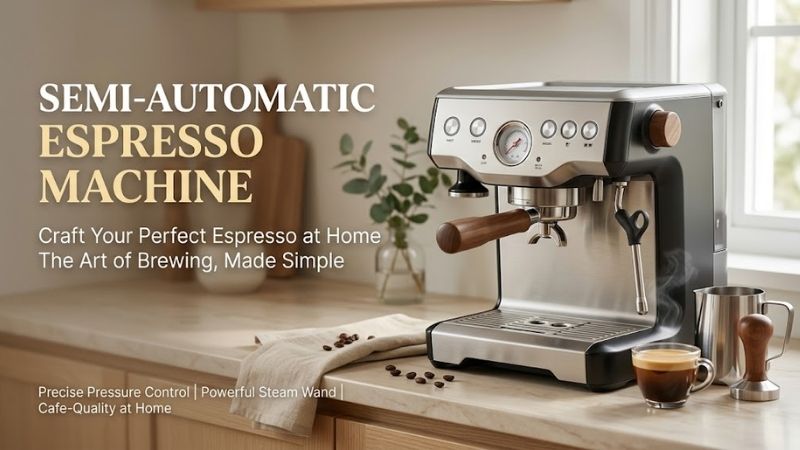
A semi-automatic espresso machine is designed for people who want to participate in making espresso rather than delegating the entire process to a bean-to-cup system. You typically grind and dose coffee, prepare the portafilter, start extraction, and manage some combination of shot volume and milk steaming.
The appeal is control. You can adjust the grind, change the coffee dose, modify your preparation technique, and gradually improve consistency. However, more involvement also means more equipment, cleaning, and learning.
This roundup focuses specifically on semi-automatic machines, rather than mixing them with pod brewers, manual lever devices, or fully automatic coffee makers. Our selections cover several levels of experience, from first-time home baristas to enthusiasts who want more temperature control.
Quick Verdict
Best Overall: Breville Bambino Plus. It offers a convenient introduction to hands-on espresso preparation while reducing the complexity of milk texturing.
- Best for New Home Baristas: Breville Bambino Plus — Compact design and automatic steam wand.
- Best for Traditional Technique: Gaggia Classic E24 — Conventional 58mm portafilter and brass boiler.
- Best for Durable Traditional Design: Rancilio Silvia — Substantial single-boiler construction and manual steaming.
- Best Integrated Grinder Setup: Breville Barista Express — Grinder and espresso brewing in one appliance.
- Best Guided Preparation: De’Longhi La Specialista Arte Evo — Built-in grinding with tools intended to simplify preparation.
- Best for Temperature-Minded Enthusiasts: Profitec GO — PID-controlled boiler temperature and adjustable brewing parameters.
Quick Comparison Table
| Machine | Grinder | Brewing Approach | Milk System | Best For |
|---|---|---|---|---|
| Breville Bambino Plus | Separate | Semi-automatic, 54mm portafilter | Automatic and manual texturing options | Beginners |
| Gaggia Classic E24 | Separate | 58mm portafilter, brass boiler | Manual steam wand | Traditional espresso |
| Rancilio Silvia | Separate | Single-boiler, commercial-style portafilter | Manual steam wand | Experienced learners |
| Breville Barista Express | Integrated | Ground coffee and user-managed puck | Manual steam wand | All-in-one learning |
| De’Longhi La Specialista Arte Evo | Integrated | Assisted preparation and extraction | Manual steam wand | Guided workflow |
| Profitec GO | Separate | PID single-boiler brewing | Manual steam wand | Temperature control |
How We Selected These Machines
We evaluated identifiable manufacturer features, brewing workflow, grinder requirements, steam systems, maintenance, and the kinds of users each machine suits.
We did not independently measure extraction consistency, boiler temperatures, noise levels, or drink quality.
The most important distinctions in this category are the amount of manual preparation required and whether the machine offers meaningful tools to help a user manage extraction.
An advanced machine may offer more consistency controls, but beginners can still struggle if their grinder is unsuitable or their puck preparation varies.
Detailed Product Reviews
1. Breville Bambino Plus — Best for New Home Baristas
Best For: Beginners who want to learn espresso extraction without immediately mastering manual milk steaming.
Why We Picked It: The Bambino Plus combines a compact espresso system with rapid heating and automatic milk texturing.
Key Specifications
- Type: Semi-automatic espresso machine
- Portafilter: 54mm
- Heating: ThermoJet system
- Advertised heat-up: Approximately three seconds
- Water tank: 64 fluid ounces
- Steam wand: Automatic texturing with manual operation
- Integrated grinder: No
Features & Benefits
The machine allows users to prepare their own coffee puck while simplifying the milk side of the process.
Automatic steam temperature and texture options are particularly useful for beginners making cappuccinos and lattes.
The relatively narrow housing reduces the amount of counter space occupied by the machine.
Performance & Practical Use
The Bambino Plus is a good choice for one or two morning beverages.
To get consistent espresso, users still need a suitable grinder and a repeatable coffee dose.
Breville’s rapid heat-up specification does not mean every part of the brewing system is instantly at the ideal working temperature. Following the recommended preparation routine remains important.
What Makes It Different: It retains hands-on espresso preparation while automating much of milk texturing.
Pros
- Compact size.
- Automatic milk texturing.
- Rapid heating system.
Cons
- Grinder purchased separately.
- Limited advanced temperature customization compared with enthusiast machines.
Buy If: You want to learn espresso while keeping milk drinks relatively approachable.
Skip If: You want an integrated grinder or complete bean-to-cup automation.
2. Gaggia Classic E24 — Best for Traditional Technique
Best For: Home baristas who enjoy adjusting grind, dose, extraction, and steaming.
Why We Picked It: The Classic E24 uses a traditional portafilter workflow with a brass boiler and commercial-style steam wand.
Key Specifications
- Type: Semi-automatic
- Portafilter: 58mm
- Boiler: Brass
- Steam wand: Manual
- Grinder: Separate
- Brewing: User-controlled puck preparation and extraction
Features & Benefits
The 58mm portafilter is useful for buyers interested in compatible traditional espresso accessories.
The machine’s straightforward construction emphasizes the basics of espresso preparation.
Users control their grinder, puck distribution, tamping, and steaming technique.
Performance & Practical Use
The Classic E24 is suitable for people who want a machine they can learn over time.
Its single-boiler configuration requires switching operating conditions between espresso brewing and steam production.
That workflow is manageable, but it is less convenient than systems designed for simultaneous brewing and steaming.
What Makes It Different: Traditional mechanical controls and a 58mm workflow.
Pros
- Brass boiler.
- Established accessory size.
- Conventional steam wand.
Cons
- Separate grinder required.
- More manual preparation.
- Single-boiler limitations.
Buy If: You value learning traditional espresso skills.
Skip If: You want automated milk preparation.
3. Rancilio Silvia — Best for Durable Traditional Design
Best For: Home baristas who want a substantial single-boiler espresso machine with conventional controls.
Why We Picked It: The Silvia has a long-established design centered on a traditional portafilter, brass boiler construction in current versions, and manual steam operation.
Key Specifications
- Type: Semi-automatic
- Portafilter: 58mm
- Boiler: Single boiler
- Steam wand: Manual
- Grinder: Separate
- Controls: Brewing and steam switches
Features & Benefits
The Silvia emphasizes hands-on espresso rather than automated drink programs.
Its substantial housing and conventional components make it attractive to users who prefer a traditional machine layout.
The steam wand supports manual preparation of textured milk.
Performance & Practical Use
The Silvia can be a rewarding espresso machine for someone willing to learn temperature management and puck preparation.
However, its conventional single-boiler workflow may involve waiting and adjusting between brewing and steaming.
Without careful operation, the same machine can produce different results from one shot to another.
What Makes It Different: An enthusiast-oriented traditional design with relatively few automatic conveniences.
Pros
- Traditional 58mm portafilter.
- Substantial construction.
- Manual steam control.
Cons
- Requires a capable separate grinder.
- Demands practice.
- Less convenient for rapid multiple milk drinks.
Buy If: You enjoy hands-on espresso and are comfortable refining your workflow.
Skip If: Your main priority is quick one-touch drinks.
4. Breville Barista Express — Best Integrated Grinder Setup
Best For: Beginners who want one appliance that handles grinding, espresso brewing, and manual milk steaming.
Why We Picked It: Its integrated grinder makes assembling an espresso station simpler.
Key Specifications
- Type: Semi-automatic
- Grinder: Integrated conical burr
- Portafilter: 54mm
- Steam system: Manual wand
- Extraction: Programmable shot controls
- Grinding: Adjustable settings
Features & Benefits
Beans can be ground directly into the portafilter, reducing the need for a separate machine.
The user still distributes and tamps the grounds, inserts the portafilter, and manages extraction.
Its manual steam wand supports latte and cappuccino preparation.
Performance & Practical Use
The Barista Express is well suited to people learning the relationship between grind size, dose, and extraction.
The integrated grinder is convenient, although it offers less freedom to independently change the grinder later.
Cleaning remains necessary around the grinder, portafilter, and steam wand.
What Makes It Different: A complete learning-oriented espresso station in one appliance.
Pros
- Integrated burr grinder.
- User-controlled espresso workflow.
- Manual milk steaming.
Cons
- Not fully automatic.
- Integrated grinder limits independent upgrades.
- Needs regular cleaning.
Buy If: You want fewer separate appliances while learning espresso.
Skip If: You already own a high-quality dedicated espresso grinder.
5. De’Longhi La Specialista Arte Evo — Best Guided Preparation
Best For: Home cooks who want hands-on espresso supported by preparation tools and integrated grinding.
Why We Picked It: The Arte Evo combines bean grinding, manual espresso preparation, and specialized drink functionality.
Key Specifications
- Type: Semi-automatic
- Grinder: Integrated
- Puck preparation: Assisted by included tools
- Milk system: Manual steam wand
- Beverage options: Espresso and other supported programs, including cold extraction functionality
- Temperature: Selectable brewing settings
Features & Benefits
The integrated grinder reduces equipment requirements.
Included preparation accessories help users dose and tamp coffee more consistently.
The machine still allows substantial manual involvement.
Performance & Practical Use
This is suitable for someone who wants to learn espresso but appreciates guidance through common steps.
Specialized drink functions can be useful, but buyers should consider whether they will actually use them.
The additional tools and controls also create more items to clean and organize.
What Makes It Different: A guided semi-automatic workflow without eliminating manual preparation.
Pros
- Built-in grinder.
- Preparation accessories.
- Multiple coffee options.
Cons
- More components to manage.
- Manual milk steaming still takes practice.
Buy If: You want a structured introduction to home espresso.
Skip If: You prefer a simple, traditional machine without additional features.
6. Profitec GO — Best for Temperature-Minded Enthusiasts
Best For: Experienced home baristas who want more deliberate control over brewing conditions.
Why We Picked It: The Profitec GO features PID temperature control and an enthusiast-oriented single-boiler design.
Key Specifications
- Type: Semi-automatic
- Boiler: Single boiler
- Temperature control: PID
- Portafilter: 58mm
- Steam wand: Manual
- Grinder: Separate
- Adjustable functions: Model-supported brewing controls
Features & Benefits
PID control provides a way to select boiler temperature more deliberately than traditional switch-based systems.
The 58mm portafilter supports compatible espresso tools.
Its compact single-boiler format avoids the larger dimensions of many dual-boiler machines.
Performance & Practical Use
The Profitec GO is particularly relevant to people experimenting with different roast levels and extraction recipes.
However, more precise temperature selection does not compensate for inconsistent grinding or puck preparation.
Because it is a single-boiler machine, users still need to manage the transition between brewing and steaming.
What Makes It Different: PID control in a relatively compact traditional espresso machine.
Pros
- PID boiler control.
- 58mm portafilter.
- Enthusiast-oriented functionality.
Cons
- Separate grinder necessary.
- Higher learning curve.
- Single-boiler brew-to-steam workflow.
Buy If: You value temperature adjustment and traditional espresso preparation.
Skip If: Convenience matters more than manual control.
Semi Automatic Espresso Machine Buying Guide
What Makes an Espresso Machine Semi-Automatic?
A semi-automatic machine uses an electric pump to generate brewing pressure but leaves important preparation steps to the user.
These usually include grinding coffee, selecting dose, distributing grounds, tamping, and maintaining the portafilter.
Some machines automate shot volume or milk texturing while still being semi-automatic in their overall workflow.
Choose Your Grinder First
Espresso grinding requires sufficiently fine adjustment.
Inconsistent grounds make it harder to establish a repeatable extraction.
A capable dedicated grinder can be a more meaningful investment than an espresso machine with numerous unused programs.
Machines with built-in grinders simplify the purchasing process but can reduce upgrade flexibility.
PID Temperature Control
A PID controller is designed to regulate boiler temperature more precisely.
This can be useful when switching between coffee roasts or experimenting with extraction.
However, boiler-temperature stability and actual temperature at the coffee puck are not identical measurements.
Single Boiler vs. Other Heating Systems
Single-boiler machines use one boiler for brewing and steaming at different operating temperatures.
This can require waiting between tasks.
Thermoblock and rapid-heating systems use different methods to bring water to operating conditions.
Consider how many drinks you prepare consecutively and whether those drinks include steamed milk.
Portafilter Size and Accessories
Portafilter sizes such as 54mm and 58mm influence compatible baskets, tampers, distribution tools, and other accessories.
Do not assume accessories from one size will fit another.
Milk Steaming
A manual steam wand requires technique.
Users must manage milk temperature, pitcher position, and air incorporation.
Automatic milk texturing can reduce the learning curve, although the steam wand still needs cleaning.
Cleaning and Descaling
Routine tasks include emptying the drip tray, cleaning the portafilter, wiping the group area, and removing milk residue.
Additional maintenance depends on water hardness, machine design, and manufacturer instructions.
Calculate Total Ownership Cost
A semi-automatic machine may require a grinder, scale, tamper, milk pitcher, cleaning products, and replacement parts.
Evaluate these expenses before comparing machine prices.
Common Mistakes
Buying Without an Espresso-Capable Grinder
A conventional blade grinder is generally unsuitable for repeatable espresso puck preparation.
Expecting Automatic Milk Drinks
Most semi-automatic machines still require active participation.
Choosing Based Only on Pump Pressure
Coffee quality depends on the entire extraction process, not simply an advertised pump-pressure number.
Ignoring Maintenance
Traditional espresso equipment requires cleaning after use and periodic servicing.
Frequently Asked Questions
Are semi-automatic espresso machines good for beginners?
Yes, especially models with straightforward controls. Beginners should expect to learn grinding, dosing, and puck preparation.
Is an integrated grinder better?
It saves space and simplifies setup. A separate grinder provides more flexibility for upgrades.
Do you need PID control?
Not necessarily. It is useful for enthusiasts who value temperature adjustment, but it is not required for every household.
Can semi-automatic espresso machines make cappuccinos?
Yes, when equipped with suitable steam or milk-frothing functionality.
What does a 58mm portafilter mean?
It refers to the approximate diameter of the compatible filter basket system.
How often should you clean a steam wand?
Clean milk residue immediately after each use according to the manufacturer’s instructions.
Conclusion
The Breville Bambino Plus is the best overall semi-automatic espresso machine here for beginners who want a compact machine with automatic milk assistance.
The Gaggia Classic E24 and Rancilio Silvia favor traditional technique, while the Profitec GO adds more deliberate temperature control.
Choose the Breville Barista Express or De’Longhi La Specialista Arte Evo when an integrated grinder and a more guided setup are more important.
A semi-automatic espresso machine is most rewarding when its controls and maintenance requirements match how much time you want to invest in coffee preparation.
Write Your Review
No reviews yet. Be the first to share your experience!