
A sous vide cooker heats and circulates water at a controlled temperature, allowing you to cook properly packaged food in a water bath. It can be particularly useful for steak, chicken, fish, and make-ahead meals. This guide compares six immersion circulators by controls, heating capacity, connectivity, cleaning requirements, and suitability for different cooking routines.
Quick Verdict: Which Sous Vide Cooker Should You Buy?
The Anova Precision Cooker 3.0 is our best overall recommendation for home cooks who want a combination of digital controls, Wi-Fi connectivity, and sufficient power for typical household water baths.
The compact Anova Nano 3.0 is better suited to smaller kitchens, while the Breville Joule Turbo offers a more app-centered cooking experience.
-
Best Overall: Anova Precision Cooker 3.0 — A versatile 1100-watt circulator with Wi-Fi connectivity.
-
Best Compact Option: Anova Precision Cooker Nano 3.0 — Smaller housing with onboard controls and wireless connectivity.
-
Best for App-Guided Cooking: Breville Joule Turbo Sous Vide — Uses Breville’s guided cooking features and app-based controls.
-
Best for Direct Manual Controls: Instant Pot Accu Slim Sous Vide Immersion Circulator V2 — Straightforward touchscreen operation.
-
Best for Connected Value: INKBIRD ISV-100W — Wi-Fi operation with a 1000-watt heating system.
-
Best for Temperature Flexibility: INKBIRD ISV-200W — Wi-Fi circulator with adjustable temperature and time settings.
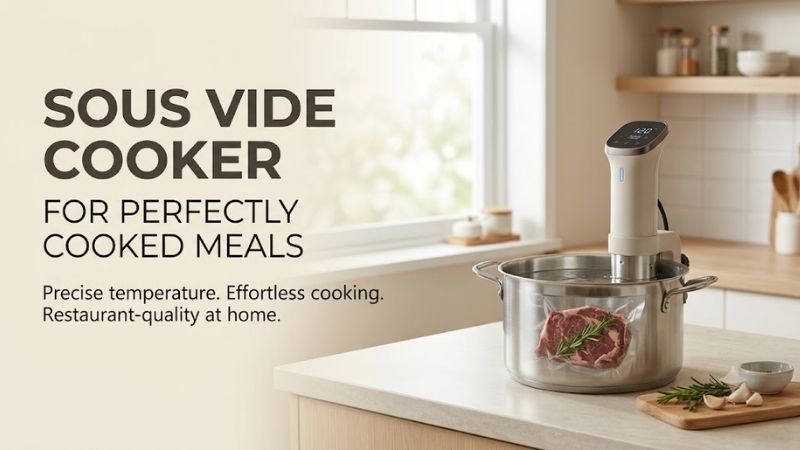
Quick Verdict: Which Sous Vide Cooker Should You Buy?
Quick Comparison Table
| Product | Best For | Key Specifications | Main Advantage | Trade-Off |
|---|---|---|---|---|
| Anova Precision Cooker 3.0 | Overall cooking | 1100W; Wi-Fi; digital controls | Strong household feature combination | Connectivity features may be unnecessary |
| Anova Nano 3.0 | Small kitchens | 12.8-inch height; Wi-Fi; touchscreen | Compact and convenient to store | More limited heating capacity |
| Breville Joule Turbo | Guided recipes | App-controlled; Turbo and Primetime functions | Advanced cooking guidance | Stronger dependence on app ecosystem |
| Instant Pot Accu Slim V2 | Manual operation | Digital touchscreen; waterproof housing | Straightforward direct control | Fewer connected features |
| INKBIRD ISV-100W | Connected cooking | 1000W; 77–210°F; 2.4GHz Wi-Fi | Remote monitoring and onboard controls | App setup adds complexity |
| INKBIRD ISV-200W | Adjustable cooking | 1000W; 32–194°F; 2.4GHz Wi-Fi | Broad adjustable temperature range | No independent cooking advantage established |
How We Selected These Sous Vide Cookers
We evaluated published specifications, heating design, water circulation, temperature-setting capabilities, controls, wireless connectivity, and practical use with common household cooking containers.
A useful immersion circulator must maintain an appropriate water temperature while circulating water around packaged food.
However, rated wattage and manufacturer-stated temperature precision do not establish actual temperature uniformity across every pot or cooking condition.
Our recommendations are based on product design and documented features, not independent measured cooking comparisons.
Detailed Sous Vide Cooker Reviews
1. Anova Precision Cooker 3.0 — Best Overall
Best For: Home cooks seeking a versatile immersion circulator for regular sous vide cooking.
Why We Picked It: The Anova Precision Cooker 3.0 combines a powerful heating system, Wi-Fi connectivity, and onboard digital controls.
Key Specifications
| Specification | Details |
|---|---|
| Model | Anova Precision Cooker 3.0 |
| Power | 1100W |
| Connectivity | Wi-Fi |
| Display | Dual-line touchscreen |
| Water Resistance | IPX7 |
| Circulation | Pump-driven |
| Mounting | Adjustable clamp |
| Control | Onboard and app-based |
Features & Benefits
The 1100-watt heating element is designed to bring a water bath to the selected temperature.
The circulating pump moves water around the cooking vessel, helping reduce localized temperature differences.
Its onboard display allows temperature and time adjustments without requiring users to handle a separate thermometer.
Wi-Fi connectivity provides access to compatible remote monitoring and app-based functions.
Performance & Practical Use
The cooker is suitable for appropriately packaged steak, chicken, pork, vegetables, and other foods prepared using validated sous vide recipes.
Its power rating suggests adequate heating capacity for typical home cooking vessels, but real heating time depends on initial water temperature, vessel size, insulation, and room conditions.
Use a properly sized container and maintain the required water level.
What Makes It Different
The combination of onboard controls and wireless features gives users more flexibility than devices that depend primarily on an app.
Pros
-
1100-watt heating system.
-
Wi-Fi connectivity and onboard controls.
-
IPX7 water-resistance rating.
Cons
-
More expensive product positioning than entry-level models.
-
Some connected features may depend on app access or subscriptions.
Buy If: You cook sous vide regularly and want both direct and connected controls.
Skip If: You rarely use wireless appliance features.
2. Anova Precision Cooker Nano 3.0 — Best Compact Option
Best For: Apartment kitchens, smaller households, and users who want to store their sous vide cooker in a drawer.
Why We Picked It: The Nano 3.0 combines a compact housing with Wi-Fi connectivity and manual touchscreen controls.
Key Specifications
-
Model: Precision Cooker Nano 3.0
-
Height: 12.8 inches
-
Connectivity: Dual-band Wi-Fi
-
Display: Two-line touchscreen
-
Advertised Temperature Control: Within 0.2°F of selected temperature
-
Cooking Method: Heated water circulation
Features & Benefits
The Nano 3.0 has a smaller body than many full-size immersion circulators.
Its two-line display shows temperature and timing information.
Wi-Fi connectivity allows compatible app interaction, while onboard controls support direct adjustment.
Performance & Practical Use
The compact design makes it suitable for preparing one or two portions of food in an appropriately sized pot.
It can also handle larger water baths within the manufacturer’s recommended limits.
However, advertised temperature precision reflects manufacturer claims and should not be treated as independently measured accuracy.
The smaller appliance format does not automatically indicate inferior cooking results, but heating capacity and bath volume remain relevant.
What Makes It Different
The Nano balances compact storage with connected controls.
Pros
-
Compact 12.8-inch body.
-
Wi-Fi connectivity.
-
Onboard touchscreen operation.
Cons
-
Less suited to unusually large water baths than high-capacity systems.
-
Connected features may add ongoing software considerations.
Buy If: You want a compact sous vide cooker without giving up connected controls.
Skip If: You regularly use very large cooking vessels.
3. Breville Joule Turbo Sous Vide — Best for App-Guided Cooking
Best For: Home cooks who prefer recipe guidance and app-based operation.
Why We Picked It: The Breville Joule Turbo provides cooking features built around guided recipes, visual doneness selection, and specialized cooking algorithms.
Key Specifications
| Specification | Details |
|---|---|
| Product | Breville Joule Turbo Sous Vide |
| Cooking Method | Immersion circulation |
| Controls | Breville+ app |
| Turbo Mode | Supported for compatible recipes |
| Primetime Function | Supported |
| Guided Recipes | Available |
| Voice Integration | Supported through compatible systems |
| Advertised Vessel Support | Up to 10 gallons |
Features & Benefits
Breville’s Turbo mode uses recipe-specific technology designed to reduce cooking time for suitable dishes.
The Primetime feature provides flexibility around serving times for compatible recipes.
Visual Doneness allows users to select their preferred result through the app.
The slim housing is designed for convenient storage.
Performance & Practical Use
The Joule Turbo is particularly useful for users who appreciate guided instructions rather than manually determining every time-and-temperature combination.
However, Turbo functionality does not apply universally to all foods or recipe thicknesses.
Follow the specific guided recipe and its food-safety limitations.
App-centered operation also requires attention to device compatibility, account requirements, and software availability.
What Makes It Different
Guided cooking and specialized recipe features are more central to the Joule experience than physical control buttons.
Pros
-
Extensive recipe guidance.
-
Specialized Turbo and Primetime functions.
-
Slim design for storage.
Cons
-
Relies heavily on app-based operation.
-
Advanced functions are recipe-dependent.
Buy If: You value guided cooking and connected kitchen technology.
Skip If: You want an appliance that can be configured entirely through physical controls.
4. Instant Pot Accu Slim Sous Vide Immersion Circulator V2 — Best for Direct Controls
Best For: Beginners who prefer straightforward manual operation.
Why We Picked It: The Accu Slim V2 features a touchscreen, easy-to-read display, and practical clamp system.
Key Specifications
| Specification | Details |
|---|---|
| Model | Accu Slim V2 |
| Product SKU | 140-3085-01 |
| Height | 13.5 inches |
| Length | 5.1 inches |
| Width | 2.6 inches |
| Housing | Stainless steel components |
| Display | Digital LED |
| Controls | Touchscreen |
| Water Protection | Waterproof housing |
| Mounting | Quick clamp |
Features & Benefits
The Accu Slim V2 uses an immersion heating system to circulate water at a selected temperature.
Its tilted display is designed to improve visibility during cooking.
The removable stainless steel skirt helps with appropriate maintenance.
An automatic protection function stops operation when the device is removed from water.
Performance & Practical Use
This model is suitable for cooks who prefer to set a temperature and timer directly on the appliance.
It is practical for everyday protein and vegetable recipes.
Like other circulators, it requires adequate water circulation and suitable packaging.
The device’s waterproof construction does not eliminate the need to follow electrical safety instructions.
What Makes It Different
Its straightforward controls reduce dependence on smartphone features.
Pros
-
Direct touchscreen operation.
-
Removable stainless steel skirt.
-
Quick-clamp attachment.
Cons
-
Fewer advanced connected features.
-
Requires suitable pot clearance and water depth.
Buy If: You prefer manual setup and uncomplicated controls.
Skip If: You want extensive remote monitoring or integrated recipe automation.
5. INKBIRD ISV-100W — Best for Connected Value
Best For: Home cooks who want Wi-Fi functionality alongside direct temperature and timer controls.
Why We Picked It: The ISV-100W provides a 1000-watt heating system, onboard display, and wireless connectivity.
Key Specifications
| Specification | Details |
|---|---|
| Model | ISV-100W |
| Power | 1000W |
| Temperature Range | 77–210°F |
| Connectivity | 2.4GHz Wi-Fi |
| Display | LCD |
| Maximum Timer Setting | 99 hours, 59 minutes |
| Advertised Capacity | 15 liters |
| Heating | Pump-driven water circulation |
Features & Benefits
The cooker supports temperature and time selection through its control system.
Wi-Fi provides compatible remote interaction.
The adjustable temperature range covers many typical sous vide cooking tasks.
Its integrated display provides a reference for monitoring selected cooking settings.
Performance & Practical Use
The 1000-watt heating element is appropriate for many household cooking vessels within the supported capacity.
However, its advertised 15-liter capacity should not be interpreted as a guarantee of identical heating behavior in every container.
Water evaporation, food quantity, and heat loss still matter.
What Makes It Different
It combines Wi-Fi functions with an accessible onboard interface.
Pros
-
1000-watt heating system.
-
Wi-Fi connectivity.
-
Broad cooking temperature range.
Cons
-
Requires 2.4GHz-compatible networking for Wi-Fi use.
-
Manufacturer precision claims are not independent test results.
Buy If: You want connected features without relying solely on an app.
Skip If: Wireless setup is not useful in your kitchen.
6. INKBIRD ISV-200W — Best for Temperature Flexibility
Best For: Home cooks who want a wide selectable temperature range and Wi-Fi functionality.
Why We Picked It: The ISV-200W offers 1000-watt heating and a temperature range extending from 32°F to 194°F.
Key Specifications
-
Model: ISV-200W
-
Power: 1000W
-
Temperature Range: 32–194°F
-
Connectivity: 2.4GHz Wi-Fi
-
Control: Onboard buttons and compatible app
-
Heating Method: Water circulation
Features & Benefits
The device provides adjustable settings for a variety of cooking applications.
The low end of its selectable temperature range should not be confused with active refrigeration.
An immersion circulator heats water; it cannot chill a bath to a selected low temperature.
The broad displayed range therefore does not mean every temperature is independently achievable from warmer starting conditions.
Performance & Practical Use
For ordinary sous vide cooking, the ISV-200W can support properly packaged foods using appropriate recipes.
The 1000-watt heating system is similar in rating to the ISV-100W, but this does not prove identical temperature performance.
Choose based on preferred controls and supported operating features.
What Makes It Different
Its published temperature range and onboard control arrangement provide an alternative to the ISV-100W.
Pros
-
Broad adjustable temperature settings.
-
Wi-Fi support.
-
1000-watt heating system.
Cons
-
Cannot actively refrigerate a water bath.
-
Feature differences may not matter for ordinary steak and chicken recipes.
Buy If: You value the specific control arrangement and selectable temperature range.
Skip If: A simpler immersion circulator already covers your usual recipes.
Sous Vide Cooker Buying Guide
Understand Temperature Control
Sous vide cooking uses controlled water temperature rather than direct exposure to a hot cooking surface.
This makes it possible to target specific cooking conditions.
However, cooking safely involves both temperature and duration.
For example, a food held at a lower temperature may require a longer validated holding period than food cooked at a higher temperature.
Do not assume that a particular target temperature alone guarantees pasteurization.
Heating Power
Higher wattage can help a circulator heat larger quantities of water, depending on its design.
However, wattage alone does not indicate temperature accuracy or finished food quality.
A smaller circulator may be entirely sufficient for a small pot.
Households using large baths should consider supported capacity and insulation.
Water Circulation
A pump distributes heated water around the cooking vessel.
Food bags should not obstruct circulation openings or block flow around other packages.
Use appropriate racks or separation methods when cooking multiple portions.
App Controls vs. Onboard Controls
App-based functions may provide guided recipes, remote monitoring, and cooking reminders.
Direct controls are convenient when a phone is unavailable or the network connection fails.
Before buying an app-dependent cooker, check device compatibility, subscription requirements, and whether essential functions remain available without an account.
Pot and Container Compatibility
Most immersion circulators attach to the side of a suitable pot or water container.
Check clamp size, minimum water depth, maximum immersion level, and container heat tolerance.
Do not place a hot water bath on a surface that cannot tolerate prolonged heat exposure.
Safe Sous Vide Packaging
Use bags specifically approved for the intended cooking temperatures and durations.
Some recipes use vacuum-sealed bags, while others permit appropriate zipper bags with air removed through a water-displacement method.
Avoid using packaging not designed for heated food contact.
Common Sous Vide Cooking Mistakes
Cooking at an Unsafe Time-and-Temperature Combination
Food safety depends on the food type, thickness, target temperature, and holding duration.
Follow validated sous vide guidance rather than applying a single setting to every protein.
Overcrowding the Water Bath
Crowded bags can obstruct circulation and create uneven heating.
Provide enough room for water to circulate around each package.
Allowing Too Much Water to Evaporate
Long cooking sessions can reduce the water level.
Use an appropriate cover where recommended and monitor the bath according to the manufacturer’s instructions.
Cooling Cooked Food Too Slowly
If you are not serving sous vide food immediately, use a validated rapid-chilling procedure.
Do not leave sealed perishable foods at room temperature for extended periods.
Assuming Vacuum Packaging Makes Food Shelf-Stable
Sous vide bags are not sterilization containers.
Vacuum packaging does not remove the need for appropriate refrigeration, freezing, or prompt service.
Frequently Asked Questions
Is a sous vide cooker worth buying?
A sous vide cooker can be worthwhile for home cooks who value controlled cooking temperatures and repeatable preparation methods. It is less useful if you rarely prepare foods suited to water-bath cooking.
Do you need a vacuum sealer for sous vide?
Not always. Certain recipes can use suitable heat-safe zipper bags with air removed through water displacement. Follow the recipe and packaging manufacturer’s instructions.
Can you cook frozen meat sous vide?
Yes, when using a validated recipe that accounts for frozen starting conditions and food thickness. Additional heating time may be required.
Is sous vide cooking safe?
Sous vide can be safe when appropriate cooking temperatures, holding times, packaging, sanitation, and chilling procedures are followed. Incorrect low-temperature cooking or storage can create food-safety risks.
Can you leave a sous vide cooker running overnight?
Some validated recipes involve long cooking periods, but the equipment must be suitable for the duration. Monitor water level and follow electrical and food-safety requirements.
Can sous vide replace pan searing?
Sous vide cooks the interior of suitable foods, but it does not produce the same surface browning as high-temperature searing. Many steak recipes use a separate finishing step.
Conclusion
The Anova Precision Cooker 3.0 is the best overall sous vide cooker in this comparison for households seeking strong heating capacity and both onboard and connected controls. Choose the Nano 3.0 for compact storage, Breville Joule Turbo for guided recipes, Instant Pot Accu Slim V2 for direct controls, or an INKBIRD model for Wi-Fi functionality. The right circulator should match your cooking vessel, preferred controls, and ability to follow safe time-and-temperature guidance.








Write Your Review
No reviews yet. Be the first to share your experience!