
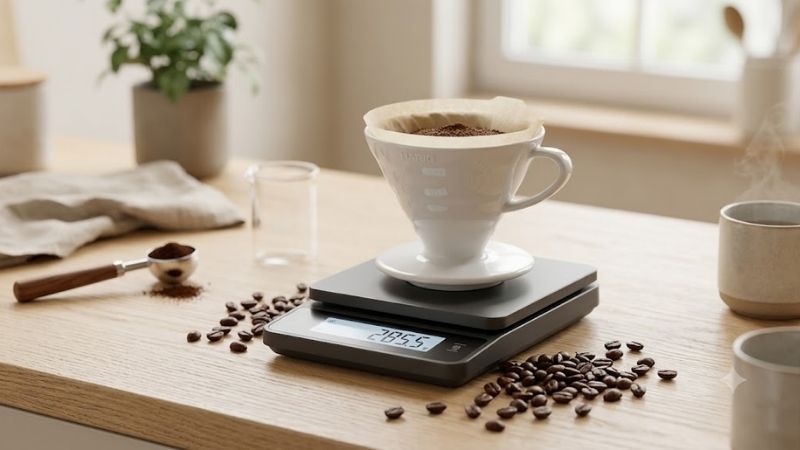
A coffee scale helps you measure beans, brewing water, and espresso output instead of guessing by scoops or cup markings. We compare six models for pour-over and espresso, focusing on readability, timer functions, platform size, weighing capacity, spill resistance, and whether advanced features actually improve your daily brewing routine.
Quick Verdict: Which Coffee Scale Should You Buy?
Best Overall: TIMEMORE Black Mirror Basic 2. Its 0.1-gram display resolution, integrated timer, flow-rate display, and 2,000-gram maximum capacity make it a practical choice for many pour-over and espresso routines.
The Acaia Lunar is more specialized for espresso, while the Acaia Pearl S provides a premium platform for detailed pour-over brewing.
| Scale | Best For | Maximum Capacity | Display Resolution | Main Advantage |
|---|---|---|---|---|
| TIMEMORE Black Mirror Basic 2 | Best overall | 2,000g | 0.1g | Timer and flow-rate display |
| Acaia Lunar | Espresso machines | 2,000g | 0.1g | Compact platform and brewing modes |
| Acaia Pearl S | Premium pour-over | 3,000g | 0.1g | Guided brewing functions |
| Hario V60 Drip Scale | Traditional pour-over | 2,000g | Variable increments | Simple weighing and timing |
| Fellow Tally Pro Precision Scale | Ratio-based brewing | 2,500g | 0.1g | Brew Assist ratio calculations |
| Acaia Pyxis | Very small espresso spaces | 500g | High-resolution weighing | Ultra-compact platform |
How We Selected These Coffee Scales
We evaluated weighing capacity, displayed resolution, practical responsiveness, brewing functions, dimensions, water resistance, charging, and cleaning.
A coffee scale should do more than display a number. It must fit the vessel being used, remain readable during pouring, and support repeatable preparation.
We also distinguished display resolution from verified measurement accuracy. A display that changes in 0.1-gram increments does not guarantee perfect accuracy under every condition.
These recommendations reflect published features and intended use rather than independent calibration testing.
Detailed Coffee Scale Reviews
1. TIMEMORE Black Mirror Basic 2 — Best Overall
Best For: Home coffee drinkers who brew pour-over regularly and occasionally prepare espresso.
Why We Picked It
The TIMEMORE Basic 2 offers the functions most users need without requiring a premium connected brewing system.
Its combination of weighing, timing, and flow-rate display is particularly valuable for manual brewing.
Key Specifications
- Maximum capacity: 2,000g
- Display increment: 0.1g
- Minimum supported measurement: Approximately 0.5g
- Size: Approximately 152 × 130 × 26mm
- Battery: Rechargeable lithium-ion
- Charging: USB-C
- Flow-rate display: Yes
- Timer: Integrated
Features and Benefits
The flow-rate display helps users see how quickly they are adding water during pour-over brewing.
This is more useful than simply watching the timer when practicing a repeatable pouring technique.
The 2,000-gram capacity also accommodates many drippers, servers, and brewing-water quantities.
Performance and Practical Use
Suppose a recipe calls for 20 grams of coffee and 320 grams of water.
The scale lets you weigh the coffee, tare the reading, and monitor water added during brewing.
However, it remains important to place the scale on a stable surface. Vibration, uneven countertops, and contact with surrounding objects can affect readings.
The Basic 2 has a protective silicone pad, but it should not be treated as a completely waterproof device.
What Makes It Different
It combines practical brewing functions with a relatively straightforward interface.
Pros
- 0.1g display resolution.
- Integrated timer.
- Flow-rate display.
- USB-C charging.
- Useful for multiple brewing methods.
Cons
- Not fully waterproof.
- Requires charging.
- Larger than specialty espresso scales.
Buy If: You want one scale for daily pour-over and occasional espresso.
Skip If: You need the smallest possible scale beneath a compact espresso machine.
2. Acaia Lunar — Best for Espresso
Best For: Home baristas who want a compact scale for measuring espresso yield in the drip tray.
Why We Picked It
The Acaia Lunar is purpose-built for espresso workflows.
Its compact 105 × 105mm platform is designed to fit many espresso-machine drip trays while accommodating an espresso cup.
Key Specifications
- Dimensions: 105 × 105 × 15mm
- Maximum capacity: 2,000g
- Readability: 0.1g
- Battery: Rechargeable lithium-ion
- Connectivity: Bluetooth
- Timer and espresso modes: Supported
- Protective pad: Included
Features and Benefits
The small platform allows users to measure the beverage output directly during extraction.
This makes it easier to stop a shot according to a target yield.
For example, a barista using 18 grams of ground coffee might aim for approximately 36 grams of beverage as a starting recipe.
The Lunar can help monitor that output rather than relying on shot duration alone.
Performance and Practical Use
The Lunar is most useful with traditional espresso machines.
However, cup weight, drip-tray geometry, and available vertical clearance still matter.
A scale that fits on a drip tray may leave insufficient height for a tall cup beneath the portafilter.
It is also a premium purchase.
What Makes It Different
Its compact dimensions and espresso-oriented functions are the principal reasons to choose it.
Pros
- Compact espresso-friendly size.
- 0.1g readability.
- Rechargeable battery.
- Dedicated espresso modes.
- Bluetooth compatibility.
Cons
- High purchase cost.
- Limited platform area for large pour-over servers.
- Connectivity may be unnecessary for simple brewing.
Buy If: Espresso is your main brewing method.
Skip If: You only need to weigh coffee beans before grinding.
3. Acaia Pearl S — Best for Advanced Pour-Over
Best For: Coffee enthusiasts who want brewing guidance and a larger weighing platform.
Why We Picked It
The Pearl S is designed for people who want to monitor more than coffee weight.
Its brewing modes and guided functions can support repeatable pour-over recipes.
Key Specifications
- Maximum capacity: 3,000g
- Readability: 0.1g
- Rechargeable battery
- Bluetooth connectivity
- Multiple brewing modes
- Brew-guide functionality
- Larger platform than compact espresso scales
Features and Benefits
The larger platform accommodates common dripper-and-server combinations.
Guided brewing functions can help users follow a recipe with staged water additions.
Connectivity provides additional possibilities for recording and reviewing brewing information.
Performance and Practical Use
The Pearl S is appropriate for someone exploring how changes in pouring technique affect the brewing process.
However, advanced modes do not automatically improve coffee. Users still need a suitable grinder, coffee dose, water, and recipe.
The scale is also more expensive than a basic timer-equipped model.
What Makes It Different
Its appeal is detailed pour-over assistance rather than compact espresso operation.
Pros
- Large platform.
- High-resolution display.
- Multiple brewing modes.
- Recipe guidance.
Cons
- Premium price.
- More functions to learn.
- Larger footprint than espresso-specific scales.
Buy If: You frequently experiment with manual pour-over recipes.
Skip If: You want a basic scale for weighing beans.
4. Hario V60 Drip Scale — Best for Traditional Pour-Over Simplicity
Best For: Coffee drinkers who want straightforward weighing and a timer without connected features.
Why We Picked It
The Hario V60 Drip Scale is designed around manual filter brewing.
Its platform accommodates a typical coffee server and dripper combination.
Key Specifications
- Maximum capacity: 2,000g
- Display intervals: 0.1g at lower weights, increasing for higher loads
- Timer: Integrated
- Platform material: ABS resin
- Battery: Replaceable batteries
- Water resistance: Not water-resistant
Features and Benefits
The scale presents weight and time without an elaborate menu.
That simplicity is useful for people following standard pour-over recipes.
Performance and Practical Use
A key limitation is the scale’s variable measurement increments.
Hario specifies 0.1g increments at lower weights, 0.5g over part of the middle range, and 1g at higher weights.
This makes it more suitable for brewing-water measurement than for buyers expecting uniform 0.1g changes throughout the entire weighing range.
What Makes It Different
It provides traditional pour-over functionality without requiring an app or a rechargeable battery system.
Pros
- Simple interface.
- Integrated timer.
- Adequate capacity for many pour-over setups.
- No connectivity requirements.
Cons
- Not water-resistant.
- Measurement increments vary with load.
- Less suitable for advanced espresso timing.
Buy If: You want a straightforward manual-brewing scale.
Skip If: You require consistent 0.1g display resolution across its full capacity.
5. Fellow Tally Pro Precision Scale — Best for Brew-Ratio Assistance
Best For: Pour-over drinkers who want the scale to calculate water targets from a selected ratio.
Why We Picked It
The Tally Pro includes a Brew Assist function designed to simplify coffee-to-water ratio calculations.
Key Specifications
- Maximum capacity: Approximately 2,500g
- Display resolution: 0.1g
- Brew Assist mode
- Timer functionality
- Rechargeable battery
- Removable weighing pan
Features and Benefits
Instead of manually calculating the target water weight each time, users can select a desired brewing ratio.
This is useful when preparing different quantities of coffee.
For example, at a 1:16 ratio, 25 grams of coffee calls for approximately 400 grams of water.
Performance and Practical Use
The Tally is a good match for households that enjoy manual brewing but dislike repeatedly calculating ratios.
However, its ratio assistance cannot determine which ratio will taste best for a particular coffee.
The user still needs to select a suitable recipe.
What Makes It Different
It turns dose-to-water calculations into an integrated brewing function.
Pros
- Brew Assist.
- Large enough for many brewing setups.
- Timer and weighing functions.
- Rechargeable design.
Cons
- More expensive than basic scales.
- Larger than compact espresso models.
- Ratio guidance cannot replace recipe judgment.
Buy If: You frequently change pour-over batch sizes.
Skip If: You prefer manually calculating ratios or use only one fixed recipe.
6. Acaia Pyxis — Best Ultra-Compact Espresso Scale
Best For: Espresso enthusiasts with very limited drip-tray space.
Why We Picked It
The Pyxis is substantially smaller than conventional coffee scales.
Its 65 × 65mm platform makes it useful for specialized espresso setups.
Key Specifications
- Dimensions: 65 × 65 × 13mm
- Maximum capacity: 500g
- High-resolution display
- Rechargeable battery
- Bluetooth connectivity
- Compact espresso format
Features and Benefits
The tiny platform can fit in places that larger scales cannot.
This is useful with compact manual espresso devices or restrictive machine layouts.
Performance and Practical Use
The small platform may not support a wide mug or large pour-over server securely.
Its 500g capacity is also restrictive for brewing arrangements involving a full carafe.
What Makes It Different
Size is the main reason to choose it over a conventional coffee scale.
Pros
- Exceptionally compact.
- High-resolution measurement.
- Rechargeable.
- Suitable for specialized espresso setups.
Cons
- Limited capacity.
- Very small platform.
- Premium price for a specialized use.
Buy If: Your espresso setup requires a particularly small scale.
Skip If: You regularly weigh large brewing vessels.
Coffee Scale Buying Guide
Is 0.1-Gram Resolution Necessary?
For espresso, 0.1g display increments are useful when measuring small doses and beverage yields.
For pour-over water, larger increments can still be adequate.
However, resolution should not be confused with verified accuracy or repeatability.
Espresso vs. Pour-Over Platform Size
Espresso scales must fit beneath the portafilter.
Pour-over scales need enough surface area and capacity for a dripper, server, and brewing water.
Measure your equipment before choosing.
Weighing Capacity
A 500g scale may accommodate an espresso cup but not a large brewing carafe.
A 2,000g or 3,000g scale provides greater flexibility for manual brewing.
Integrated Timer
A timer helps track extraction or steeping.
It can be especially useful when following a repeatable pour-over recipe or comparing espresso shots.
Flow-Rate Monitoring
A flow-rate display shows how quickly water is being added.
This is mainly useful for manual pouring techniques.
It is less important when weighing beans before grinding.
Automatic Tare and Timing
Some scales detect weight changes and start timing automatically.
These functions can simplify espresso extraction but may require learning different modes.
Water Resistance
Coffee scales often operate around spills and steam.
Splash resistance is useful, but not every scale is waterproof.
Follow manufacturer instructions for cleaning and charging.
Rechargeable vs. Replaceable Batteries
Rechargeable scales eliminate routine disposable battery purchases.
Replaceable-battery models may be convenient when electrical charging is unavailable.
Calibration
Some scales support calibration using specified weights.
Calibration procedures vary, and a display reading of zero does not prove the scale is correctly calibrated.
Follow the manufacturer’s instructions.
Brew-Ratio Calculations
A useful starting coffee-to-water ratio for pour-over is around 1:15 to 1:17.
For a 1:16 recipe, 20g of coffee pairs with 320g of water.
The ideal ratio depends on the brewing method, beans, and preferred strength.
Common Coffee Scale Problems
The Reading Drifts
Check the surface, airflow, nearby vibration, and contact with surrounding objects.
The Scale Does Not Fit Under the Portafilter
Measure the available vertical clearance with the intended cup before purchasing.
Water Causes Unreliable Readings
Dry the scale according to its care instructions. Do not assume that a protective pad makes it waterproof.
Timing Starts Unexpectedly
Review the selected automatic timing mode and switch to manual timing when necessary.
The Display Shows Different Increments
Some scales change display intervals at different weights. Review the product’s specifications.
Frequently Asked Questions
What is the best coffee scale overall?
The TIMEMORE Black Mirror Basic 2 balances practical brewing features, 0.1g resolution, and a 2,000g weighing capacity.
Do you need a scale for espresso?
It is very useful for measuring coffee doses and beverage yield, especially when adjusting extraction.
Can you use a kitchen scale for coffee?
Yes, if it has adequate resolution, responsiveness, and a suitable platform.
Is a timer necessary?
Not strictly, but an integrated timer makes repeatable brewing easier.
Are expensive coffee scales more accurate?
Not necessarily. Higher prices may reflect speed, construction, connectivity, and specialized modes. Accuracy should be verified independently.
Can one scale work for espresso and pour-over?
Yes, if its size, capacity, and clearance suit both workflows.
Do coffee scales need calibration?
Some support user calibration. Follow the manufacturer’s instructions and recommended weights.
Conclusion
The TIMEMORE Black Mirror Basic 2 is our best coffee scale for combining weight, timing, and flow-rate monitoring. Choose Acaia Lunar for espresso, Pearl S for advanced pour-over, Hario V60 for simplicity, or Fellow Tally for ratio assistance. Match capacity and platform dimensions to the brewer you actually use.





Write Your Review
No reviews yet. Be the first to share your experience!