
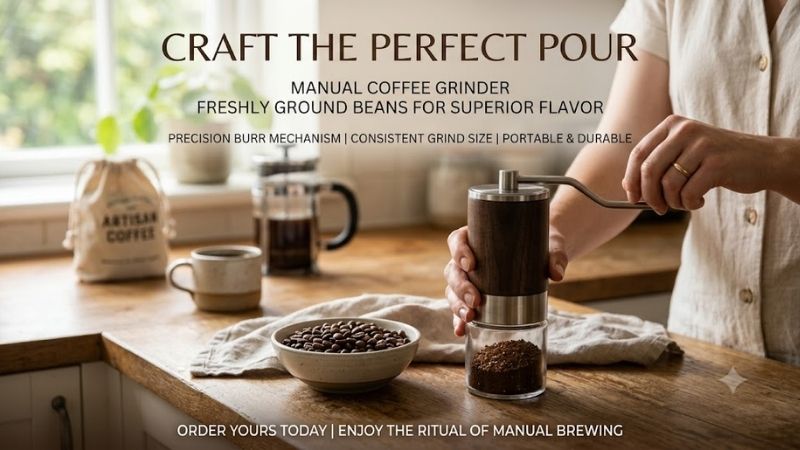
A manual coffee grinder gives you control over grind size without relying on an electric motor, making it useful at home, while traveling, or when brewing a single fresh cup. We compare six hand grinders for espresso, pour-over, and everyday coffee, focusing on burr design, adjustment precision, capacity, grinding effort, portability, and long-term value.
Quick Verdict: Which Manual Coffee Grinder Should You Buy?
The 1Zpresso K-Ultra is our best overall manual coffee grinder for buyers who want one premium hand grinder that can accommodate multiple brewing methods. Its external adjustment ring, 20-micron burr movement per click, folding handle, and 35–40-gram grounds capacity make it particularly flexible.
However, it is not the most economical choice, and its broad versatility does not make it the ideal grinder for every situation.
If espresso is your priority, the 1Zpresso J-Ultra provides much finer adjustment increments. The KINGrinder K6 offers an appealing balance of adjustment and functionality, while the 1Zpresso Q is more suitable for people who value portability above large batch capacity.
Our Top Six Recommendations
| Manual Coffee Grinder | Best For | Grind Adjustment | Capacity | Main Trade-Off |
|---|---|---|---|---|
| 1Zpresso K-Ultra | Best overall | External ring; 20 microns per click | 35–40g | Premium price and substantial weight |
| 1Zpresso J-Ultra | Dedicated manual espresso | External ring; 8 microns per click | Approximately 35–40g | Espresso-oriented rather than filter-specialized |
| KINGrinder K6 | Versatile value | External ring; 16 microns per click | Approximately 25–35g, depending on configuration | Less compact than ultralight travel grinders |
| TIMEMORE Chestnut C3ESP Pro | Portable espresso-capable grinding | Fine internal adjustment; approximately 23 microns per click | Up to 30g | Adjustment is less convenient than an external dial |
| Comandante C40 MK4 Nitro Blade | Premium traditional hand grinding | Internal stepped adjustment | Up to 40g per included jar | Espresso fine-tuning may benefit from an optional upgrade |
| 1Zpresso Q | Lightweight travel brewing | Internal adjustment; 30 clicks per rotation | 15–20g | Small batches and limited espresso emphasis |
The right choice depends on three factors: how fine you need to grind, how frequently you change brewing methods, and how much hand grinding you are comfortable performing.
How We Selected These Manual Coffee Grinders
A manual coffee grinder is relatively simple in concept. Beans enter a hopper, a hand crank rotates a burr mechanism, and ground coffee collects in a lower container.
However, the quality of the grinding experience depends on much more than the fact that the grinder uses burrs.
We focused on six areas that have a direct impact on everyday ownership.
Burr Design and Intended Brewing Method
Modern manual grinders commonly use stainless steel conical burrs.
But two grinders with apparently similar burr arrangements can behave differently because of cutting geometry, alignment, rotational resistance, and adjustment design.
A burr set optimized for espresso may not be the ideal choice for someone preparing only delicate pour-over coffee.
We therefore prioritized products with a clearly defined brewing purpose.
Grind Adjustment Precision
A manual grinder’s adjustment mechanism is particularly important.
Traditional espresso often requires very small changes in grind size to control the flow of water through a coffee puck.
Pour-over coffee generally benefits from repeatable adjustments across a broader range.
External adjustment rings are convenient because the user can change settings without removing the collection cup.
Internal adjustment systems can work well but may be less convenient when switching methods frequently.
Capacity and Batch Size
The amount of coffee a hand grinder can hold determines whether you can prepare an entire dose in one operation.
A grinder with a 15–20-gram capacity may be ideal for one cup of pour-over coffee.
However, it could require multiple loads to prepare a large French press batch.
A 35–40-gram capacity is more convenient for users preparing two servings or a larger manual brew.
Grinding Effort and Ergonomics
Hand grinding requires physical effort.
Resistance varies with grind size, coffee bean characteristics, burr geometry, and the mechanical advantage of the handle.
Espresso grinding generally places greater demands on the user than many coarser brewing settings.
We considered handle construction, grip, body size, and portability.
However, we do not assign fabricated rankings for grinding speed or hand effort because those would require comparable independent testing.
Maintenance and Durability
A manual grinder should be practical to clean.
Coffee particles accumulate around burrs, bearings, adjustment systems, and collection cups.
We considered how easily owners can access these components and whether the manufacturer provides clear maintenance guidance.
Product Verification
These recommendations are based on identifiable manufacturer specifications, instruction manuals, and practical brewing requirements.
They are not presented as independently conducted grinding tests, and no invented particle-size measurements, extraction yields, or durability results are used.
Detailed Reviews of the Best Manual Coffee Grinders
1. 1Zpresso K-Ultra — Best Overall Manual Coffee Grinder
Best For: Coffee enthusiasts who want one hand grinder for pour-over, AeroPress, moka pot, and occasional espresso preparation.
Why We Picked It
The 1Zpresso K-Ultra offers a particularly useful combination of precise external adjustment, generous capacity, and portable construction.
It is designed as a broad-purpose premium grinder rather than being dedicated exclusively to espresso.
That makes it appropriate for people who own several different coffee makers.
Someone might brew V60 coffee on weekdays, prepare a moka pot on weekends, and occasionally use a manual espresso maker. The K-Ultra can accommodate those activities without requiring a separate grinder for each method.
Key Specifications
| Specification | Details |
|---|---|
| Product | 1Zpresso K-Ultra |
| Burr Design | Heptagonal stainless steel conical burr |
| Adjustment | External ring |
| Adjustment Precision | 20 microns of burr movement per click |
| Adjustment Range | More than 100 clicks |
| Grounds Capacity | 35–40g |
| Collection Cup | Magnetic |
| Handle | Foldable |
| Weight | Approximately 700g |
| Power | Manual |
Features and Benefits
The external adjustment ring is one of the K-Ultra’s strongest practical advantages.
Users can move between settings without removing the collection container or counting an internal dial from zero every time.
The ring provides 100 clicks per full revolution, and each click changes the burr position by approximately 20 microns.
Importantly, this specification refers to burr movement. It does not mean the coffee particles themselves change by exactly 20 microns.
The heptagonal conical burr is designed to accommodate multiple brewing ranges.
The folding handle reduces the space required for storage, while the magnetic catch cup simplifies removal of the finished grounds.
With approximately 35–40 grams of capacity, the grinder is suitable for many individual and two-person recipes.
Performance and Practical Use
The K-Ultra makes particular sense for someone switching between manual brewing methods.
For example, a 20-gram pour-over dose easily fits within its capacity.
A larger 35-gram dose may also fit, depending on coffee bean size and density.
For traditional espresso, its adjustment system provides useful control, although the 1Zpresso J-Ultra offers finer increments specifically intended for espresso dialing-in.
The K-Ultra’s relatively substantial construction is another consideration.
It is portable in the sense that it does not require electricity and has a folding handle, but it is not as lightweight as the compact 1Zpresso Q.
For airplane travel or minimalist camping, the smaller grinder may be more appealing.
What Makes It Different
The K-Ultra combines broad brewing compatibility, external adjustment, and a relatively generous capacity within a hand-operated design.
Its main value is versatility rather than being the smallest or least expensive option.
Pros
- External adjustment ring.
- Wide range of brewing applications.
- Approximately 35–40g capacity.
- Foldable handle.
- Magnetic catch cup.
- Premium metal construction.
Cons
- Premium purchase price.
- Heavier than compact travel grinders.
- Espresso users may prefer finer adjustment increments.
- Requires physical effort for every dose.
Buy If: You want one premium hand grinder for several brewing methods.
Skip If: You exclusively prepare espresso or need the lightest possible travel setup.
2. 1Zpresso J-Ultra — Best for Manual Espresso
Best For: Home baristas using a manual lever espresso maker or semi-automatic espresso machine.
Why We Picked It
Espresso is particularly sensitive to grind adjustment.
A small change in particle size can alter water resistance through the coffee puck, affecting extraction time and beverage concentration.
The 1Zpresso J-Ultra is specifically designed to make these small adjustments practical.
Its external ring offers burr movement of approximately 8 microns per click, providing finer increments than the K-Ultra.
That makes it attractive for people who regularly adjust traditional espresso recipes.
Key Specifications
| Specification | Details |
|---|---|
| Product | 1Zpresso J-Ultra |
| Burrs | 48mm espresso-oriented coated stainless steel burr |
| Adjustment | External |
| Burr Movement | 8 microns per click |
| Clicks per Rotation | 100 |
| Adjustment Travel | Multiple full rotations |
| Grounds Capacity | Approximately 35–40g |
| Collection Cup | Magnetic |
| Main Purpose | Espresso |
Features and Benefits
The J-Ultra’s external adjustment dial allows users to move between fine settings without opening the grinder.
Its 8-micron increment is useful for making small changes while dialing in espresso.
The magnetic catch cup improves convenience when transferring grounds into a portafilter.
The ergonomic body and curved handle are intended to make hand grinding manageable.
Performance and Practical Use
Suppose an espresso shot runs too quickly.
With the J-Ultra, the user can make a small adjustment toward a finer setting and repeat the recipe.
That allows deliberate changes instead of large jumps between grind sizes.
However, grind setting is only one part of espresso preparation.
Coffee freshness, dose, distribution, tamping, basket geometry, and machine pressure also influence the result.
A very precise grinder does not automatically guarantee excellent espresso.
Because the J-Ultra is espresso-oriented, filter-coffee specialists may prefer the K-Ultra or Comandante C40.
What Makes It Different
Its fine adjustment system is designed for a task where tiny changes can matter significantly.
Pros
- Very fine adjustment increments.
- External numbered dial.
- Espresso-oriented burr design.
- Generous hand-grinder capacity.
- Magnetic catch cup.
Cons
- More specialized than some all-purpose grinders.
- Fine espresso grinding requires physical effort.
- Premium price compared with entry-level hand grinders.
- May be unnecessary for ordinary French press brewing.
Buy If: You regularly prepare espresso and want detailed grind control.
Skip If: You only brew coarse French press coffee and prefer a simpler grinder.
3. KINGrinder K6 — Best Versatile Value
Best For: Buyers who want external grind adjustment and broad brewing compatibility without immediately choosing a top-tier premium grinder.
Why We Picked It
The KINGrinder K6 offers several features commonly associated with more expensive manual grinders.
These include stainless steel burrs, an aluminum body, and a numbered external adjustment system.
Its 16-micron adjustment increment also provides relatively fine control.
For a household that prepares both espresso and pour-over coffee, this makes the K6 an appealing value-oriented option.
Key Specifications
| Specification | Details |
|---|---|
| Product | KINGrinder K6 |
| Burrs | Stainless steel |
| Adjustment | External numbered ring |
| Clicks per Rotation | 60 |
| Burr Movement | 16 microns per click |
| Capacity | Approximately 25–35g, depending on configuration |
| Body | Aluminum |
| Power | Manual |
| Cleaning | Tool-free disassembly for supported components |
Features and Benefits
The external dial helps users record and repeat grind settings.
That is particularly useful when switching between brewing methods.
The full-metal body provides a substantial construction style.
The K6 also supports a broad range of grind settings rather than being limited to one particular coffee preparation.
Performance and Practical Use
The K6 is a sensible option for someone who enjoys making espresso on a Flair or Picopresso while also brewing filter coffee.
However, the user should consider the time and effort required for fine grinding.
A 25–35-gram capacity is sufficient for many single and double servings, but large batches may require refilling.
The manufacturer’s specifications also vary slightly across configurations and descriptions, so checking the exact version is worthwhile.
What Makes It Different
It offers practical external adjustment and broad brewing capability at a value-oriented product position.
Pros
- External grind adjustment.
- Fine 16-micron increments.
- Stainless steel burrs.
- Metal body.
- Multiple brewing applications.
Cons
- Capacity varies by configuration.
- May require refilling for large batches.
- Hand grinding remains slower than electric grinding for frequent large quantities.
- Exact US seller support should be checked.
Buy If: You want capable manual grinding for both espresso and filter coffee.
Skip If: You need the smallest travel grinder or prefer automatic grinding.
4. TIMEMORE Chestnut C3ESP Pro — Best Compact Espresso-Capable Option
Best For: Coffee drinkers who want a relatively compact manual grinder with fine adjustment and a folding handle.
Why We Picked It
The Chestnut C3ESP Pro combines TIMEMORE’s stainless steel burr design with a finer adjustment mechanism intended to support espresso preparation.
It also uses a folding handle, which makes storage more convenient.
The result is a useful middle ground between basic entry-level hand grinders and larger premium models.
Key Specifications
| Specification | Details |
|---|---|
| Product | TIMEMORE Chestnut C3ESP Pro |
| Burr Design | S2C stainless steel |
| Adjustment | Internal |
| Adjustment Precision | Approximately 23 microns per click |
| Capacity | Up to approximately 30g |
| Handle | Foldable |
| Body | Aluminum alloy |
| Operation | Manual |
Features and Benefits
The C3ESP Pro uses a more finely divided adjustment arrangement than basic grinders intended mainly for coarse coffee.
This is useful for espresso because smaller adjustments help users refine the extraction.
The folding handle reduces the amount of space the grinder occupies in a bag or cupboard.
Its metal construction and compact cylindrical format are suitable for everyday home use.
Performance and Practical Use
The C3ESP Pro is useful for users who prepare one or two servings.
It can handle espresso-oriented grinding, though very fine settings will require more effort than many filter-coffee settings.
Its internal adjustment mechanism is an important compromise.
To change settings, users interact with the adjustment beneath the grinder rather than simply rotating an external ring.
For someone brewing the same coffee method every day, this may not be inconvenient.
For someone constantly switching between espresso and French press, the external dial of the K6 or K-Ultra may be preferable.
What Makes It Different
It combines fine adjustment and a folding handle within a relatively compact hand-grinder design.
Pros
- Espresso-capable adjustment.
- Folding handle.
- Metal construction.
- Suitable for several brewing methods.
- Approximately 30g capacity.
Cons
- Internal adjustment is less convenient than an external ring.
- Very fine grinding requires effort.
- Limited batch size compared with some larger models.
- Specific regional configurations should be confirmed.
Buy If: You want a compact manual grinder that can support espresso and filter coffee.
Skip If: You frequently change grind settings and strongly prefer external adjustment.
5. Comandante C40 MK4 Nitro Blade — Best for Traditional Premium Hand Grinding
Best For: Coffee enthusiasts who prioritize a long-established premium manual grinding platform, particularly for brewed coffee.
Why We Picked It
The Comandante C40 MK4 is a well-known premium hand grinder built around its Nitro Blade burr design.
Its construction and adjustment system emphasize precise, repeatable manual grinding.
Unlike models using an external adjustment ring, the C40 uses an internal stepped mechanism.
That approach is less convenient for frequent changes but familiar to users who prefer to count and record their settings.
Key Specifications
| Specification | Details |
|---|---|
| Product | Comandante C40 MK4 Nitro Blade |
| Burr Design | Nitro Blade stainless steel |
| Adjustment | Internal stepped |
| Grounds Containers | Included glass and polymer jars |
| Jar Capacity | Approximately 40g each |
| Handle | Removable crank |
| Production | Germany |
| Operation | Manual |
Features and Benefits
The Nitro Blade burr system is designed for controlled manual coffee grinding.
The MK4 configuration includes both a glass jar and a durable polymer jar.
The polymer container is particularly useful for travel, where a glass collection vessel may be impractical.
The grinder’s adjustment mechanism uses distinct clicks, which makes it possible to record a preferred setting.
Performance and Practical Use
The C40 is well suited to pour-over enthusiasts who enjoy repeatable brewing recipes.
For example, a user can record a setting for a particular coffee and return to it after experimenting with another roast.
However, users need to count clicks carefully.
Its internal adjustment is less immediately convenient than a numbered external dial.
The standard adjustment can also be less suitable for espresso users who want very small changes. Comandante offers a Red Clix accessory for finer adjustment, but that adds another purchase and requires understanding the modified setting system.
What Makes It Different
The C40 combines a distinctive burr design, established manual grinding workflow, and interchangeable collection jars.
Pros
- Premium burr design.
- Established hand-grinding platform.
- Glass and polymer jars included.
- Approximately 40g jar capacity.
- Suitable for specialty filter coffee.
Cons
- Internal adjustment.
- Espresso fine-tuning may benefit from an accessory.
- Premium price.
- Glass jar needs careful handling.
Buy If: You value a premium traditional hand-grinding system and primarily make brewed coffee.
Skip If: You want the easiest external grind adjustment for frequent espresso dialing-in.
6. 1Zpresso Q — Best Lightweight Travel Grinder
Best For: Travelers, campers, and coffee drinkers who make small individual servings.
Why We Picked It
The 1Zpresso Q focuses on portability.
It is smaller and lighter than many premium manual grinders, making it attractive for people who want fresh-ground coffee away from home.
The compact design is particularly well suited to AeroPress, pour-over, and other single-cup brewing methods.
Key Specifications
| Specification | Details |
|---|---|
| Product | 1Zpresso Q |
| Burr Design | Stainless steel conical |
| Adjustment | Internal |
| Adjustment Structure | 30 clicks per rotation |
| Grounds Capacity | Approximately 15–20g |
| Weight | Approximately 475g for the Q version |
| Handle | Foldable |
| Power | Manual |
Features and Benefits
The compact body occupies little storage space.
The folding handle makes it easier to pack.
Its stainless steel burr system offers controlled grinding without a power source.
The small capacity is appropriate for a typical individual coffee dose.
Performance and Practical Use
For someone brewing a 15-gram AeroPress recipe while traveling, the Q is practical.
However, a 30-gram French press recipe may require more than one grinding batch.
The small hopper is therefore both an advantage and a limitation.
Because adjustment is internal, switching frequently between radically different brew sizes is less convenient than on grinders with external dials.
The Q is primarily attractive for portable filter coffee rather than being the first recommendation for demanding traditional espresso.
What Makes It Different
Its strongest benefit is a compact, lightweight design for individual coffee preparation.
Pros
- Lightweight.
- Compact body.
- Folding handle.
- Stainless steel burrs.
- Practical for travel.
Cons
- Small 15–20g capacity.
- May require multiple loads for larger brews.
- Internal adjustment.
- Not the first choice for precision espresso.
Buy If: You want fresh-ground coffee while traveling or camping.
Skip If: You regularly prepare large batches or need very fine espresso adjustment.
Manual Coffee Grinder Buying Guide
Why Choose a Manual Coffee Grinder Instead of an Electric One?
A manual grinder is not automatically better than an electric grinder.
Its main advantages are portability, compact size, independence from electrical power, and direct control over the grinding process.
Manual grinders can be useful when a household does not have enough counter space for another electrical appliance.
They also avoid motor noise, although the sound of the beans being ground remains audible.
However, electric grinders provide a considerable convenience advantage when preparing multiple servings.
Someone grinding 60 grams of coffee every morning may find a motorized burr grinder much easier to live with.
How Much Coffee Do You Grind at Once?
Capacity deserves attention before purchasing.
A grinder with a 15–20g hopper is suitable for many single-cup brewing recipes.
A 30g grinder can accommodate larger individual servings or some two-person recipes.
A 35–40g model is more convenient when preparing multiple cups.
Remember that nominal capacity can vary according to bean density and roast.
Large, low-density roasted beans occupy more space than smaller dense beans at the same mass.
External vs. Internal Grind Adjustment
External adjustment rings provide a visible way to change grind size.
They are particularly helpful when switching frequently between brewing methods.
For example, a user may move from a fine espresso setting to a much coarser French press setting.
With an external numbered dial, returning to a former position is generally straightforward.
Internal adjustment systems often require removing or accessing the lower part of the grinder.
They can still provide excellent repeatability, but changing settings may take more time.
The correct choice depends on how often you make adjustments.
Understanding Microns per Click
Manufacturers sometimes describe adjustment precision in microns.
For example, the J-Ultra specifies 8 microns of burr movement per click, while the K-Ultra specifies 20 microns.
These figures describe movement within the adjustment mechanism.
They do not directly indicate that all coffee particles change size by the same amount.
Coffee grinding produces a distribution of particle sizes rather than one uniform dimension.
The practical benefit of a fine adjustment increment is the ability to make smaller changes to the grinding conditions.
This is especially useful for espresso.
Manual Espresso Requires Fine Adjustment
Traditional espresso uses finely ground coffee packed into a filter basket.
Small grind adjustments influence the resistance water encounters during extraction.
A hand grinder designed primarily for French press may lack the adjustment precision required.
If espresso is your main brewing method, prioritize an espresso-oriented grinder such as the J-Ultra.
Also consider the physical effort required.
Grinding light-roasted coffee at a fine espresso setting can be demanding.
A capable grinder may improve the experience, but it cannot eliminate the need to turn the handle.
Choosing a Grinder for Pour-Over
Pour-over brewing usually benefits from a repeatable medium-to-medium-fine grind range, depending on the dripper and recipe.
A manual grinder should let you return to familiar settings reliably.
A K-Ultra or Comandante C40 is particularly suitable for enthusiasts preparing different pour-over recipes.
However, a more economical grinder can still provide useful results.
The best improvement often comes from consistent measurements and brewing technique rather than always purchasing the most expensive model.
Choosing a Grinder for French Press
French press usually requires a coarser grind than espresso.
For this method, extremely fine espresso adjustment is less important.
Capacity and comfortable operation may matter more.
If you regularly make a large French press batch, a small 15g travel grinder may be inconvenient.
A 30–40g model is generally more practical.
Choosing a Grinder for AeroPress
AeroPress recipes use a wide range of grind sizes.
Some use relatively fine grounds with short contact times, while others use coarser grinds and longer immersion.
Because AeroPress is portable, a compact grinder can be a good pairing.
The 1Zpresso Q is attractive for this use.
However, not every manual grinder is guaranteed to fit inside the AeroPress plunger, and compatibility varies by exact model and generation.
Burr Size Is Not Everything
Larger burrs can provide certain mechanical advantages.
However, size alone does not establish grind consistency or beverage quality.
Burr geometry, steel characteristics, alignment, axle stability, and adjustment precision also matter.
A well-designed smaller grinder may be more suitable than a larger grinder with an inconvenient adjustment system.
What About Ceramic Burrs?
Some entry-level manual grinders use ceramic burrs.
These can perform basic grinding tasks.
However, premium modern manual grinders often use stainless steel burrs with more elaborate cutting geometry.
Material alone does not guarantee performance.
Compare actual product design rather than assuming every steel burr is superior to every ceramic burr.
How Important Is Handle Design?
The handle affects comfort and leverage.
A longer handle may provide useful mechanical advantage, while a folding handle improves portability.
The grip should feel secure during use.
A grinder that is too wide for the user’s hand can be uncomfortable, even if its burr system is technically impressive.
Consider both the handle and the body diameter.
Grinding Light vs. Dark Roasts
Roast level influences bean density and mechanical behavior.
Light-roasted beans can be harder to grind, especially at fine espresso settings.
Dark-roasted beans may be more brittle and can produce different grinding behavior.
Very oily beans can also create maintenance concerns.
Follow the grinder manufacturer’s recommendations and avoid assuming one setting works identically for all coffees.
Should You Grind by Weight or Volume?
Weighing coffee beans provides more repeatable dosing than filling a hopper by eye.
For example, a 20g coffee dose paired with 320g of water gives a 1:16 ratio.
The grinder’s capacity tells you how much coffee it can hold, not how much you should necessarily brew.
A small coffee scale is therefore a useful companion to a manual grinder.
What Is Grind Retention?
Grind retention refers to coffee particles that remain inside the grinder after operation.
Manual grinders may have relatively direct grinding paths, but some grounds can still adhere to internal surfaces.
The amount varies with design, coffee characteristics, and static.
A small quantity of retained coffee is not automatically evidence of poor construction.
Users who switch between coffee varieties frequently may want to minimize carryover between doses.
Static Electricity in Manual Grinders
Coffee grounds can cling to collection cups because of static electricity.
This problem varies with humidity, bean characteristics, and construction materials.
Some users employ a very small amount of moisture on beans to manage static, but this should only be done when the grinder manufacturer approves the method.
Introducing excessive water into an unsuitable grinder can cause corrosion or bearing problems.
Cleaning a Manual Coffee Grinder
Most hand grinders should be cleaned using a suitable brush or manufacturer-approved tools.
Not every component can be washed with water.
Steel burrs, bearings, and internal adjustment mechanisms may be vulnerable to corrosion or damage if immersed.
Always follow the instructions for the exact grinder.
Do not assume the collection cup and burr assembly have identical cleaning requirements.
How Often Should You Clean It?
Cleaning frequency depends on coffee consumption and whether the beans are oily.
A light brushing after regular use can help remove loose residue.
More thorough maintenance may be appropriate when switching coffee varieties or when grind performance changes.
However, unnecessary full disassembly can introduce calibration problems.
Follow the manufacturer’s recommended maintenance schedule.
Calibration and Zero Points
Some hand grinders have a mechanical zero point where the burrs begin to touch or the handle no longer turns freely.
The setting labels may not correspond perfectly between individual grinders.
Manufacturers sometimes specify allowable calibration variation.
When using an online recipe, treat another user’s click count as a starting point rather than a universal setting.
Never force an adjustment mechanism past its safe limit.
Durability and Replacement Parts
A premium hand grinder can be a long-term investment.
However, durability depends on proper use and maintenance.
Dropping a grinder may damage its shaft, bearings, collection cup, or alignment.
Before purchasing, consider whether the manufacturer provides replacement components, warranty support, and clear instructions.
Are Manual Coffee Grinders Worth the Money?
The answer depends on coffee volume and brewing style.
For a person preparing one pour-over every morning, a manual grinder can offer an appealing balance of grind control and compact size.
For someone making six espresso drinks for a household each day, an electric grinder may be far more practical.
A premium hand grinder is most worthwhile when its advantages match your routine rather than when it is purchased simply because it is mechanically sophisticated.
Common Manual Coffee Grinder Problems
The Grinder Is Difficult to Turn
This can happen when grinding dense beans at a very fine setting.
Check that the setting is appropriate and that the burrs are not contacting incorrectly.
Do not force the handle if the mechanism appears jammed.
Coffee Grind Size Is Inconsistent
Possible causes include unsuitable settings, assembly issues, worn parts, or coffee characteristics.
Clean and inspect the grinder according to manufacturer instructions.
The Grounds Container Is Hard to Remove
Check whether the cup uses a threaded or magnetic connection.
Avoid excessive force.
Coffee residue around the connection can sometimes interfere with smooth removal.
The Grinder Produces Too Much Fine Coffee
Every grinder produces some fines.
If the resulting brew is muddy or overextracted, try a slightly coarser setting and review your recipe.
Do not assume an expensive grinder produces no fines.
Settings Change After Cleaning
The grinder may require recalibration or correct reassembly.
Consult the exact model’s manual.
Grinding Takes Too Long
Check whether the coffee dose is appropriate and whether the grind setting is unnecessarily fine.
For large daily quantities, consider whether an electric grinder would better fit the workload.
Frequently Asked Questions
What is the best manual coffee grinder overall?
The 1Zpresso K-Ultra is our best overall recommendation for people wanting broad brewing compatibility, external adjustment, and a generous hand-grinder capacity.
What is the best manual coffee grinder for espresso?
The 1Zpresso J-Ultra is particularly well suited to espresso because its 8-micron adjustment increments allow small changes while dialing in extraction.
Are manual coffee grinders better than electric grinders?
Not universally. Manual grinders emphasize portability and direct operation, while electric grinders are generally more convenient for frequent or large batches.
Can a manual coffee grinder handle French press and espresso?
Some can. The K-Ultra and KINGrinder K6 support broad grinding ranges, but espresso performance depends on sufficient fine adjustment.
Do manual grinders produce consistent coffee grounds?
Well-designed burr grinders can provide controlled particle-size distributions. No grinder produces perfectly uniform particles.
How much coffee can a manual grinder hold?
Small travel models may hold approximately 15–20g, while larger premium hand grinders may accommodate 35–40g or more depending on the model.
Are stainless steel burrs better than ceramic burrs?
Steel is common in premium modern hand grinders, but material alone does not establish quality. Burr geometry and construction are also important.
How should I clean a manual coffee grinder?
Use the approved brush and maintenance procedure. Do not immerse steel burrs or internal mechanisms unless the manufacturer explicitly permits washing.
Can I take a manual coffee grinder camping?
Yes. Many are portable and do not need electricity. You will still need coffee, an appropriate water-heating method, and suitable cleaning supplies.
How long does grinding coffee by hand take?
It depends on bean type, roast, grind size, dose, burr design, and user technique. Fine espresso grinding generally requires more effort than coarser settings.
Conclusion
The 1Zpresso K-Ultra is our best manual coffee grinder for versatile home brewing, while the J-Ultra suits dedicated espresso preparation. Choose KINGrinder K6 for adjustable value, TIMEMORE C3ESP Pro for compact versatility, Comandante C40 for premium traditional grinding, or 1Zpresso Q for travel. Match the grinder to your brew method and daily dose.





Write Your Review
No reviews yet. Be the first to share your experience!