
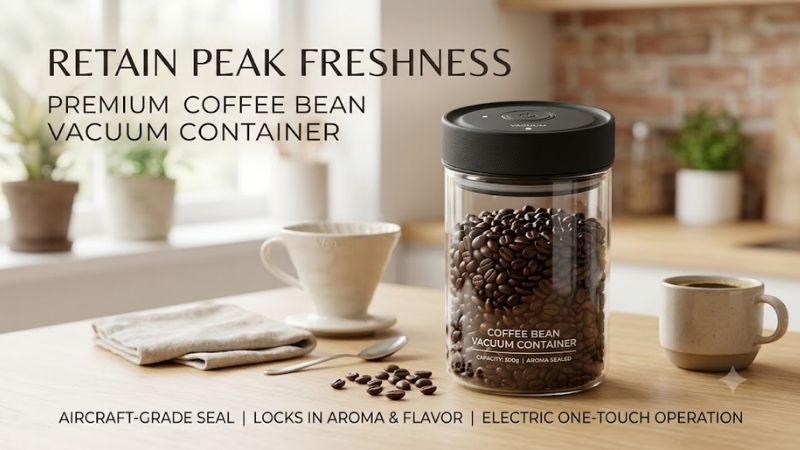
A coffee bean vacuum container is designed to reduce air exposure after you open a bag of roasted coffee. We compare six manual, electric, and air-displacement storage options, examining their sealing mechanisms, capacity, bean compatibility, everyday operation, and maintenance. Learn which containers create a vacuum and which simply reduce headspace.
Quick Verdict: Which Coffee Bean Vacuum Container Is Best?
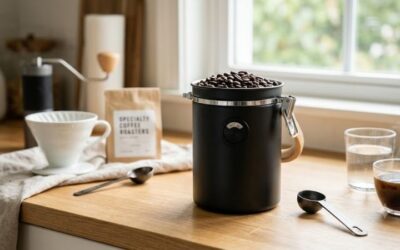
Best Overall: Fellow Atmos Manual Vacuum Canister. Its integrated twist-operated pump makes it straightforward to remove some air from the container without a separate accessory or battery.
The Fellow Electric Atmos is more suitable for people who value automatic vacuum operation. The ZWILLING Fresh & Save system uses a separate vacuum pump and is useful when several containers share one system.
The Planetary Design Airscape products are included as air-removal alternatives. They reduce the air space surrounding stored beans but should not be described as equivalent to a pump-operated vacuum container.
Quick Comparison Table
| Container | Best For | Air Management | Main Advantage | Main Limitation |
|---|---|---|---|---|
| Fellow Atmos Manual Stainless Steel | Best overall | Built-in manual vacuum pump | Integrated twist-to-seal operation | Must maintain and periodically restore seal |
| Fellow Electric Atmos Stainless Steel | Automatic vacuum storage | Electric pump in lid | Push-button operation | Battery and electronics |
| Fellow Atmos Manual Glass | Visible whole-bean storage | Built-in manual vacuum pump | View beans without opening | Light exposure and breakage |
| ZWILLING Fresh & Save Glass Container | Multi-container households | Separate electric vacuum pump | Shared vacuum ecosystem | Additional pump required |
| Planetary Design Airscape Stainless Steel | Manual air removal without a pump | Plunger reduces headspace | No battery or separate pump | Not an actively pumped vacuum |
| Planetary Design Airscape Glass | Visible air-displacement storage | Adjustable inner plunger | Visible contents and reduced headspace | Not a pump vacuum; admits light |
How We Selected These Containers
The phrase vacuum coffee container is frequently used loosely.
Some containers genuinely include a mechanism that lowers the internal air pressure.
Others rely on airtight seals, one-way valves, or movable plungers.
These are different technologies.
We evaluated the products according to what they actually do, how easy they are to use, and whether their storage method is appropriate for roasted coffee beans.
We also considered material, capacity, maintenance, and seal integrity.
No container should be assumed to preserve flavor indefinitely, and we do not treat unverified shelf-life multipliers as universal guarantees.
Detailed Coffee Bean Vacuum Container Reviews
1. Fellow Atmos Manual Stainless Steel — Best Overall
Best For: Coffee drinkers who want vacuum storage without batteries or an external pump.
Why We Picked It
The manual Atmos incorporates a vacuum pump within the lid.
Rather than attaching another tool, users twist the lid to remove some of the air and create a vacuum seal.
Key Features
- Manual integrated vacuum pump
- Stainless steel body
- Silicone sealing components
- Release button
- Selected capacities include 0.7L and 1.2L
- Primarily intended for whole coffee beans
- Not dishwasher-safe
Features and Benefits
The integrated pump reduces accessory clutter.
The opaque stainless steel version also limits light exposure.
When opening the canister, the release button equalizes the pressure before the lid is removed.
Performance and Practical Use
The manual Atmos is particularly suitable for households that use whole beans regularly.
However, the seal needs maintenance. Fellow recommends periodically twisting the lid again to restore the vacuum.
Roasted coffee beans also release gas after roasting, and the container’s internal pressure may change over time.
The manufacturer advises against placing fine ground coffee inside because particles can clog the valve.
What Makes It Different
It integrates manual vacuum creation directly into the lid.
Pros
- No external vacuum pump.
- No charging.
- Opaque body.
- Multiple sizes.
- Straightforward pressure release.
Cons
- Requires repeated twisting.
- Seal may need refreshing.
- Not dishwasher-safe.
- Fine ground coffee can interfere with the pump.
Buy If: You want everyday vacuum storage for whole beans without electronics.
Skip If: You prefer a one-touch electric process.
2. Fellow Electric Atmos Stainless Steel — Best Automatic Vacuum Option
Best For: People who want vacuum sealing with minimal manual effort.
Why We Picked It
The Electric Atmos uses an integrated powered vacuum mechanism.
This simplifies the process for users who prefer pressing a button rather than twisting a manual lid.
Key Features
- Electric vacuum pump built into lid
- Automatic sealing operation
- Rechargeable electronic system
- Stainless steel storage body
- Vacuum status indication
- Whole-bean coffee storage focus
Features and Benefits
The powered lid reduces repeated manual work.
It can also provide a more convenient routine for someone who opens the container several times daily.
Performance and Practical Use
The Electric Atmos is useful for a dedicated coffee station where automatic operation matters.
However, electronics introduce new maintenance responsibilities.
Users must charge the lid and avoid inappropriate exposure to water.
The container also cannot prevent changes in coffee caused by age, roast characteristics, heat, or moisture.
What Makes It Different
An integrated electric pump makes the vacuum process largely automatic.
Pros
- Push-button operation.
- Integrated pump.
- Opaque steel option.
- Convenient for repeated use.
Cons
- Requires charging.
- Electronics complicate care.
- More expensive than manual alternatives.
- Vacuum storage does not guarantee unchanged flavor.
Buy If: You want convenient automatic vacuum storage.
Skip If: You prefer equipment without batteries or electronic components.
3. Fellow Atmos Manual Glass — Best for Visible Coffee Storage
Best For: Coffee drinkers who want vacuum operation while keeping the bean supply visible.
Why We Picked It
The glass version retains the Atmos manual vacuum mechanism but substitutes a transparent vessel.
Key Features
- Twist-operated vacuum lid
- Glass container
- Release button
- Selected capacities include 0.7L and 1.2L
- Primarily intended for whole beans
- Manual vacuum maintenance
Features and Benefits
The transparent body makes it easy to estimate how many beans remain.
Users can avoid opening the container solely to inspect the supply.
Performance and Practical Use
The glass version is most appropriate inside a dark cupboard or away from direct light.
Although visibility is convenient, a clear vessel does not protect coffee from light exposure.
Care is also required to avoid breaking the glass.
What Makes It Different
It combines vacuum storage with visible contents.
Pros
- Integrated manual pump.
- Easy to view beans.
- No battery.
- Multiple sizes.
Cons
- Admits light.
- Fragile compared with steel.
- Requires periodic vacuum maintenance.
- Not suitable for fine powders.
Buy If: You want to see the remaining bean quantity and can store the container away from sunlight.
Skip If: You want a rugged opaque canister on an exposed countertop.
4. ZWILLING Fresh & Save Glass Vacuum Container — Best for Multi-Container Households
Best For: Households already using the ZWILLING Fresh & Save system.
Why We Picked It
ZWILLING uses a separate vacuum pump that can work with multiple compatible containers.
This differs from Fellow’s self-contained lid approach.
Key Features
- Vacuum-compatible glass container
- Separate Fresh & Save vacuum pump
- Valve-equipped lid
- Reusable food-storage system
- Multiple container formats
- External charging requirements for pump
Features and Benefits
A shared pump can serve several containers.
This is useful if coffee storage is only one part of a larger food-storage routine.
Performance and Practical Use
The system can be practical for users who already own the compatible pump.
However, the suitability of a specific container for long-term dry coffee storage should be checked against the manufacturer’s instructions.
Coffee packaging and roasted-bean degassing also remain relevant.
It is not necessarily the simplest choice for someone who only wants one coffee canister.
What Makes It Different
Its vacuum system is shared across multiple compatible food containers.
Pros
- Reusable vacuum ecosystem.
- Glass container options.
- Suitable for households using several compatible vessels.
- Separate pump can be reused.
Cons
- Pump sold separately in some configurations.
- More components.
- Transparent storage requires light protection.
- Exact container suitability must be checked.
Buy If: You already use Fresh & Save products.
Skip If: You want a standalone coffee-specific container with no external pump.
5. Planetary Design Airscape Stainless Steel — Best Air-Displacement Alternative
Best For: Coffee drinkers who want to reduce headspace without maintaining a vacuum pump.
Why We Picked It
The Airscape’s adjustable inner plunger decreases the air volume directly above the beans.
Although often compared with vacuum storage, it uses a different mechanism.
Key Features
- Opaque stainless steel body
- Adjustable inner lid
- One-way air-release valve
- Separate outer lid
- Replacement components available
- No electrical power
Features and Benefits
The inner plunger can be pushed down as the bean supply decreases.
This makes the storage arrangement adaptable.
Performance and Practical Use
The Airscape is useful when you consume coffee from the same container every day.
However, buyers seeking a true reduced-pressure vacuum system should understand that plunger displacement is not equivalent to active pumping.
What Makes It Different
It reduces headspace mechanically without creating a pump-operated vacuum.
Pros
- No battery.
- Adjustable interior.
- Opaque storage.
- Replacement parts.
Cons
- Not a true pump vacuum.
- Two lids to handle.
- Requires cleaning around the valve.
Buy If: You want simple air management without powered components.
Skip If: A genuine vacuum mechanism is essential to your purchase.
6. Planetary Design Airscape Glass — Best Visible Air-Displacement Alternative
Best For: People who like the adjustable plunger concept but prefer a transparent vessel.
Why We Picked It
The glass Airscape combines visual monitoring with mechanical headspace reduction.
Key Features
- Glass body
- Adjustable inner plunger
- Outer lid
- Air-release mechanism
- Multiple sizes
- No electrical power
Features and Benefits
The vessel lets users see the remaining coffee supply.
The inner plunger decreases the open air space above the contents.
Performance and Practical Use
It is best stored away from direct light.
Users should also remember that this design does not actively evacuate air with a vacuum pump.
What Makes It Different
It provides adjustable headspace in a transparent format.
Pros
- Visible contents.
- No charging.
- Adjustable inner lid.
- Reusable.
Cons
- Does not create a pump vacuum.
- Glass breakage risk.
- Light protection necessary.
Buy If: You want a visible container with reduced headspace.
Skip If: You require a vacuum-pump system.
Coffee Bean Vacuum Container Buying Guide
What Is a Vacuum Coffee Container?
A vacuum container attempts to reduce the quantity of air inside a sealed vessel.
A pump may be manual or electric.
This is different from an ordinary airtight seal, which primarily restricts air exchange after closing.
Vacuum vs. Air Displacement
A vacuum pump removes some air.
An adjustable plunger reduces the empty volume available for air.
Both may be useful, but they should not be presented as the same technology.
Does Vacuum Storage Preserve Coffee Flavor?
Reducing oxygen exposure may slow some oxidative changes.
However, coffee still ages through multiple processes.
Flavor preservation depends on bean freshness, roast level, storage temperature, moisture, and handling.
No home canister guarantees permanent freshness.
Roasted Coffee Releases Gas
Roasted beans release carbon dioxide after roasting.
This can affect internal pressure and vacuum-seal maintenance.
A vacuum container may require occasional resealing.
Whole Beans vs. Ground Coffee
Whole beans are generally more suitable for many coffee-specific vacuum systems.
Fine grounds can interfere with valves in some designs.
Always follow the manufacturer’s approved contents.
Manual vs. Electric Pumps
Manual pumps eliminate charging but require physical operation.
Electric pumps add convenience but introduce electronics and battery management.
Choose according to how frequently you access the container.
Integrated vs. Separate Pumps
Integrated pumps are convenient for one dedicated canister.
Separate pumps can serve multiple containers, which may be valuable in a broader kitchen-storage system.
Stainless Steel vs. Glass
Stainless steel provides an opaque, relatively durable body.
Glass provides visibility but requires light protection and more careful handling.
Choose the Right Capacity
Match the container to the size of coffee bags you usually purchase.
Remember that darker roasts may occupy more space for the same weight.
How Often Should You Open the Container?
Frequent opening introduces new air.
A vacuum mechanism must operate again after opening.
If you access beans many times daily, convenience can be just as important as the theoretical seal.
Cleaning a Vacuum Lid
Do not immerse electronic or mechanical pump lids unless the manufacturer explicitly permits it.
Coffee oils and fine dust can contaminate sealing surfaces.
Clean carefully according to the instructions.
When Vacuum Storage Is Unnecessary
If you buy small quantities of coffee and finish them quickly, the original resealable bag or a suitable airtight canister may already be sufficient.
A more expensive system is not automatically necessary.
Common Vacuum Storage Problems
The Vacuum Seal Does Not Hold
Inspect the gasket, sealing surface, valve, and lid. Follow the manufacturer’s troubleshooting instructions.
The Lid Becomes Difficult to Remove
Use the pressure-release mechanism rather than forcing it open.
The Canister Has Fine Coffee Dust Around the Valve
Check whether the manufacturer permits ground coffee and clean the lid appropriately.
The Electric Pump Stops Working
Check charging status and manufacturer-approved maintenance before assuming the container is defective.
Frequently Asked Questions
What is the best coffee bean vacuum container?
The Fellow Atmos Manual Stainless Steel Canister is our preferred standalone option for whole beans and simple vacuum operation.
Is the Airscape a vacuum container?
It reduces headspace with an inner plunger. This is different from actively pumping air out to produce a vacuum.
Is an electric vacuum canister better?
It is more convenient for some people, but requires charging and electronic maintenance.
Can vacuum containers store ground coffee?
Only when the specific product permits it. Fellow advises against fine grounds in Atmos.
Does vacuum storage stop coffee from going stale?
No. It may reduce some forms of air exposure, but it cannot eliminate coffee aging.
Is glass safe for storing coffee?
Yes, when the vessel is suitable for food storage and kept away from direct light and heat.
Should coffee be stored in the freezer instead?
Properly portioned and sealed freezer storage can be useful for some longer-term needs, but repeated moisture exposure should be avoided.
Conclusion
The Fellow Atmos Manual Stainless Steel is our best coffee bean vacuum container for integrated, battery-free sealing. Choose Electric Atmos for automatic operation or ZWILLING Fresh & Save if you already use its pump system. Airscape is a worthwhile headspace-reduction alternative, but it is not an actively pumped vacuum container.




Write Your Review
No reviews yet. Be the first to share your experience!