
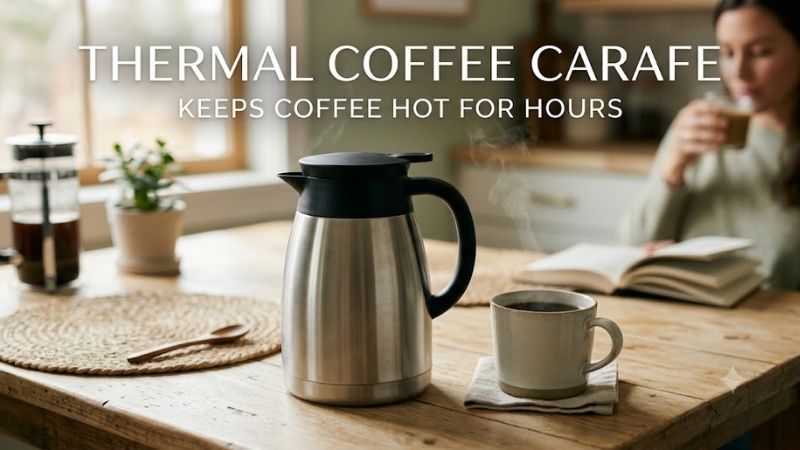
A thermal coffee carafe should keep brewed coffee at a pleasant serving temperature without relying on a warming plate. We compare six insulated servers for different household sizes and brewing routines, focusing on vacuum construction, capacity, lid design, pouring control, heat retention, and whether each carafe is easy to clean after everyday use.
Quick Verdict
Best Overall: Zojirushi Stainless Steel Vacuum Carafe. Its range of insulated serving designs makes it a strong choice for households that want reliable coffee service without continuous heating.
Best for larger gatherings: Thermos Stainless King Beverage Server. A larger insulated vessel is more convenient when serving several cups.
Best for a manual-brewing setup: Hario V60 Insulated Stainless Steel Server. Its format is particularly relevant to people who regularly brew pour-over coffee.
Comparison Table
| Carafe | Best For | Construction | Main Advantage | Main Limitation |
|---|---|---|---|---|
| Zojirushi Stainless Steel Vacuum Carafe | Best overall | Vacuum-insulated steel | Everyday coffee serving | Exact capacity and lid differ by model |
| Thermos Stainless King Beverage Server | Larger shared servings | Double-wall vacuum steel | Generous serving format | Requires storage space |
| Hario V60 Insulated Stainless Steel Server | Pour-over setups | Insulated stainless steel | Manual-brewing compatibility | Smaller than large office servers |
| Cresimo Thermal Coffee Carafe | Household value | Vacuum-insulated steel | Practical push-button pouring | Model-specific cleaning requirements |
| Stanley Classic Legendary Bottle | Rugged portable serving | Vacuum-insulated steel | Durable transport format | Bottle-style serving rather than a tabletop carafe |
| Zojirushi Air Pot Beverage Dispenser | Office and group service | Insulated dispenser | Pump-operated serving | Large footprint and more parts |
How We Selected These Carafes
Thermal coffee carafes have a straightforward purpose: slow the transfer of heat from the beverage to the surroundings.
However, real-world usefulness depends on the entire serving process.
A carafe that insulates well but is awkward to pour, difficult to clean, or too large for the household may not be the best choice.
We considered vacuum insulation, capacity, lid design, pouring behavior, handling, and cleaning access.
We also distinguished tabletop coffee servers from portable insulated bottles and larger pump dispensers.
These recommendations are not based on independently measured heat-retention tests. Actual beverage temperature depends on fill level, starting temperature, ambient conditions, lid operation, and whether the vessel was preheated.
Detailed Reviews
1. Zojirushi Stainless Steel Vacuum Carafe — Best Overall
Best For: Households serving brewed coffee over breakfast, meetings, or extended conversation.
Why We Picked It
Zojirushi produces several vacuum-insulated beverage-serving products emphasizing heat retention and controlled pouring.
A suitable stainless steel carafe can keep coffee available without leaving it on an active warming plate.
Key Features
- Vacuum-insulated stainless steel construction
- Multiple available capacities
- Model-specific pouring mechanisms
- Tabletop serving format
- No continuous electrical heating
Benefits
Vacuum insulation reduces heat transfer.
A well-designed lid also limits heat loss between pours.
The carafe can be moved from kitchen counter to dining table without an electrical cord.
Practical Use
This is useful when a household prepares a pot of drip coffee but consumes it over time.
However, it is important to select the exact serving model rather than assume all Zojirushi insulated products have the same lid or capacity.
Pros
- Vacuum-insulated construction.
- Suitable for tabletop service.
- Multiple product sizes.
- No warming plate.
Cons
- Specific features vary by model.
- Lid components require cleaning.
- A full carafe can be relatively heavy.
Buy If: You want an insulated vessel for everyday shared coffee.
Skip If: You only need a small personal travel mug.
2. Thermos Stainless King Beverage Server — Best for Shared Coffee
Best For: Families and small groups that want a larger insulated coffee vessel.
Why We Picked It
Thermos has a long-established range of vacuum-insulated food and beverage containers.
Its beverage-serving designs can be practical when the household needs more than one or two cups.
Key Features
- Stainless steel vacuum insulation
- Model-specific large serving capacity
- Insulated lid
- Carrying and pouring arrangement
- No electrical heating
Benefits
A larger insulated server can reduce repeated trips to the kitchen.
It is useful for shared breakfasts or meetings.
Practical Use
Large capacity has a trade-off.
The vessel takes more storage space and may be cumbersome when filled.
If you usually prepare just one cup, a smaller server is more appropriate.
Pros
- Suitable for multiple servings.
- Vacuum insulation.
- Portable from kitchen to table.
Cons
- Larger storage footprint.
- Heavy when full.
- Lid cleaning may be involved.
Buy If: You prepare coffee for several people.
Skip If: You mainly brew individual servings.
3. Hario V60 Insulated Stainless Steel Server — Best for Pour-Over
Best For: People who want to brew manual filter coffee and retain its temperature after brewing.
Why We Picked It
Hario’s insulated serving products are intended to work alongside manual brewing routines.
A dedicated server can be useful for preparing multiple pour-over cups.
Key Features
- Stainless steel insulated construction
- Coffee-serving spout
- V60-related brewing format
- Multiple capacities or versions
- Removable lid
Benefits
The server can collect coffee during a pour-over brew and keep it insulated afterward when used as instructed.
This reduces the need to immediately divide coffee into individual mugs.
Practical Use
Ensure that the particular dripper sits securely on the server.
Not every Hario server has the same dimensions, and compatibility should be checked rather than assumed.
Pros
- Manual coffee brewing focus.
- Insulated storage.
- Suitable for shared pour-over servings.
Cons
- Smaller than large beverage dispensers.
- Dripper compatibility varies.
- Pouring and lid design depend on version.
Buy If: You regularly prepare V60-style coffee.
Skip If: You need a large office beverage dispenser.
4. Cresimo Thermal Coffee Carafe — Best Practical Household Alternative
Best For: Buyers seeking a conventional insulated jug for home coffee service.
Why We Picked It
Cresimo’s thermal coffee carafes are positioned around everyday vacuum-insulated pouring and household convenience.
Key Features
- Stainless steel vacuum insulation
- Push-button pouring on selected models
- Tabletop format
- Multiple advertised capacities
- Insulated lid
Benefits
A push-button lid can make serving easier without fully removing the top.
This may reduce heat loss associated with repeatedly opening the entire vessel.
Practical Use
The quality of the seal and cleanliness of the pouring mechanism are particularly important.
Buyers should check the exact model’s cleaning instructions and replacement-part support.
Pros
- Convenient pouring format.
- Vacuum insulation.
- Suitable for home gatherings.
Cons
- Model specifications vary.
- Push-button mechanisms collect residue.
- Independent heat-retention claims may be difficult to compare.
Buy If: You want a traditional insulated coffee jug.
Skip If: You prefer a fully removable simple lid.
5. Stanley Classic Legendary Bottle — Best Rugged Portable Alternative
Best For: People transporting several servings of coffee rather than keeping a decorative carafe on the dining table.
Why We Picked It
Stanley’s insulated bottle design emphasizes portability and ruggedness.
Although not a traditional tabletop carafe, it can be useful for carrying brewed coffee.
Key Features
- Double-wall vacuum insulation
- Stainless steel construction
- Screw-top closure
- Multiple capacities
- Carry-oriented design
Benefits
A sealed bottle format is appropriate for transport in situations where an open-spout carafe would be inconvenient.
Practical Use
Pouring may require removing or adjusting the cap.
It is less suitable for frequent quick service at a crowded table than a dedicated push-button carafe.
Pros
- Durable transport-oriented design.
- Vacuum insulation.
- Suitable for outdoor use.
Cons
- Less convenient tabletop pouring.
- Bottle geometry may be harder to clean.
- Not intended as a conventional drip-brewer carafe replacement.
Buy If: You frequently transport coffee.
Skip If: You want a dedicated countertop serving jug.
6. Zojirushi Air Pot Beverage Dispenser — Best for Offices
Best For: Meetings, shared workspaces, and group coffee service.
Why We Picked It
An air-pot dispenser provides a different serving arrangement from a conventional carafe.
Users dispense the beverage using a pump mechanism rather than lifting and tilting the container.
Key Features
- Large insulated body
- Pump-operated dispensing
- Multiple capacities
- Tabletop design
- Suitable for group beverage service
Benefits
A pump system is convenient when several people serve themselves.
It also reduces the need to lift a large filled vessel repeatedly.
Practical Use
The pump, spout, and internal tubing need careful cleaning.
For a small household, the larger size and maintenance may be unnecessary.
Pros
- Convenient group dispensing.
- Large capacity.
- No need to tilt the filled container.
Cons
- More components to clean.
- Large footprint.
- Excessive for one-person use.
Buy If: You serve coffee to groups regularly.
Skip If: You only brew one or two cups at home.
Thermal Coffee Carafe Buying Guide
What Is Vacuum Insulation?
Most quality thermal carafes use a double-wall structure with a reduced-pressure space between the walls.
This limits heat transfer.
However, heat still escapes through the lid, neck, and other components.
Does a Thermal Carafe Keep Coffee Hot All Day?
Some products advertise extended heat retention, but results depend on fill level, starting temperature, ambient conditions, and frequency of pouring.
Do not compare claims without checking test conditions.
Preheating the Carafe
Preheating can help reduce the temperature drop when hot coffee is first transferred into a cold vessel.
Use hot water according to the manufacturer’s instructions, then empty it before adding coffee.
Avoid unsafe thermal shocks or unapproved heating methods.
Glass-Lined vs. Stainless Interiors
Some insulated vessels use glass vacuum liners, while others use stainless steel.
Glass liners can be fragile if dropped.
Stainless steel may provide greater impact resistance.
Follow the care instructions for the particular construction.
Capacity
Choose based on the actual number of servings.
A one-liter carafe holds approximately four 8-ounce cups before allowing for any other practical factors.
An oversized carafe may retain heat differently when only partially filled.
Lid Design
Push-button, screw-top, flip-top, and pump lids have different advantages.
Push-button lids can be convenient but include mechanisms that require cleaning.
Simple screw lids may be easier to inspect.
Pouring Control
A well-designed spout should help reduce dripping and splashing.
When comparing options, consider whether the lid must be removed for pouring and whether the handle remains comfortable when full.
Cleaning Access
Coffee oils accumulate in serving vessels.
Narrow necks and complex lids can be harder to clean.
Follow the manufacturer’s approved washing instructions.
Dishwasher Compatibility
Do not assume insulated carafes are dishwasher-safe.
Some vacuum-insulated products require hand washing, particularly around seals and coatings.
Thermal Carafe vs. Warming Plate
A thermal vessel retains heat without applying continuous heat to brewed coffee.
A warming plate actively supplies heat, which may affect flavor during extended holding.
The better option depends on your brewing routine.
Coffee Maker Compatibility
A standalone carafe is not automatically compatible with a drip coffee maker’s brew-stop mechanism or dimensions.
When replacing an integrated carafe, use a compatible manufacturer-approved model.
Common Thermal Carafe Problems
Coffee Cools Faster Than Expected
Check fill level, preheating, lid closure, and seal condition.
The Carafe Drips When Pouring
Clean the lid and spout, and confirm all parts are seated correctly.
Coffee Develops an Off-Taste
Residual coffee oils may be trapped inside the vessel or lid.
The Pump Dispenses Poorly
Check the air-pot cleaning and assembly instructions.
Frequently Asked Questions
What is the best thermal coffee carafe overall?
A compatible Zojirushi vacuum-insulated serving carafe is a strong everyday choice.
Is stainless steel better than glass?
Stainless steel is generally more impact-resistant, while some glass-lined thermal designs have different insulating properties. Complete construction matters.
Should you preheat a thermal carafe?
It can improve initial heat retention when done according to the manufacturer’s instructions.
Can a thermal carafe replace a drip coffee maker’s original pot?
Only if it is specifically compatible with that machine.
Are thermal carafes dishwasher-safe?
Some are, but many require hand washing. Check the manual.
Is an air pot better than a carafe?
An air pot is more convenient for group dispensing, while a conventional carafe is simpler for smaller households.
Why does coffee taste stale after sitting?
Aroma changes, oxidation, and continued exposure to heat can affect flavor, even inside an insulated container.
Conclusion
A suitable Zojirushi vacuum-insulated carafe is our best thermal coffee carafe for everyday serving. Consider Thermos for shared batches, Hario for pour-over, Cresimo for push-button convenience, or a Zojirushi air pot for meetings. Choose the right capacity and lid design, and remember that actual heat retention depends on fill level and use.


Write Your Review
No reviews yet. Be the first to share your experience!