
A countertop ice maker for small kitchens can provide fresh ice without a built-in freezer dispenser or permanent plumbing. However, limited counter space makes dimensions, ventilation, noise, cleaning access, and ice storage especially important. This guide explains how to choose a machine that fits both your kitchen and your daily routine.
- Quick Answer: What Should You Buy?
- Understanding Countertop Ice Makers
- How to Choose the Right Size for a Small Kitchen
- Ice Production Capacity: Understanding the Numbers
- Water Reservoirs, Drainage, and Cleaning
- Noise, Electricity, and Daily Convenience
- Choosing the Right Ice Maker for Your Kitchen
- Common Buying Mistakes to Avoid
- Frequently Asked Questions
- Conclusion
- Quick Answer: What Should Beginners Look For?
- Understanding Nugget Ice Makers
- How to Choose Your First Nugget Ice Maker
- Cleaning and Maintenance: What Beginners Must Know
- Countertop Space and Everyday Operation
- Choosing by Household Needs
- Nugget Ice Maker Buying Mistakes
- Frequently Asked Questions
- Conclusion
Quick Answer: What Should You Buy?
For most small kitchens, a compact, manually filled bullet-ice maker is the most practical starting point. It generally offers a simpler design and a smaller equipment commitment than a larger nugget or clear-ice machine.
However, the smallest advertised dimensions do not automatically make a machine the best choice. The ice maker must also have enough clearance for airflow, a convenient way to add water, sufficient space to open its lid, and a practical location for draining the reservoir.
Prioritize these features:
-
A compact footprint with adequate manufacturer-specified ventilation clearance.
-
A removable ice basket that can be accessed without moving the appliance.
-
An internal refillable water reservoir.
-
A convenient drain plug and accessible surfaces for cleaning.
-
Daily production capacity matched to your actual ice consumption.
-
Manageable operating noise for an apartment or open kitchen.
A machine that fits inside an available corner but cannot ventilate or open properly is not a suitable purchase.
Understanding Countertop Ice Makers
How Does a Countertop Ice Maker Work?
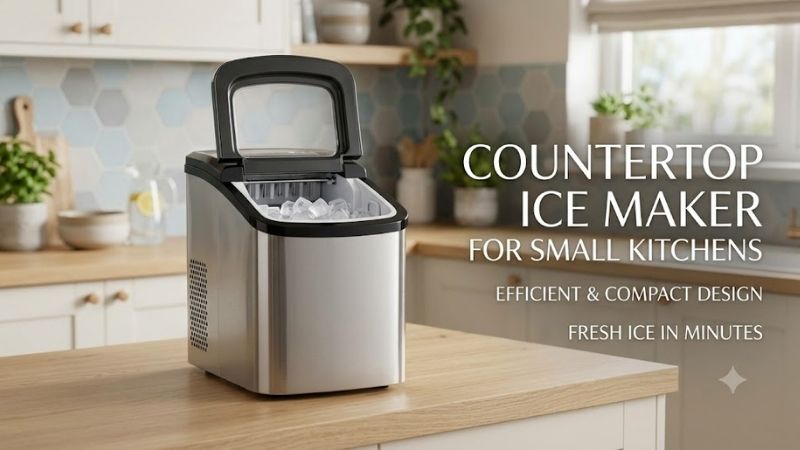
Most compact countertop ice makers contain a water reservoir, refrigeration system, ice-forming mechanism, and removable collection basket.
After the user fills the reservoir and starts the machine, water is circulated through the freezing mechanism. Once a batch forms, the machine releases the ice into its collection basket and begins another cycle when operating conditions permit.
Many countertop machines reuse water from melted ice. This reduces the need for constant manual refilling, but it also means that regular cleaning and fresh water are important.
Unlike a conventional freezer, most portable countertop ice makers do not maintain their collection baskets at freezing temperatures. Ice left inside eventually melts.
What Types of Ice Can These Machines Produce?
Ice shape matters because it affects texture, drink dilution, equipment complexity, and cost.
| Ice Type | Characteristics | Best Use | Main Trade-Off |
|---|---|---|---|
| Bullet ice | Rounded or hollow pieces, often somewhat soft when freshly made | Water, iced coffee, casual drinks | May melt relatively quickly |
| Nugget ice | Small, chewable pieces made from compressed ice | Soft drinks, iced tea, chewable ice preferences | Greater mechanical complexity and maintenance |
| Clear or solid-style ice | Denser pieces, depending on the freezing design | Mixed drinks and slower dilution preferences | May need more space, time, or expense |
For households that simply want cold drinks throughout the day, bullet ice is usually sufficient.
Nugget ice makes more sense when its chewable texture is an important part of the experience. Clear-ice machines are more specialized and should be considered when ice appearance or particular drink preparation needs justify the added commitment.
Who Benefits Most From a Compact Ice Maker?
A countertop ice maker is useful when a household regularly runs out of freezer ice or lacks a refrigerator ice dispenser.
Apartment residents may benefit from a manually filled machine because it generally avoids plumbing modifications. Small households that drink iced beverages daily can also benefit from making repeated batches throughout the day.
However, an ice maker is not automatically better than freezer trays. Someone who uses only a few cubes occasionally may get better value from reusable ice trays or a small freezer container.
How to Choose the Right Size for a Small Kitchen
Measure the Full Operating Space
Start by measuring the area where the appliance will actually operate.
Record the available width, depth, and vertical clearance. Then compare those measurements with the exact dimensions listed for the ice maker.
Do not stop at the exterior dimensions. Consider whether the unit can operate normally in that space.
Check for:
-
Adequate space around its ventilation openings.
-
Room to raise the lid completely.
-
Access to remove the ice basket.
-
A comfortable angle for pouring water into the reservoir.
-
Clearance for the power cord.
-
Enough access to drain and clean the machine.
For example, a machine might fit comfortably beneath a wall cabinet when closed, yet become difficult to refill because the lid cannot fully open.
In that situation, a different lid design or a location without an overhead cabinet may be more practical.
Check Ventilation Requirements
Countertop ice makers use refrigeration systems that release heat into the surrounding air.
If ventilation openings are obstructed, heat may accumulate, reducing ice production and potentially interfering with normal operation.
Required clearance varies between manufacturers and models. Some machines require substantial open space around their vents, while others use different airflow arrangements.
Follow the exact model’s installation instructions rather than assuming that every compact ice maker can operate against a wall or inside a tight appliance garage.
A location that is physically large enough for the machine but too restricted for safe airflow should be rejected.
Consider the Weight and Portability
A compact ice maker may still be inconvenient to move frequently.
Compare the listed appliance weight with how often you intend to lift it, store it, or move it for cleaning.
For occasional use, manageable weight and convenient carrying features matter more than they would for a permanently installed machine.
However, an ice maker generally needs a stable, level operating surface. A carrying handle does not mean it can be operated while being moved.
After transportation or significant tilting, follow the manufacturer’s instructions regarding the appropriate waiting period before switching it on.
Ice Production Capacity: Understanding the Numbers
Daily Ice Production vs. Ice Basket Capacity
These specifications describe different things.
Daily ice production is the amount a manufacturer says a machine can produce over a specified operating period, commonly 24 hours under stated conditions.
Ice basket capacity is how much finished ice the collection basket can hold at one time.
For example, a hypothetical machine rated for 26 pounds of ice per day with a 1.5-pound basket would not store 26 pounds of ready-to-use ice.
The daily figure assumes repeated production and removal or melting of ice throughout the operating period.
For a small household, basket capacity and the ability to produce enough ice when needed may be more important than a large daily production claim.
First-Batch Time and Continuous Production
Manufacturers frequently advertise how quickly their machines can produce an initial batch.
This figure is useful, but it does not describe every operating condition.
Ice production can change with:
-
Ambient room temperature.
-
Starting water temperature.
-
Ventilation and heat buildup.
-
Ice size selection, when available.
-
Machine operating condition.
-
Mineral accumulation and maintenance.
A machine advertised as producing its first batch quickly may take longer during hot weather or when filled with warmer water.
Look for documented operating conditions and realistic production information rather than selecting a model entirely on its fastest advertised cycle.
How Much Ice Does a Household Actually Need?
The right capacity depends on how ice is used.
A single person adding ice to one or two drinks daily may need only a modest machine.
Two or three people drinking iced beverages throughout the day may benefit from repeated production and a reasonably accessible collection basket.
A household that entertains regularly should pay greater attention to total output, basket capacity, and the ability to transfer finished ice to freezer storage.
For occasional large gatherings, buying bagged ice might be more economical and convenient than purchasing a larger permanent countertop appliance.
Water Reservoirs, Drainage, and Cleaning
Choose an Accessible Water Reservoir
Most portable countertop ice makers are manually filled.
This is convenient for rentals and small kitchens because installation usually does not require connecting a water supply line.
However, you will need to add water whenever the reservoir runs low.
Check the filling opening, maximum fill marking, and whether the reservoir is easy to inspect and access.
An appliance with a larger reservoir may require less frequent refilling, but a larger tank can also contribute to the overall footprint.
Do not pay for greater reservoir capacity unless that convenience matters to your routine.
Understand Drain Plug Placement
Drainage is an easily overlooked buying consideration.
Many machines include a drain plug that allows water to be emptied during cleaning or storage.
Some drain plugs are accessible from the side or back, while others are located underneath the machine.
For a small kitchen, a bottom-mounted drain can be inconvenient if it requires lifting a heavy appliance containing water.
Before purchasing, inspect the product manual or diagram to identify the drain location and recommended emptying procedure.
Consider where the water will go and whether you can perform the procedure without spilling it near an electrical outlet.
Is a Self-Cleaning Function Worth Having?
A self-cleaning function can reduce the amount of manual effort required to circulate a cleaning solution through the water pathway.
However, the term does not guarantee that every surface is cleaned automatically.
Depending on the model, owners may still need to wipe the reservoir, wash removable components, remove mineral deposits, rinse internal pathways, and drain the system.
Choose a machine with clearly documented cleaning instructions and accessible components.
Use only manufacturer-approved cleaning and descaling products and concentrations. Never mix cleaning chemicals.
Noise, Electricity, and Daily Convenience
How Noisy Are Countertop Ice Makers?
Countertop ice makers can produce several types of sound during operation.
The compressor and fan generate ongoing mechanical noise, while water movement and ice dropping into the basket can create intermittent sounds.
Noise levels vary by design, operating conditions, and the surrounding room.
For an open-plan apartment, intermittent ice-dropping sounds may be more noticeable than steady fan noise.
If quiet operation is a priority, look for reliable published noise measurements that explain how they were obtained. Avoid assuming that an appliance described as quiet is nearly silent.
Place the machine on a stable surface to reduce unnecessary vibration.
Check Electrical Requirements
Most countertop ice makers sold for household use in the United States are designed for ordinary domestic electrical systems, but the exact rated voltage, frequency, power draw, and connection requirements are model-specific.
Check the appliance label and manual before use.
Prefer a suitable grounded wall outlet when required by the manufacturer. Keep the cord away from sinks, standing water, hot cookware, and stove burners.
Do not use an extension cord or power strip unless the manufacturer explicitly permits the arrangement.
Consider Energy Use and Operating Habits
Ice makers use electricity while producing ice, and their energy consumption depends on the refrigeration design, operating duration, surrounding temperature, and other factors.
A higher advertised daily ice output does not automatically mean greater efficiency.
When available, compare credible energy-consumption measurements made under similar conditions.
If you use ice only in the afternoon, operating the machine when needed may be more sensible than leaving it running unnecessarily.
Follow the manufacturer’s operating and storage instructions, particularly regarding water left in the machine.
Choosing the Right Ice Maker for Your Kitchen
Best for a Studio Apartment
A compact bullet-ice machine is generally the most practical starting category.
Focus on dimensions, ventilation requirements, cleaning access, and manageable noise.
A modest capacity is preferable to a larger machine that takes away essential food preparation space.
Best for Daily Iced Coffee
Choose a machine with convenient repeated production, easy refilling, and a basket large enough for your usual beverage routine.
Bullet ice is suitable for many iced coffee drinks, while nugget ice may appeal to people who prefer smaller, chewable pieces.
The ice shape should reflect personal preference rather than assumptions about universal superiority.
Best for Frequent Entertaining
Higher daily output and convenient basket access become more important when preparing multiple drinks.
However, because the basket is not a freezer, plan to transfer excess finished ice into suitable freezer storage when appropriate.
For larger gatherings, compare the convenience of machine production with simply purchasing enough bagged ice.
Best for Occasional Use
If ice is needed only for weekend drinks or infrequent visitors, portability and easy storage should be priorities.
A machine that is difficult to drain, dry, and put away may not justify its counter space.
Freezer trays may remain the better solution for very limited use.
Common Buying Mistakes to Avoid
Choosing Based Only on Daily Production
A large production rating can look impressive, but it does not tell you how much ice will be ready when you open the basket.
Evaluate production capacity together with basket size, cycle behavior, and your drinking habits.
Ignoring Lid and Drain Access
A machine may appear compact in a product photograph while requiring extra space for refilling and cleaning.
Check its working dimensions and maintenance routine before ordering.
Assuming Ice Remains Frozen
Most portable machines do not offer freezer-like storage.
Plan to use the ice promptly or move it into a freezer when longer storage is needed.
Underestimating Maintenance
Standing water, mineral deposits, and neglected components can affect taste, cleanliness, and operation.
An ice maker should be purchased with a realistic willingness to follow its cleaning and water-management instructions.
Frequently Asked Questions
Do Countertop Ice Makers Need a Water Line?
Most portable countertop models use internal water reservoirs and do not require a permanent water connection.
Some specialized appliances offer additional water-supply options, so confirm the configuration of the exact model.
Can I Put an Ice Maker Under Kitchen Cabinets?
Only if there is enough room for the lid, water filling, ventilation, and manufacturer-required operating clearance.
An appliance that fits under a cabinet when switched off may still be unsuitable for operation there.
Do Countertop Ice Makers Keep Ice Frozen Overnight?
Most portable countertop models do not maintain freezer temperatures in their baskets.
Unused ice can melt and may return to the water reservoir. Transfer finished ice to freezer storage when appropriate rather than relying on the machine for long-term preservation.
Is Nugget Ice Better Than Bullet Ice?
Neither is universally better.
Nugget ice offers a softer, chewable texture, while bullet-ice machines are often simpler and more economical for everyday use.
Choose based on drink preferences, available space, maintenance requirements, and budget.
How Often Should I Clean a Countertop Ice Maker?
Follow the exact model’s instructions.
Cleaning frequency depends on usage, water quality, operating conditions, and manufacturer requirements. Drain and refresh water as directed, and address visible residue or unusual odors promptly.
Is a Countertop Ice Maker Worth It for One Person?
It can be worthwhile if you use ice frequently, lack an adequate freezer ice supply, and have enough counter space.
If you need only a small amount of ice occasionally, conventional ice trays will usually be simpler and less expensive.
Conclusion
The right countertop ice maker for small kitchens is one that fits your actual working space, produces enough ice for your routine, and remains easy to refill, drain, and clean. For most compact households, a manually filled bullet-ice maker offers a practical balance of convenience and simplicity. Prioritize operating clearance, accessible maintenance, and realistic ice storage expectations over impressive daily production claims.
ARTICLE 2 OF 5 — BUYING GUIDE
SEO Title: Nugget Ice Maker for Beginners: A Practical Buying Guide
Meta Description: Find a nugget ice maker for beginners by learning how chewable ice is made, what capacity means, how much upkeep to expect, and which features matter most.
Nugget Ice Maker for Beginners: A Practical Buying Guide
Choosing a nugget ice maker for beginners means looking beyond the promise of soft, chewable ice. These appliances differ in production capacity, reservoir design, cleaning requirements, and counter space. Understanding those differences helps you avoid paying for features you will not use while finding a machine that suits your drinks and daily routine.
Quick Answer: What Should Beginners Look For?
For a first nugget ice maker, prioritize straightforward controls, an accessible water reservoir, clear cleaning instructions, and a capacity matched to your household.
A manually filled countertop model is often a practical starting point because it generally requires no permanent plumbing connection.
The most useful features include:
-
Simple start, stop, and status controls.
-
An accessible ice bin and water reservoir.
-
Clearly documented cleaning and descaling procedures.
-
Automatic alerts for low water or a full ice bin.
-
Sufficient ventilation clearance.
-
Manageable operating noise.
-
A warranty and available customer support.
Avoid choosing a machine simply because it advertises the highest daily ice production. Everyday convenience matters more than maximum theoretical output.
Understanding Nugget Ice Makers
What Is Nugget Ice?
Nugget ice consists of small, irregular pieces of compressed ice with a comparatively soft, chewable texture.
It is often associated with fountain drinks, iced tea, lemonade, and other cold beverages.
Unlike large solid cubes, nugget ice contains many small pieces and spaces between them. This gives it a distinctive mouthfeel and allows drinks to flow between the pieces.
Its smaller structure also provides considerable ice surface area, which can promote heat transfer and dilution.
Whether this is desirable depends on the drink and how quickly it will be consumed.
How Does a Nugget Ice Maker Work?
Many nugget ice machines use an auger-based freezing system.
Water freezes along a chilled surface. A rotating auger moves the formed ice through the mechanism, where it is compressed into pieces before entering the collection bin.
This design differs from common bullet-ice makers, which typically freeze water around refrigerated metal elements and release the formed pieces into a basket.
The additional mechanical components help explain why nugget machines can require more maintenance and cost more than basic bullet-ice appliances.
Different manufacturers use different internal designs, so the exact operation and maintenance procedures depend on the model.
Is Nugget Ice the Same as Crushed Ice?
No. Although both consist of small ice pieces, they are produced differently.
| Feature | Nugget Ice | Crushed Ice |
|---|---|---|
| Production | Typically compressed from mechanically formed ice | Created by breaking larger ice pieces |
| Texture | Often softer and more chewable | Can contain harder, sharper fragments |
| Shape | Small, irregular nuggets | Variable chips and fragments |
| Typical appeal | Chewable ice for beverages | Rapid chilling and mixed drinks |
A household blender can crush suitable ice in some cases, but it does not automatically reproduce the texture of mechanically formed nugget ice.
If chewable ice is the main goal, a dedicated nugget machine is the more appropriate category.
How to Choose Your First Nugget Ice Maker
Determine the Right Production Capacity
Manufacturers often advertise output in pounds per 24 hours.
This is an indication of production capability under specified conditions, not a guarantee of how much ice will remain ready in the collection bin.
A machine with high daily output may still have a relatively small bin.
Consider whether you need ice for one person’s daily beverages, several household members, or frequent entertaining.
If you only drink a few iced beverages daily, a modest machine may be sufficient. Higher production capacity becomes more useful when ice is consumed repeatedly or prepared for guests.
Do not purchase more capacity than you can realistically use, store, or manage.
Compare Ice Bin Capacity
The ice bin determines how much finished ice can accumulate before the machine needs attention.
A small bin can be entirely adequate for one or two drinks at a time.
For larger households, limited storage may require more frequent scooping or transferring ice to a freezer.
Most countertop nugget machines are not freezers. Ice can gradually melt while sitting in the bin, and many models recycle melted water into the production system.
Check whether the bin is removable, easy to reach, and convenient to clean.
Choose a Convenient Water Reservoir
Beginners generally benefit from a manually filled reservoir with a clear maximum fill marking.
A larger reservoir may reduce the frequency of water refills, especially when the machine operates for extended periods.
However, extra water capacity may increase the space needed for the appliance or its accessories.
Some nugget machines use an additional side tank. This can make refilling more convenient, but it also increases the complete operating footprint.
For a small kitchen, compare the dimensions with every accessory installed.
Understand First-Ice Time
Some manufacturers advertise quick initial ice production.
However, first-ice time depends on the starting temperature, water temperature, operating environment, and design.
The time required to receive the first nuggets is also different from the time required to fill the entire bin.
If you want ice for drinks immediately after switching on the appliance, first-production speed matters.
If you typically start the machine before preparing a meal or entertaining, ease of operation and total production may matter more.
Look for Simple Controls and Useful Indicators
Beginner-friendly machines should communicate basic operating conditions clearly.
Useful indicators include low water, full ice bin, cleaning requirements, and operating status.
Automatic shutoff or production pauses can also reduce unnecessary intervention when the bin reaches its limit.
However, control layouts differ. A touchscreen is not necessarily easier than a few clearly labeled buttons.
Choose a machine whose instructions are understandable without relying on complicated menus or unnecessary connectivity features.
Cleaning and Maintenance: What Beginners Must Know
Why Do Nugget Ice Makers Need Regular Cleaning?
Nugget machines contain water pathways and internal ice-forming components that require proper maintenance.
Mineral deposits can accumulate from water, while damp surfaces and standing water can contribute to sanitation problems if neglected.
Regular maintenance supports consistent operation, cleaner ice-handling surfaces, and more predictable performance.
A machine with a convenient cleaning cycle can reduce some maintenance effort, but it does not eliminate the need for manual inspection and care.
Cleaning vs. Descaling
These are related but different tasks.
Cleaning addresses residue, contamination, and buildup on surfaces or within water pathways.
Descaling removes mineral deposits associated with water hardness.
An automatic cleaning cycle may circulate an approved solution through the machine, but the exact process depends on the manufacturer.
Do not assume that a cycle designed for one purpose automatically completes the other.
Use only the cleaning and descaling agents specified for the machine. Do not mix bleach, acids, or other cleaning chemicals.
Rinse and discard ice as directed after maintenance.
How Water Quality Affects Maintenance
Water quality can influence mineral accumulation and ice taste.
Filtered water may reduce certain impurities, but filtration does not necessarily remove all dissolved minerals.
Distilled or demineralized water may not be appropriate for every machine because some designs rely on specific water characteristics or sensors.
Follow the manufacturer’s stated water requirements.
If you live in an area with hard water, prioritize a model with an understandable descaling procedure and accessible maintenance components.
Features That Make Maintenance Easier
Look for a removable ice bin, accessible reservoir, practical drain location, and clearly documented maintenance cycle.
A machine that requires awkward lifting or complicated disassembly may become frustrating over time.
Before buying, check whether the manufacturer provides replacement filters, cleaning accessories, and service instructions when relevant.
Long-term convenience depends on the entire maintenance routine, not just the presence of a self-clean button.
Countertop Space and Everyday Operation
Measure Width, Depth, and Height
A nugget ice machine may occupy more counter space than expected.
Measure the actual location before purchasing.
Check the full appliance dimensions, required ventilation clearance, lid-opening space, and the additional width of any side tank.
Do not position ventilation openings against walls or enclosed cabinetry unless the manufacturer specifically permits that installation.
Also verify that the drain and water-fill locations remain accessible.
Consider Operating Noise
Nugget ice makers contain moving mechanical components as well as refrigeration equipment.
Depending on the design, users may hear compressor noise, fans, water circulation, or the ice-making mechanism.
Noise is particularly important in studio apartments, shared kitchens, and open-plan living areas.
Compare documented sound measurements when available, but remember that perceived noise depends on placement and the surrounding environment.
Avoid purchasing based solely on unverified descriptions such as ultra-quiet operation.
Evaluate Electrical and Placement Requirements
Use an appropriate wall outlet that meets the appliance’s electrical requirements.
Place the machine on a stable, level surface away from stove heat, splashing water, and other unsuitable conditions.
Check manufacturer guidance before using an extension cord or power strip.
A machine that cannot be placed safely near a suitable outlet should not be forced into an inconvenient location.
Choosing by Household Needs
Best Type for a Single Beginner
For one person, a compact manual-fill nugget machine with straightforward controls is usually the most sensible category.
Prioritize easy cleaning and a practical footprint over unusually high production ratings.
Best Type for Families
A household using nugget ice throughout the day may benefit from greater reservoir capacity and a bin that accommodates repeated drink preparation.
Easy removal of ice and convenient water refilling become more important as use increases.
Best Type for Small Apartments
Select a model based on its total operating footprint, not its closed dimensions.
Consider noise, ventilation, drainage, and access under wall cabinets.
A smaller machine that is easy to maintain can be more useful than a larger one that dominates the countertop.
Best Type for Frequent Entertaining
Higher production capacity becomes more valuable when preparing multiple beverages.
Still, the ice bin will not necessarily preserve all that output.
Plan ahead by transferring appropriate finished ice to freezer storage or supplementing with bagged ice for large events.
Nugget Ice Maker Buying Mistakes
Paying for Features You Will Not Use
Connected-app features, elaborate displays, and additional accessories can increase cost without changing your basic ice needs.
Beginners should prioritize reliability of operation, accessible cleaning, and appropriate capacity.
Confusing Ice Output With Storage
An advertised daily production figure does not mean that amount is ready simultaneously.
Check bin capacity separately.
Assuming the Machine Is Maintenance-Free
Even appliances with automatic cleaning functions require regular care.
Review the maintenance instructions before purchasing, especially if you intend to use the machine daily.
Ignoring Ongoing Ownership Costs
Beyond purchase price, consider replacement filters when applicable, approved cleaning supplies, electricity, and potential maintenance or service needs.
A less expensive machine is not automatically the better long-term value if routine upkeep is difficult or costly.
Frequently Asked Questions
Are Nugget Ice Makers Easy to Use?
Many countertop models are designed for straightforward operation: add suitable water, start the machine, and collect finished ice.
The larger learning requirement is understanding cleaning, draining, and storage procedures.
Do Nugget Ice Makers Keep Ice Frozen?
Most countertop nugget models do not store ice at freezer temperatures indefinitely.
Ice can melt in the collection bin. Transfer it to a freezer if you need longer storage, following appropriate handling practices.
Can I Use Tap Water in a Nugget Ice Maker?
Many models accept potable tap water, but water requirements vary.
Follow the manufacturer’s instructions and consider water hardness and filtration requirements.
Is Nugget Ice Better for Iced Coffee?
Nugget ice can provide a pleasant texture and distribute throughout a drink.
However, its smaller pieces may melt and dilute coffee differently from larger cubes. The preferred choice depends on beverage preparation and personal taste.
How Long Does a Nugget Ice Maker Last?
Service life depends on design, operating conditions, water quality, maintenance, and component reliability.
A single lifespan estimate would not accurately describe every model. Compare warranty coverage, service options, and documented reliability evidence when available.
Should a Beginner Buy a Nugget or Bullet Ice Maker?
Choose nugget ice when the chewable texture is important to you and you accept the additional equipment and maintenance requirements.
Choose bullet ice when straightforward daily ice production, lower complexity, and a smaller financial commitment are more important.
Conclusion
A nugget ice maker for beginners should be easy to operate, practical to clean, and appropriately sized for everyday ice consumption. Start with a manual-fill countertop model that offers clear maintenance instructions, accessible water handling, and sufficient production for your household. Prioritize simplicity and long-term usability over extra features or oversized output claims.

Write Your Review
No reviews yet. Be the first to share your experience!